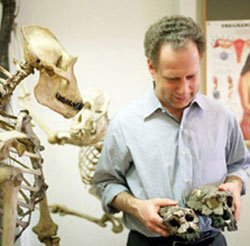
Daniel E. Lieberman, Professor of Human Evolutionary Biology, Harvard University
It was not for nothing that the late William F. Buckley, Jr. declared: “I would rather be governed by the first two thousand people in the Boston telephone directory than by the two thousand people on the faculty of Harvard University.”
Daniel E. Lieberman, a Harvard-educated Anthropologist who has managed to segue smoothly from his native social science to teaching Evolutionary Biology, won recent top marks in Scientism, the inappropriate and hubristic application of scientific theories to political and moral issues, when in a New York Time’s editorial last week, he informed readers that Evolution was voting in favor of Mayor Bloomberg’s soft drink ban specifically and government coercion in general.
Lessons from evolutionary biology support the mayor’s plan: when it comes to limiting sugar in our food, some kinds of coercive action are not only necessary but also consistent with how we used to live. …
Since sugar is a basic form of energy in food, a sweet tooth was adaptive in ancient times, when food was limited. However, excessive sugar in the bloodstream is toxic, so our bodies also evolved to rapidly convert digested sugar in the bloodstream into fat. Our hunter-gatherer ancestors needed plenty of fat — more than other primates — to be active during periods of food scarcity and still pay for large, expensive brains and costly reproductive strategies (hunter-gatherer mothers could pump out babies twice as fast as their chimpanzee cousins).
Simply put, humans evolved to crave sugar, store it and then use it. For millions of years, our cravings and digestive systems were exquisitely balanced because sugar was rare. Apart from honey, most of the foods our hunter-gatherer ancestors ate were no sweeter than a carrot. The invention of farming made starchy foods more abundant, but it wasn’t until very recently that technology made pure sugar bountiful.
The food industry has made a fortune because we retain Stone Age bodies that crave sugar but live in a Space Age world in which sugar is cheap and plentiful. …
We humans did not evolve to eat healthily and go to the gym; until recently, we didn’t have to make such choices. But we did evolve to cooperate to help one another survive and thrive. Circumstances have changed, but we still need one another’s help as much as we ever did. For this reason, we need government on our side, not on the side of those who wish to make money by stoking our cravings and profiting from them. [Emphasis added] We have evolved to need coercion.
Professor Lieberman neglects to explain how Evolution effectively draws the line between acceptable, desirable, and morally justifiable forms of state coercion, including taxes, regulations, and special paternalistic supervision of children, and even more effective and draconian measures, for instance, the Khmer Rouge marching the overweight urban inhabitants of Cambodia back into the country at machine gun point, aimed at “restoring a natural part of our environment. ”
He doesn’t offer any general principled account of why Evolution supports this and doesn’t support that precisely because he hasn’t got one. Professor Lieberman simply assumes that Evolution and Science (and Progress and the God of History) is embodied in the world by the consensus of people like himself, by the current opinions of the educated elite community of fashion.
One can find the scientific way of deciding things simply by reading the editorial pages of the Times.
All this, of course, is rubbish. The opinions and theories of Evolutionary Biology (let alone Anthropology) are anything but set in stone. Someone may discover next week the intense Neolithic cultivation of sugar beets in the Fertile Crescent. Medicine may decide that obesity is really caused by a particular gene, and that the specifics of diet play only a small role.
In the 1950s, Evolution would have decreed that you must drink milk to cure ulcers produced by the unnatural stress of modern capitalist life. Our latest information contends that bacteria are to blame and milk-drinking doesn’t do a thing.
More importantly, though, mere scientific facts are incapable of addressing philosophical questions of individual rights and the proper role and limits of the powers of government. Those issues have nothing to do with imaginary dietary teleologies and have to be debated on an entirely different level.
Scientism, the presumptuous attempt to misapply scientific theories or data in contexts in which they cannot possibly be determinative, is actually, I would argue, decisive evidence of bad education and intellectual incompetence.
It has been recognized for many decades now, certainly back to the 1960s or 1970s when Bill Buckley offered his famous apothegm concerning the faculty of Harvard, that there exists a tremendous and thoroughly alarming disconnect between our establishment intelligentsia and wisdom and common sense. Professor Lieberman is simply the most recent in a long series of wise fools.
The New York Daily News has the story of a young girl, abandoned by her parents, indigent, who slept on friends’ couches and worked part-time jobs to survive.
She was never trained in personal hygiene or social conventions by anyone, wore the same dress for months at a time, and was forced to transfer to six different schools. She worked a job as a janitor in her high school but nonetheless got straight A’s.
“There are no excuses,†she told the interviewer from a local radio station. “It all depends on you, and no one else.â€
It doesn’t take a village. It takes personal determination and drive.
[Kaczynski] lists his occupation as “prisoner” and says his awards are “Eight life sentences, issued by the United States District Court for the Eastern District of California, 1998.”
It’s an update the alumni association now regrets.
“While all members of the class who submit entries are included, we regret publishing Kaczynski’s references to his convictions and apologize for any distress that it may have caused others,” the Harvard Alumni Association said in a statement Wednesday evening.
The alumni association said all class members, including Kaczynski, were invited to submit entries for the class report, distributed for reunion activities during commencement week.
We’ve recently learned that it isn’t only Harvard which has acquired a NSFW site where students (and/or alumni) post naked pictures.
Unlike Harvard’s gay-interest-only site, the Brown site is coed and publishes student-written porn.
There wasn’t any Internet back during the consulate of Plancus, but I expect we also had an adequate quantity of horny exhibitionists willing to post personal pictures on these kinds of sites back then, too.
Yale’s Kroon Hall, a recently built, fantabulously expensive ecological Taj Mahal proves that Harvard is not unique. In that building in order to reduce tapwater usage, “Stormwater is collected from the roof and grounds and filtered through native aquatic plants. Wastewater collected from sinks and showers is added to the stormwater and used for all non-potable needs such as toilets and irrigation. Water demand is further reduced by the installation of low-flow plumbing and irrigation fixtures.”
James Delingpole referred recently to the immense difficulty sane people face in trying to resist an unstoppable bandwagon of do-gooders and reformers, brainwashed kids, powerful NGOs, sanctimonious corporations, and politicians all pushing the party-line of Enviromentalist stupidity. At American Thinker, Peter Wilson admires the colossal scale of resources the other side has at its disposal, and notes just how deeply entrenched the green priesthood is at one of our most prestigious universities.
Australian science writer Jo Nova estimates that since 1989 the U.S. government has spent $79 billion on global warming-friendly climate research. Nova notes that the “figure does not include money from other western governments, private industry, [or universities] and is not adjusted for inflation,” and yet even this partial sum is 3,500 times the $23 million spent by Exxon in the same period. Global warming alarmists however continue to accuse skeptics of being duped by disinformation from well-funded carbon polluters, while they seem incapable of recognizing the far greater funding that supports their own efforts.
Case in point: I attended a “Harvard Thinks Green” program last week, which promised “6 all-star environmental faculty, 6 big green ideas.” (According to the flyer, “Green is the new crimson.”) The most polemical of the six speakers was medical doctor Eric Chivian, a founder of the International Physicians for the Prevention of Nuclear War, the nuclear freeze group that won the 1985 Nobel Peace Prize. One of Chivian’s big green ideas: “legal restrictions on oil consumption.” Dr. Chivian lashed out at the evil Koch brothers, enunciating their middle initials as further evidence of their perfidy: “Charles G. Koch and David H. Koch,” who together with “vested interests” like Exxon-Mobil, have spent “tens of millions of dollars” on a “disinformation campaign,” aided by the likes of Rush Limbaugh.
Vested interests? Take a look in the mirror, Dr. Chivian. His speech came from the podium in Saunders Theatre, a sumptuous wood-paneled auditorium in H.H. Richardson’s Memorial Hall, a clubhouse for the 1% at Harvard University. Dr. Chivian earns his generous salary as Founder/Director of the Harvard Medical School’s Center for Health and the Global Environment, which is “designated an official ‘Collaborating Center’ of the United Nations Environment Programme.” The Center’s Corporate Council includes 3M, Baxter (pharmaceuticals & medical devices), Johnson & Johnson, and Siemens. These are some deep pockets and vested interests.
Looking further: The sponsor of the evening was the Harvard Office for Sustainability, which is staffed by fifteen full-time employees, holding graduate degrees in things like Public Administration and the Sociology of Religion/Gender Studies. They hold titles like: Manager, Sustainability Communications; Manager, Sustainability Engagement; Coordinator, Business and Finance Sustainability Engagement Program; or Coordinator, FAS Green Resource Efficiency Program.
A separate department called Green Building Services employs seven full-time employees and manages student volunteer teams at Harvard College, the Business School and the Law School.
Harvard students can apply for the following 10-hour-a-week internships: Sustainability Innovation Challenge Engagement Assistant, OFS Events and Sustainability Engagement Intern, Housing and Real Estate Design Internship, Greenhouse Gas Reduction Program Research Assistant, Green Skillet Team Leader, Green Skillet Assessor, Green Office Liaison and the Green Ribbon Commission Internship.
Over at the Graduate School of Design there’s the Sustainable Design program G(SD)2. And Harvard Business School has a Green Living Program, “a peer-to-peer education program” that…well, you get the idea.
These various activities are supported by the Harvard University Task Force on Greenhouse Gas (GHG) Emissions, commissioned by President Drew Faust, which is committed to reduce the University’s GHGs through 2016. In other words, these people will not be losing their jobs any time soon, no matter what happens at COP-18.
Reading this, I was reflecting that, if Jonathan Edwards and the other “New Light” enthusiasts of the mid-18th century Great Awakening had only taken care to arrange for the construction of exceptionally architecturally distinguished buildings to serve as centers for the study the personal experience of religious revelation and the penning of passionate sermons, and taken care to establish well-paid corps of special managers, communicators, coordinators, deans and interns, all devoted to intensifying man’s consciousness of his sinfulness, unworthiness, and dependence of Divine restraint, why, the emotionalist version of Congregationalism and Sunday hell-fire sermons about sinners in the hands of an angry God might never have gone out of fashion at Harvard and Yale at all.
There has been a fair amount of comment in certain alumni circles about the latest Ivy League kerfuffle: Harvard University’s effort, at the beginning of this year’s Fall Term, to “encourage” freshmen to sign a kindness pledge.
Harvard’s new initiative provoked some serious criticism noting that students were likely to feel pressured to sign (as a copy of the pledge with each student’s name and a space for a signature was placed hanging in each entryway), but Harvard then apologized and retreated (being so nice, after all).
Not surprisingly, the incident produced a good deal of coverage, and some mockery.
Ross Douthat (who attended the little school in Cambridge) responded to Virginia Postrel’s reaction in Bloomberg by explaining that there is a bit more to elite Ivy League nicey-goodiness than may be recognized by outsiders not fully acquainted with the culture and patterns of expression of this particular tribe.
[There is an] element of ruthlessness that runs through the culture of elite colleges, and… the prevailing spirit of deference and niceness is a defense mechanism and a facade — a kind of ritualized politesse, like the elaborate bowing and flowery compliments of a 17th century European court, that conceals the vaulting ambitions and furious rivalries that actually predominate on campus. (The essential ruthlessness of the meritocracy was one of the themes of my own subsequent attempt to distill the culture of elite education.) Which is why I appreciated how Postrel’s column finishes up.
Harvard is the strongest brand in American higher education, and its identity is clear. As its students recognize, Harvard represents success. But, it seems, Harvard feels guilty about that identity and wishes it could instead (or also) represent “compassion.†These two qualities have a lot in common. They both depend on other people, either to validate success or serve as objects of compassion. And neither is intellectual.
Rochefoucauld observed that hypocrisy was the tribute that vice pays to virtue.
I suppose it would be fair to say that constant poses of kindness and compassion are the tribute, these days, that the excessively ambitious and success-obsessed pay to failure.
“My board scores and grades were infinitely better than yours. I’m going to Harvard and on to a prominent bank or law firm and seven figures annually. But I will support plenty of welfare entitlement programs for you losers down in the bad neighborhood.”
Out-of-date “Heather Has Two Mommies†controversy to be superseded by the hip new “Kate Has Three Mommies†model?
————————-
On a leafy drive in west Los Angeles, at a newly renovated home with cathedral ceilings and a backyard pool, 4-year-old Kate Eisenpresser-Davis’ friends have been known to pose an intriguing question: “Why does Kate have three mommies?”
Lisa Eisenpresser, 44, and her partner, Angela Courtin, 38, share custody of Kate with Eisenpresser’s ex-partner.
When asked to describe their life, Eisenpresser and Courtin respond with the same word: “Normal.” Days are spent searching for the right balance between work and home, and zigzagging through Mar Vista to meetings, school and gymnastics.
Courtin is pregnant. Kate will soon have a sister, Phoebe, conceived from Eisenpresser’s egg and sperm from a donor — the same 6-foot-1 Harvard grad, who scored a 1580 on the SAT, who served as Kate’s donor.
“It’s almost like I’m too busy to be thinking too deeply about being gay and different,” Eisenpresser said.
Maybe she shouldn’t bother. According to a Times analysis of new U.S. Census figures, the Eisenpresser-Courtin-Davises are on the leading edge of change — of a steady evolution in the meaning of “family” and “home” in California.
————————-
J continues:
But what the heck kind of woman not only tells the media that the sperm donor that facilitated her childbearing is a Harvard grad but tells the media his frickin’ SAT scores? (Unfortunately, I can’t evaluate how awestruck I ought to be without more information on whether the reported score was generated before or after the various dumbing-down “renormings†of the scoring system.)
————————-
T responds:
Presumably the singing groups will soon need to update their repertoires to include “Your Daddy Was a Yale Sperm….”*.
————————-
* A reference to the old-time Yale a capella singing group song “Your Daddy is a Yale Man,” which not every reader may be familiar with, so here are the 2009 Whiffenpoofs performing same:
Who would have imagined that Knife Collecting guru Bernard Levine is a Harvard ’69 dropout, who became an expert on knives as a way of surviving in the city on the Bay back in the era of the Summer of Love?
In February 1969, Levine headed west, looking to connect with a love interest in San Francisco—who promptly returned east to enroll in college. He knocked about the city for a couple of years, working as a stevedore and in construction. His first job, hanging sheetrock, had five other Harvard students on the site. “I realized that I wasn’t strong enough to do this kind of work,†he says, “and that it wasn’t getting me far enough away from Harvard!â€
He tried a small business gathering wild yarrow stalks in the hills near San Francisco, which natural food stores sold in bundles of 50 because dividing piles of yarrow is a classical method of consulting the I Ching. “Then they found a lower-priced source,†Levine says. “That was my first lesson in business.â€
In September 1971, a couple at the house Levine lived in invited him to come to a flea market; they were moving and had some items to sell. He went to a Goodwill store to find something he might sell at the flea market, and purchased a box of old knives for $3.00—30 knives, as it turned out, at a dime each. “I knew less than nothing about knives,†he says. “The little I knew was wrong. But I spread my knives out on a cloth and was overwhelmed by people.â€
Levine learned that there were knife collectors, and the brand names that were collectible. “It was a revelation,†he admits. He continued selling knives at flea markets on weekends. “It turned out to be much longer hours than any job,†he says. “I’d spend all week scrounging up knives and on Friday bring them to a cutlery shop in North Beach where they’d restore them for me. The grandfather there—born in Romania in 1885—taught me a lot about the European cutlery business in the early twentieth century.
“My great love in school had been history,†he says. “Old knives are a good window into history, and a window that looks out in every direction.†From the very first day, Levine recorded every knife he sold, including brand markings and a description, eventually logging 13,000 entries.
Harvard’s 1899 football team passed that kind of exam.
Eve Binder, Managing Editor at Ivygate and Yale ’11, reports on earlier admissions examinations at Harvard and Columbia with altogether excessive frivolity and dismisses the Classics with proud Philistinism. (Reverend Davenport would not be pleased.)
The New York Times recently unearthed a Harvard entrance exam from 1899, and man, is it ugly. The text spans three major disciplines–classical languages, history and math–and requires its victims to jump through flaming hoops in topics like Greek Composition, Random-Ass Geography, and Hard Numbers. Take, for instance:
[in Logarithms and Trigonometry] 9. Find by logarithms, using arithmetical complements, the value of the following:
[(0.02183)2 x (7)2/5]/[√(0.0046) x 23.309]
Remember, folks, there were no calculators in 1899. Nor, apparently, was there mercy.
[In History and Geography] VI. Leonidas, Pausanias, Lysander.
Evidently this is a question, not just a list of people you’ve never heard of. Oh, wait, we’ve heard of Leonidas–but that’s only because we’ve seen 300, which someone living in the 1800s would most likely not have seen. Wonder if you’d get partial credit for identifying Lysander as “that dude in A Midsummer Night’s Dream.“
[In Greek Composition] [Insert ancient cryptic mumbo-jumbo here]
Hey, it’s all ελληνικά to us. Can you imagine if this were on the SAT?
Speaking of the SAT, it’s hard to tell whether the replacement of questions like “bound the basin of the Po†with ones like “find the noun in this sentence†has been a good or bad thing. A good thing for us, certainly, because if we’d been forced to draw the route of the Ten Thousand on a map in order to get into college, we’d have been working at the 1899 equivalent of a Chick-Fil-A faster than you can say “Gay Nineties.†But perhaps not such a good thing for the overall intelligence quotient of our nation’s youth, which would unquestionably have been strengthened by the knowledge of “Pharsalia, Philippi and Actium.†All of which, by the way, sound like sleep medications.
In an interesting final coup, Columbia Spectrum columnist Thomas Rhiel has noted that the 1899 Harvard entrance exam pales in comparison to that of Columbia, which apparently required knowledge of French, German, and the following works:
Milton’s Paradise Lost, Books I and II; Pope’s Iliad, Books I and XXII; the Sir Roger de Coverley Papers in The Spectator; Goldsmith’s The Vicar of Wakefield, Coleridge’s Ancient Mariner, Southey’s Life of Nelson, Carlyle’s Essay on Burns, Lowell’s Vision of Sir Launfal, Hawthorne’s The House of the Seven Gables, […] Shakespeare’s Macbeth, Burke’s Speech on Conciliation with America, De Quincey’s The Flight of a Tartar Tribe, [and] Tennyson’s The Princess.
Times sure have changed, haven’t they? Back then you actually had to read all these books in order to get anywhere in life. Now all you have to do is Google the ending and lie. Yeah, sorry we’re not sorry.
It’s understandable that the educated classes, force-fed for generations on the Classics, finally rebelled against the older system in favor of the more utilitarian, more flexible, and more modern. But the older I get, the more strongly I tend to believe that higher education made a gravely wrong turn when it made the decision to discard Classics as its foundation.
Serious and extended study of Latin and Greek reliably conferred a sort of grace and skill in written expression which has largely vanished from more contemporary prose. I routinely find the memoirs of colonial administrators and retired colonels produced before WWI far better written than the essays of the most admired current writers in today’s Spectator and New York Review of Books.
Reading the ancient authors also characteristically broadened the perspective of members of the educated elite of that earlier time. Rivalries between great powers, the outrages and brutalities performed by barbarian tribes, the forms of perfidy committed by foreign adversaries were all far more familiar and comprehensible to minds steeped in Xenophon and Thucydides.
Ivy League education today more commonly narrows the outlook of members of the contemporary elite, turning them into provincial conformists and uncritical followers of the fashionable consensus, lacking in sympathy for, or identification with, not our civilization’s past, but any past. Today’s commentariat is characteristically unable to consult the examples set by nations and leaders in conducting war during WWII when discussing current military operations, let alone reflect on what Alcibiades or Caesar might have done.
I had a few drinks last night, so I don’t actually remember how it was that I stumbled upon this amusing 2005 article in the New Journal by Adriane Quinlan providing a tour d’horizon of the best t shirt slogan expressions of the traditional Yale-Harvard football rivalry.
Sigma Alpha Epsilon’s pledges sell shirts “to raise money for their pledge project—usually an improvement to the infrastructure of the house. “For example,†said Fraternity president Billy Deitch, “rebuilding the basement bar.†Two years ago the frat put out one of the most successful shirts in recent memory, the front of which argued, “You’d have to be crazy to go to Harvard…†and the back of which provided evidence: a picture of Unabomber Ted Kaczynski, Harvard Class of 1962. A later shirt was more minimal in design, “VE-RI-DUM,†which Branford Senior Jonathan Breit claimed as his favorite game shirt: “Everything is perfect: the number of syllables, the latin-esque ending of ‘dum,’ the fact that ‘dumb’ is misspelled. It just works.â€





 is a key reference in any collector’s library and Bernard Levine’s earlier
  is a classic book on a very special subject.





