Category Archive 'History'
25 Jul 2018


And Ned Ryun thinks all the Treason talk is pretty rich, coming as it does from the party that has generally made treason into a fashion statement and a class identifier.
The past week of Russia hysteria has me longing for the good old days. Like 2009, when a Democratic president could pull missile defense systems out of Poland and the Czech Republic to appease Vladimir Putin without facing charges of treason. Or 2010, when a former Democratic president could take a cool half-million from a suspected Russian government-backed source to speak in Moscow and that wasn’t considered treasonous, either. Or 2012, when no one was screaming for impeachment when a Democratic president on a hot mic assured the Russian president that he’ll have “more flexibility†on missile defense systems once he’s re-elected. Or when the previous Democratic administration helped Putin toward his goal of controlling the worldwide supply chain of uranium and that was really all about “resetting†relationships.
Oh, how the times have changed!
RTWT
HT: Bird Dog.
22 Jul 2018

An Igbo with his slave.
Adaobi Tricia Nwaubani, in the New Yorker, has news for Ta-Nehisi Coates and all the other noisy SJWs denouncing European Civilization and America for the sin of Slavery: Slavery existed in Africa long before the European Reconnaissance and has continued right down to the present day, long after Slavery was abolished in America and everywhere else in the Western World. Africans, unlike Americans, are proud of the slave-owning ancestors and despise complaining slave descendants.
There is no Atlantic magazine in Nigeria, TNC!
Down the hill, near the river, in an area now overrun by bush, is the grave of my most celebrated ancestor: my great-grandfather Nwaubani Ogogo Oriaku. Nwaubani Ogogo was a slave trader who gained power and wealth by selling other Africans across the Atlantic. “He was a renowned trader,†my father told me proudly. “He dealt in palm produce and human beings.â€
Long before Europeans arrived, Igbos enslaved other Igbos as punishment for crimes, for the payment of debts, and as prisoners of war. The practice differed from slavery in the Americas: slaves were permitted to move freely in their communities and to own property, but they were also sometimes sacrificed in religious ceremonies or buried alive with their masters to serve them in the next life. When the transatlantic trade began, in the fifteenth century, the demand for slaves spiked. Igbo traders began kidnapping people from distant villages. Sometimes a family would sell off a disgraced relative, a practice that Ijoma Okoro, a professor of Igbo history at the University of Nigeria, Nsukka, likens to the shipping of British convicts to the penal colonies in Australia: “People would say, ‘Let them go. I don’t want to see them again.’ †Between the fifteenth and nineteenth centuries, nearly one and a half million Igbo slaves were sent across the Middle Passage.
My great-grandfather was given the nickname Nwaubani, which means “from the Bonny port region,†because he had the bright skin and healthy appearance associated at the time with people who lived near the coast and had access to rich foreign foods. (This became our family name.) In the late nineteenth century, he carried a slave-trading license from the Royal Niger Company, an English corporation that ruled southern Nigeria. His agents captured slaves across the region and passed them to middlemen, who brought them to the ports of Bonny and Calabar and sold them to white merchants. Slavery had already been abolished in the United States and the United Kingdom, but his slaves were legally shipped to Cuba and Brazil. To win his favor, local leaders gave him their daughters in marriage. (By his death, he had dozens of wives.) His influence drew the attention of colonial officials, who appointed him chief of Umujieze and several other towns. He presided over court cases and set up churches and schools. He built a guesthouse on the land where my parents’ home now stands, and hosted British dignitaries. To inform him of their impending arrival and verify their identities, guests sent him envelopes containing locks of their Caucasian hair.
Funeral rites for a distinguished Igbo man traditionally include the slaying of livestock—usually as many cows as his family can afford. Nwaubani Ogogo was so esteemed that, when he died, a leopard was killed, and six slaves were buried alive with him. My family inherited his canvas shoes, which he wore at a time when few Nigerians owned footwear, and the chains of his slaves, which were so heavy that, as a child, my father could hardly lift them. Throughout my upbringing, my relatives gleefully recounted Nwaubani Ogogo’s exploits. When I was about eight, my father took me to see the row of ugba trees where Nwaubani Ogogo kept his slaves chained up. In the nineteen-sixties, a family friend who taught history at a university in the U.K. saw Nwaubani Ogogo’s name mentioned in a textbook about the slave trade. Even my cousins who lived abroad learned that we had made it into the history books. …
Are you not ashamed of what he did?†I asked.
“I can never be ashamed of him,†he said, irritated. “Why should I be? His business was legitimate at the time. He was respected by everyone around.†My father is a lawyer and a human-rights activist who has spent much of his life challenging government abuses in southeast Nigeria. He sometimes had to flee our home to avoid being arrested. But his pride in his family was unwavering. “Not everyone could summon the courage to be a slave trader,†he said. “You had to have some boldness in you.†…
The British tried to end slavery among the Igbo in the early nineteen-hundreds, though the practice persisted into the nineteen-forties. In the early years of abolition, by British recommendation, masters adopted their freed slaves into their extended families. One of the slaves who joined my family was Nwaokonkwo, a convicted murderer from another village who chose slavery as an alternative to capital punishment and eventually became Nwaubani Ogogo’s most trusted manservant. In the nineteen-forties, after my great-grandfather was long dead, Nwaokonkwo was accused of attempting to poison his heir, Igbokwe, in order to steal a plot of land. My family sentenced him to banishment from the village. When he heard the verdict, he ran down the hill, flung himself on Nwaubani Ogogo’s grave, and wept, saying that my family had once given him refuge and was now casting him out. Eventually, my ancestors allowed him to remain, but instructed all their freed slaves to drop our surname and choose new names. “If they had been behaving better, they would have been accepted,†my father said.
he descendants of freed slaves in southern Nigeria, called ohu, still face significant stigma. Igbo culture forbids them from marrying freeborn people, and denies them traditional leadership titles such as Eze and Ozo. (The osu, an untouchable caste descended from slaves who served at shrines, face even more severe persecution.) My father considers the ohu in our family a thorn in our side, constantly in opposition to our decisions. In the nineteen-eighties, during a land dispute with another family, two ohu families testified against us in court. “They hate us,†my father said. “No matter how much money they have, they still have a slave mentality.
RTWT
15 Jul 2018

(from the Danville Morning News)
Narratively:
On a damp Thursday morning in May 1938, hundreds of workers from Western Pennsylvania oil fields, given the day off to look for a missing girl, walked through the Allegheny Forest at arms’ length. They traversed the tangled underbrush alongside police with bloodhounds, World War I veterans, Cornplanter Indians, coal miners, and assorted others who’d responded to the local mayor’s call for 1,000 volunteers. They killed rattlesnakes and were careful not to drop a foot down into one of the hundreds of oil wells dug during the area’s petroleum boom in the 1870s.
But by nightfall, the “haggard, sleep-robbed faces of scores of men,†as the Bradford Era newspaper described them, told onlookers the grim truth: another day had passed without finding the little red-haired four-year-old, Marjorie West.
Eighty years ago today, Marjorie vanished while at a Mother’s Day picnic in the forest with her family. To this day she is the subject of one of the oldest unsolved cases recorded by the National Center for Missing and Exploited Children. Her search was one of the largest for a child since the Lindbergh Baby kidnapping six years earlier. Residents of Western Pennsylvania and Marjorie’s surviving relatives still hold out hope she’s alive. If she is, she may yet celebrate her 85th birthday next month.
RTWT
03 Jul 2018

For every Southern boy fourteen years old, not once but whenever he wants it, there is the instant when it’s still not yet two o’clock on that July afternoon in 1863, the brigades are in position behind the rail fence, the guns are laid and ready in the woods and the furled flags are already loosened to break out and Pickett himself with his long oiled ringlets and his hat in one hand probably and his sword in the other looking up the hill waiting for Longstreet to give the word and it’s all in the balance, it hasn’t happened yet, it hasn’t even begun yet, it not only hasn’t begun yet but there is still time for it not to begin against that position and those circumstance which made more men than Garnett and Kemper and Armistead and Wilcox look grave yet it’s going to begin, we all know that, we have come too far with too much at stake and that moment doesn’t need even a fourteen-year-old boy to think This time. Maybe this time with all this much to lose than all this much to gain: Pennsylvania, Maryland, the world, the golden dome of Washington itself to crown with desperate and unbelievable victory the desperate gamble, the cast made two years ago.
—William Faulkner, Intruder in the Dust, 1948.
22 Jun 2018

Edward the Confessor, depicted in the Bayeaux Tapestry.
History Extra:
The people we call Anglo-Saxons were actually immigrants from northern Germany and southern Scandinavia. Bede, a monk from Northumbria writing some centuries later, says that they were from some of the most powerful and warlike tribes in Germany.
Bede names three of these tribes: the Angles, Saxons and Jutes. There were probably many other peoples who set out for Britain in the early fifth century, however. Batavians, Franks and Frisians are known to have made the sea crossing to the stricken province of ‘Britannia’.
The collapse of the Roman empire was one of the greatest catastrophes in history. Britain, or ‘Britannia’, had never been entirely subdued by the Romans. In the far north – what they called Caledonia (modern Scotland) – there were tribes who defied the Romans, especially the Picts. The Romans built a great barrier, Hadrian’s Wall, to keep them out of the civilised and prosperous part of Britain.
As soon as Roman power began to wane, these defences were degraded, and in AD 367 the Picts smashed through them. Gildas, a British historian, says that Saxon war-bands were hired to defend Britain when the Roman army had left. So the Anglo-Saxons were invited immigrants, according to this theory, a bit like the immigrants from the former colonies of the British empire in the period after 1945.
RTWT
19 Apr 2018

Hannes Wessels is angry that his teenage daughters are being indoctrinated with the Left’s Victimology approach to History. So angry that he produced a rant full of denied, ignored, and absolutely unspeakable truths.
That “truth†goes right to the core of busting the myth about colonialism being a blight on the continent [of Africa] and the independence that followed being a blessing, when in fact, the very converse is true. That would be made embarrassingly obvious if the countries of Europe and North America were to make it known that they were back in the slave trade and boats were on their way to the ports. The response from the forsaken millions, destined for lives of endless poverty, would doubtless be overwhelming, and the rush for the ships would be unstoppable. If the demand were to be there, I have little doubt Africa would soon be bereft of people. The vast majority would choose to abandon their purported “freedom†on a continent fast reversing back into anarchy and savagery and become “unfree†again under European suzerainty.
Hobbes in Leviathan painted a grim picture when he suggested that the natural state of mankind is a “war of all against all†in which men’s lives are “solitary, poor, nasty, brutish, and short.†Unfortunately, in most cases, especially in Africa, he’s been proved right. But if there is a chance to escape this dystopia, it rests with that part of the world where Europeans built societies on a foundation forged out of the Christian ethos. But of course, nobody is supposed to know that, either.
RTWT
08 Apr 2018

Florida Rep. Kimberly Daniels
Kimberly Daniels is a former prostitute who got religion, became a minister, and wound up elected to the Florida State House of Representatives from Jacksonville as a democrat.
She recently sponsored a bill which would require Florida public schools to post “In God We Trust” on their premises, which has outraged the militant secularist crowd.
Progressive Secular Humanist Michael Stone had a cow on the Patheos blog over a recent comment by Daniels thanking God for American Antebellum Slavery, because “if it wasn’t for slavery, I might be somewhere in Africa worshipping a tree.â€
Personally, I found her comment refreshingly un-PC and a lot more intelligent than the standard bitching and moaning about 150-years-dead historical circumstances and events.
Rep. Daniels’ quip is obviously not precisely accurate, absent slavery, today’s individual African Americans simply would never would have been born. But if, like Rep. Daniels, they indulge in imagining themselves born with the same identical personhood in their ancestral African place of genetic origin, they obviously would find themselves living in extreme poverty and primitive circumstances, with a much shorter life expectancy, possibly exposed to the hazards of tribal or religious violence or even to a slave trade still operating in the 21st Century, and worshiping trees or worse.
Michael Stone barks: “The stupid, it burns.” Well, he ought to know, because he, not Rep. Daniels, is the stupid one.
The African American community would be a lot better off with more leaders and spokesmen like Kimberly Daniels than they are with Al Sharpton and Ta-Nehisi Coates.
01 Apr 2018
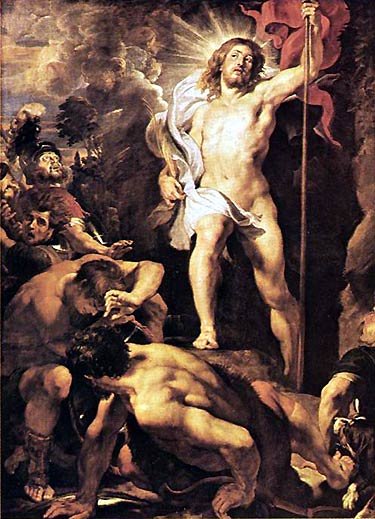
Peter Paul Rubens, The Resurrection of Christ, 1611-1612, Vrouwekathedraal, Antwerp
From Robert Chambers, The Book of Days, 1869:
Easter
Easter, the anniversary of our Lord’s resurrection from the dead, is one of the three great festivals of the Christian year,—the other two being Christmas and Whitsuntide. From the earliest period of Christianity down to the present day, it has always been celebrated by believers with the greatest joy, and accounted the Queen of Festivals. In primitive times it was usual for Christians to salute each other on the morning of this day by exclaiming, ‘Christ is risen;’ to which the person saluted replied, ‘Christ is risen indeed,’ or else, ‘And hath appeared unto Simon;’—a custom still retained in the Greek Church.
The common name of this festival in the East was the Paschal Feast, because kept at the same time as the Pascha, or Jewish passover, and in some measure succeeding to it. In the sixth of the Ancyran Canons it is called the Great Day. Our own name Easter is derived, as some suppose, from Eostre, the name of a Saxon deity, whose feast was celebrated every year in the spring, about the same time as the Christian festival—the name being retained when the character of the feast was changed; or, as others suppose, from Oster, which signifies rising. If the latter supposition be correct, Easter is in name, as well as reality, the feast of the resurrection.
Though there has never been any difference of opinion in the Christian church as to why Easter is kept, there has been a good deal as to when it ought to be kept. It is one of the moveable feasts; that is, it is not fixed to one particular day—like Christmas Day, e. g., which is always kept on the 25th of December—but moves backwards or forwards according as the full moon next after the vernal equinox falls nearer or further from the equinox. The rule given at the beginning of the Prayer-book to find Easter is this: ‘Easter-day is always the first Sunday after the full moon which happens upon or next after the twenty-first day of March; and if the full moon happens upon a Sunday, Easter-day is the Sunday after.’
The paschal controversy, which for a time divided Christendom, grew out of a diversity of custom. The churches of Asia Minor, among whom were many Judaizing Christians, kept their paschal feast on the same day as the Jews kept their passover; i. e., on the 14th of Nisan, the Jewish month corresponding to our March or April. But the churches of the West, remembering that our Lord’s resurrection took place on the Sunday, kept their festival on the Sunday following the 14th of Nisan. By this means they hoped not only to commemorate the resurrection on the day on which it actually occurred, but also to distinguish themselves more effectually from the Jews. For a time this difference was borne with mutual forbearance and charity. And when disputes began to arise, we find that Polycarp, the venerable bishop of Smyrna, when on a visit to Rome, took the opportunity of conferring with Anicetas, bishop of that city, upon the question. Polycarp pleaded the practice of St. Philip and St. John, with the latter of whom he had lived, conversed, and joined in its celebration; while Anicetas adduced the practice of St. Peter and St. Paul. Concession came from neither side, and so the matter dropped; but the two bishops continued in Christian friendship and concord. This was about A.D. 158.
Towards the end of the century, however, Victor, bishop of Rome, resolved on compelling the Eastern churches to conform to the Western practice, and wrote an imperious letter to the prelates of Asia, commanding them to keep the festival of Easter at the time observed by the Western churches. They very naturally resented such an interference, and declared their resolution to keep Easter at the time they had been accustomed to do. The dispute hence-forward gathered strength, and was the source of much bitterness during the next century. The East was divided from the West, and all who, after the example of the Asiatics, kept Easter-day on the 14th, whether that day were Sunday or not, were styled Qiccertodecimans by those who adopted the Roman custom.
One cause of this strife was the imperfection of the Jewish calendar. The ordinary year of the Jews consisted of 12 lunar months of 292 days each, or of 29 and 30 days alternately; that is, of 354 days. To make up the 11 days’ deficiency, they intercalated a thirteenth month of 30 days every third year. But even then they would be in advance of the true time without other intercalations; so that they often kept their passover before the vernal equinox. But the Western Christians considered the vernal equinox the commencement of the natural year, and objected to a mode of reckoning which might sometimes cause them to hold their paschal feast twice in one year and omit it altogether the next. To obviate this, the fifth of the apostolic canons decreed that, ’ If any bishop, priest, or deacon, celebrated the Holy Feast of Easter before the vernal equinox, as the Jews do, let him be deposed.’
At the beginning of the fourth century, matters had gone to such a length, that the Emperor Constantine thought it his duty to take steps to allay the controversy, and to insure uniformity of practice for the future. For this purpose, he got a canon passed in the great Ecumenical Council of Nice (A.D. 325), that everywhere the great feast of Easter should be observed upon one and the same day; and that not the day of the Jewish passover, but, as had been generally observed, upon the Sunday afterwards. And to prevent all future disputes as to the time, the following rules were also laid down:
‘That the twenty-first day of March shall be accounted the vernal equinox.’
‘That the full moon happening upon or next after the twenty-first of March, shall be taken for the full moon of Nisan.’
‘That the Lord’s-day next following that full moon be Easter-day.’
‘But if the full moon happen upon a Sunday, Easter-day shall be the Sunday after.’
As the Egyptians at that time excelled in astronomy, the Bishop of Alexandria was appointed to give notice of Easter-day to the Pope and other patriarchs. But it was evident that this arrangement could not last long; it was too inconvenient and liable to interruptions. The fathers of the next age began, therefore, to adopt the golden numbers of the Metonic cycle, and to place them in the calendar against those days in each month on which the new moons should fall during that year of the cycle. The Metonie cycle was a period of nineteen years. It had been observed by Meton, an Athenian philosopher, that the moon returns to have her changes on the same month and day of the month in the solar year after a lapse of nineteen years, and so, as it were, to run in a circle. He published his discovery at the Olympic Games, B.C. 433, and the cycle has ever since borne his name. The fathers hoped by this cycle to be able always to know the moon’s age; and as the vernal equinox was now fixed to the 21st of March, to find Easter for ever. But though the new moon really happened on the same day of the year after a space of nineteen years as it did before, it fell an hour earlier on that day, which, in the course of time, created a serious error in their calculations.
A cycle was then framed at Rome for 84 years, and generally received by the Western church, for it was then thought that in this space of time the moon’s changes would return not only to the same day of the month, but of the week also. Wheatley tells us that, ‘During the time that Easter was kept according to this cycle, Britain was separated from the Roman empire, and the British churches for some time after that separation continued to keep Easter according to this table of 84 years. But soon after that separation, the Church of Rome and several others discovered great deficiencies in this account, and therefore left it for another which was more perfect.’—Book on the Common Prayer, p. 40. This was the Victorian period of 532 years. But he is clearly in error here. The Victorian period was only drawn up about the year 457, and was not adopted by the Church till the Fourth Council of Orleans, A.D. 541.
Now from the time the Romans finally left Britain (A.D. 426), when he supposes both churches to be using the cycle of 84 years, till the arrival of St. Augustine (A.D. 596), the error can hardly have amounted to a difference worth disputing about. And yet the time the Britons kept Easter must have varied considerably from that of the Roman missionaries to have given rise to the statement that they were Quartodecimans, which they certainly were not; for it is a well-known fact that British bishops were at the Council of Nice, and doubtless adopted and brought home with them the rule laid down by that assembly. Dr. Hooke’s account is far more probable, that the British and Irish churches adhered to the Alexandrian rule, according to which the Easter festival could not begin before the 8th of March; while according to the rule adopted at Rome and generally in the West, it began as early as the fifth. ‘They (the Celts) were manifestly in error,’ he says; ‘but owing to the haughtiness with which the Italians had demanded an alteration in their calendar, they doggedly determined not to change.’—Lives of the Archbishops of Canterbury, vol. i. p. 14.
After a good deal of disputation had taken place, with more in prospect, Oswy, King of Northumbria, determined to take the matter in hand. He summoned the leaders of the contending parties to a conference at Whitby, A.D. 664, at which he himself presided. Colman, bishop of Lindisfarne, represented the British church. The Romish party were headed by Agilbert, bishop of Dorchester, and Wilfrid, a young Saxon. Wilfrid was spokesman. The arguments were characteristic of the age; but the manner in which the king decided irresistibly provokes a smile, and makes one doubt whether he were in jest or earnest. Colman spoke first, and urged that the custom of the Celtic church ought not to be changed, because it had been inherited from their forefathers, men beloved of God, &c. Wilfrid followed:
‘The Easter which we observe I saw celebrated by all at Rome: there, where the blessed apostles, Peter and Paul, lived, taught, suffered, and were buried.’ And concluded a really powerful speech with these words: ‘And if, after all, that Columba of yours were, which I will not deny, a holy man, gifted with the power of working miracles, is he, I ask, to be preferred before the most blessed Prince of the Apostles, to whom our Lord said, “Thou art Peter, and upon this rock will I build my church, and the gates of hell shall not prevail against it; and to thee will I give the keys of the kingdom of heaven†?’
The King, turning to Colman, asked him, ‘Is it true or not, Colman, that these words were spoken to Peter by our Lord?’ Colman, who seems to have been completely cowed, could not deny it. ‘It is true, 0 King.’ ‘Then,’ said the King, ‘can you shew me any such power given to your Columba? ’ Colman answered, ’ No.’ ‘You are both, then, agreed,’ continued the King, are you not, that these words were addressed principally to Peter, and that to him were given the keys of heaven by our Lord?’ Both assented. ‘Then,’ said the King, ‘I tell you plainly, I shall not stand opposed to the door-keeper of the kingdom of heaven; I desire, as far as in me lies, to adhere to his precepts and obey his commands, lest by offending him who keepeth the keys, I should, when I present myself at the gate, find no one to open to me.’
This settled the controversy, though poor honest Colman resigned his see rather than submit to such a decision.
On Easter-day depend all the moveable feasts and fasts throughout the year. The nine Sundays before, and the eight following after, are all dependent upon it, and form, as it were, a body-guard to this Queen of Festivals. The nine preceding are the six Sundays in Lent, Quinquagesima, Sexagesima, and Septuagesima; the eight following are the five Sundays after Easter, the Sunday after Ascension Day, Whit Sunday, and Trinity Sunday.
EASTER CUSTOMS
The old Easter customs which still linger among us vary considerably in form in different parts of the kingdom. The custom of distributing the ‘pace’ or ‘pasche ege,’ which was once almost universal among Christians, is still observed by children, and by the peasantry in Lancashire. Even in Scotland, where the great festivals have for centuries been suppressed, the young people still get their hard-boiled dyed eggs, which they roll about, or throw, and finally eat. In Lancashire, and in Cheshire, Staffordshire, and Warwickshire, and perhaps in other counties, the ridiculous custom of ‘lifting’ or ‘heaving’ is practised.
On Easter Monday the men lift the women, and on Easter Tuesday the women lift or heave the men. The process is performed by two lusty men or women joining their hands across each other’s wrists; then, making the person to be heaved sit down on their arms, they lift him up aloft two or three times, and often carry him several yards along a street. A grave clergyman who happened to be passing through a town in Lancashire on an Easter Tuesday, and having to stay an hour or two at an inn, was astonished by three or four lusty women rushing into his room, exclaiming they had come ‘to lift him.’ ‘To lift me!’ repeated the amazed divine; ‘what can you mean?’ ‘Why, your reverence, we’re come to lift you, ‘cause it’s Easter Tuesday.’ ‘Lift me because it’s Easter Tuesday? I don’t understand. Is there any such custom here?’ ‘Yes, to be sure; why, don’t you know? all us women was lifted yesterday; and us lifts the men today in turn. And in course it’s our rights and duties to lift ‘em.’
After a little further parley, the reverend traveller compromised with his fair visitors for half-a-crown, and thus escaped the dreaded compliment. In Durham, on Easter Monday, the men claim the privilege to take off the women’s shoes, and the next day the women retaliate. Anciently, both ecclesiastics and laics used to play at ball in the churches for tansy-cakes on Eastertide; and, though the profane part of this custom is happily everywhere discontinued, tansy-cakes and tansy-puddings are still favourite dishes at Easter in many parts. In some parishes in the counties of Dorset and Devon, the clerk carries round to every house a few white cakes as an Easter offering; these cakes, which are about the eighth of an inch thick, and of two sizes —the larger being seven or eight inches, the smaller about five in diameter— have a mingled bitter and sweet taste. In return for these cakes, which are always distributed after Divine service on Good Friday, the clerk receives a gratuity- according to the circumstances or generosity of the householder.
09 Mar 2018

1910 Republican campaign poster.
Charles G. Mills does a good, and succinct, job of explaining tariffs, historically and politically.
President Trump has proposed significant tariffs on the importation of steel and aluminum. Should we support or oppose these measures? The answer is not simple; it lies in the details of the tariff law, rather than in a single principle about all tariffs. On balance, a significant tariff on steel and aluminum is worthy of support, despite its harmful effects.
RTWT
15 Feb 2018
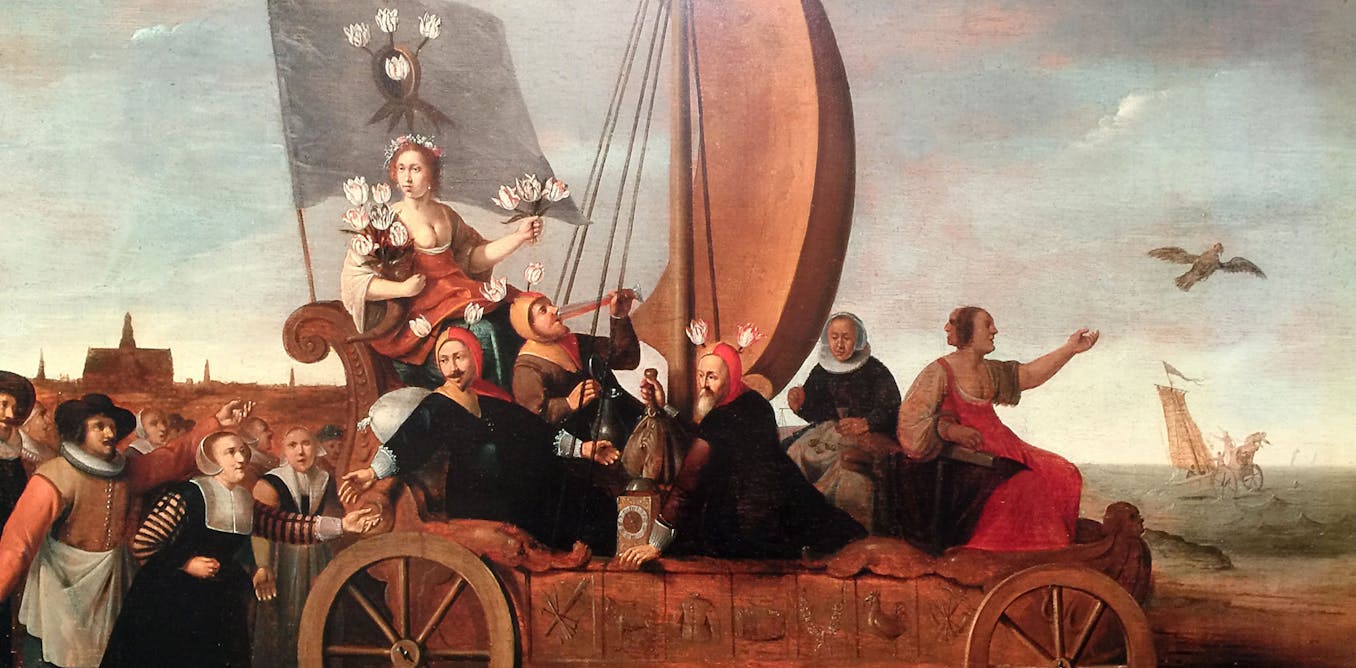
Hendrik Gerritsz Pot, Floraes Mallewagen (Flora’s wagon of fools), c.1640.
Anne Goldgar explains that the cautionary story of the great 17th century Dutch Tulip Bubble is mostly wrong.
Why have these myths persisted? We can blame a few authors and the fact they were bestsellers. In 1637, after the crash, the Dutch tradition of satirical songs kicked in, and pamphlets were sold making fun of traders. These were picked up by writers later in the 17th century, and then by a late 18th-century German writer of a history of inventions, which had huge success and was translated into English. This book was in turn plundered by Charles Mackay, whose Extraordinary Popular Delusions and the Madness of Crowds of 1841 has had huge and undeserved success. Much of what Mackay says about tulip mania comes straight from the satirical songs of 1637 – and it is repeated endlessly on financial websites, in blogs, on Twitter, and in popular finance books like A Random Walk down Wall Street. But what we are hearing are the fears of 17th-century people about a 17th-century situation.
It was not actually the case that newcomers to the market caused the crash, or that foolishness and greed overtook those who traded in tulips. But this, and the possible social and cultural changes stemming from massive shifts in the distribution of wealth, were fears then and are fears now. Tulip mania gets brought up again and again, as a warning to investors not to be stupid, or to stay away from what some might call a good thing.
RTWT
14 Feb 2018
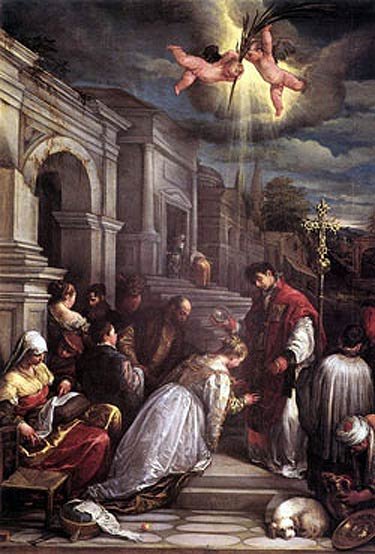
Jacopo Bassano, St Valentine Baptizing St Lucilla, 1575, oil on canvas, Museo Civico, Bassano del Grappa
The popular customs associated with Saint Valentine’s Day undoubtedly had their origin in a conventional belief generally received in England and France during the Middle Ages, that on 14 February, i.e., half way through the second month of the year, the birds began to pair. Thus in Chaucer’s Parliament of Foules we read:
For this was sent on Seynt Valentyne’s day
Whan every foul cometh ther to choose his mate.
For this reason the day was looked upon as specially consecrated to lovers and as a proper occasion for writing love letters and sending lovers’ tokens. Both the French and English literatures of the fourteenth and fifteenth centuries contain allusions to the practice. Perhaps the earliest to be found is in the 34th and 35th Ballades of the bilingual poet, John Gower, written in French; but Lydgate and Clauvowe supply other examples. Those who chose each other under these circumstances seem to have been called by each other their Valentines.
In the Paston Letters, Dame Elizabeth Brews writes thus about a match she hopes to make for her daughter (we modernize the spelling), addressing the favoured suitor:
And, cousin mine, upon Monday is Saint Valentine’s Day and every bird chooses himself a mate, and if it like you to come on Thursday night, and make provision that you may abide till then, I trust to God that ye shall speak to my husband and I shall pray that we may bring the matter to a conclusion.
——————————————–
From Robert Chambers, The Book of Days, 1869: Feast Day: St. Valentine, priest and martyr, circ. 270.
ST. VALENTINE’S DAY
Valentine’s Day is now almost everywhere a much degenerated festival, the only observance of any note consisting merely of the sending of jocular anonymous letters to parties whom one wishes to quiz, and this confined very much to the humbler classes. The approach of the day is now heralded by the appearance in the print-sellers’ shop windows of vast numbers of missives calculated for use on this occasion, each generally consisting of a single sheet of post paper, on the first page of which is seen some ridiculous coloured caricature of the male or female figure, with a few burlesque verses below. More rarely, the print is of a sentimental kind, such as a view of Hymen’s altar, with a pair undergoing initiation into wedded happiness before it, while Cupid flutters above, and hearts transfixed with his darts decorate the corners. Maid-servants and young fellows interchange such epistles with each other on the 14th of February, no doubt conceiving that the joke is amazingly good: and, generally, the newspapers do not fail to record that the London postmen delivered so many hundred thousand more letters on that day than they do in general. Such is nearly the whole extent of the observances now peculiar to St. Valentine’s Day.
At no remote period it was very different. Ridiculous letters were unknown: and, if letters of any kind were sent, they contained only a courteous profession of attachment from some young man to some young maiden, honeyed with a few compliments to her various perfections, and expressive of a hope that his love might meet with return. But the true proper ceremony of St. Valentine’s Day was the drawing of a kind of lottery, followed by ceremonies not much unlike what is generally called the game of forfeits. Misson, a learned traveller, of the early part of the last century, gives apparently a correct account of the principal ceremonial of the day.
‘On the eve of St. Valentine’s Day,’ he says, ‘the young folks in England and Scotland, by a very ancient custom, celebrate a little festival. An equal number of maids and bachelors get together: each writes their true or some feigned name upon separate billets, which they roll up, and draw by way of lots, the maids taking the men’s billets, and the men the maids’: so that each of the young men lights upon a girl that he calls his valentine, and each of the girls upon a young man whom she calls hers. By this means each has two valentines: but the man sticks faster to the valentine that has fallen to him than to the valentine to whom he is fallen. Fortune having thus divided the company into so many couples, the valentines give balls and treats to their mistresses, wear their billets several days upon their bosoms or sleeves, and this little sport often ends in love.’
St. Valentine’s Day is alluded to by Shakespeare and by Chaucer, and also by the poet Lydgate (who died in 1440).
The origin of these peculiar observances of St. Valentine’s Day is a subject of some obscurity. The saint himself, who was a priest of Rome, martyred in the third century, seems to have had nothing to do with the matter, beyond the accident of his day being used for the purpose. Mr. Douce, in his Illustrations of Shakespeare, says:
“It was the practice in ancient Rome, during a great part of the month of February, to celebrate the Lupercalia, which were feasts in honour of Pan and Juno. whence the latter deity was named Februata, Februalis, and Februlla. On this occasion, amidst a variety of ceremonies, the names of young women were put into a box, from which they were drawn by the men as chance directed. The pastors of the early Christian church, who, by every possible means, endeavoured to eradicate the vestiges of pagan superstitions, and chiefly by some commutations of their forms, substituted, in the present instance, the names of particular saints instead of those of the women: and as the festival of the Lupercalia had commenced about the middle of February, they appear to have chosen St. Valentine’s Day for celebrating the new feast, because it occurred nearly at the same time.”
—————————————————-
February 14th, prior to 1969, was the feast day of two, or possibly three, saints and martyrs named Valentine, all reputedly of the Third Century.
The first Valentine, legend holds, was a physician and priest in Rome, arrested for giving aid to martyrs in prison, who while there converted his jailer by restoring sight to the jailer’s daughter. He was executed by being beaten with clubs, and afterwards beheaded, February 14, 270. He is traditionally the patron of affianced couples, bee keepers, lovers, travellers, young people, and greeting card manufacturers, and his special assistance may be sought in conection with epilepsy, fainting, and plague.
A second St. Valentine, reportedly bishop of Interamna (modern Terni) was also allegedly martyred under Claudius II, and also allegedly buried along the Flaminian Way.
A third St. Valentine is said to have also been martyred in Roman times, along with companions, in Africa.
Due to an insufficiency of historical evidence in the eyes of Vatican II modernizers, the Roman Catholic Church dropped the February 14th feast of St. Valentine from its calendar in 1969.
/div>

Feeds
|