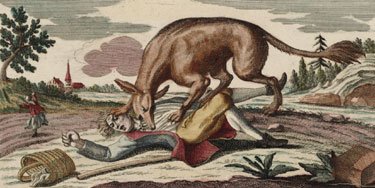
Victims were often killed by having their throats torn out. The Kingdom of France used a considerable amount of manpower and money to hunt the animals; including the resources of several nobles, soldiers, civilians, and a number of royal huntsmen.
The number of victims differs according to sources. In 1987, one study estimated there had been 210 attacks; resulting in 113 deaths and 49 injuries; 98 of the victims killed were partly eaten. However, other sources claim it killed between 60 to 100 adults and children, as well as injuring more than 30.
Scandinavian researchers have exhumed the bones of two direct descendants of Rollo, the 10th century Viking founder of the Duchy of Normandy, in an attempt to answer the long-debated question of whether Rollo was Danish or Norwegian.
Historians have differed on the matter of Rollo’s national origins since at least the 11th century. …
They were hoping to find teeth because extracting ancient DNA is tricky and the genetic material inside teeth is well-protected by the outer layers. Holck and Orlando retrieved five of the teeth. They will be tested at the University of Oslo and the Centre for GeoGenetics at the University of Copenhagen. If all goes well, the research team and French authorities will announce the results in the autumn.
The Art of Battle serves up PowerPoint presentations showing the course of events in a large number of Ancient, Medieval, Early Modern (Gunpowder Era), and Modern battles.
In West Flanders, during the 1500s, criminals were punished symbolically by being obliged to have cast in metal a copy of the hand they used to commit some act of violence.
Adriaen Bra was a fisherman who was convicted of assaulting the servant of the bailiff with a knife. He had won the knife playing dice with the Pub owner Pieter Ritssaerss. But Ritssaerss wagered the knife on the condition that the knife’s new owner would take it and use it to “cloppen” the bailiff and his minions. Ritssaerss evidently had a score to settle.
Adriaen Bra was the happy (and perhaps also drunk) winner. He kept his word and proceeded a week later to attack a servant of the bailiff with the knife. He was apprehended and sentenced to the making of the fist, and that was not the only punishment. He was banned from Walcheren for an interval of time, and if he came back earlier he would have to pay for it with his neck.
The judgment of Adriaen Bra is preserved in the archives of the tribunal of the city Veere roll of criminal cases from 1514 to 1552.
The relic dating from the fifteenth century was sold for 297,600 pounds (376,833 euros –$410,361.72) to a Frenchman who wished to remain anonymous, said the spokesman for the Timeline auctions.
The opening bid was 14,000 pounds (19,051 euros — $20,746.06).
According to representatives of the auction house, Joan of Arc gave a detailed description of the ring during her interrogation at Rouen 17 March 1431. It contains the inscription Jhesus Maria and three engraved crosses.
The ring, accompanied by authentication documents, is kept in a wooden casket. After the execution of Joan, the precious object was worn by King Henry VII of England.
“The ring returns to France,” the spokesman for the auction house told reporters without revealing the name of the French citizen who acquired the relic.
The jewelery was sold by the son of Charles de Gaulle’s personal physician. Earlier, the French government had proposed to examine the possibility of buying this relic.
—————————————–
——————————————
——————————————
Timeline Auctions, Antiquities, 25 February 2016, Lot 1220
MEDIEVAL JOAN OF ARC DEVOTIONAL RING WITH CASKET AND DOCUMENTS
15th century AD
With a published Joan of Arc association dating back over a century, exhibited twice in France in the 1950s and in the Museum of Lancashire Millennium Exhibition, January to December 2000, this ring has a silver-gilt hoop with facetted outer face, expanding shoulders and two rectangular and angled fields to the bezel; the hoop with incised niello-filled florid lozenges and triangles, the design giving the appearance of three crosses, the ends of the shoulders with blackletter ‘I’ and ‘M’ (for ‘Iesus Maria’), the lateral faces with blackletter ‘IHS’ and ‘MAR’ (as abbreviations for Jesus and Maria); a small section inserted later to the hoop, sufficient possibly to enlarge it from a band suitable for a small, feminine finger to a larger male(?) hand; the degree of wear generally evident to the ring, including to the hoop insert, suggesting an extended period of wear, long after the date of making, perhaps indicative of the ring’s appeal as a talisman; contained in an antique, small oak casket in the form of an architectural reliquary with pitched and hipped lid, the ridge surmounted by a plain cross in iron, the box red velvet-lined, with a removable rectangular holder (the compartment beneath possibly having once held a small document or label), arranged to display the bezel and purpose-made to hold the ring, indicating the reverence in which the ring was already held when the box was made for it; the ring is very unusual in that the vast majority of rings with angled rectangular bezels have them engraved with pictures of saints rather than being inscribed (generally termed as iconographic rings); inscriptions on such rings are normally on the hoop part.
Accompanied by a professional drawing showing the ring extended, with the three crosses forming part of the design to the shank clearly depicted; also with publications, documents, press cuttings and correspondence including a photocopy of the 1917 Oates privately printed catalogue; a cuttings book containing an extract from the Sotheby’s sale of 1947 (including an image of the ring), with press cuttings from such publications as the Evening Standard, Daily Telegraph and Le Figaro at the time of that sale, followed by others (some illustrated, showing both ring and casket) including from English, American and French newspapers and periodicals in the 1950s, from when the ring was exhibited in France (at La Turbie and also at Rouen and Paris); associated correspondence with the mayor of La Turbie and further referring to the 500th rehabilitation anniversary exhibition; typescript research notes and a signed note by Cyril Bunt (dated 1949) discussing Cardinal Beaufort and the ring and its descent to Lady Morrell; papers relating to two interviews with the British Broadcasting Corporation (BBC) in 1953 and 1956; correspondence with the French embassy in London, shipping documents and permissions for the ring to be sent to France for exhibition; a photocopy of the last letter (with transcript) of Joan of Arc; the exhibition pamphlet for La Turbie (4 copies, 3 in English, 1 in French, 1952), the catalogue for the Jeanne d’Arc et Son Temps exhibition (Rouen and Paris, 1956); documents, including the mounted display caption, from the AD 2000 – The Story of Christianity in Lancashire exhibition at the Museum of Lancashire held in 2000; other correspondence of various dates from 1950s to 1980s regarding the ring, most of the letters with envelopes. Ring: 4.90 grams, 21mm overall, 18.27mm internal diameter (approximate size British Q, USA 8, Europe 17.49, Japan 17); casket: 127 grams total, 79 x 58 x 77mm (Ring: 3/4″ casket: 3 1/4 x 2 1/4 x 3″). Good condition; surfaces worn.
Provenance
Property of an Essex gentleman; inherited 1979 from Dr James Hasson of Harley Street, London; acquired Sotheby’s sale, 1 April 1947, lot 37; formerly in a private collection (1929-1947); previously with the F. A. Harman Oates collection (sold Sotheby’s, 20 February 1929, lot 21); earlier with Augustus John before 1914, the gift to him of Lady Ottoline Morrell; by descent, through the Cavendish-Bentinck family (Duke of Portland) from cardinal Henry Beaufort (1375-1447), who was present at the trial and execution of Joan of Arc in 1431; the ring stated by Joan at her trial to have been a gift from her parents. Supplied with a positive X-Ray Fluorescence metal analysis certificate.
The submersion of the national holiday honoring George Washington into a generic and meaningless “Presidents Day” is one of the nearly too-many-to-count bad things we owe to the administration of the late and unlamented Richard Nixon. A number of editorialists this year are arguing that America needs to do the right thing by going back to honoring our first, and possibly greatest, national hero.
In 1968, the public-employee unions, seeking a three-day weekend, convinced Congress to move the commemoration of Washington’s birthday to the third Monday in February. This eventually led to what we now call Presidents Day, which marks the birthday not only of Washington but of Lincoln and all other presidents. By celebrating every birthday, we effectively celebrate none.
Washington’s contemporaries hailed his Revolutionary War victories at Trenton and Yorktown, but they honored him more for risking his fame, fortune and life in taking on military responsibilities for which he wasn’t paid—and then giving up command to return to his farm and family. The young American citizenry esteemed him for bringing together and presiding over the Constitutional Convention, but they honored him more for his steadfastness in holding the colonies together and facing down potential insurrectionists who might have seized the government and made him a military dictator. And while they appreciated him returning to public service as president, they honored him more for leaving an office that many expected him to hold for life.
Americans in the 18th and 19th centuries were unaware of, but they would not have been surprised by, what King George III supposedly said upon hearing that Washington, after winning the Revolutionary War, had refused to be king: “If that is true, he must be the greatest man in the world.” …
Our ancestors expected that America would produce other great leaders. But they celebrated Washington’s birthday because, as the Connecticut Courant observed in 1791, “Many a private man might make a great president; but will there ever be a President who will make so great a man as WASHINGTON?”
——————————————-
Basil explains that the federal holiday really is still officially designated as Washington’s Birthday.
I know. Some of you thought today was “Presidents’ Day.†Don’t let that bother you. Some of you believe in the Loch Ness Monster, UFOs, and that Elvis works at a Burger King in Michigan.
Where I come from, we usually look at such people and say “Bless their heart.†That’s Georgia-speak for “What a dumbass.â€
I know, the calendar you got at the kiosk at the mall has “Presidents Day†written in the little block for today. Well, about those people that made that calendar? Bless their heart.
I know, all the TV and radio ads talk about “Presidents Day†sales going on today. Those people that wrote those commercials? Bless their heart.
Today’s a federal holiday. And, it’s “Washington’s Birthday.†Take a look at United States Code 5 U.S.C. 6103 and see what it says. Sure enough, it says “Washington’s Birthday.â€
Now, the truth is that George Washington’s birthday isn’t until tomorrow. In fact, the official federal holiday for Washington’s Birthday never falls on his actual birthday. Who else but the government could screw up a birthday so bad? And some folks want them in charge of health care. Bless their heart.
Why do I make a big deal about what today is called? Because I think it’s bad idea to ignore history. George Washington was actually a pretty important guy in American history. Important enough to actually give a holiday for his birthday. …
In 1968, the movement to change many holidays to a nearby Monday began. In 1971, Richard Nixon issued Executive Order 11582, beginning that process. Still, the holiday is officially Washington’s Birthday, and has always been Washington’s Birthday. (Snopes has a write-up about this, too, by the way.)
Some states observed Abraham Lincoln’s birthday (February 12). Some still might. And some people got the idea that the new federal holiday in February was for Washington and Lincoln. Bless their heart.
Somewhere along the way, people began to call today’s holiday “Presidents’ Day.†Whether by design or not, it contributes to the ignorance of Americans. It ignores the importance of George Washington. And it causes many Americans to either forget or never understand the contributions of George Washington in the formation of this great country.
So, I wish you a very pleasant Washington’s Birthday today. Some of you are off work. Others, like me, have a regular work day. Whatever your plans are, take some time to remember George Washington.
And, if you’re celebrating Presidents Day today? Bless your heart.
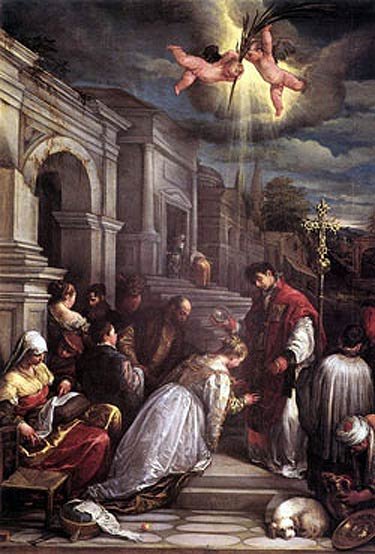
Jacopo Bassano, St Valentine Baptizing St Lucilla, 1575, oil on canvas, Museo Civico, Bassano del Grappa
The popular customs associated with Saint Valentine’s Day undoubtedly had their origin in a conventional belief generally received in England and France during the Middle Ages, that on 14 February, i.e., half way through the second month of the year, the birds began to pair. Thus in Chaucer’s Parliament of Foules we read:
For this was sent on Seynt Valentyne’s day
Whan every foul cometh ther to choose his mate.
For this reason the day was looked upon as specially consecrated to lovers and as a proper occasion for writing love letters and sending lovers’ tokens. Both the French and English literatures of the fourteenth and fifteenth centuries contain allusions to the practice. Perhaps the earliest to be found is in the 34th and 35th Ballades of the bilingual poet, John Gower, written in French; but Lydgate and Clauvowe supply other examples. Those who chose each other under these circumstances seem to have been called by each other their Valentines.
In the Paston Letters, Dame Elizabeth Brews writes thus about a match she hopes to make for her daughter (we modernize the spelling), addressing the favoured suitor:
And, cousin mine, upon Monday is Saint Valentine’s Day and every bird chooses himself a mate, and if it like you to come on Thursday night, and make provision that you may abide till then, I trust to God that ye shall speak to my husband and I shall pray that we may bring the matter to a conclusion.
——————————————–
From Robert Chambers, The Book of Days, 1869: Feast Day: St. Valentine, priest and martyr, circ. 270.
ST. VALENTINE’S DAY
Valentine’s Day is now almost everywhere a much degenerated festival, the only observance of any note consisting merely of the sending of jocular anonymous letters to parties whom one wishes to quiz, and this confined very much to the humbler classes. The approach of the day is now heralded by the appearance in the print-sellers’ shop windows of vast numbers of missives calculated for use on this occasion, each generally consisting of a single sheet of post paper, on the first page of which is seen some ridiculous coloured caricature of the male or female figure, with a few burlesque verses below. More rarely, the print is of a sentimental kind, such as a view of Hymen’s altar, with a pair undergoing initiation into wedded happiness before it, while Cupid flutters above, and hearts transfixed with his darts decorate the corners. Maid-servants and young fellows interchange such epistles with each other on the 14th of February, no doubt conceiving that the joke is amazingly good: and, generally, the newspapers do not fail to record that the London postmen delivered so many hundred thousand more letters on that day than they do in general. Such is nearly the whole extent of the observances now peculiar to St. Valentine’s Day.
At no remote period it was very different. Ridiculous letters were unknown: and, if letters of any kind were sent, they contained only a courteous profession of attachment from some young man to some young maiden, honeyed with a few compliments to her various perfections, and expressive of a hope that his love might meet with return. But the true proper ceremony of St. Valentine’s Day was the drawing of a kind of lottery, followed by ceremonies not much unlike what is generally called the game of forfeits. Misson, a learned traveller, of the early part of the last century, gives apparently a correct account of the principal ceremonial of the day.
‘On the eve of St. Valentine’s Day,’ he says, ‘the young folks in England and Scotland, by a very ancient custom, celebrate a little festival. An equal number of maids and bachelors get together: each writes their true or some feigned name upon separate billets, which they roll up, and draw by way of lots, the maids taking the men’s billets, and the men the maids’: so that each of the young men lights upon a girl that he calls his valentine, and each of the girls upon a young man whom she calls hers. By this means each has two valentines: but the man sticks faster to the valentine that has fallen to him than to the valentine to whom he is fallen. Fortune having thus divided the company into so many couples, the valentines give balls and treats to their mistresses, wear their billets several days upon their bosoms or sleeves, and this little sport often ends in love.’
St. Valentine’s Day is alluded to by Shakespeare and by Chaucer, and also by the poet Lydgate (who died in 1440).
The origin of these peculiar observances of St. Valentine’s Day is a subject of some obscurity. The saint himself, who was a priest of Rome, martyred in the third century, seems to have had nothing to do with the matter, beyond the accident of his day being used for the purpose. Mr. Douce, in his Illustrations of Shakespeare, says:
“It was the practice in ancient Rome, during a great part of the month of February, to celebrate the Lupercalia, which were feasts in honour of Pan and Juno. whence the latter deity was named Februata, Februalis, and Februlla. On this occasion, amidst a variety of ceremonies, the names of young women were put into a box, from which they were drawn by the men as chance directed. The pastors of the early Christian church, who, by every possible means, endeavoured to eradicate the vestiges of pagan superstitions, and chiefly by some commutations of their forms, substituted, in the present instance, the names of particular saints instead of those of the women: and as the festival of the Lupercalia had commenced about the middle of February, they appear to have chosen St. Valentine’s Day for celebrating the new feast, because it occurred nearly at the same time.”
February 14th, prior to 1969, was the feast day of two, or possibly three, saints and martyrs named Valentine, all reputedly of the Third Century.
The first Valentine, legend holds, was a physician and priest in Rome, arrested for giving aid to martyrs in prison, who while there converted his jailer by restoring sight to the jailer’s daughter. He was executed by being beaten with clubs, and afterwards beheaded, February 14, 270. He is traditionally the patron of affianced couples, bee keepers, lovers, travellers, young people, and greeting card manufacturers, and his special assistance may be sought in conection with epilepsy, fainting, and plague.
A second St. Valentine, reportedly bishop of Interamna (modern Terni) was also allegedly martyred under Claudius II, and also allegedly buried along the Flaminian Way.
A third St. Valentine is said to have also been martyred in Roman times, along with companions, in Africa.
Due to an insufficiency of historical evidence in the eyes of Vatican II modernizers, the Roman Catholic Church dropped the February 14th feast of St. Valentine from its calendar in 1969.
Tintoretto, Presentation of Jesus at the Temple, 1550-1555, Gallerie dell Accademi, Venice
From Robert Chambers, The Book of Days, 1869:
From a very early, indeed unknown date in the Christian history, the 2nd of February has been held as the festival of the Purification of the Virgin, and it is still a holiday of the Church of England. From the coincidence of the time with that of the Februation or purification of the people in pagan Rome, some consider this as a Christian festival engrafted upon a heathen one, in order to take advantage of the established habits of the people; but the idea is at least open to a good deal of doubt. The popular name Candlemass is derived from the ceremony which the Church of Rome dictates to be observed on this day; namely, a blessing of candles by the clergy, and a distribution of them amongst the people, by whom they are afterwards carried lighted in solemn procession. The more important observances were of course given up in England at the Reformation; but it was still, about the close of the eighteenth century, customary in some places to light up churches with candles on this day.
At Rome, the Pope every year officiates at this festival in the beautiful chapel of the Quirinal. When he has blessed the candles, he distributes them with his own hand amongst those in the church, each of whom, going singly up to him, kneels to receive it. The cardinals go first; then follow the bishops, canons, priors, abbots, priests, &c., down to the sacristans and meanest officers of the church. According to Lady Morgan, who witnessed the ceremony in 1820:
‘When the last of these has gotten his candle, the poor conservatori, the representatives of the Roman senate and people, receive theirs. This ceremony over, the candles are lighted, the Pope is mounted in his chair and carried in procession, with hymns chanting, round the ante-chapel; the throne is stripped of its splendid hangings; the Pope and cardinals take off their gold and crimson dresses, put on their usual robes, and the usual mass of the morning is sung.’
Lady Morgan mentions that similar ceremonies take place in all the parish churches of Rome on this day.
It appears that in England, in Catholic times, a meaning was attached to the size of the candles, and the manner in which they burned during the procession; that, moreover, the reserved parts of the candles were deemed to possess a strong supernatural virtue:
‘This done, each man his candle lights,
Where chiefest seemeth he,
Whose taper greatest may be seen; And fortunate to be,
Whose candle burneth clear and bright: A wondrous force and might
Both in these candles lie, which if At any time they light,
They sure believe that neither storm Nor tempest cloth abide,
Nor thunder in the skies be heard, Nor any devil’s spide,
Nor fearful sprites that walk by night,
Nor hurts of frost or hail,’ &c.
The festival, at whatever date it took its rise, has been designed to commemorate the churching or purification of Mary; and the candle-bearing is understood to refer to what Simeon said when he took the infant Jesus in his arms, and declared that he was a light to lighten the Gentiles. Thus literally to adopt and build upon metaphorical expressions, was a characteristic procedure of the middle ages. Apparently, in consequence of the celebration of Mary’s purification by candle-bearing, it became customary for women to carry candles with them, when, after recovery from child-birth, they went to be, as it was called, churched. A remarkable allusion to this custom occurs in English history. William the Conqueror, become, in his elder days, fat and unwieldy, was confined a considerable time by a sickness. ‘Methinks,’ said his enemy the King of France, ‘the King of England lies long in childbed.’ This being reported to William, he said, ‘When I am churched, there shall be a thousand lights in France !’ And he was as good as his word; for, as soon as he recovered, he made an inroad into the French territory, which he wasted wherever he went with fire and sword.
At the Reformation, the ceremonials of Candlemass day were not reduced all at once. Henry VIII proclaimed in 1539:
‘On Candlemass day it shall be declared, that the bearing of candles is done in memory of Christ, the spiritual light, whom Simeon did prophesy, as it is read in. the church that day.’
It is curious to find it noticed as a custom down to the time of Charles II, that when lights were brought in at nightfall, people would say—’ God send us the light of heaven!’ The amiable Herbert, who notices the custom, defends it as not superstitious. Some-what before this time, we find. Herrick alluding to the customs of Candlemass eve: it appears that the plants put up in houses at Christmas were now removed.
Down with the rosemary and bays,
Down with the mistletoe;
Instead of holly now upraise
The greener box for show.
The holly hitherto did sway,
Let box now domineer,
Until the dancing Easter day
Or Easter’s eve appear.
The youthful box, which now hath grace
Your houses to renew,
Grown old, surrender must his place
Unto the crisped yew.
When yew is out, then birch comes in,
And many flowers beside,
Both of a fresh and fragrant kin’,
To honour Whitsuntide.
Green rushes then, and sweetest bents,
With cooler oaken boughs,
Come in for comely ornaments,
To re-adorn the house.
Thus times do shift; each thing in turn does hold;
New things succeed, as former things grow old.’
The same poet elsewhere recommends very particular care in the thorough removal of the Christmas garnishings on this eve:
‘That so the superstitious find
No one least branch left there behind;
For look, how many leaves there be
Neglected there, maids, trust to me,
So many goblins you shall see.’
He also alludes to the reservation of part of the candles or torches, as calculated to have the effect of protecting from mischief:
‘Kindle the Christmas brand, and then
Till sunset let it burn,
Which quenched, then lay it up again, Till Christmas next return.
Part must be kept, wherewith to tend
The Christmas log next year;
And where ‘tis safely kept, the fiend Can do no mischief there.’
Considering the importance attached to Candlemass day for so many ages, it is scarcely surprising that there is a universal superstition throughout Christendom, that good weather on this day indicates a long continuance of winter and a bad crop, and that its being foul is, on the contrary, a good omen. Sir Thomas Browne, in his Vulgar Errors, quotes a Latin distich expressive of this idea:
‘Si sol splendescat Maria purificante,
Major erit glacies post festum quam fait ante;
which maybe considered as well translated in the popular Scottish rhyme:
If Candlemass day be dry and fair,
The half o’ winter’s to come and mair;
If Candlemass day be wet and foul,
The half o’ winter’s gave at Yule.’
In Germany there are two proverbial expressions on this subject: 1. The shepherd would rather see the wolf enter his stable on Candlemass day than the sun; 2. The badger peeps out of his hole on Candlemass day, and when he finds snow, walks abroad; but if he sees the sun shining, he draws back into his hole. It is not improbable that these notions, like the festival of Candlemass itself, are derived from pagan times, and have existed since the very infancy of our race. So at least we may conjecture, from a curious passage in Martin’s Description of the Western Islands. On Candlemass day, according to this author, the Hebrideans observe the following curious custom:
The mistress and servants of each family take a sheaf of oats and dress it up in women’s apparel, put it in a large basket, and lay a wooden club by it, and this they call BrÃd’s Bed.; and then the mistress and servants cry three times, “BrÃd is come; BrÃd is welcome!†This they do just before going to bed, and when they rise in the morning they look among the ashes, expecting to see the impression of BrÃd’s club there; which, if they do, they reckon it a true presage of a good crop and prosperous year, and the contrary they take as an ill omen.
Nguyen Hoa Giai, a former Viet Cong guerilla fighter, discusses eight common misconceptions about the War in Vietnam, thereby providing an interesting read.
Once the fighting started, a lot of people died, well over a million on our side alone. For the war to continue, a constant stream of new fighters had to join up, and they didn’t have the benefit of such luxuries as “functional equipment” or “the slightest idea what to do.” Over 90 percent of these new recruits were teenagers or younger. Many of them weren’t even particularly invested in the “cause” itself. Supporting Communism or the dream of a united Vietnam was less a motivator than wanting revenge for the death of a parent, loved one, or child. The Viet Cong (literally: the National Liberation Front or just “the front”) were just a means for securing that revenge.
Most of them were aware that Stalin and Mao each had movements named after them (Stalinism and Maoism), so they just assumed Socialism was named after a guy named Social and Communism was named after a guy named Commun. A distressing number of my co-soldiers still thought we were fighting France. They knew of Ho Chi Minh, but only in vague propagandistic terms, not the man’s actual history. When we told them we wanted a Socialist society, they just said yes because they were mostly poor, grieving peasants living through a shortage of damns, and thus had none to spare for politics.
“For the people. And truly I desire their Liberty and Freedom as much as any Body whomsoever. But I must tell you, That their Liberty and Freedom, consists in having of Government; those Laws, by which their Life and their goods may be most their own. It is not for having share in government, Sir, that is nothing pertaining to them. A subject and a soveraign are clean different things, and therefore until they do that, I mean, that you do put the people in that liberty as I say, certainly they will never enjoy themselves.
Sirs, It was for this that now I Am come here. If I would have given way to an Arbitrary way, for to have all Laws changed according to the power of the Sword, I needed not to have come here; and therefore, I tell you, (and I pray God it be not laid to your charge) That I Am the Martyr of the People.”