Category Archive 'History'
06 Jul 2014


Thomas Babbington Macauley: “[The Roman Catholic Church] saw the commencement of all the governments and of all the ecclesiastical establishments that now exist in the world; and we feel no assurance that she is not destined to see the end of them all. She was great and respected before the Saxon had set foot on Britain, before the Frank had passed the Rhine, when Grecian eloquence still flourished at Antioch, when idols were still worshipped in the temple of Mecca. And she may still exist in undiminished vigour when some traveller from New Zealand shall, in the midst of a vast solitude, take his stand on a broken arch of London Bridge to sketch the ruins of St. Paul’s.”
Oscar Halecki, The Limits and Divisions of European History, 1950 is ultimately optimistic.
It has been frequently stressed that, from the point of view of the historical method, ancient history is so instructive to study because it is completed;we are able to contemplate the whole process of its evolution from beginning to end. The same can be said today [1950] of European history. That comparison with the ancient, Greco-Roman world is both suggestive and comforting, for it shows that the end of an age, and even of a whole cultural world, need not necessarily mean complete extinction like that which occurred, for instance, in the case of the pre-Columbian civilizations of America. Europe’s present decline need not lead to what Oswald Spengler calls an Untergang, although the crisis is much more acute today than it was when he wrote his sensational book. Nor need Macauley’s gloomy vision of a New Zealander meditating over the ruins of London ever come true, although this time seemed so near in 1940. …
Europe came into existence as an historical community because numerous peoples entirely different from each other, without effacing their particularities and without ever uniting politically, joined in a co-operation based upon common cultural conceptions, traditions, and principles. The individual nations which developed within that community were rather small if compared, for instance, with the peoples of India or China. Likewise small was the area in which they had their home; and compared with the length of other histories –to mention only that of Egypt– the age of their common greatness was of rather short duration.
But within these narrow limits of time we see the same variety of events in rapidly changing periods that is so striking in Europe’s physical and ethnical backgrounds. This certainly is an unusually dynamic history, whether proceeding through evolution or through revolutionary upheavals. And that is the first argument in favor of the conviction that the end of the European Age in history is not necessarily the end of Europe, or of a civilization which, though inseparable from the European heritage, has ceased to be exclusively European.
05 Jul 2014



Built, just before the start of WWII, on the rear-engine Mercedes-Benz 170H chassis it was known as the Göttinger Ei (“an egg from Göttingen”) or the Schlörwagen. Its designer, Karl Schlör, a Krauss Maffei engineer, had proposed a bodyshell with extremely low drag coefficient as early as of 1936. The prototype dazzled the public at the Berlin autoshow of 1939. But, because of the outbreak of WWII, the Schlörwagen never actually went into production. Karl Schlör died in 1997.
Via Retronaut.
02 Jul 2014

Matti Friedman gives a fascinating account of the history, and recent partial theft, of one of the oldest and most valuable books in the world.
The Aleppo Codex, a bound book of approximately 500 parchment pages, was compiled in Tiberias around the year 930 C.E., making it the oldest known copy of the complete Bible. It was moved to Jerusalem, stolen by crusaders in 1099, ransomed by the Jews of Cairo, and studied by the philosopher Maimonides, who declared it the most accurate version of the holy text. It was later taken to Aleppo, Syria, and guarded for six centuries. There it became known as the “Crown of Aleppo.â€
In 1947, in a riot that followed the United Nations vote on the partition of Palestine, the codex disappeared, surfacing 10 years later in mysterious circumstances in the new state of Israel. The codex is currently held in the Israel Museum, in the same building as the Dead Sea Scrolls. It is controlled not by the museum, however, but by a prestigious academic body, the Ben-Zvi Institute, founded by Israel’s second president, Yitzhak Ben-Zvi. Somewhere along the way in the mid-20th century, 200 priceless pages—around 40 percent of the total—went missing. These include the most important pages: the Torah, or Five Books of Moses.
There are two mysteries linked to the codex. The first: How did the book move to Israel from a grotto in Aleppo’s Great Synagogue and effectively become the property of the new state? And the second: How did its missing pages vanish, and where might they be now? …
The official version of the story, propagated by the academics in Israel who control the manuscript, claimed the pages vanished in Aleppo around the time of the 1947 riot. But we know now that the manuscript was seen whole as late as 1952, five years later. The first description of any significant damage to the codex dates, strikingly, only to 1958—after the manuscript reached the Ben-Zvi Institute in Jerusalem.
At around the same time, my investigation found, dozens of valuable books and manuscripts vanished from the library of the same institute. When I approached former officials at the institute with evidence of the other missing books, several went on record saying the man responsible for their disappearance was the institute’s director at the time, Meir Benayahu, a scholar who throughout a long and illustrious career studied, collected, bought, and sold rare Hebrew books. He left his post amid a legal battle over control of the institute in 1970.
Benayahu, who died in 2009, came from a powerful political family with roots in Iraq; he was the son of a Sephardic chief rabbi, Yitzhak Nissim, and brother of a senior Likud cabinet minister, Moshe Nissim. (As was common in those years, Benayahu adopted a more modern and Israeli-sounding last name.) This scandal has long been known in Israel’s small and insular academic world but was never made public. Legal proceedings were avoided at the time thanks to the direct intervention of Israel’s president, Zalman Shazar. Police were never summoned, no charges were filed, and no books were returned. Benayahu’s family denies any wrongdoing and says the accusations against him are a smear campaign aimed at covering up thefts by other people; they have asked, rightly, why no one went to the police at the time. Today Benayahu’s family owns a collection of Hebrew texts that is one of the world’s largest in private hands.
Whatever precisely happened at the Ben-Zvi Institute, the long-buried affair of the institute’s vanished books—whether it is connected or not to the disappearance of the codex pages—is arguably the worst corruption scandal in the history of the Israeli academy.
The Aleppo Codex web-site.
18 Jun 2014

Marc Chagall, I and the Village, Museum of Modern Art, New York.
In Tablet magazine, Cherie Woodworth reviews the fascinating debate on the origin of the Yiddish language.
That history revolves around two theories, that proposed by Max Weinrich:
If you want to know not just what Yiddish is but where it came from, how it managed to survive and even to flourish, you can do no better than the new edition of Max Weinreich’s History of the Yiddish Language—but be sure to read the footnotes. They extend for over 750 pages, are now published in English for the first time in the new Yale edition, and contain the most interesting, and controversial, part of what had seemed till now a fairly straightforward and unchallenged historical narrative.
Weinreich’s original text and notes were published in 1973, four years after his death. A partial translation into English—without the notes—was published by the University of Chicago Press in 1980. Yale’s new edition thus finally makes available for the first time the greater part of Weinreich’s work—the notes are longer than the text—thoroughly edited by Paul Glasser. The notes cite research in two dozen languages and took more than a decade to edit and check even after they were translated. These notes are not just the usual formal apparatus, reassuring to any scholarly reader: They are essential to understanding Weinreich’s many-stranded argument about the relationship between culture and language. They also provide a subtle counter-argument to his lifelong thesis. Weinreich was a careful, fair, and judicious scholar, and it was in the notes to his monumental work that he gave place to the vexing confusion of counter-evidence to his main, and beloved, story of Yiddish origins and, by implication, the origins of millions of East European Jews and their descendants in America. …
Weinreich’s basic story of the beginnings of Yiddish in the Rhine valley and its centrality in creating a European Jewish culture are repeated everywhere, and without question. But the pillars of Weinreich’s argument are too broad, their foundations in a millennial-old history too unstable, to be as unshakable as his subsequent readers have made them seem—a fact that Weinreich knew very well. He was too careful a scholar to buy into a simplistic view, as the publication of the notes now clearly reveals.
Weinreich’s first innovation in the History was to argue, against apparent common sense and abundant personal experience, that Yiddish was formed not through isolation but through constant interaction combined with a chosen separateness. The walled-off ghettos of 18th-century European cities, although they preserved Yiddish, were not the environment that gave it life. Weinreich’s innovation was to argue that “Jewish othernessâ€â€”and the language that goes with it—“cannot be the result of ‘exclusion’; it is not even the result of exile.â€
Where others had persistently told the story of confinement, prejudice, and persecution, Weinreich spoke of independence, self-government, selfassertion, and community building. It was undeniable that “without communal separateness there is no separate language,†and so the separateness of the Ashkenazi community was necessary for Yiddish to arise. But the modern explanation for that separateness, according to Weinreich, got the story exactly backward. Nineteenth-century Jewish activists, demanding rights of citizenship, created the story that the Jews had been locked in ghettos since the Middle Ages, “and thus excluded from society at large and its intellectual development; in this forced isolationâ€â€”an influential Jewish assimilationist argued—“both their mode of life in general and their language in particular became corrupted.†…
For Weinreich, based on both the linguistic and historical evidence, there could be no doubt that up until the 18th century “the Jews wanted to be by themselves. … Separate residence (strange as this may appear in the light of present Jewish and general conceptions of rights) was part of the privileges granted the Jews at their own request†so they could worship together; provide for their own slaughterhouse, bathhouse, cemetery, and social halls; study together; run their own rabbinic courts; supervise tax collection; and when necessary, protect themselves from attacks.
Archeology supports this part of Weinreich’s argument. Befuddled tour guides in Prague struggle to explain why, given the expectation of exclusion of Jews, the city’s famous Jewish quarter, Josefov, is so central to the old town. (One misguided explanation is that the Jews were given land near the river that was too marshy for the other city inhabitants, prone to flooding and disease-bearing miasmas.) But Prague’s Josefov is not an isolated case—it is typical. Weinreich’s point is that exclusion could also be exclusivity; restrictions also came with designated privileges. In Trier, Mainz, Aachen, Cologne, Worms, and more than 100 medieval towns in Central Europe, the Jewish district was both a central and a prime location, close to the economic heart of the city. The German Bishop Rüdiger, granting a charter of the city of Speyer in 1084 wrote, “I thought that I would increase the glory of our city a thousandfold if I were to include Jews.†…
Once he demonstrated that Yiddish is an independent language, Weinreich explained how it came to be, first as an altered language formed among medieval Jewish trading settlements in the French–German borderland along the Rhine valley. Weinreich deduced from traces left in early Yiddish that these first Jewish immigrants to the heart of Europe spoke a Romance language, having left Hebrew, Aramaic, and Greek behind when they left the eastern Mediterranean, although Hebrew and Aramaic were still languages of study. But early on (in the 10th or 11th century) these Jews from Rhineland France, presumably through contact with Jewish settlements in southern Germany, converted from old Judeo-French to western Yiddish, which was more purely German with some elements of Latin or early French. In subsequent centuries—when, exactly, is a source of considerable debate—this language moved east with Jewish emigrants, settlers, and refugees, either in the 12th century (after the Crusades and persecutions) or in the 14th or 15th. There it picked up a significant cargo of Slavic vocabulary and expressions and became the Yiddish more familiar today: eastern Yiddish.
With his 1,000-year history, Weinreich thus removed the East European Jews from both the poor shtetls (the cliché associated with Jewish immigrants to America of the 19th and early 20th century) and their tragic end. Distancing them from their Slavic neighbors, who had little cultural cachet in America, and bypassing the association with Germany, which had become toxic after 1945, he placed their roots instead in France, where Jews still like to go on vacation.
And the alternative argued by Paul Wexlar:
[H]ow to account, demographically, for the millions of Jews who appear on the records in Poland, Ukraine, Lithuania, Hungary, and elsewhere by the 19th century. Immigration following the medieval Crusades and expulsions from Western Europe, followed by 400 to 500 years of natural biological growth, are not enough to account for the size of the East European Jewish population. The numbers simply don’t add up. Two scholars from disparate fields of inquiry have recently tried anew to solve this puzzle, first noted at least a century ago: Paul Wexler from comparative linguistics and David Goldstein from genetics.
The title of Paul Wexler’s detailed study, The Ashkenazic Jews: A SlavoTurkic People in Search of a Jewish Identity, is not shy about his claim: Yiddish has Slavic grammar, syntax, morphemes, phonemes, and lexicon, with a smaller input from Turkic. Wexler made the case that Yiddish is a “relexificationâ€â€”a massive borrowing of Germanic words onto a basically Slavic structure, as opposed to Weinreich’s view that Slavic words were added to a Germanic structure. Wexler’s claim applies not only to the language: “The bulk of their [Ashkenazi Jewish] religious practices and folkways also prove to be of Slavic origin†and thus “the Ashkenazic [sic] Jews may be in the main ethnic Slavsâ€â€”Wexler added his own italics, in case readers should not get the point. Wexler’s preferred term for modern Judaism was “Judaized pagano-Christianity,†though he used the term rarely on the grounds that it was too cumbersome. …
Genetics might provide us with an exit to this uncomfortable, and vexingly arcane, linguistic argument. Recent studies of markers on the Y chromosome of Ashkenazi men hold out the possibility of determining, with apparent mathematical precision, how many Ashekenazi men share markers distinctive to the European, Middle Eastern, or other (for example, Central Asian Turkic) gene pool. The results are inconclusive, puzzling, and unexpected. David Goldstein, a molecular geneticist at Duke, undertook to trace Y markers among two Ashekenazi subgroups: the Cohanim (the class of priests narrowly defined) and the Levites (liturgical officiants from the tribe of Levi). He found that the Cohanim from both Ashkenazi and Sephardic populations shared an unusual marker on the Y chromosome that set them apart both from the surrounding non-Jewish populations—and from their own communities. He traced the marker to a mutation originating about 3,000 years ago and suggested in conclusion that this showed both groups had a real and unbroken genetic link with the original priestly Jews of Israel. (He received tremendous media coverage as a result.)
The Ashkenazi Levites, on the other hand, showed a puzzling genetic signature: they did not match particularly well with the Cohanim, nor with the broader population of Ashkenazi Jews. Comparing this group with the most common Y-chromosome micro-mutations in European and West Eurasian populations (i.e., Turkic and Caucasian tribes), Goldstein concluded that though he had at first been very skeptical of the “Khazar hypothesis†that Ashkenazi Jews came to Eastern Europe from the Eurasian steppe, rather than from Germany, he now found it “plausible, if not likely†and “worth investigating further.â€
In his latest work—more linguistic studies, as well as an etymological dictionary of Yiddish—Wexler argues that the core of what became the Ashkenazi Jews originated not in post-exilic Judea, later dispersed through the Mediterranean Roman Empire, but in Persia: the Azhkenazi(c) Jews were “an outgrowth of Jewish Iranians who brought Judaism to the Khazars, and subsequently migrated westwards with Turkic-origin Jews and non-Jewish Khazars.â€
Read the whole thing, and look forward to part two.
12 Jun 2014

Funeral of my great great uncle Frank Petrusky [Lith.: Pranas Petrauskas], killed in the mines, May 3, 1892, Shenandoah, Pennsylvania.
If you want to identify the proper American policy, the sensible and correct way of doing things, I commonly observe, all you need to do is go back a bit in history to a point in time before Liberalism, Socialism, Progressivism, Reformism, Statism, and Goo-Goo-ism had hijacked the American Experiment and messed everything up.
What, then, was the real, traditional American policy on Immigration?
Well, boys and girls, before 1875, immigration to the United States was utterly and totally unrestricted. The Page Act of 1875 was the very first US law restricting immigration in any way. The Page Act was aimed at restricting the immigration of cheap Chinese labor and “immoral” Chinese women. This was the first of a series of laws aimed at restricting Oriental Immigration, based on philosophically questionable principles (excluding cheap labor competition, racism) as well as more reasonable practical considerations (the disinclination of Oriental immigrants at that time to assimilate and their continued loyalty to alien cultures, polities, and princes).
There was no federal role in naturalizing immigrants at all before 1906. Prior to the Naturalization Act of that year, naturalizing people was entirely up to the individual states. The 1906 Law federalized, and standardized, the naturalization process (and, for the first time, insisted on recording the names of wives and children of immigrant men becoming naturalized as citizens). Things were a lot more informal before 1906.
Additional legislation followed, in 1907 and 1908, and in 1917 and 1918, banning the entry of the disabled and diseased, requiring literacy on the part of non-elderly immigrants over 14 years of age, and placing more barriers to immigration from Asian countries. But, there remained no quotas at all on non-Asian immigration until 1921. In 1921, a national negative reaction to the recent arrival of people like my Lithuanian grandparents, all the Italians, the Poles and Slovaks, and the Eastern European Jews produced the Emergency Quota Act, which restricted the number of immigrants admitted from any country annually to 3% of the number of residents from that same country living in the United States as of the U.S. Census of 1910. This was, we need to recall, the great era of the second creation of the Ku Klux Klan, not to be confused with the original Reconstruction era Klan which was dissolved in the 1870s, whose membership peaked in the mid-1920s at 4-5 million men (roughly 15% of the eligible, non-Negro, non-Jewish, non-Catholic population). The quota system of the 1921 Act remained in place until 1965.
Restricting immigration is a Progressive Era policy constituting a radical break with earlier American practices and, I would argue, with the philosophy the country was founded upon.
The 13 colonies which united to become the United States were not culturally or ethnically uniform. The Puritans of Massachusetts Bay and the Cavaliers of Virginia both originated from England, but they had been cultural opponents, blood enemies, and opposing parties in a Civil War in their home country. Rhode Island was founded by religious radicals who would not live under Massachusetts law. Pennsylvania was founded by Quakers; Maryland by Roman Catholics. New York had originally been a Dutch colony. The Swedes first settled Delaware Bay. The original colonies, before the Revolution, contained significant populations as well of Scots Irish, German religious dissenters, French Huguenots, Scots Highlanders, and various other European groups.
Benjamin Franklin famously complained about Germans with “swarthy complexions” coming over, settling in Pennsylvania, refusing to learn English and not assimilating.
Those who come hither are generally of the most ignorant Stupid Sort of their own Nation — and as few of the English understand the German Language, and so cannot address them either from the Press or Pulpit — ’tis almost impossible to remove any prejudices they once entertained. Not being used to Liberty, they know not how to make a modest use of it. I remember when they modestly declined intermeddling in our Elections, but now they come in droves, and carry all before them, except in one or two Counties…In short unless the stream of their importation could be turned from this to other colonies, as you very judiciously propose, they will soon so out number us, that all the advantages we have will not in My Opinion be able to preserve our language, and even our Government will become precarious.
Those rascally Germans, in some well-known cases, have never assimilated and it isn’t hard, even today, to find in Pennsylvania Amish, Mennonites, Dunkards, Schwenkfelders, and so on who still speak German. But Franklin was obviously wrong. They never did take over culturally or politically. Most of their descendants did assimilate, and the ones who didn’t we look upon today as quaint and think that they make an excellent tourist attraction.
Attempting to restrict the free movement of people, proposing to restrict the supply of labor in order to prevent competition, undertaking to have government favor a particular culture, and attempts to exclude hopelessly inferior people are all classic Progressive policies.
Hispanic immigrants come here because Americans need affordable low-skilled labor not otherwise available and we hire them. I would contend that the federal government has no business trying to come between me and Jose the Mexican, if I want to hire Jose to mow my lawn and Jose wants to take the job.
I’ve gotten around a good deal in the last decade, and my own experience persuades me that, in much of the country, all the low skill manual labor these days is being done by illegal Hispanic immigrants.
People who think that the government can stop illegal immigration (when Americans need and want to hire affordable low skill labor) are just as crazy as the people who think the government could successfully ban private gun ownership or who suppose that the government can win the War on Drugs.
In the first year of law school, they teach students the difference between things which are malum in se, things like theft and murder, which are wrong in themselves, and things which are malum prohibitum, things which are wrong only because the government says so.
It’s pretty easy to enforce laws against things which are malum in se. Even the criminals who break those kinds of laws know they are in the wrong. But malum prohibitum matters are different. Normal people just perform a mental calculus about how likely they actually are to get caught, and when they recognize that the state is in no position to catch them, they commonly just ignore those kinds of laws and do as they like.
People who get bent out of shape because somebody crossed the border illegally to come here to do honest work are crazy. They suffer from an excess of law worship.
Wake up and smell the coffee. There are something like 12 million illegal immigrants living in this country. This is exactly like guns. We are never going to go from door to door, searching through every innocent, law-abiding person’s house to confiscate all the guns. And we are never going to go door to door and round up 12 million, mostly honest and hard working people, then march them off, with women and children crying, at bayonet point to the cattle cars to be deported. Germany in the 1930s, the Soviet Union under Stalin, could pull off that kind of thing, but it is not in the American character.
I agree that we should not be providing welfare to illegal aliens, but straightening out our domestic politics and policies is our responsibility, not theirs.
Ever see my traditional memorial day posting? This country let my grandparents in. My grandparents were Roman Catholics (shudder!). They were Lithuanian, representatives of a people with a lot fewer ties (Thaddeus Kosciusko built West Point!) to American history and culture than the Mexicans, whose ancestors owned, settled, and explored what? 8 or 9 states before the first Anglo-Saxon ever set foot in them. What did the US get in return? They got labor in the coal mines, dangerous work that most Americans didn’t want to do, which labor played a key role in building industrial America and keeping the offices and homes in American cities lighted and heated for generations. America also got from my paternal grandparents three sons and one daughter who served in uniform during WWII.
If this country ever has another serious war, it will be damned glad it failed to deport all those illegal alien Hispanics, whose children will probably actually serve (unlike our privileged elite intelligentsia).
10 Jun 2014

(Image: Museum of Victoria)
earthstory: This is the Welcome Stranger Nugget.
Discovered in 1869 by Cornishmen John Deason and Richard Oates in Victoria, Australia, it is the largest gold nugget ever discovered.
It weighed in at 69kg (152.1 lb.) and measured 61x31cm (24×12.2″) and it was found just a couple of metres below the surface.
At the time no scale was big enough to weight the nugget so it was broken into 3 pieces and each piece weighed separately.
At today’s Gold Value the nugget would be worth
$3,786,257.01 AUD (Correct 21/09/2012 Perth Royal Mint)
To read more:
Museum Victoria
Australia Historical Finds and Discoveries
Australian Gold
VisitMaryBorough.com
Via Ratak Monodosico.
02 Jun 2014

Bye, bye, Ta-Nehisi Coates!
Now that Gay Marriage, on the basis of a series of fabricated popular opinion polls and even-more-shamelessly-fabricated judicial opinions, seems to be firmly established as a feature of American life, the Establishment media is competing to pick the next great liberal cause. Time Magazine plumped for Transgender Rights. The Atlantic, more conservatively, just allowed its house affirmative action senior editor to publish an interminable screed demanding reparations.
That editor, a fellow named Coates who affects the silly and pretentious Afro praenomen Ta-Nehisi, makes an essentially preposterous claim. His contention is that we all owe him money because the entire American economy and Capitalist System as we know is built upon the unremunerated contributions of black slaves prior to 1865.
There are a number of obvious problems with this theory. According to historian Eugene Genovese, the most authoritative student of the subject, during the Antebellum period, black slaves typically received a significantly larger share of the product of their production than did free laborers in the North.
Additionally, the economic contribution of black slaves was regional, overwhelmingly restricted to the agricultural and non-industrial South. Industrial America and modern American capitalism developed in the far more urban and populous North. The wealth of the South was ultimately sunk in the struggle for Southern Independence, and its economic assets, its modest industries, and its large agricultural economy was destroyed in the war. After the Civil War, the Southern states sank into provincial poverty and economic backwardness for most of a century.
If the South owed Black America anything, in 1865 it was bankrupt and in no position to pay. Congress, moreover, specifically repudiated all the debts of the late Confederacy.
The Northern States extinguished Slavery at the cost of more than 700,000 American lives, the equivalent of two and half percent of the entire population of the country, four years of war, and the expenditure of what would undoubtedly be trillions of today’s dollars in wealth. The entire record of history fails to disclose any equivalent example of so enormous an effort and so enormous a sacrifice of blood and treasure by any society for the benefit of another people. The absolutely incredible cost of the Civil War would be taken by any fair-minded person to wipe the slate clean for the entire nation, North and South.
Finally, of course, there is to be considered the obvious enormous distance of time, and the tremendous changes in American society and its population which have occurred in that century and a half since 1865. Few people living today actually even know the names of their ancestors who were living in 1865, let alone their circumstances.
For Mr. Coates to claim that America owes him, and others of his kind, for potential underpayments of wages to some great great grandfather is just ridiculous. Nor does his endless series of sob stories about bad real estate deals and segregation impress me very much.
I don’t think I owe Mr. Coates, or the rest of Black America, a damn thing. No members of my family ever set foot in this country before the mid-1890s, a full generation after slavery was extinguished. My Lithuanian ancestors settled in the Anthracite mining region of Northeastern Pennsylvania, where they enjoyed the distinctly white European privileges of digging coal, getting killed in cave-ins or gas explosions, and dying unusually young of Anthrosilicosis.
They probably would have discriminated against Mr. Coates’ ancestors, given the chance, but happily they were spared the moral burden of Black Segregation because there simply weren’t any blacks at all living in their part of the country.
Segregation would have seemed the natural order of things to my relatives, who self-segregated themselves by settling in Lithuanian communities, living in Lithuanian neighborhoods, building and attending Lithuanian churches and schools, shopping at Lithuanian butcher shops, and drinking in Lithuanian saloons.
We owned no slaves, oppressed no Negroes, denied them no public accommodations, and had nothing to do with them whatsoever. My family additionally, in generations gone by, enjoyed no particular white privileges denied to Mr. Coates’ family. I was the first member of my family to attend an elite college. My father had to leave school after the 8th grade and go to work. His father was dying of miner’s asthma and the family needed the money. My grandparents bought a house in Mahanoy City early in the 1920s. They paid it off in three years, having no more access to federal mortgage financing than Mr. Coates’ family and their peers.
But, I’m willing to be generous. I don’t believe I, or any other Americans, owe Mr. Coates anything, but let us bend over backwards to quiet his complaints and make him whole.
I agree with the philosophy expressed by Rupert Birkin, speaking for D.H. Lawrence in Women in Love:
The minute you begin to compare, one man is seen to be far better than another, all the inequality you can imagine is there by nature. I want every man to have his share in the world’s goods, so I can be rid of his importunity, so that I can tell him: “Now you’ve got what you want — you’ve got your fair share of the world’s gear. Now, you foul-mouthed fool, mind yourself and don’t obstruct me.
And what would appropriate reparation for Mr. Coates consist of?
Clearly, we need to remove all the burdens and oppressions heaped upon his shoulders by evil America and wicked European Civilization. We ought to restore to him everything he has lost. We should give Mr. Coates a spear, and grass skirt, and along with them a one-way ticket back to Africa. As part of the deal, of course, we’ll have to take away his shoes, his trousers, his personal computer, and his position as senior editor at The Atlantic. Good luck in Africa, Mr. Coates! Say hello to that panther there for me.
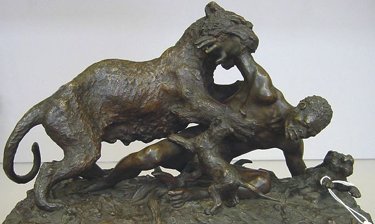
Christophe Fratin, Panther and Cubs Attacking an African Native, 1834, The Peabody Art Collection, Baltimore.
13 May 2014

Emanuel Leutze, Christopher Columbus on the Santa Maria in 1492, 1855
The Independent:
More than five centuries after Christopher Columbus’s flagship, the Santa Maria, was wrecked in the Caribbean, archaeological investigators think they may have discovered the vessel’s long-lost remains – lying at the bottom of the sea off the north coast of Haiti. It’s likely to be one of the world’s most important underwater archaeological discoveries.
“All the geographical, underwater topography and archaeological evidence strongly suggests that this wreck is Columbus’ famous flagship, the Santa Maria,†said the leader of a recent reconnaissance expedition to the site, one of America’s top underwater archaeological investigators, Barry Clifford.
“The Haitian government has been extremely helpful – and we now need to continue working with them to carry out a detailed archaeological excavation of the wreck,†he said.
So far, Mr Clifford’s team has carried out purely non-invasive survey work at the site – measuring and photographing it.
Tentatively identifying the wreck as the Santa Maria has been made possible by quite separate discoveries made by other archaeologists in 2003 suggesting the probable location of Columbus’ fort relatively nearby. Armed with this new information about the location of the fort, Clifford was able to use data in Christopher Columbus’ diary to work out where the wreck should be.
————————
HuffPo:
[The] team found and photographed the wreck 10 years ago, but did not realize what it was until recently, the paper reported.
The Santa Maria ran into a reef off the coast of Haiti with Columbus aboard, forcing him to build a small settlement for his crew — the first European settlement in the Americas since the Vikings’ 11th century village in Newfoundland.
He named it La Navidad — Christmas — and then returned to Spain on the Nina, leaving behind 39 crew members unable to fit on the ship.
The third ship, the Pinta, was separated from the other two at the time.
One year later, Columbus returned with 17 ships and some 1,200 men, but the settlement had been burned and no one remained. (This Smithsonian article has more on La Navidad.)
The 2003 discovery of the possible ruins of La Navidad led Clifford to the current location off the coast, where he re-examined the wreck that had been found by his team. He says the size and location in relation to the ruined fort match what he’d expect from the Santa Maria.
“I am confident that a full excavation of the wreck will yield the first ever detailed marine archaeological evidence of Columbus’ discovery of America,” Clifford was quoted as saying.
10 May 2014

Thezman:
A massive problem in contemporary intellectual discourse is that people don’t remember the past well and don’t have a critical attitude toward whatever is the latest conventional wisdom about the backwardness of the past. In the Obama Era, we see race and sex disparities all around us, and the only socially acceptable explanation for them is that the past was so incredibly racist/sexist until … well, nobody can quite remember when, but it must have been practically the day before yesterday. So, it’s hard for contemporary intellectuals to put themselves back into the shoes of their predecessors. …
[I]t is part of a greater war on the past, which is a manifestation of self-loathing.The modern Progressive hates his ancestors because they created the present, which the moral man detests and wishes to change. All that “leaning forward†stuff looked like pulling at the leash for a reason.
The left imagines themselves at war with the past, trying to break free from that which ties them to the present. It is why they deny biology, for example. The thought that we are the accumulation of genetic experimentation over millions of years is horrifying. Even accepting that we are the result of our parents is impossible. How can we break free when we are just a point in the time line? They never have solved the central dilemma of every religion. That is, how do you get to the promised land. Pagans believed a noble death was the ticket. Christians believed a noble life was the answer. Modern liberals believe amnesia is the solution.
07 May 2014
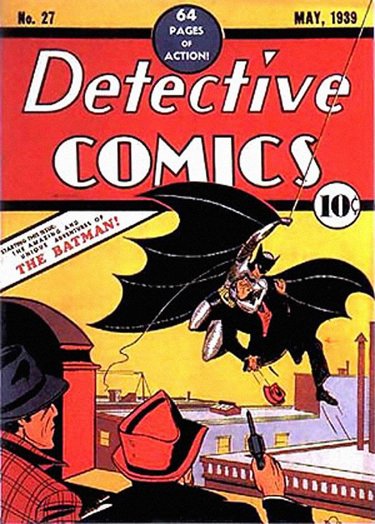
Richard A. Warshak, in the Atlantic, associates the origin of the dark crimefighter with a boyhood beating experienced by his creator.
Years ago I became aware that a particular superhero, who has entertained millions of people, had special appeal to the traumatized children who visited my office. I had a hunch that a trauma had inspired the creation of this superhero. See if you think my hunch was correct.
His pals nicknamed him “Doodler†because he was constantly drawing pictures. His pals had nicknames, too—they were fellow members of a neighborhood club know as “The Zorros,†an appellation that a young Robert Kahn had chosen, inspired by the cinematic crusader for justice played by Douglas Fairbanks, Sr. The Zorros’ clubhouse was built with wood stolen from the neighborhood lumber yard—a place whose many nooks and crannies made it the location of choice for their games of hide-and-seek.
One night, when he was 15 years old, Kahn—who went by “Robbie†at the time—had a terrifying encounter. Walking home through rough neighborhoods of the Bronx after a music lesson, carrying a violin case, he was followed by “a group of seedy-looking roughnecks from the tough Hunts Point district,†as he wrote in his autobiography 57 years later:
They wore the sweatshirts of the Vultures, and they were known to be a treacherous gang. They were whistling at me and making snide remarks that only “goils†played with violins. I stepped up my pace and so did they. Finally, I started running and they did likewise, until I reached my neighborhood. Unfortunately, my buddies were not hanging around the block at the time.
Kahn’s memoir goes on to give a very lengthy, melodramatic blow-by-blow account of his dash to the familiar lumberyard, the Vultures’s pursuit (“with terrifying menace in their eyesâ€), and his attempts at self-defense, complete with “Zorro†leaps, grappling hook, and mid-air kicks while swinging on a rope. He fought bravely, he writes, but for naught:
My worst fears came true. Two Vultures pinned both my arms behind my back and held me firm while another beat a staccato rhythm on my belly, knocking the wind out of me. Another bully stepped in and used my face for a punching bag—while he cracked a couple of my front teeth.
I was in a fog, when I felt my right arm crack at the elbow after a gang member deliberately twisted it behind me in order to break it. The pain was excruciating and I screamed in agony.
Before I blacked out and fell to the ground like a limp rag doll, I heard him laugh sardonically, “Just to make sure dat da Fiddler ain’t gonna play his fiddle no more!†Little did he know that it wasn’t playing the violin again that concerned me, but the fact that he had broken my drawing arm.
Then he stepped on the hand of my broken arm! I don’t remember how long I remained in a blanket of darkness before I regained consciousness, but when I came to, I was a beaten, bloody wreck. Somehow I managed to pull myself up and it was then that I noticed my violin on the ground, smashed to pieces. This was the coup de grace!
This whole episode, to this day, remains in my subconscious like a nightmare. I had played Zorro and lost! Had it really been a dream or a movie, I would have emerged victorious. But this real-life drama had almost cost the life of a reckless fifteen-year-old.
Here we have a boy who was attacked by a gang of Vultures in the night. He defended himself by playing Zorro, using a grappling hook to fend off his attackers. He was unsuccessful and was hospitalized, severely injured, with the possibility that he would be unable to pursue his chosen career. In spite of permanent injuries—scars, chipped teeth, and limited mobility in one arm—he went on to become a cartoonist.
Seven years after being brutalized, he created a comic-book superhero that would become a pop-culture legend—and whose appeal may be deeply, subtly connected to what happened that night in the lumber yard.
07 May 2014
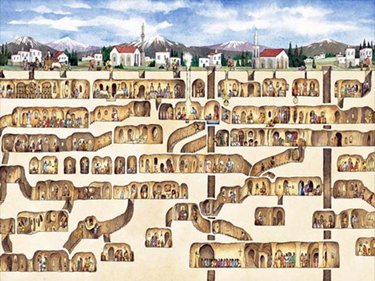
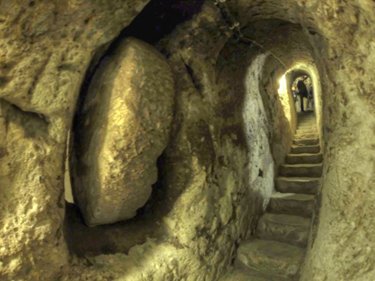


Welcome to Derinkuyu, an underground city that once housed up to 20,000 people. In the Cappadocia region, famous for its cave dwellings and underground villages, Derinkuyu stands out for sheer size and complexity. Locals began digging in the 500s BCE. The city consists of over 600 doors, each of which can be closed from the inside. Each floor could be closed off as well. And just to make attacking completely impossible, the entire city was deliberately built without any logic. Its maze-like layout makes navigating the city nightmarish for unfamiliar invaders.
Via Ratak Monodosico.
/div>

Feeds
|