Category Archive 'History'
02 Nov 2013

Exeter, New Hampshire volunteers leaving for the Mexican War, circa 1846, Daguerreotype, 1/4 plate, Amon Carter Museum, Fort Worth, Texas.
26 Oct 2013

  
In the 1920’s and 30’s Hyman S. (Hymie) Lehman was a small time Jewish gunsmith who worked out of a leather and saddlery shop in San Antonio, Texas. At the height of his career he invented a new type of firearm based on similar concepts used in World War I; the machine pistol. Essentially Lehman took a Colt 1911, chambered for either .45 ACP or .38 Super, and converted it to fully automatic. At full auto the 7 round magazine of a 1911 would be instantly drained, so he combined his new weapon with a custom 20 or 30 round magazine. In addition, for more control when firing the weapon he attached the foregrip from a Thompson Submachine Gun, and installed a compensator on the muzzle. The result was a very small weapon that could pour out a ton of firepower.
Obviously an ingenious design, surely the military or police would be interested in such a weapon. In fact Lehman probably could have become rich if he was awarded a government contract. However, Lehman’s clientele was made up of some very seedy characters. Infamous names such as John Dillinger, Baby Face Nelson, Pretty Boy Floyd, and Roger “The Terrible†Touhy all purchased one of Lehman’s baby machine guns. Indeed, Lehman’s machine pistols became a part of the violence that was the gangster era. Baby Face Nelson even used his to kill Federal Agent W. Carter Baum and wound two others during a shootout at the Little Bohemia Lodge in Wisconsin. When questioned about the sales, Lehman simply maintained that he had no idea that the men he sold them to were dangerous criminals.
In 1934 the National Firearms Act was passed into law, outlawing the manufacture or possession of fully automatic firearms without a special government tax stamp. Early Texas had passed a similar state law. In 1935 Lehman was arrested for violating that law. Despite two trials he was never convicted. He died due to complications caused by Alzheimer’s Disease in 1990.
Wikipedia
Via Ratak Monodosico.
06 Oct 2013
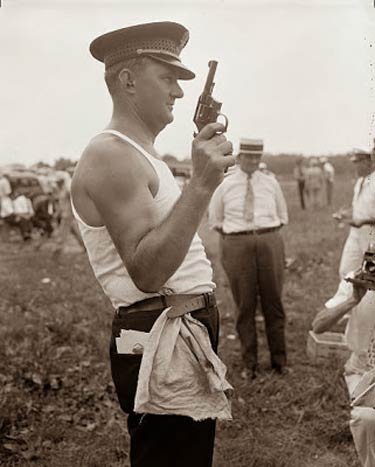
Old Picture of the Day says:
Today’s picture is from 1937, and it shows a White House police officer. This was after a shooting competition, and this officer had the top score. I am surprised however that in 1937 the officers would not be carrying more significant fire power . . . like maybe a Colt 1911 or a Tommy Gun.
Back in the old days, police officers could shoot and a six shot .38 Special revolver was thought perfectly adequate, even for defending the president.
Remember the 1950 attempt to assassinate Harry Truman by Puerto Rican terrorosts?
[Griselio] Torresola had approached a guard booth at the west corner and took White House police officer Leslie Coffelt by surprise, shooting at him four times from close range and mortally wounding him with a 9mm German Luger. Three of those shots struck Coffelt in the chest and abdomen, and the fourth went through his tunic.
Torresola shot police officer Joseph Downs in the hip, before he could draw his weapon. As Downs turned toward the house, Torresola shot him in the back and in the neck. Downs got into the basement and secured the door, denying Torresola entry into the Blair House.
Torresola turned his attention to the shoot-out between his partner Collazo and several other police officers. He shot officer Donald Birdzell in the left knee.
Birdzell could no longer stand and was effectively incapacitated (he would later recover).
Torresola stood to the left of the Blair House steps to reload. President Truman had awakened from a nap to the sound of gunfire and looked outside his second floor window. Torresola was 31 feet (9.4 m) away from Truman’s window.
At that same moment, Coffelt left the guard booth, propped against it, and fired his .38-caliber service revolver at Torresola, about 30 feet (10 m) away. Coffelt hit Torresola two inches above the ear, killing him instantly. Taken to the hospital, Coffelt died four hours later.
04 Oct 2013

Scene from the Constitutional Convention of 1787
Andrew C. McCarthy delivers a nice history lesson on why the framers accorded the House of Representatives the power of the purse and then explains why that power both can and should to be applied to defund Obamacare.
Let’s move directly to the 1787 convention in Philadelphia.
One of the major challenges confronting the delegates was to broker the competing claims of small and large states. As Franklin summarized, “If a proportional representation takes place, the small States contend that their liberties will be in danger. If an equality of votes is to be put in its place, the large States say their money will be in danger.†This resulted, of course, in the great compromise: equality among states in the Senate and proportional representation (by population) in the House. But this arrangement was inadequate to quell the large states’ fears; it was also necessary to tinker with the powers assigned to the two chambers. As Franklin put it, the Senate would be restricted generally in all appropriations & dispositions of money to be drawn out of the General Treasury; and in all laws for supplying that Treasury, the Delegates of the several States shall have suffrage in proportion to the Sums which their respective States do actually contribute to the Treasury [emphasis added].
When the Origination Clause was specifically taken up, a spirited debate ensued, with some delegates protesting against restrictions on the Senate. According to Madison’s records, however, what “generally prevailed†was the argument of George Mason:
The consideration which weighed with the Committee was that the 1st branch [i.e., the House of Representatives] would be the immediate representatives of the people, the 2nd [the Senate] would not. Should the latter have the power of giving away the people’s money, they might soon forget the source from whence they received it [emphasis added]. We might soon have an Aristocracy.
Mason’s concerns seem prescient in our era of mammoth national government presided over by an entrenched ruling class of professional politicians. He worried that
the Senate is not like the H. of Representatives chosen frequently and obliged to return frequently among the people. They are chosen by the Sts for 6 years, will probably settle themselves at the seat of Government, will pursue schemes for their aggrandizement. . . . If the Senate can originate, they will in the recess of the Legislative Sessions, hatch their mischievous projects, for their own purposes, and have their money bills ready cut & dried, (to use a common phrase) for the meeting of the H. of Representatives. . . . The purse strings should be in the hands of the Representatives of the people.
Yes, the purse strings, not just the power to tax. Concededly, the Origination Clause speaks of bills “for raising revenue.†In selling the Constitution to the nation, though, it was portrayed as securing in the hands of the people’s representatives the power of the purse. It is an empty power if spending is not included.
The relevant paragraph in Madison’s Federalist No. 58 is worth quoting in full (all italics mine):
A constitutional and infallible resource still remains with the larger states by which they will be able at all times to accomplish their just purposes. The House of Representatives cannot only refuse, but they alone can propose the supplies requisite for the support of government. They, in a word, hold the purse — that powerful instrument by which we behold, in the history of the British constitution, an infant and humble representation of the people gradually enlarging the sphere of its activity and importance, and finally reducing, as far as it seems to have wished, all overgrown prerogatives of the other branches of the government. This power over the purse may, in fact, be regarded as the most complete and effectual weapon with which any constitution can arm the immediate representatives of the people, for obtaining a redress of every grievance, and for carrying into effect every just and salutary measure.
To my mind, what Madison describes unquestionably transcends taxing authority. I believe a “complete and effectual weapon . . . for obtaining a redress of every grievance†must give “the immediate representatives of the people†the power to block funding for a government takeover of health care that was enacted by fraud and strong-arming; that was adamantly represented not to be the tax that the Supreme Court later found it to be; and that is substantially opposed by the people, and has been since its enactment.
29 Sep 2013
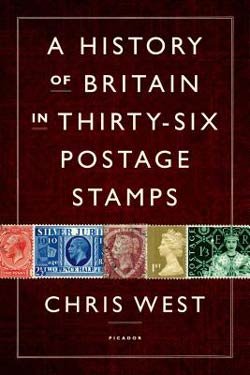
IndieBound sings its praises:
A History of Britain in Thirty-six Postage Stamps tells the rich, layered, and breathtaking history of England through thirty-six of its fascinating, often beautiful, and sometimes eccentric postage stamps. West shows that stamps have always mirrored the events, attitudes, and styles of their time. Through them, one can glimpse the whole epic tale of an empire unfolding. From the famous Penny Black, printed soon after Queen Victoria’s coronation, to the Victory! stamp of 1946, anticipating the struggle of postwar reconstruction—A History of Britain in Thirty-six Postage Stamps is a hugely entertaining and idiosyncratic romp, told in Chris West’s lively prose.
On their own, stamps can be curiosities, even artistic marvels; in this book, stamps become a window into the larger sweep of history.
————————-
Sadie O. Stein, in Paris Review, also praises it.
I have a terrible feeling that A History of Britain in Thirty-Six Postage Stamps may be a hard sell for some readers. But trust me: Chris West’s cultural history is fast paced and engaging, and the organizing principle takes the narrative in all kinds of unexpected directions. Sure, there’s a little light philately in there, but even those who only communicate electronically will be glad they picked it up.
So I guess I have to read it, despite having zero interest in stamps.
Via Madame Scherzo.
29 Sep 2013
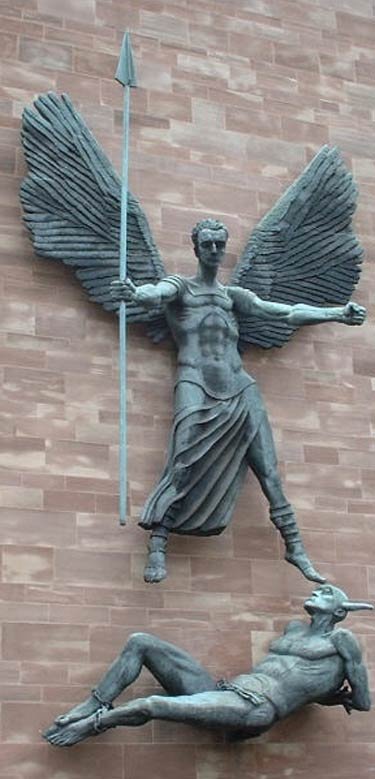
Jacob Epstein, The Victory of St. Michael Over the Devil, 1958, St. Michael’s New Cathedral, Coventry
From Robert Chambers, Book of Days, 1864:
Michaelmas Day, the 29th of September, properly named the day of St. Michael and All Angels, is a great festival of the Church of Rome, and also observed as a feast by the Church of England. In England, it is one of the four quarterly terms, or quarter-days, on which rents are paid, and in that and other divisions of the United Kingdom, as well as perhaps in other countries, it is the day on which burgal magistracies and councils are re-elected. The only other remarkable thing connected with the day is a widely prevalent custom of marking it with a goose at dinner.
Michael is regarded in the Christian world as the chief of angels, or archangel. His history is obscure. In Scripture, he is mentioned five times, and always in a warlike character; namely, thrice by Daniel as fighting for the Jewish church against Persia; once by St. Jude as fighting With the devil about the body of Moses; and once by St. John as fighting at the head of his angelic troops against the dragon and his host. Probably, on the hint thus given by St. John the Romish church taught at an early period that Michael was employed, in command of the loyal angels of God, to overthrow and consign to the pit of perdition Lucifer and his rebellious associates—a legend which was at length embalmed in the sublimest poetry by Milton.
Sometimes Michael is represented as the sole arch-angel, sometimes as only the head of a fraternity of archangels, which includes likewise Gabriel, Raphael, and some others. He is usually represented in coat-armour, with a glory round his head, and a dart in his hand, trampling on the fallen Lucifer. He has even been furnished, like the human warriors of the middle ages, with a heraldic ensign—namely, a banner hanging from a cross. We obtain a curious idea of the religious notions of those ages, when we learn that the red velvet-covered buckler worn by Michael in his war with Lucifer used to be shewn in a church in Normandy down to 1607, when the bishop of Avranches at length forbade its being any longer exhibited.
Angels are held by the Church of Rome as capable of interceding for men; wherefore it is that prayers are addressed to them and a festival appointed in their honour. Wheatley, an expositor of the Book of Common Prayer, probably expresses the limited view of the subject which is entertained in the Church of England, when he says, that ‘I the feast of St. Michael and All Angels is observed that the people may know what blessings are derived from the ministry of angels.’
Amongst Catholics, Michael, or, as he has been named, St. Michael, is invoked as ‘a most glorious and warlike prince,’ chief officer of paradise,’ I captain of God’s hosts,’ receiver of souls,’ ‘the vanquisher of evil spirits,’ and ‘the admirable general.’ It may also be remarked, that in the Sarum missal, there is a mass to St. Raphael, as the protector of pilgrims and travellers, and a skilful worker with medicine; likewise an office for the continual intercession of St. Gabriel and all the heavenly militia. Protestant writers trace a connection between the ancient notion of tutelar genii and the Catholic doctrine respecting angels, the one being, they say, ingrafted on the other. …
these notions of presiding angels and saints are what have led to the custom of choosing magistracies on the 29th of September. The history of the middle ages is full of curious illogical relations, and this is one of them. Local rulers were esteemed as in some respects analogous to tutelar angels, in as far as they presided over and protected the people. It was therefore thought proper to choose them on the day of St. Michael and All Angels. The idea must have been extensively prevalent, for the custom of electing magistrates on this day is very extensive,
‘September, when by custom (right divine)
Geese are ordained to bleed at Michael’s shrine’
says Churchill. This is also an ancient practice, and still generally kept up, as the appearance of the stage-coaches on their way to large towns at this season of the year amply testifies. In Blount’s Tenures, it is noted in the tenth year of Edward IV, that John de la Hay was bound to pay to William Barnaby, Lord of Lastres, in the county of Hereford, for a parcel of the demesne lands, one goose fit for the lord’s dinner, on the feast of St. Michael the archangel. Queen Elizabeth is said to have been eating her Michaelmas goose when she received the joyful tidings of the defeat of the Spanish Armada. The custom appears to have originated in a practice among the rural tenantry of bringing a good stubble goose at Michaelmas to the landlord, when paying their rent, with a view to making him lenient. In the poems of George Gascoigne, 1575, is the following passage:
And when the tenants come to pay their quarter’s rent,
They bring some fowl at Midsummer, a dish of fish in Lent,
At Christmas a capon, at Michaelmas a goose,
And somewhat else at New-year’s tide, for fear their lease fly loose.’
We may suppose that the selection of a goose for a present to the landlord at Michaelmas would be ruled by the bird being then at its perfection, in consequence of the benefit derived from stubble-feeding. It is easy to see how a general custom of having a goose for dinner on Michaelmas Day might arise from the multitude of these presents, as land-lords would of course, in most cases, have a few to spare for their friends. It seems at length to have become a superstition, that eating of goose at Michaelmas insured easy circumstances for the ensuing year. In the British Apollo, 1709, the following piece of dialogue occurs:
‘Q: Yet my wife would persuade me (as I am a sinner)
To have a fat goose on St. Michael for dinner:
And then all the year round, I pray you would mind it,
I shall not want money—oh, grant I may find it!
Now several there are that believe this is true,
Yet the reason of this is desired from you.
A: We think you’re so far from the having of more,
That the price of the goose you have less than before:
The custom came up from the tenants presenting
Their landlords with geese, to incline their relenting
On following payments, &c.’
————————————-
Wikipedia:
In late medieval Christianity, Michael, together with Saint George, became the patron saint of chivalry and is now also considered the patron saint of police officers, paramedics, and the military.
In mid to late 15th century, France was one of only four courts in Western Christendom without an order of knighthood. Later in the 15th century, Jean Molinet glorified the primordial feat of arms of the archangel as “the first deed of knighthood and chivalrous prowess that was ever achieved.” Thus Michael was the natural patron of the first chivalric order of France, the Order of Saint Michael of 1469. In the British honours system, a chivalric order founded in 1818 is also named for these two saints, the Order of St Michael and St George. The Order of Michael the Brave is Romania’s highest military decoration.
Apart from his being a patron of warriors, the sick and the suffering also consider Archangel Michael their patron saint. Based on the legend of his 8th century apparition at Mont-Saint-Michel, France, the Archangel is the patron of mariners in this famous sanctuary. After the evangelisation of Germany, where mountains were often dedicated to pagan gods, Christians placed many mountains under the patronage of the Archangel, and numerous mountain chapels of St. Michael appeared all over Germany. Since the victorious Battle of Lechfeld against the Hungarians in 955, Michael was the patron saint of the Holy Roman Empire and still is the patron saint of modern Germany and other German speaking regions formerly covered by the realm.
He has been the patron saint of Brussels since the Middle Ages. The city of Arkhangelsk in Russia is named for the Archangel. Ukraine and its capital Kiev also consider Michael their patron saint and protector.
An Anglican sisterhood dedicated to Saint Michael under the title of the Community of St Michael and All Angels was founded in 1851. The Congregation of Saint Michael the Archangel (CSMA), also known as the Michaelite Fathers, is a religious order of the Roman Catholic Church founded in 1897.
————————————-
The tradition of celebrating the feast day of the warrior angel saint persists in Central Pennsylvania up to today, particularly in Mifflin County, which is holding a Community Goose Day Dinner today at 3:00 at the Brooklyn Firehouse on Main Street in Lewistown.
18 Sep 2013

A Puritan Family
Joseph Norwood, at Slate, admires the religiously enthusiastic Onomastic customs of Puritan New England.
My personal favorite Puritan name is If Christ Had Not Died For Thy Sins Thou Shouldst Be Damned Forever Barebones.
Even after these kinds of expressive of over-the-top religious sentiments personal names went out of fashion, Puritan New Englanders still continued naming their children, right up into the early 20th Century, in colorful and distinctive ways. I actually used to know a Reverdy Whitlock. But my favorite new era Puritan name, dating from the late 18th century, would have to be Epaphroditus Champion.
11 Sep 2013

Captain Rescorla in action at Ia Drang, Republic of Vietnam, 15 November 1965.
photograph: Peter Arnett/AP.
Born in Hayle, Cornwall, May 27, 1939, to a working-class family, Rescorla joined the British Army in 1957, serving three years in Cyprus. Still eager for adventure, after army service, Rescorla enlisted in the Northern Rhodesia Police.
Ultimately finding few prospects for advancement in Britain or her few remaining colonies, Rescorla moved to the United States, and joined the US Army in 1963. After graduating from Officers’ Candidate School at Fort Benning, Georgia in 1964, he was assigned as a platoon leader to Bravo Company of the 2nd Battalion, 7th Cavalry, Third Brigade of the 1st Cavalry Division (Airmobile). Rescorla’s serious approach to training and his commitment to excellence led to his men to apply to him the nickname “Hard Corps.”
The 2nd Battalion of the 7th Cavalry was sent to Vietnam in 1965, where it soon engaged in the first major battle between American forces and the North Vietnamese Army at Ia Drang.
The photograph above was used on the cover of Colonel Harold Moore’s 1992 memoir We Were Soldiers Once… and Young, made into a film starring Mel Gibson in 2002. Rescorla was omitted from the cast of characters in the film, which nonetheless made prominent use of his actual exploits, including the capture of the French bugle and the elimination of a North Vietnamese machine gun using a grenade.
For his actions in Vietnam, Rescorla was awarded the Silver Star, the Bronze Star (twice), the Purple Heart, and the Vietnamese Cross of Gallantry. After Vietnam, he continued to serve in the Army Reserve, rising to the rank of Colonel by the time of his retirement in 1990.
Rick Rescorla became a US citizen in 1967. He subsequently earned bachelor’s, master’s, and law degrees from the University of Oklahoma, and proceeded to teach criminal law at the University of South Carolina from 1972-1976, before he moved to Chicago to become Director of Security for Continental Illinois Bank and Trust.
In 1985, Rescorla moved to New York to become Director of Security for Dean Witter, supervising a staff of 200 protecting 40 floors in the South Tower of the World Trade Center. (Morgan Stanley and Dean Witter merged in 1997.) Rescorla produced a report addressed to New York’s Port Authority identifying the vulnerability of the Tower’s central load-bearing columns to attacks from the complex’s insecure underground levels, used for parking and deliveries. It was ignored.
On February 26, 1993, Islamic terrorists detonated a car bomb in the underground garage located below the North Tower. Six people were killed, and over a thousand injured. Rescorla took personal charge of the evacuation, and got everyone out of the building. After a final sweep to make certain that no one was left behind, Rick Rescorla was the last to step outside.
—————————————-

Directing the evacuation on September 11th.
Security Guards Jorge Velasquez and Godwin Forde are on the right.
photograph: Eileen Mayer Hillock.
Rescorla was 62 years old, and suffering from prostate cancer on September 11, 2001. Nonetheless, he successfully evacuated all but 6 of Morgan Stanley’s 2800 employees. (Four of the six lost included Rescorla himself and three members of his own security staff, including both the two security guards who appear in the above photo and Vice President of Corporate Security Wesley Mercer, Rescorla’s deputy.) Rescorla travelled personally, bullhorn in hand, as low as the 10th floor and as high as the 78th floor, encouraging people to stay calm and make their way down the stairs in an orderly fashion. He is reported by many witnesses to have sung “God Bless America,” “Men of Harlech, ” and favorites from Gilbert & Sullivan operettas. “Today is a day to be proud to be an American,” he told evacuees.
A substantial portion of the South Tower’s workforce had already gotten out, thanks to Rescorla’s efforts, by the time the second plane, United Airlines Flight 175, struck the South Tower at 9:02:59 AM. Just under an hour later, as the stream of evacuees came to an end, Rescorla called his best friend Daniel Hill on his cell phone, and told him that he was going to make a final sweep. Then the South Tower collapsed.
Rescorla had observed a few months earlier to Hill, “Men like us shouldn’t go out like this.” (Referring to his cancer.) “We’re supposed to die in some desperate battle performing great deeds.” And he did.
—————————————-
His hometown of Hayle in Cornwall has erected a memorial.

—————————————-
2,996 was a project put together by blogger Dale Roe to honor each victim of the September 11, 2001 attacks. 3,061 blogs committed to posting tributes to each victim. Never Yet Melted’s tribute was to Rick Rescorla, and is republished annually.
08 Sep 2013

Charles Godefroy taking his Nieuport 11 “Bébé†through the Arc de Triomphe in Paris on August 7th, 1919.
Wikipedia:
For the occasion of the victory parade on the Champs Élysées on 14 July 1919, marking the end of hostilities in World War I, the military command ordered the airmen to participate “on foot†– like the infantry. This was a provocation to the pilots, who regarded themselves as “heroes of the airâ€. At a meeting in the “Fouquet†bar located on the Champs Élysées, a group of aviators decided to address this affront by selecting one of them to fly through the Arc de Triomphe during the parade. The choice fell on Jean Navarre, who had twelve air victories and was considered to be an ace among the fighter pilots. However, Navarre was killed in a practice flight on 10 July. With 500 flying hours, Charles Godefroy considered himself experienced enough to take over the task, which excited the young aviator. With his close companion, the journalist Jacques Mortane, he inspected the Arc de Triomphe several times to examine the air route and the air currents; then he began to practice at the bridge over the Small Rhône at Miramas.
On 7 August 1919, three weeks after the victory parade, under cover of secrecy and dressed in his warrant officer uniform, Charles Godefroy took off at 7.20 a.m. from the airfield of Villacoublay in a biplane “Nieuport 11 Bébé†(Bébé = baby – because of its low wing span of 24.67 ft / 24’8’’ or 7.52 m). He reached the Porte Maillot shortly thereafter. Coming from the west, he circled the Arc de Triomphe twice and began the approach along the Avenue de la Grande-Armée. He gathered speed and forced the plane down and through the Arc. He did not have much clearance – the width of the Arc is 47.57 ft / 47’6’’ (14.50 m). He passed at a low level over a tram in which passengers threw themselves to the ground, and many passers-by ran away frightened. Godefroy flew over the Place de la Concorde before returning to the airfield, where his mechanic checked over the engine. No one at the airfield had taken any notice of the flight, which had lasted half an hour.
The journalist Jacques Mortane had the whole event filmed and photographed. Articles have been published in many newspapers. The film screening was banned by the Commissioner of Police. Godefroy stayed officially in the background, but his name could not be kept secret for long. The authorities disapproved of the event and were afraid of it being imitated, but Godefroy escaped with only a warning.
Hat tip to Ratak Monodosico.
25 Aug 2013
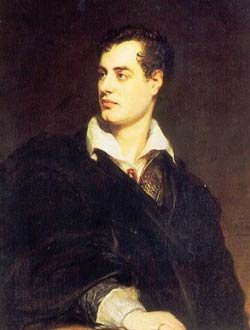
Lord Byron
Percy Bysshe Shelley on Lord Byron’s lifestyle.
Lord Byron gets up at two. I get up, quite contrary to my usual custom… at twelve. After breakfast we sit talking till six. From six to eight we gallop through the pine forest which divides Ravenna from the sea; we then come home and dine, and sit gossiping till six in the morning. I don’t suppose this will kill me in a week or a fortnight, but I shall not try it longer. Lord B.’s establishment consists, besides servants, of ten horses, eight enormous dogs, three monkeys, five cats, an eagle, a crow, and a falcon; and all these, except the horses, walk about the house , which every now and the resounds with their unarbitrated quarrels, as if they were the masters of it… .[P.S.] I find that my enumeration of the animals in this Circean palace was defective… .I just met on the grand staircase five peacocks, two guinea hens, and an Egyptian crane. I wonder who all these animals were before they changed into these shapes.
Via Ratak Mondosico.
24 Aug 2013
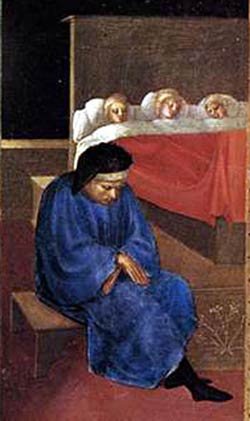
Detail from Fra Angelico, St. Nicholas Giving Gold to the Three Poor Girls, 1437, Città del Vaticano, Pinacoteca.
SlumberWise explains that people used to sleep differently in Olden Times.
[W]e didn’t always sleep in one eight hour chunk. We used to sleep in two shorter periods, over a longer range of night. This range was about 12 hours long, and began with a sleep of three to four hours, wakefulness of two to three hours, then sleep again until morning.
References are scattered throughout literature, court documents, personal papers, and the ephemera of the past. What is surprising is not that people slept in two sessions, but that the concept was so incredibly common. Two-piece sleeping was the standard, accepted way to sleep.
“It’s not just the number of references – it is the way they refer to it, as if it was common knowledge,†Ekirch says.
An English doctor wrote, for example, that the ideal time for study and contemplation was between “first sleep†and “second sleep.†Chaucer tells of a character in the Canterbury Tales that goes to bed following her “firste sleep.†And, explaining the reason why working class conceived more children, a doctor from the 1500s reported that they typically had sex after their first sleep.
Ekirch’s book At Day’s Close: Night in Times Past is replete with such examples.
But just what did people do with these extra twilight hours? Pretty much what you might expect.
Most stayed in their beds and bedrooms, sometimes reading, and often they would use the time to pray. Religious manuals included special prayers to be said in the mid-sleep hours.
Hat tip to Ann Rice [via FB].
/div>

Feeds
|




