Category Archive 'History'
08 Apr 2013

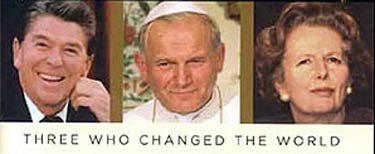
Richard Fernandez reminds us that we need to mourn not only Margaret Thatcher’s departure, but even more the failure of the Trans-Atlantic democracies to live up to, and properly value, the legacy of greatness of the three leaders who defeated Communism.
Margaret Thatcher will not be remembered for that minor conflict which we call the Falklands War. It will be for her role in the fall of the Soviet Union.
And therein lies the crux of the matter. To understand the challenge — to hear the question — is perhaps the greatest obstacle to greatness on history’s stage.
The great achievement of Reagan, Thatcher, and the Pope lay in remembering that Communism was an evil thing. By that time it was conventional wisdom that the Soviet Union was permanent. And therefore their revolutionary act consisted, in the first place, of understanding the question. The reply they gave was not remarkable, just what most of us would say had we known the interrogative.
The three were poorly instructed in the by-then perfected art of moral relativism. The archived punditry is full of jibes attacking their failure to understand that their human imperfections disqualified them from exercising judgment, or that the defects of their societies necessarily compelled them into inaction.
To the chagrin of the intelligensia, the three still thought in the obsolete categories of “oughts†and “shoulds,†in the distinction between the normative and the normal. Fortunately for the world, they understood that the mud of creation was not a bar to the quest for paradise.
If there was greatness in Thatcher, it lay in the ability to hear the signal hidden from those too obsessed with their own greatness. It lay in being able to see the fastball over home plate that nobody else could see. Clinton, who lived in the aftermath of Reagan, John Paul II, and Thatcher, approached the problem as a question of how to spend the Peace Dividend; as a matter of how to remake the world now that his predecessors had cleared the way for him.
And he hit the ball he saw out of the park. Too bad if it was the wrong ball and the wrong park.
But if he wasn’t listening to history, maybe it wasn’t listening to him. And that’s too bad. Perhaps no one truly attains greatness by believing “it is in me.†Everyone who eventually gets there reaches it in surprise.
What made Margaret Thatcher noteworthy will not lie with her in the coffin, either to praise or — as is almost as certain — for her enemies to revile. The essence of her accomplishment was external to her. She only gave it a medium; a voice. Ronald Reagan perhaps put it best when he said: “There is no limit to what you can accomplish if you don’t care who gets the credit.â€
Thatcher ends her long life, the last of the three, at a moment when everyone is out of credit, or rather living on it. She passes in an uncertain hour, the story of her life and times a pointed reminder of how far we have fallen from those days.
02 Apr 2013
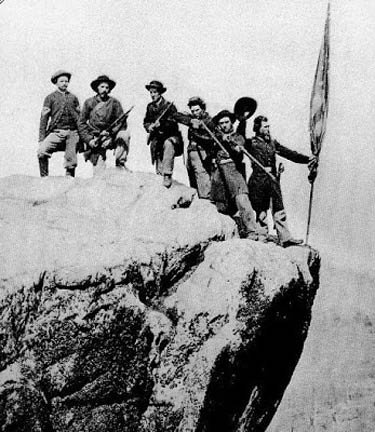
Lookout Mountain is a highly defensible position for riflemen.
Tennessean Andrew Exum rattles Volunteer State sabres in the direction of Georgia, and plots defensive strategies in a Wired article delightfully titled: Graveyard of Peaches.
The Georgia Legislature had better think twice about trying to move the state line in order to correct that surveying error made in 1818.
As a soldier, I fought in both Iraq and Afghanistan; as a scholar, I performed most of the fieldwork for my doctoral dissertation in southern Lebanon. Nowhere in the world, though, have I ever encountered a more brutal, tribal and violent race of people than the Scots-Irish of East Tennessee. Any Georgian occupation force would inevitably get sucked into our petty politics and family vendettas. We might share a language, but Georgia would struggle to relate to its new foreign subjects, let alone entrench its authority over us.
From Glenn Reynolds, another belligerent Tennessean.
31 Mar 2013

Piero della Francesca, Resurrection, circa 1463, Museo Civico, Sansepolcro
From Robert Chambers, The Book of Days, 1869:
Easter
Easter, the anniversary of our Lord’s resurrection from the dead, is one of the three great festivals of the Christian year,—the other two being Christmas and Whitsuntide. From the earliest period of Christianity down to the present day, it has always been celebrated by believers with the greatest joy, and accounted the Queen of Festivals. In primitive times it was usual for Christians to salute each other on the morning of this day by exclaiming, ‘Christ is risen;’ to which the person saluted replied, ‘Christ is risen indeed,’ or else, ‘And hath appeared unto Simon;’—a custom still retained in the Greek Church.
The common name of this festival in the East was the Paschal Feast, because kept at the same time as the Pascha, or Jewish passover, and in some measure succeeding to it. In the sixth of the Ancyran Canons it is called the Great Day. Our own name Easter is derived, as some suppose, from Eostre, the name of a Saxon deity, whose feast was celebrated every year in the spring, about the same time as the Christian festival—the name being retained when the character of the feast was changed; or, as others suppose, from Oster, which signifies rising. If the latter supposition be correct, Easter is in name, as well as reality, the feast of the resurrection.
Though there has never been any difference of opinion in the Christian church as to why Easter is kept, there has been a good deal as to when it ought to be kept. It is one of the moveable feasts; that is, it is not fixed to one particular day—like Christmas Day, e. g., which is always kept on the 25th of December—but moves backwards or forwards according as the full moon next after the vernal equinox falls nearer or further from the equinox. The rule given at the beginning of the Prayer-book to find Easter is this: ‘Easter-day is always the first Sunday after the full moon which happens upon or next after the twenty-first day of March; and if the full moon happens upon a Sunday, Easter-day is the Sunday after.’
The paschal controversy, which for a time divided Christendom, grew out of a diversity of custom. The churches of Asia Minor, among whom were many Judaizing Christians, kept their paschal feast on the same day as the Jews kept their passover; i. e., on the 14th of Nisan, the Jewish month corresponding to our March or April. But the churches of the West, remembering that our Lord’s resurrection took place on the Sunday, kept their festival on the Sunday following the 14th of Nisan. By this means they hoped not only to commemorate the resurrection on the day on which it actually occurred, but also to distinguish themselves more effectually from the Jews. For a time this difference was borne with mutual forbearance and charity. And when disputes began to arise, we find that Polycarp, the venerable bishop of Smyrna, when on a visit to Rome, took the opportunity of conferring with Anicetas, bishop of that city, upon the question. Polycarp pleaded the practice of St. Philip and St. John, with the latter of whom he had lived, conversed, and joined in its celebration; while Anicetas adduced the practice of St. Peter and St. Paul. Concession came from neither side, and so the matter dropped; but the two bishops continued in Christian friendship and concord. This was about A.D. 158.
Towards the end of the century, however, Victor, bishop of Rome, resolved on compelling the Eastern churches to conform to the Western practice, and wrote an imperious letter to the prelates of Asia, commanding them to keep the festival of Easter at the time observed by the Western churches. They very naturally resented such an interference, and declared their resolution to keep Easter at the time they had been accustomed to do. The dispute hence-forward gathered strength, and was the source of much bitterness during the next century. The East was divided from the West, and all who, after the example of the Asiatics, kept Easter-day on the 14th, whether that day were Sunday or not, were styled Qiccertodecimans by those who adopted the Roman custom.
One cause of this strife was the imperfection of the Jewish calendar. The ordinary year of the Jews consisted of 12 lunar months of 292 days each, or of 29 and 30 days alternately; that is, of 354 days. To make up the 11 days’ deficiency, they intercalated a thirteenth month of 30 days every third year. But even then they would be in advance of the true time without other intercalations; so that they often kept their passover before the vernal equinox. But the Western Christians considered the vernal equinox the commencement of the natural year, and objected to a mode of reckoning which might sometimes cause them to hold their paschal feast twice in one year and omit it altogether the next. To obviate this, the fifth of the apostolic canons decreed that, ’ If any bishop, priest, or deacon, celebrated the Holy Feast of Easter before the vernal equinox, as the Jews do, let him be deposed.’
At the beginning of the fourth century, matters had gone to such a length, that the Emperor Constantine thought it his duty to take steps to allay the controversy, and to insure uniformity of practice for the future. For this purpose, he got a canon passed in the great Ecumenical Council of Nice (A.D. 325), that everywhere the great feast of Easter should be observed upon one and the same day; and that not the day of the Jewish passover, but, as had been generally observed, upon the Sunday afterwards. And to prevent all future disputes as to the time, the following rules were also laid down:
‘That the twenty-first day of March shall be accounted the vernal equinox.’
‘That the full moon happening upon or next after the twenty-first of March, shall be taken for the full moon of Nisan.’
‘That the Lord’s-day next following that full moon be Easter-day.’
‘But if the full moon happen upon a Sunday, Easter-day shall be the Sunday after.’
As the Egyptians at that time excelled in astronomy, the Bishop of Alexandria was appointed to give notice of Easter-day to the Pope and other patriarchs. But it was evident that this arrangement could not last long; it was too inconvenient and liable to interruptions. The fathers of the next age began, therefore, to adopt the golden numbers of the Metonic cycle, and to place them in the calendar against those days in each month on which the new moons should fall during that year of the cycle. The Metonie cycle was a period of nineteen years. It had been observed by Meton, an Athenian philosopher, that the moon returns to have her changes on the same month and day of the month in the solar year after a lapse of nineteen years, and so, as it were, to run in a circle. He published his discovery at the Olympic Games, B.C. 433, and the cycle has ever since borne his name. The fathers hoped by this cycle to be able always to know the moon’s age; and as the vernal equinox was now fixed to the 21st of March, to find Easter for ever. But though the new moon really happened on the same day of the year after a space of nineteen years as it did before, it fell an hour earlier on that day, which, in the course of time, created a serious error in their calculations.
A cycle was then framed at Rome for 84 years, and generally received by the Western church, for it was then thought that in this space of time the moon’s changes would return not only to the same day of the month, but of the week also. Wheatley tells us that, ‘During the time that Easter was kept according to this cycle, Britain was separated from the Roman empire, and the British churches for some time after that separation continued to keep Easter according to this table of 84 years. But soon after that separation, the Church of Rome and several others discovered great deficiencies in this account, and therefore left it for another which was more perfect.’—Book on the Common Prayer, p. 40. This was the Victorian period of 532 years. But he is clearly in error here. The Victorian period was only drawn up about the year 457, and was not adopted by the Church till the Fourth Council of Orleans, A.D. 541.
Now from the time the Romans finally left Britain (A.D. 426), when he supposes both churches to be using the cycle of 84 years, till the arrival of St. Augustine (A.D. 596), the error can hardly have amounted to a difference worth disputing about. And yet the time the Britons kept Easter must have varied considerably from that of the Roman missionaries to have given rise to the statement that they were Quartodecimans, which they certainly were not; for it is a well-known fact that British bishops were at the Council of Nice, and doubtless adopted and brought home with them the rule laid down by that assembly. Dr. Hooke’s account is far more probable, that the British and Irish churches adhered to the Alexandrian rule, according to which the Easter festival could not begin before the 8th of March; while according to the rule adopted at Rome and generally in the West, it began as early as the fifth. ‘They (the Celts) were manifestly in error,’ he says; ‘but owing to the haughtiness with which the Italians had demanded an alteration in their calendar, they doggedly determined not to change.’—Lives of the Archbishops of Canterbury, vol. i. p. 14.
After a good deal of disputation had taken place, with more in prospect, Oswy, King of Northumbria, determined to take the matter in hand. He summoned the leaders of the contending parties to a conference at Whitby, A.D. 664, at which he himself presided. Colman, bishop of Lindisfarne, represented the British church. The Romish party were headed by Agilbert, bishop of Dorchester, and Wilfrid, a young Saxon. Wilfrid was spokesman. The arguments were characteristic of the age; but the manner in which the king decided irresistibly provokes a smile, and makes one doubt whether he were in jest or earnest. Colman spoke first, and urged that the custom of the Celtic church ought not to be changed, because it had been inherited from their forefathers, men beloved of God, &c. Wilfrid followed:
‘The Easter which we observe I saw celebrated by all at Rome: there, where the blessed apostles, Peter and Paul, lived, taught, suffered, and were buried.’ And concluded a really powerful speech with these words: ‘And if, after all, that Columba of yours were, which I will not deny, a holy man, gifted with the power of working miracles, is he, I ask, to be preferred before the most blessed Prince of the Apostles, to whom our Lord said, “Thou art Peter, and upon this rock will I build my church, and the gates of hell shall not prevail against it; and to thee will I give the keys of the kingdom of heaven†?’
The King, turning to Colman, asked him, ‘Is it true or not, Colman, that these words were spoken to Peter by our Lord?’ Colman, who seems to have been completely cowed, could not deny it. ‘It is true, 0 King.’ ‘Then,’ said the King, ‘can you shew me any such power given to your Columba? ’ Colman answered, ’ No.’ ‘You are both, then, agreed,’ continued the King, are you not, that these words were addressed principally to Peter, and that to him were given the keys of heaven by our Lord?’ Both assented. ‘Then,’ said the King, ‘I tell you plainly, I shall not stand opposed to the door-keeper of the kingdom of heaven; I desire, as far as in me lies, to adhere to his precepts and obey his commands, lest by offending him who keepeth the keys, I should, when I present myself at the gate, find no one to open to me.’
This settled the controversy, though poor honest Colman resigned his see rather than submit to such a decision.
On Easter-day depend all the moveable feasts and fasts throughout the year. The nine Sundays before, and the eight following after, are all dependent upon it, and form, as it were, a body-guard to this Queen of Festivals. The nine preceding are the six Sundays in Lent, Quinquagesima, Sexagesima, and Septuagesima; the eight following are the five Sundays after Easter, the Sunday after Ascension Day, Whit Sunday, and Trinity Sunday.
EASTER CUSTOMS
The old Easter customs which still linger among us vary considerably in form in different parts of the kingdom. The custom of distributing the ‘pace’ or ‘pasche ege,’ which was once almost universal among Christians, is still observed by children, and by the peasantry in Lancashire. Even in Scotland, where the great festivals have for centuries been suppressed, the young people still get their hard-boiled dyed eggs, which they roll about, or throw, and finally eat. In Lancashire, and in Cheshire, Staffordshire, and Warwickshire, and perhaps in other counties, the ridiculous custom of ‘lifting’ or ‘heaving’ is practised.
On Easter Monday the men lift the women, and on Easter Tuesday the women lift or heave the men. The process is performed by two lusty men or women joining their hands across each other’s wrists; then, making the person to be heaved sit down on their arms, they lift him up aloft two or three times, and often carry him several yards along a street. A grave clergyman who happened to be passing through a town in Lancashire on an Easter Tuesday, and having to stay an hour or two at an inn, was astonished by three or four lusty women rushing into his room, exclaiming they had come ‘to lift him.’ ‘To lift me!’ repeated the amazed divine; ‘what can you mean?’ ‘Why, your reverence, we’re come to lift you, ‘cause it’s Easter Tuesday.’ ‘Lift me because it’s Easter Tuesday? I don’t understand. Is there any such custom here?’ ‘Yes, to be sure; why, don’t you know? all us women was lifted yesterday; and us lifts the men today in turn. And in course it’s our rights and duties to lift ‘em.’
After a little further parley, the reverend traveller compromised with his fair visitors for half-a-crown, and thus escaped the dreaded compliment. In Durham, on Easter Monday, the men claim the privilege to take off the women’s shoes, and the next day the women retaliate. Anciently, both ecclesiastics and laics used to play at ball in the churches for tansy-cakes on Eastertide; and, though the profane part of this custom is happily everywhere discontinued, tansy-cakes and tansy-puddings are still favourite dishes at Easter in many parts. In some parishes in the counties of Dorset and Devon, the clerk carries round to every house a few white cakes as an Easter offering; these cakes, which are about the eighth of an inch thick, and of two sizes —the larger being seven or eight inches, the smaller about five in diameter— have a mingled bitter and sweet taste. In return for these cakes, which are always distributed after Divine service on Good Friday, the clerk receives a gratuity- according to the circumstances or generosity of the householder.
29 Mar 2013

(click on picture for larger image)
I recently sold one gun via an Internet gun auction site and purchased another. Each transaction constituted a complex bureaucratic nightmare passage through a labyrinth of rules and restrictions.
Paypal, the (commonly used, and ill-loved by everyone) vehicle for on-line payments, is a California entity and will have nothing to do with firearms transactions.
You cannot send a gun to anyone who is not a dealer possessing a Federal Firearms License (and the BATF has been doing its best for years now to restrict the number out there and to make FFLs very difficult to get).
Handguns and ammunition present special problems. The US Post Office shuns the kind of moral lepers who own handguns today, and won’t convey them, period. FedEx and UPS will reluctantly carry them, but only by exorbitantly-priced Priority Overnight or Next Day Air respectively.
When you buy a gun, you have to pay a dealer a fee to receive it for you, and you also have to pay for a police check on yourself.
Essentially, buying or selling any non-antique gun in any federally-regulated interstate transaction is a royal pain. The whole affair is loaded with added costs, occult rules and regulations, laws with stiff penalties just waiting to be violated, and the opportunity to be treated like a criminal.
This month’s issue of the NRA’s magazine, American Rifleman, had a letter from a reader (unfortunately not posted on the American Rifleman web-site) which really got my attention.
Just a few generations back, when America was still a free country, an American soldier could slap a handful of stamps on the buttstock of a captured enemy rifle, put on an address label, and (just for safety’s sake) hang a second address tag from the front sling swivel, and put a completely unpackaged, unwrapped rifle in the mail to his dad back home. And the post office would a) deliver it without demurral, and b) not break it.
20 Mar 2013

RAF officer Francis R.L. Mellersh (1922-1996) reads John Buchan’s thriller Greenmantle and smokes his pipe, while getting in a haircut between fighter sorties to intercept the Luftwaffe.
Boots loosened, pipe in mouth, reading his book, being attended to by a servant, the pilot resembles a medieval knight resting between the lists at a tournament.
David Frum got hold of the photo from the pilot’s daughter, who tells us:
We have the original of the photo, and the book (he was crazy about John Buchan) and that bloody pipe killed him in the end at 72. I’m afraid those who have been to war and daily diced with death are rather cavalier with their health. I’ll tweet you a pic of him in his 60s…the red hair’s faded to strawberry blonde but still recognisably the chap getting his hair cut.
file
Instead of resuming his Oxford studies at the end of the war he remained in the RAF for another 30 plus years and flew right until the end (often with the Red Arrows – stress!). He reached Air Vice Marshal and was Assistant Chief of the Defence Staff. He was a very modest man, very laid-back (that photo says it all) and spoke little of the war.
You’ll like this bit. My grandfather, his father, was a WW1 ace and was on the sortie which downed the Red Baron. Forensic historians of course now say he was shot from the ground…my grandfather’s eye witness account is often quoted. We have a little box made from Richthofen’s propeller wood. He too made a career of the RAF, was in charge of operations in Burma etc in WW2 and, at one point, my father’s boss…somewhat disastrously! He died in a bizarre accident shortly after retiring…ironic given he survived the RB.
My grandfather was AVM Sir Francis (FJW) Mellersh, nickname “Tog” and my father AVM Francis (FRL) Mellersh, known always as Togs (nanny’s nickname ie. “of Tog”). Quite ridiculous. I have their obituaries and citations and some extracts from Aces High etc as well as my father’s log book filled in somewhat irreverently. He flew Beaufighters, Mosquitoes and Spitfires.
David Frum adds:
Francis Mellersh was twice awarded Britain’s Distinguished Flying Cross and was recommended for the Victoria Cross.
———————————
RAF records state:
He was quite a successful night-fighter pilot, ending the war with a tally of eight destroyed and one probable, however, during 1944, he destroyed 39, possibly 42, V-1 flying bombs. …
Citation for the award of the Distinguished Flying Cross.
“Flying Officer Francis Richard Lee MELLERSH (105145), Royal Air Force Volunteer ‘Reserve, No.600 Squadron.
This officer is a tenacious and skilful fighter and has destroyed 5 enemy aircraft in combat. On 1 occasion in April,1943, during a patrol off Algiers at dusk, he encountered a large formation of enemy aircraft. In the ensuing engagement, Flying Officer Mellersh shot down 2 of them. Although his aircraft was badly damaged he flew it to base. More recently, in July, 1943, Flying Officer Mellersh destroyed 2 enemy aircraft during 1 sortie. This officer has set a praiseworthy example.â€
(London Gazette – 20 August 1943)
Citation for the award of the Bar to the Distinguished Flying Cross
“Flight Lieutenant Francis Richard Lee MELLERSH, D.F.C. (1105145), R.A.F.V.R., 96 Sqn.
This officer has proved himself, to be a night fighter pilot of outstanding ability and determination and his skill and keenness have set an excellent example. Flight Lieutenant Mellersh has completed many sorties and has destroyed eight enemy aircraft; he has also destroyed a large number of flying bombs.â€
(London Gazette – 3 October 1944)
———————————

This is obviously the cover of the book he is reading.
18 Mar 2013
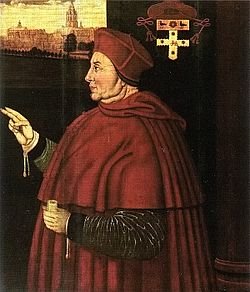
Sampson Strong, Cardinal Wolsey, 1610, Christ Church College, Oxford.
The Telegraph reports that the successful search for Richard III’s remains is prompting the city fathers of Leicester to promote a search for another lost burial, that of Cardinal Thomas Wolsey.
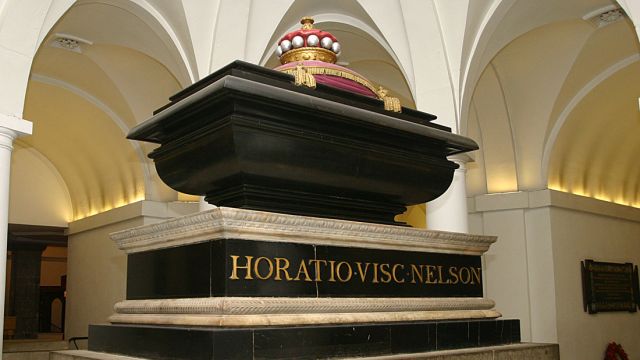
Wolsey, a great builder, had arranged for himself a magnificent black sarcophagus in the crypt of St. Paul’s Cathedral, but his failure to procure Henry VIII the annulment of his marriage to Catherine of Aragon led to Wolsey’s downfall, the confiscation of his properties, and finally to his arrest for treason. He was lucky enough to expire in Leicester of natural causes en route to London for his trial and inevitable execution. Wolsey was consequently buried in the same Leicester Abbey as Richard III, without a monument. The grand sarcophagus eventually went to a more worthy occupant: naval hero Lord Nelson.
City councillor Ross Willmott said: “The discovery of Richard III is wonderful news, yet there remains something of a mystery about what happened to Wolsey, who rivaled Henry VIII in wealth and power and was one of the most significant political figures of the era.
“Arguably, he is far more influential than Richard III. To discover his remains would help tell the story of another historic figure linked to the city.”
“There have been digs over the years to try to find him but they have not succeeded. I would like another go.
“It would bring more tourists to the city and further excite the interest in history and archeology that we are now seeing.”
The churchman, Henry VIII’s Lord Chancellor, died at the town’s abbey, the ruins of which can be seen from the city centre, while travelling to London after being accused of treason when he failed to secure the annulment of the king’s marriage to his first wife Catherine of Aragon.
He served as royal chaplain to Henry VII, who seized the throne after Richard was killed at the Battle of Bosworth in 1485.
It is likely he was buried with great ceremony at the abbey but historians think his tomb was destroyed later in Henry VIII’s reign, when abbeys were dissolved in the late 1530s after England’s split with the Catholic Church.
Attempt to locate Wolsey’s remains during digs in 1820 and again in the 1930s drew blanks.
However, Leicester Civic Society chairman Stuart Bailey said: “His bones may have been scattered and any remnants destroyed, but for years they said that about Richard III.
“I think it would be marvellous to have another look. It was a great fluke that Richard was found but we know Wolsey was buried in the Lady Chapel of the abbey church, which is not all that big.”
17 Mar 2013

From Robert Chambers, The Book of Days, 1869:
LEGENDARY HISTORY OF ST. PATRICK
Almost as many countries arrogate the honour of having been the natal soil of St. Patrick, as made a similar claim with respect to Homer. Scotland, England, France, and Wales, each furnish their respective pretensions: but, whatever doubts may obscure his birthplace, all agree in stating that, as his name implies, he was of a patrician family. He was born about the year 372, and when only sixteen years of age, was carried off by pirates, who sold him into slavery in Ireland; where his master employed him as a swineherd on the well-known mountain of Sleamish, in the county of Antrim. Here he passed seven years, during which time he acquired a knowledge of the Irish language, and made himself acquainted with the manners, habits, and customs of the people. Escaping from captivity, and, after many adventures, reaching the Continent, he was successively ordained deacon, priest, and bishop: and then once more, with the authority of Pope Celestine, he returned to Ireland to preach the Gospel to its then heathen inhabitants.
The principal enemies that St. Patrick found to the introduction of Christianity into Ireland, were the Druidical priests of the more ancient faith, who, as might naturally be supposed, were exceedingly adverse to any innovation. These Druids, being great magicians, would have been formidable antagonists to any one of less miraculous and saintly powers than Patrick. Their obstinate antagonism was so great, that, in spite of his benevolent disposition, he was compelled to curse their fertile lands, so that they became dreary bogs: to curse their rivers, so that they produced no fish: to curse their very kettles, so that with no amount of fire and patience could they ever be made to boil; and, as a last resort, to curse the Druids themselves, so that the earth opened and swallowed them up. …
The greatest of St. Patrick’s miracles was that of driving the venomous reptiles out of Ireland, and rendering the Irish soil, for ever after, so obnoxious to the serpent race, that they instantaneously die on touching it. Colgan seriously relates that St. Patrick accomplished this feat by beating a drum, which he struck with such fervour that he knocked a hole in it, thereby endangering the success of the miracle. But an angel appearing mended the drum: and the patched instrument was long exhibited as a holy relic. …
When baptizing an Irish chieftain, the venerable saint leaned heavily on his crozier, the steel-spiked point of which he had unwittingly placed on the great toe of the converted heathen. The pious chief, in his ignorance of Christian rites, believing this to be an essential part of the ceremony, bore the pain without flinching or murmur; though the blood flowed so freely from the wound, that the Irish named the place St. fhuil (stream of blood), now pronounced Struill, the name of a well-known place near Downpatrick. And here we are reminded of a very remarkable fact in connection with geographical appellations, that the footsteps of St. Patrick can be traced, almost from his cradle to his grave, by the names of places called after him.
Thus, assuming his Scottish origin, he was born at Kilpatrick (the cell or church of Patrick), in Dumbartonshire. He resided for some time at Dalpatrick (the district or division of Patrick), in Lanarkshire; and visited Crag-phadrig (the rock of Patrick), near Inverness. He founded two churches, Kirkpatrick at Irongray, in Kireudbright; and Kirkpatrick at Fleming, in Dumfries: and ultimately sailed from Portpatrick, leaving behind him such an odour of sanctity, that among the most distinguished families of the Scottish aristocracy, Patrick has been a favourite name down to the present day.
Arriving in England, he preached in Patterdale (Patrick’s dale), in Westmoreland: and founded the church of Kirkpatrick, in Durham. Visiting Wales, he walked over Sarn-badrig (Patrick’s causeway), which, now covered by the sea, forms a dangerous shoal in Carnarvon Bay: and departing for the Continent, sailed from Llan-badrig (the church of Patrick), in the island of Anglesea. Undertaking his mission to convert the Irish, he first landed at Innis-patrick (the island of Patrick), and next at Holmpatrick, on the opposite shore of the mainland, in the county of Dublin. Sailing northwards, he touched at the Isle of Man, sometimes since, also, called. Innis-patrick, where he founded another church of Kirkpatrick, near the town of Peel. Again landing on the coast of Ireland, in the county of Down, he converted and baptized the chieftain Dichu, on his own threshing-floor. The name of the parish of Saul, derived from Sabbal-patrick (the barn of Patrick), perpetuates the event. He then proceeded to Temple-patrick, in Antrim, and from thence to a lofty mountain in Mayo, ever since called Croagh-patrick.
He founded an abbey in East Meath, called Domnach-Padraig (the house of Patrick), and built a church in Dublin on the spot where St. Patrick’s Cathedral now stands. In an island of Lough Deng, in the county of Donegal, there is St. Patrick’s Purgatory: in Leinster, St. Patrick’s Wood; at Cashel, St. Patrick’s Rock; the St. Patrick’s Wells, at which the holy man is said to have quenched his thirst, may be counted by dozens. He is commonly stated to have died at Saul on the 17th of March 493, in the one hundred and twenty-first year of his age.
Poteen, a favourite beverage in Ireland, is also said to have derived its name from St. Patrick: he, according to legend, being the first who instructed the Irish in the art of distillation. This, however, is, to say the least, doubtful: the most authentic historians representing the saint as a very strict promoter of temperance, if not exactly a teetotaller. We read that in 445 he commanded his disciples to abstain from drink in the day-time, until the bell rang for vespers in the evening. One Colman, though busily engaged in the severe labours of the field, exhausted with heat, fatigue, and intolerable thirst, obeyed so literally the injunction of his revered preceptor, that he refrained from indulging himself with one drop of water during a long sultry harvest day. But human endurance has its limits: when the vesper bell at last rang for evensong, Colman dropped down dead—a martyr to thirst. Irishmen can well appreciate such a martyrdom; and the name of Colman, to this day, is frequently cited, with the added epithet of Shadhack—the Thirsty.
‘In Burgo Duno, tumulo tumulantur in uno,
Brigida, Patricius, atque Columba pins.’
Which may be thus rendered:
‘In the hill of Down, buried in one tomb,
Were Bridget and Patricius, with Columba the pious.’
The shamrock, or small white clover (trifolium repens of botanists), is almost universally worn in the hat over all Ireland, on St. Patrick’s day. The popular notion is, that when St. Patrick was preaching the doctrine of the Trinity to the pagan Irish, he used this plant, bearing three leaves upon one stem, as a symbol or illustration of the great mystery. To suppose, as some absurdly hold, that he used it as an argument, would be derogatory to the saint’s high reputation for orthodoxy and good sense: but it is certainly a curious coincidence, if nothing more, that the trefoil in Arabic is called skamrakh, and was held sacred in Iran as emblematical of the Persian Triads. Pliny, too, in his Natural History, says that serpents are never seen upon trefoil, and it prevails against the stings of snakes and scorpions. This, considering St. Patrick’s connexion with snakes, is really remarkable, and we may reasonably imagine that, previous to his arrival, the Irish had ascribed mystical virtues to the trefoil or shamrock, and on hearing of the Trinity for the first time, they fancied some peculiar fitness in their already sacred plant to shadow forth the newly revealed and mysterious doctrine. …
In the Galtee or Gaultie Mountains, situated between the counties of Cork and Tipperary, there are seven lakes, in one of which, called Lough Dilveen, it is said Saint Patrick, when banishing the snakes and toads from Ireland, chained a monster serpent, telling him to remain there till Monday.
The serpent every Monday morning calls out in Irish, ‘It is a long Monday, Patrick.’
That St Patrick chained the serpent in Lough Dilveen, and that the serpent calls out to him every Monday morning, is firmly believed by the lower orders who live in the neighbourhood of the Lough.
14 Mar 2013

A furniture retail chain, as a promotion for British furniture, set out to find the oldest piece of furniture still in daily domestic use in Britain.
I don’t suppose their search was absolutely exhaustive, but they did find the Berkeley Bed, listed in a 1608 family inventory, used by 15th generations of the Berkeley family, and still being slept in by John Berkeley, 81, and his wife Georgina, 73, in the Great State Bedroom in Berkeley Castle, site of the presumed murder of Edward II in 1327, and the third oldest continuously-occupied castle in England after the royal fortresses of the Tower of London and Windsor Castle), and the oldest to be continuously owned and occupied by the same family.
Lady Georgina Berkeley testified to the Telegraph that: “Despite its great age, it is the most comfortable bed in the castle.”
07 Mar 2013
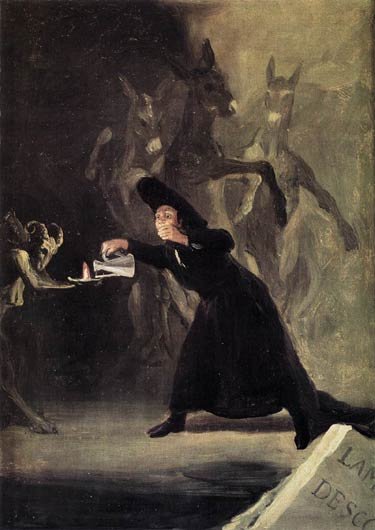
Francisco Goya y Lucientes, The Bewitched Man. 1798, National Gallery, London.
The last major witchcraft trial took place in Chile in 1880. The memory of this unusual event was revived by British travel writer Bruce Chatwin in his highly-praised first book, In Patagonia (1977).
Apparently, a local sect of male witches called La Recta Provincia, “the Righteous Province,” operated a sort of protection racket, punishing persons refusing to pay by supernatural means or merely murdering them. Accounts of their activities include the organization of a large underground system of government rivaling conventional governmental authority, the mutilation of children, and elaborate initiation ceremonies and rituals involving the use of human body parts.
Smithsonian has an interesting account of all this which could be more detailed, but which finally concludes with the concession that, in the end, the stories of supernatural powers and activities failed to persuade Chilean authorities, and that most of the relatively modest sentences originally handed down were overturned on appeal.
26 Feb 2013

Matt Kahn is undertaking an interesting challenge. He intends to read his way through a century’s worth of Publishers Weekly’s annual bestsellers, which means that he has to read (and review) 94 individual titles, since a small number of books succeeded in capturing the title for two years running.
This sort of enterprise will doubtless be at times laborious, but it definitely will have its rewards. When he’s done, Mr. Kahn will be a wiser man with a much better understanding of the ways the consciousness of the American reading public has changed and has not changed.
Kahn started off in 1913 with a real forgotten clunker, Winston Churchill (the American novelist, not the British politician)’s The Inside of the Cup, a dated and tendentious screed attempting to prove novelistically that Christianity and Progressive politics are the same thing. (Yes, Virginia, popular culture was rife with bolshevism and anti-business agitprop, even way back then.)
The Publisher Weekly annual bestseller list turns out to be a bit odd. Hardly any canonical classics get into it (though some by Sinclair Lewis do). It seems to rise from the primitive turn-of-the-century stuff to virtuous middle-brow “important books” interspersed with big pulp, and then –with the 1960s– becomes quite erratic.
Oddly enough, it is perfectly evident that even the most purple examples of forgotten teens and twenties tripe will not constitute the roughest patches of Mr. Kahn’s literary road. When he gets to the 1990s (Gawd help him!), it’s going to be John Grisham and Dan Brown all the way, ending with a bang at Fifty Shades of Grey.
Hat tip to the Dish.
22 Feb 2013

Col. George Washington, Foxhunter (Ralph Boyer, aquatint, Fathers of American Sport, Derrydale Press, 1931)
David Hackett Fischer (who first traced the pre-Revolutionary influence of four different regions and cultures of Great Britain upon the United States in Albion’s Seed , 1989), in Bound Away: Virginia and the Westward Movement , 1989), in Bound Away: Virginia and the Westward Movement , written with James C. Kelly and published in 2000, identifies another major and distinctive pre-Revolutionary regional American cultural strain: a tradition of elite patriotism most prominently exemplified in George Washington, but originating from the influence of his friend and mentor, Lord Fairfax. , written with James C. Kelly and published in 2000, identifies another major and distinctive pre-Revolutionary regional American cultural strain: a tradition of elite patriotism most prominently exemplified in George Washington, but originating from the influence of his friend and mentor, Lord Fairfax.
The Northern Neck [i.e. the region between the Potomac and Rappahannock Rivers] rapidly developed into a distinctive region of Virginia with a character that was largely defined by Lord Fairfax himself and his friends and agents, who included the Washington, Lee, and Marshall families.
Fairfax liked the country so well that he returned as an immigrant in 1747 and made his permanent home in Virginia. He built himself a long, rambling hunting lodge called Greenway Court and a small stone land office high in the Shenandoah country at the western end of his domain. At the same time he became justice of the peace of all the counties in the Northern Neck, county lieutenant, and commandant of the militia. Lord Fairfax acquiesced in the American Revolution and was treated always with honor both by the people of the Northern Neck and the Virginia General Assembly. He died at Greenway Court in 1781 at the age of eighty-eight.
In the course of his long life, a circle formed around him. Lord Fairfax’s drawing room became a school of manners for young gentlemen of the Northern Neck —among them, many Washingtons, Lees, Marshalls, and others who shared a distinctive set of values and beliefs.
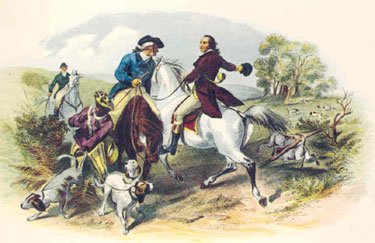
Lord Fairfax Fox Hunting with George Washington, engraving by Henry Bryan Hall, after Felix O. C. Darley, from Washington Irving, Life of George Washington, 1855-1859
The Northern Neck was very much a part of the culture of Virginia, but it gave that culture a special meaning. On this frontier there was little of democracy and nothing of equality, but a strong tradition of service, character, right conduct, and the rule of law.
We have been trained by the materialism of American social science to think of regional culture as a reflex of economic interests and environmental conditions. So it is sometimes, but the culture of the Northern Neck was shaped when it was a frontier, in large degree by the interplay of culture, environment, and the purposes of a single individual. A cultural tradition was planted by Lord Fairfax at Greenway Court. It took root in the fertile soil of the Northern Neck and flowered in the careers of George Washington in the Revolution, Robert E. Lee in the Civil War, and George C. Marshall in World War II.
The values of this tradition were in many ways different from the liberal ideas on which the American republic was founded. Yet this tradition supplied that nation with many leaders who served it in a distinctive way. The Northern Neck was the cradle of their culture, and Lord Fairfax was its founding father.
George Washington, born today in 1732, was obviously the greatest epigone of the Northern Virginia tradition of scrupulously dutiful aristocratic leadership. Without Washington, the thirteen colonies could not have won the War for American Independence. As president, Washington then proceeded to establish personally the examples of Republican modesty and executive forbearance which defined the fundamental character of American goverment.
16 Feb 2013

Leon Kapliński, Hetman Stefan Czarniecki, 1863, National Museum Cracow.
Died 16 February 1665, Polish national hero Hetman [Field Marshal] Stefan Czarniecki [pronounced “Charnyetsky”] of an infected wound received in battle against the Cossacks the previous July.
One of the greatest commanders in Polish history, Czarniecki fought in 27 major engagements. He played the principal role in evicting the Swedes and the Russians from Poland in the mid-17th century period of national disaster known as “The Deluge.”
Despite his age and illness, Czarniecki persisted in traveling in the most bitter winter weather to Lwow, but his strength began to fail and he was taken to a cottage in Sokołówce. Recognizing that he was dying, the hero is said to have insisted that his white charger be brought to his bedside for a last farewell. The horse refused the water and oats offered to him, and instead beat the floor with his hoofs, saluting his master. Czarniecki sank into a coma and died after receiving the last rites.
The horse also died shortly afterward, and the peasants living near Czarnca Wloszczowa, where Czarniecki was buried, claim that on February 16th, the hoofbeats of Czarniecki’s horse can be heard on the nearby meadows as he continues to watch over his master’s grave.

Leopold Löffler, The Death of Stefan Czarnecki, 1860, National Museum Warsaw.
/div>

Feeds
|