The BBC reports on the Japanese obsession with ketsueki-gata, a form of racialist junk science resembling astrology, which claims to be able to predict a person’s personality, temperament, and behavioral propensities from his blood type.
[In Japan,] a person’s blood type is popularly believed to determine temperament and personality. “What’s your blood type?” is often a key question in everything from matchmaking to job applications.
According to popular belief in Japan, type As are sensitive perfectionists and good team players, but over-anxious. Type Os are curious and generous but stubborn. ABs are arty but mysterious and unpredictable, and type Bs are cheerful but eccentric, individualistic and selfish.
About 40% of the Japanese population is type A and 30% are type O, whilst only 20% are type B, with AB accounting for the remaining 10%.
Four books describing the different blood groups characteristics became a huge publishing sensation, selling more than five million copies.
Morning television shows, newspapers and magazines often publish blood type horoscopes and discuss relationship compatibility. Many dating agencies cater to blood types, and popular anime (animations), manga (comics) and video games often mention a character’s blood type.
A whole industry of customised products has also sprung up, with soft drinks, chewing gum, bath salts and even condoms catering for different blood groups on sale.
A reanalysis of U.S. surface station temperatures has been performed using the recently WMO-approved Siting Classification System devised by METEO-France’s Michel Leroy. The new siting classification more accurately characterizes the quality of the location in terms of monitoring long-term spatially representative surface temperature trends. The new analysis demonstrates that reported 1979-2008 U.S. temperature trends are spuriously doubled, with 92% of that over-estimation resulting from erroneous NOAA adjustments of well-sited stations upward.
“Darkling I listen; and, for many a time I have been half in love with easeful Death.â€
— John Keats
In Mother Jones, Clive Thompson describes with relish the coercive fantasies of a variety of leftist sophisters, economists, and calculators, who theorize on the ways and means to end the growth and expansion of the human population and economy, and who yearn for stagnation and retrenchment.
What would just a world be like? Thompson quotes Peter Alan Victor, a environmental sophister at the University of Toronto and a former senior economist at the World Bank named Herman Daly.
Americans would need to scale back our energy consumption to 1960s levels (assuming we stick to a predominantly fossil-fueled economy). Victor, for his part, points out that 1983 was the last year that “the world economy was just at the level of the capacity of the planet to support it.” Since then, of course, world population has exploded and global resources have dwindled even further.
Beyond these big-picture parameters, none of the experts has really crunched the numbers to envision what daily life might be like in a no-growth world—though they agree that it’s something people had better start thinking about.
For starters, they say, Western consumption rates would need to shrink disproportionately so that citizens of countries like India and El Salvador could enjoy a lifestyle upgrade. Why? The no-growthers argue that a world with fewer yawning inequities between the rich and poor would be more stable; but quite apart from that, their models require stabilizing world population, and raising the economic lot of the poor is a proven way to do that.
Given the shift in wealth needed to accomplish this, Americans would need to turn back the clock to well before 1983; in fact, we’d be pretty lucky even to find ourselves where we were in 1960—when the median family made $35,994 in today’s dollars (versus $61,932 in 2008).
Hardly the plenitude we’re accustomed to. Still, technological advances mean that your dollar buys a lot more than it did back then. For a couple of bucks, you can score a pocket calculator that does things it once took a million-dollar university machine to accomplish. “We’re better at making things now,” Victor says, so our living standards would be considerably higher than this figure suggests.
In a no-growth economy, as Daly points out, we would still consume new stuff—just at a much slower pace. People might need to develop a renewed appreciation for durable goods that require lots of labor to make but ultimately use fewer resources than their throwaway counterparts. We would also have to evolve away from “positional” consumption—feeling good because you possess something the Joneses don’t.
So maybe hipsters won’t be buying the latest iPhone every 12 monthsÂ. Or perhaps we’ll seek more fulfillment through activities with a lighter footprint—sports, music, hiking. The vexing reality is that the no-growth thinkers simply don’t know how things would shake out. We don’t have any realistic examples to learn from, after all. In the past, the only no-growth societies were agrarian or consisted of hunter-gatherers.
But these great minds are willing and eager to take us right back there. We need only surrender the necessary authority to credentialed experts in Environmental Witch-Doctory like themselves.
Yesterday, one of my liberal Yale classmates responded to my anti-Warmism posting by complaining that I was guilty of believing in a conspiracy of climate scientists.
I responded:
If there is no imminent catastrophe, “climate science” is a very minor and insignificant branch of geology populated by ill-paid, failed chemists and people unable to do physics. If the very existence of life on this planet as we know it is at stake, and vast new accretions of governmental power and revenue are required, climate scientists are cooler than ****, and you can just back up the truck full of money to
the loading dock at the climate science research center. Gosh, I wonder what position most climate scientists are likely to prefer?
Jonathan Adler got himself quoted approvingly by Megan McArdle, in her Atlantic blog, for identifying conservatives outraged by NJ Governor Chris Christie’s recent public testimony to his belief in Warmism as being guilty of “anti-scientific know-nothingism.”
Last week, Christie vetoed legislation that would have required New Jersey to remain in the Regional Greenhouse Gas Initiative (RGGI), a multi-state agreement to control greenhouse gas emissions through a regional cap-and-trade program. The bill was an effort to overturn Christie’s decision earlier this year to withdraw from the program. Given conservative opposition to greenhouse gas emission controls, the veto should have been something to cheer, right? Nope.
The problem, according to some conservatives, is that Christie accompanied his veto with a statement acknowledging that human activity is contributing to global climate change. Specifically, Christie explained that his original decision to withdraw from RGGI was not based upon any “quarrel†with the science.
While I acknowledge that the levels of carbon dioxide and other greenhouse gases in our atmosphere are increasing, that climate change is real, that human activity plays a role in these changes and that these changes are impacting our state, I simply disagree that RGGI is an effective mechanism for addressing global warming.
As Christie explained, RGGI is based upon faulty economic assumptions and “does nothing more than impose a tax on electricity†for no real environmental benefit. As he noted, “To be effective, greenhouse gas emissions must be addressed on a national and international scale.â€
Although Christie adopted the desired policy — withdrawing from RGGI — some conservatives are aghast that he would acknowledge a human contribution to global warming. According to one, this makes Christie “Part RINO. Part man. Only more RINO than man.†[“RINO†as in “Republican in Name Only.â€]
Those attacking Christie are suggesting there is only one politically acceptable position on climate science — that one’s ideological bona fides are to be determined by one’s scientific beliefs, and not simply one’s policy preferences. This is a problem on multiple levels. Among other things, it leads conservatives to embrace an anti-scientific know-nothingism whereby scientific claims are to be evaluated not by scientific evidence but their political implications. Thus climate science must be attacked because it provides a too ready justification for government regulation. This is the same reason some conservatives attack evolution — they fear it undermines religious belief — and it is just as wrong. …
[E]ven the vast majority of warming “skeptics†within the scientific community would agree with Governor Christie’s statement that “human activity plays a role†in rising greenhouse gas levels and resulting changes in the climate.
——————————
McArdle refers to scientific “denialism,” then establishes a new confirmatory experimental principle: if three libertarians accept it, then it must be true.
I am quite convinced that the planet is warming, and fairly convinced that human beings play a role in this. (When you’ve got Reason’s Ron Bailey, Cato’s Patrick Michaels, and Jonathan Adler, you’ve convinced me). I reserve the right to be skeptical about particular claims about effects (particularly when those claims come via people who implausibly insist that every major effect will be negative) . . . and, of course, of ludicrous worries that global warming will cause aliens to destroy us. But generally, I think global warming is happening, and even that we should probably do something about that, though I’m flexible on “something.”
However. Even if you disagree, it is reprehensible to have a litmus test around empirical matters of fact.
——————————-
It is always difficult in addressing the enormous pile of rubbish and intellctual confusion that constitutes Warmism to decide exactly where to begin.
Megan McArdle tells us that she is “quite convinced that the planet is warming.” What does she mean exactly? If McArdle means that the climate is generally warmer today than in the 17th century when the Thames froze regularly in the winter, she is obviously correct. If she, on the other hand, thinks that the widely noticed warming trend that began around 1980 has continued uninterrupted to the present day and constitutes a meaningful pattern, she is obviously wrong.
It is generally accepted by everyone that mankind has been living for the last eleven thousand years in a period of Interglacial Warming. So, yes, Megan, the planet is warming. That’s is what happens during periods between glaciations.
The catastrophist statists allege that there is a grave danger of “climate change.” Climate change is a heads I win, tails you lose kind of proposition, as the climate is always changing. There is a major warming (or cooling) trend direction of the earth’s climate, and there are constant short-term variations of irregular interval.
Geologic evidence indicates that periods of glaciation have lasted as long as nearly two hundred million years. Climate change is an enormously long-term phenomenon and the earth’s climate has moved from extremes far beyond anything known in human history during times in which there was no possibility of human agency playing any role.
Human observational capabilities with respect to phenomena occurring over geologic periods of time is limited by the brevity of our life spans and also by the brevity of the existence of our species and our civilization. Anyone attempting to draw some kind of conclusions on the basis of temperature patterns going back three decades is an idiot.
——————————-
Warmism rests on unverifiable models and on one grand scientific metaphor, the notion that the earth’s atmosphere is like a greenhouse. But the greenhouse reference is only a metaphor.
A 2007 paper by Gerhard Gerlich and Ralf D. Tscheuschner argues, I think quite successfully, that the greenhouse model is incompatible with Physics.
The atmospheric greenhouse effect, an idea that authors trace back to the traditional works of Fourier 1824, Tyndall 1861, and Arrhenius 1896, and which is still supported in global climatology, essentially describes a fictitious mechanism, in which a planetary atmosphere acts as a heat pump driven by an environment that is radiatively interacting with but radiatively equilibrated to the atmospheric system. According to the second law of thermodynamics such a planetary machine can never exist. Nevertheless, in almost all texts of global climatology and in a widespread secondary literature it is taken for granted that such mechanism is real and stands on a firm scientific foundation.
——————————-
Mr. Adler’s accusation that aversion to Warmism amounts to “know-nothingism” is based on uncritical acceptance of the greenhouse metaphor and acceptance of the proposition that increased atmospheric carbon dioxide causes warming. Only superstitious savages would deny that carbon dioxide must be decreased.
Well, the role of CO2 in warming and the timing of increased CO2 is a seriously controversial issue.
There is excellent data also showing that historically increases in CO2 occurred after planetary warming, not before.
Patrick J. Michaels may accept the Greenhouse model and claims of increasing CO2, but Mr. Adler and Ms. McArdle ought to delve a little deeper into these issues before climbing on board.
I will only mention in passing that it is possible, further, to dissent from Warmist Catastrophism by taking the view that a slightly warmer climate would not be an entirely bad thing, particularly if you happen to live in Canada, Scandinavia, or Russia.
And, even if one were to surrender completely and abandon critical science and skepticism, even if one were to simply accept that everything Al Gore says is true, human reproduction and increased energy use and industrial development will inevitably continue. The undeveloped world will not relinquish material progress and efforts to close the gap with the developed world, and no collection of treaties and international conferences will prevent everyone in India and China from wanting an automobile and a full assortment of electrical appliances. If human population growth and economic activity really dooms the planet, the planet is well and truly doomed, because government efforts will not succeed in preventing growth and progress.
The real Know-Nothings, the real parties guilty of a lack of seriousness and respect for science, are the people who accept the herd consensus of interested parties and the community of fashion as probative, and who are willing to accept on its say-so unverifiable models as established science.
Adler and McArdle are totally wrong. It would take a very thick book to discuss all the ways that Warmism fails to represent legitimate science, worthy of acceptance and suitable as a basis for public policy. Some of the issues are technical, but a lot of all this is basically pretty obvious.
To believe in Anthropogenic Global Warming, you have be an urban narcissist whose perspective on reality resembles Saul Steinberg’s 1976 “View of the World From 9th Avenue” cover. You have to be the sort of person who believes that human actions, the human world, biomass, and mental life absolutely dominate the natural world, that mankind could “destroy the planet” through nuclear war, or by further indulgence in materialistic consumption. You have to be a dualist and a fool, who believes that there is an essential disjunction between humanity and the natural world and that the key ingredient of the fundamental basis of life on this planet (photosynthesis) is a dangerous pollutant, and you have to be stupid enough to fail to notice that we are dealing with a popular theory based, at root, on a few years of warmer weather beginning in 1980 promulgated by the same people who were previously warning us about a New Ice Age.
Stupidity on this scale is incompatible with a role in the Conservative Movement. Sorry about that! That’s not religion. That’s just having intellectual standards.
The Guardian (with only mild jocundity) reports the latest warning of untoward consequences associated with Anthropogenic Global Warming from NASA scientists. Warmlist is going to love this one.
[R]educing our emissions might just save humanity from a pre-emptive alien attack, scientists claim.
Watching from afar, extraterrestrial beings might view changes in Earth’s atmosphere as symptomatic of a civilisation growing out of control – and take drastic action to keep us from becoming a more serious threat, the researchers explain.
This highly speculative scenario is one of several described by a Nasa-affiliated scientist and colleagues at Pennsylvania State University that, while considered unlikely, they say could play out were humans and alien life to make contact at some point in the future.
ETI [Extraterrestrial Intelligence] could seek our harm if they believe that we are a threat to other civilizations.
The thought of humanity being a threat to other civilizations may seem implausible given the likelihood of our technological inferiority relative to other civilizations. However, this inferiority may be a temporary phenomenon. Perhaps ETI observe our rapid and destructive
expansion on Earth and become concerned of our civilizational trajectory. … [P]erhaps ETI believe that rapid expansion is threatening on a galactic scale. Rapidly (maximally) expansive civilizations may have a tendency to destroy other civilizations in the process, just as humanity has already destroyed many species on Earth. ETI that place intrinsic value on civilizations may ideally wish that our civilization changes its ways, so we can survive along with all the other civilizations. But if ETI doubt that our course can be changed, then they may seek to preemptively destroy our civilization in order to protect other civilizations from us. A preemptive strike would be particularly likely in the early phases of our expansion because a civilization may become increasingly difficult to destroy as it continues to expand. Humanity may just now be entering the period in which its rapid civilizational expansion could be detected by an ETI because our expansion is changing the composition of Earth’s atmosphere (e.g. via greenhouse gas emissions), which therefore changes the spectral signature of Earth. While it is difficult to estimate the likelihood of this scenario, it should at a minimum give us pause as we evaluate our expansive tendencies.
It is worth noting that there is some precedent for harmful universalism within humanity. This precedent is most apparent within universalist ethics that place intrinsic value on ecosystems. Human civilization affects ecosystems so strongly that some ecologists now often refer to this epoch of Earth’s history as the anthropocene. If one’s goal is to maximize ecosystem flourishing, then perhaps it would be better if humanity did not exist, or at least if it existed in significantly reduced form. Indeed, there are some humans who have advanced precisely this argument. If it is possible for at least some humans to advocate harm to their owncivilization by drawing upon universalist ethical principles, then it is at a minimum plausible that ETI could advocate harm to humanity following similar principles.
We might never have heard of any of this, but Monnett is being passionately defended by Public Employees for Environmental Responsibility (PEER), and the staff of that organization is so thoroughly infatuated with its own assumptions and perspective that it cannot even imagine what the material it is disseminating enthusiastically in Monnett’s defense would look like to parties less ideologically committed than themselves.
The Inspector General interview transcript (excerpts) had me, for instance, in stitches.
Disclosing as it does the level of rigor of methodology being employed:
ERIC MAY: Well, actually, since you‟re bringing that up, 18 and, and I‟m a little confused of how many dead or drowned polar bears you did observe, because in the manuscript, you indicate three, and in the poster presentation –
CHARLES MONNETT: No.
ERIC MAY: – you mentioned four.
CHARLES MONNETT: No, now you‟re confusing the, um, the estimator with the, uh, the sightings. There were four drowned bears seen.
ERIC MAY: Okay.
CHARLES MONNETT: Three of which were on transects.
ERIC MAY: Okay.
CHARLES MONNETT: And so for the purpose of that little ratio estimator, we only looked at what we were seeing on transects, because that‟s a – you know, we couldn‟t be very rigorous, but the least we could do is look at the random transects. And so we based, uh, our extrapolation to only bears on transects, because we‟re saying that the transects, the, the swaths we flew, represented I think it was 11 percent of the entire habitat that, you know, that could have had dead polar bears in it.
ERIC MAY: Um-hm [yes].
CHARLES MONNETT: And, um, so by limiting it to the transect bears, then, you know, we could do that ratio estimator and say three is to, um, uh, “x†as, uh, 11 is to 100. I mean, it‟s that kind of thing. You, you‟ve, you‟re nodding like you understand.
LYNN GIBSON: Yeah.
CHARLES MONNETT: Yeah, that‟s pretty simple, isn‟t confusing. I mean, it‟s –
ERIC MAY: So, so, so you observed four dead polar bears during MMS –
CHARLES MONNETT: One of which was not on transect.
ERIC MAY: Okay, so that‟s what –
CHARLES MONNETT: Yeah. …
ERIC MAY: So I highlighted under here, and we‟ve got the four, and that‟s what –
CHARLES MONNETT: Oh, here you go. Yeah. Well, I‟m pretty confident that it was four. I mean, that‟s, um – uh, look, look what is in the paper. I mean, it should have the – probably the same information that, you know –
ERIC MAY: Well, it –
CHARLES MONNETT: There‟s a table in there, but does it – it has the dead ones in it, doesn‟t it?
ERIC MAY: Well, and I think you, you explain, so this is the portion where you‟re talking about the 25 percent survival rate.
CHARLES MONNETT: Yeah.
ERIC MAY: And you‟re talking about four swimming bears and three drowned or dead polar bears.
CHARLES MONNETT: Yeah. Yeah, but that‟s because those are on transects.
ERIC MAY: On part of this 11 percent?
CHARLES MONNETT: Yeah, it says that right in here and, 11 and –
ERIC MAY: Right, right, but that‟s what you‟re talking about. …
How to do things with statistics.
3 CHARLES MONNETT: The paragraph in the left-hand column. Um, God, I‟ve got people here who are second-guessing my calculations. Um, well, um, we flew transects. That was our basic methodology. They were partially randomized. And we, uh, we looked at a, a map. I think we probably used GIS to do it, and we said that our survey area, if you bound it, is so big.
ERIC MAY: Um-hm [yes].
CHARLES MONNETT: And then we made some assumptions about our swath width, and I think we assumed we could see a, a bear out to a kilometer with any reliability, which mean you‟re looking down like that. And, uh, sometimes you might see more; sometimes you wouldn‟t. Sometimes you can‟t see a whale out that far, so it depends on the water conditions. And so we just said that, um, if you add up, we had 34 north/south transects provide 11 percent coverage of the 630 kilometer-wide study area, and that was just to get our ratio of coverage. And then the area we really were concerned about was just the area where the bears were, so we could ignore the area at that point and just go with a ratio, because we assume that‟s the same, because these things are pretty, uh, they‟re pretty standardized. They were designed to be standardized, so in each bloc – have you seen the blocs? Have you seen our design? It‟s in here.
ERIC MAY: I took – yeah, in, in your study.
CHARLES MONNETT: It‟s right at the beginning here. Um, every map in here has got it on it. Um, there, those are our blocs. And so, uh, this one would have four pairs. This one would have probably three pairs. I don‟t know, there will be later maps. Um, and there, you can see the flights. Uh, well, yeah, they‟re in here. Um, so we‟re flying these transects, and we‟re assuming we can see a certain percentage or a certain, certain distance. Therefore, we can total up the length and the width and come up with an area. And so we calculated that
our coverage was 11 percent, plus or minus a little bit.
ERIC MAY: Okay. And I believe you rounded up, too. It was 10.8 and you rounded up to 11?
CHARLES MONNETT: Yeah. Well, that‟s a nothing. Um, yeah, 10.8. And then we said, um, four dead – four swimming polar bears were encountered on these transects, in addition to three.
ERIC MAY: Three dead polar bears?
CHARLES MONNETT: Yeah, three dead.
ERIC MAY: Right.
CHARLES MONNETT: But the four swimming were a week earlier.
ERIC MAY: Okay.
CHARLES MONNETT: And, um, then we said if they accurately reflect 11 percent of the bears present so, in other words, they‟re just distributed randomly, so we looked at 11 percent of the area.
ERIC MAY: In that transect?
CHARLES MONNETT: Yeah.
ERIC MAY: Right.
CHARLES MONNETT: In, in our, in our area there, um –
ERIC MAY: Right.
CHARLES MONNETT: – and, therefore, we should have seen 11 percent of the bears. Then you just invert that, and you come up with, um, nine times as many. So that‟s where you get the 27, nine times three.
ERIC MAY: Where does the nine come from?
CHARLES MONNETT: Uh, well 11 percent is one-ninth of 100 percent. Nine times 11 is 99 percent. Is that, is that clear? …
LYNN GIBSON: I think what he‟s saying is since there‟s four swimming and three dead, that makes –
ERIC MAY: And three dead.
CHARLES MONNETT: Well, you don‟t count them all together. That doesn‟t have anything to do. You can‟t – that doesn‟t even –
LYNN GIBSON: So you‟re not saying that the seven represent 16 11 percent of the population.
CHARLES MONNETT: They‟re different events.
ERIC MAY: Well, that‟s what you try – we‟re trying to –
LYNN GIBSON: You‟re talking about they‟re separate?
CHARLES MONNETT: Yeah, they‟re different events.
ERIC MAY: Right, so explain to us how –
CHARLES MONNETT: On one day – well, let me draw. I, I, I don‟t have confidence that you‟re understanding me here, so let me (inaudible/mixed voices). …
CHARLES MONNETT: It makes me feel more professorial if I write it on the blackboard.
LYNN GIBSON: Okay, go ahead.
CHARLES MONNETT: No, that‟s okay.
ERIC MAY: (Inaudible/mixed voices)
CHARLES MONNETT: If you could see it, I wanted you to see it was why I was going to do it there.
ERIC MAY: (Inaudible/mixed voices)
LYNN GIBSON: We‟re your students today.
CHARLES MONNETT: Uh, well, this has transects on it, doesn‟t it, guys?
LYNN GIBSON: Yes, it does.
CHARLES MONNETT: I mean, look right here. So here‟s our coastline right here, this red thing.
ERIC MAY: Okay, yep.
CHARLES MONNETT: And here‟s our, um, our study area. We go out to whatever it was. I don‟t remember, 70, 71 degrees or something like that. And, um, around each of these things, we survey a tenth of the distance between, basically.
ERIC MAY: Okay.
CHARLES MONNETT: And so if you draw these lines here, and this is – you‟re just going to have to pretend like I did this for all of them. And you calculate the area in here.
LYNN GIBSON: Um-hm [yes].
CHARLES MONNETT: And you total them all, and then you calculate the whole area. This – the area inside here was 11 percent.
LYNN GIBSON: Okay.
CHARLES MONNETT: Okay? Now what we said is that we saw three, three bears in 11 percent.
ERIC MAY: Three dead bears?
CHARLES MONNETT: Three dead, yeah, dead –
ERIC MAY: Right.
CHARLES MONNETT: – in the 11 percent of the habitat. And so you could set up a, um, a ratio here, three is to “x†25 equals 11 over 100, right? And so you end up with – you can cross-multiply. You know algebra?
ERIC MAY: Um-hm [yes], yeah.
CHARLES MONNETT: You can cross-multiply. Okay, so you end up with 300 equals 11x, and I am sure that that‟s – equals 27, okay?
ERIC MAY: Right, right, got that.
CHARLES MONNETT: And if you stick four in here instead, you end up with –
ERIC MAY: Thirty-six.
CHARLES MONNETT: – whatever that number was, yeah, 36. Now, um, those numbers aren‟t related, except we made the further
assumption, which is implicit to the analysis. Seems obvious to me. We went out there one week, and we saw four swimming on the transect, which we estimated could have been as many as 36.
LYNN GIBSON: Correct.
CHARLES MONNETT: If we correct for the area. And we went out there later, a week to two weeks later, and then we saw the dead ones, the three dead ones in the same area, which could have been 27. And then we said let‟s make the further assumption that – and this, this isn‟t in the paper, but it‟s implicit to this aument –
ERIC MAY: Um-hm [yes].
CHARLES MONNETT: – that right after we saw these bears swimming, this storm came in and caught them offshore, all right? And so if, um, if you assume that the, the, the 36 all were exposed to the storm, and then we went back and we saw tentially 27 of them, that gives you your 25 percent survival rate. Now that‟s, um, statistically, um, irrelevant. I mean, it, it‟s not statistical. It‟s just an argument. It‟s for, it‟s for the sake of discussion. See, right here, “Discussion.â€
ERIC MAY: Um-hm [yes].
CHARLES MONNETT: That‟s what you do in discussions is you throw things out, um, for people to think about. And so what we said is, look, uh, we saw four. We saw a whole bunch swimming, but if you want to compare them, then let‟s do this little ratio estimator and correct for the percentage of the area surveyed. And just doing that, then there might have been as many as 27 bears out there that were dead. There might have been as many as 36, plus or minus. There could have been 50. I don‟t know. But the way we were posing it was that it‟s serious, because it‟s not just four. It‟s probably a lot more. And then we said that with the further assumption, you know, that the bears were exposed or, you know, the ones we‟re measuring later that are carcasses out there, it looks like a lot of them, you know, didn‟t survive, so – but it‟s, it‟s discussion, guys. I mean, it‟s not in the results. …
The reliability of the calculations used and the scrupulous oversight of the peer-review process.
ERIC MAY: So combining the three dead polar bears and the four alive bears is a mistake?
CHARLES MONNETT: No, it‟s not a mistake. It‟s just not a, a, a real, uh, rigorous analysis. And a whole bunch of peer reviewers and a journal, you know –
ERIC MAY: Did they go through – I mean, did they do the calculations as you just did with us?
CHARLES MONNETT: Well, I assume they did. That‟s their purpose.
ERIC MAY: Okay. Right, and that‟s – again, that‟s why I was asking peer review.
CHARLES MONNETT: Yeah.
ERIC MAY: Did they do that with that particular section of your manuscript?
CHARLES MONNETT: Well, I don‟t, I don‟t remember anybody doing the calculations but, um, uh, there weren‟t any huge objections. There weren‟t a – let‟s put it this way, there weren‟t sufficient objections for the journal editor to ask us to take it out.
ERIC MAY: Right. Well, let me, let me read you what – the four bears – and representing what we were just talking about, this section.
CHARLES MONNETT: Yeah.
ERIC MAY: So just let me, let me read what I have here, okay?
CHARLES MONNETT: Okay.
ERIC MAY: “If four swimming bears, if four bears represent 11 percent of the population of bears swimming before the storm,†–
CHARLES MONNETT: Um-hm [yes].
ERIC MAY: – okay? “Then 36 bears were likely swimming.â€
CHARLES MONNETT: Yeah, maybe, I mean –
ERIC MAY: Okay, but I mean –
CHARLES MONNETT: No, we didn‟t say “likely.†I think we said “possibly,†or did you say “likely†or –?
ERIC MAY: Well, or this – again, as you just stated earlier, this is Discussion, so –
CHARLES MONNETT: I‟d be surprised if we said “likely,†but mostly we were saying “possibly.â€
ERIC MAY: Okay, so let me – let, let me continue, so –
CHARLES MONNETT: Okay.
ERIC MAY: – so you have that. “If three bears represent 11 percent of the population of bears that may have died†–
CHARLES MONNETT: Yeah.
ERIC MAY: – right?
CHARLES MONNETT: Yeah.
ERIC MAY: I think those are your words in your manu- – “may have died.â€
CHARLES MONNETT: Yeah.
ERIC MAY: “ – as a result of this storm, then 27 bears were likely drowned.†Okay, so far, so good?
CHARLES MONNETT: Well, if I used “likely.†I don‟t know if I did. …
And, then, the interview really gets humorous. “I mean, the storm had nothing to do with it!”
ERIC MAY: Isn‟t that stretching it a bit, though, saying – making that conclusion that no dead polar bears were observed during these years, and then, all of a sudden, 2003, you guys are – you observe dead polar bears?
CHARLES MONNETT: I don‟t think so.
ERIC MAY: Why?
CHARLES MONNETT: Well, if you ask me, I would know, I mean, what I saw, I mean, if I saw something weird like that.
ERIC MAY: So as a scientist, if another scientist made these conclusions based on the information, you would be okay with that as a peer reviewer?
CHARLES MONNETT: Well, yeah, I would, I mean, if, you know, if they told me that. They keep notes. I mean, they did this – every, everything like we do, so –.
ERIC MAY: And that‟s a, that‟s a – and it‟s a stretch, isn‟t it, though, to make that statement?
CHARLES MONNETT: Well, no, I didn‟t think so. I thought that was perfectly reasonable to ask them, since it isn‟t something – remember, the reason it‟s not in the database is because it, it doesn‟t happen. You know, you don‟t see it, so – and there‟s a reason, uh, why it‟s changed, which is in, in, in a lot of the early years, there was a lot of ice out there, and there just weren‟t opportunities for there to be dead bears. You know, bears don‟t drown when there‟s ice all over the place.
ERIC MAY: Well, so let me elaborate what I just asked you. Wouldn‟t you, wouldn‟t you notate that as a – like maybe a – you know, your statement kind of is stretching it, and you would say, “Well, based on my conversations with individuals during these surveys, although they weren‟t supposed to look for dead polar bears, they did not†– I mean, because you‟re making a very broad statement by, by that, saying that no dead polar bears were observed during those years. …
ERIC MAY: Well, and based on, based on what I just said, in terms of the, you know, your statement, would it not make more sense, too, because there was a major windstorm during this period of time, which you do mention, but you didn‟t talk too much about that as in 2004 regarding these dead polar bears.
CHARLES MONNETT: What do you mean (inaudible/mixed voices)?
ERIC MAY: Well, you‟re saying that from 1987 to 2003, there was no dead polar bears.
CHARLES MONNETT: Yeah.
ERIC MAY: Did you discuss the storm conditions during those period, period of years as well? I mean, you‟re extrapolating a lot to make such, you know, scientific findings.\
CHARLES MONNETT: You mean, the storms are increasing up there?
ERIC MAY: No, you‟re saying that there was no dead polar bears during those years.
CHARLES MONNETT: Certainly.
ERIC MAY: Yet in 2004, you, you observed four dead polar bears.
CHARLES MONNETT: Right.
ERIC MAY: Yet you didn‟t really elaborate on why you believe those dead polar bears died or drowned.
CHARLES MONNETT: Well, yeah, we did actually. I don‟t know why you‟re saying that. We‟ve got an extensive section in the paper talking about the, uh, you know, the wind speeds and out there, and we looked into that very hard. And, and we, um, we‟re very, very careful in this manuscript to, um, write it so that it, uh, reflects uncertainty, uncertainty about the extent of what happened, the uncertainty of why it happened, the uncertainty of what it meant in a, in a broader context.
We knew three things: That we had seen a bunch of swimming bears and that that was unusual in the context of the whole data stream. We knew we saw some dead bears, which had not been reported before and that we had been assured, you know, was new to the study. And we saw, uh – we experienced, we were there, a, a, uh, high wind event, which was actually not a, a very severe high – and it wasn‟t, you know, one of the really severe high wind events, but it was enough to shut us down, which meant that there were some pretty good waves breaking, you know, out at sea, which, um, is pretty easy to imagine would be, uh, challenging, you know, for a bear swimming. And a good bit of that, there‟s a whole section in the paper that talks about the windstorm.
ERIC MAY: Okay.
CHARLES MONNETT: Um, right here, there‟s a map, you know, of the wind speeds and all that and, uh, you know, it shows that it just fits right in there. Um –
ERIC MAY: When I was relating to th
CHARLES MONNETT: Well, I don‟t know, we, we had complete confidence in it. Um, people worked extensively with, with the database and, and, uh, so we were totally comfortable with the swimming ones, um, which, you know, were rarely seen. And it‟s a small thing I think to assume that a, um – you know, the person managing the survey would know and – ….
And here comes Jeff Ruch of PEER to the rescue.
1 JEFF RUCH: This is Jeff Ruch. We‟ve been at this for an hour and 45 minutes, and I‟m curious, are we going to get to the allegations of scientific misconduct or, uh, have – is that what we‟ve been doing?
LYNN GIBSON: Actually, a lot of the questions that we‟ve been discussing relate to the allegations.
ERIC MAY: Right.
JEFF RUCH: Um, but, uh, Agent May indicated to, um, Paul that he was going to lay out what the allegations are, and we haven‟t heard them yet, or perhaps we don‟t understand them from this line of questioning.
ERIC MAY: Well, the scientif- – well, scientific misconduct, basically, uh, wrong numbers, uh, miscalculations, uh –
JEFF RUCH: Wrong numbers and calculations?
ERIC MAY: Well, what we‟ve been discussing for the last hour.
JEFF RUCH: So this is it?
CHARLES MONNETT: Well, that‟s not scientific misconduct anyway. If anything, it‟s sloppy. I mean, that‟s not – I mean, I mean, the level of criticism that they seem to have leveled here, scientific misconduct, uh, suggests that we did something deliberately to deceive or to, to change it. Um, I sure don‟t see any indication of that in what you‟re asking me about.
What is downright scary is the way these bozos think that dressing up wildly extravagant theories resting on baseless extrapolations of insignificant anecdotal-level observations with jargon and a few formulae in order to reach preconceived and intensely desired conclusions is perfectly legitimate scientific activity.
If anybody wonders how junk science can become established science and the accepted basis for fabulously costly governmental programs and polices, just look at the work of Dr. Charles Monnett and at PEER.
Indignant female surgeons force President of the American College of Surgeons to resign over Valentine’s Day editorial. New York Times:
Dr. [Lazar] Greenfield, 78, was the editor in chief of Surgery News when the editorial was published but resigned that position in the wake of the controversy; the entire issue of the newspaper was withdrawn. He is an emeritus professor of surgery at the University of Michigan School of Medicine.
The editorial cited research that found that female college students who had had unprotected sex were less depressed than those whose partners used condoms. It speculated that compounds in semen have antidepressant effects.
“So there’s a deeper bond between men and women than St. Valentine would have suspected, and now we know there’s a better gift for that day than chocolates,†it concluded.
The editorial outraged many women in the field, some of whom said that it reflected a macho culture in surgery that needed to change.
Richard Ingham identifies climate-change litigation as the next gold-rush opportunity for inventive lawyers, ultimately likely to produce settlement deals dwarfing the major prizes of the past.
[C]limate-change litigation is fast emerging as a new frontier of law where some believe hundreds of billions of dollars are at stake.
Compensation for losses inflicted by man-made global warming would be jaw-dropping, a payout that would make tobacco and asbestos damages look like pocket money.
Imagine: a country or an individual could get redress for a drought that destroyed farmland, for floods and storms that created an army of refugees, for rising seas that wiped a small island state off the map.
In the past three years, the number of climate-related lawsuits has ballooned, filling the void of political efforts in tackling greenhouse-gas emissions.
Eyeing the money-spinning potential, some major commercial law firms now place climate-change litigation in their Internet shop window.
Seminars on climate law are often thickly attended by corporations that could be in the firing line — and by the companies that insure them. …
“There’s a large number of entrepreneurial lawyers and NGOs who are hunting around for a way to gain leverage on the climate problem,” said David Victor, director of the Laboratory on International Law and Regulation at the University of California at San Diego.
“The number of suits filed has increased radically. But the number of suits claiming damages from climate change that have been successful remains zero.”
Lawsuits in the United States related directly or indirectly almost tripled in 2010 over 2009, reaching 132 filings after 48 a year earlier, according to a Deutsche Bank report.
Elsewhere in the world, the total of lawsuits is far lower than in the US, but nearly doubled between 2008 and 2010, when 32 cases were filed, according to a tally compiled by AFP from specialist sites.
The majority of these cases touch on regulatory issues and access to information, which can have many repercussions for coal, gas and oil producers and big carbon-emitting industries such as steel and cement.
“In this area, the floodgates have opened,” said Michael Gerrard, director of the recently-opened Center for Climate Change Law at Columbia Law School in New York. …
“There are billions of potential plaintiffs and millions of potential defendants,” said Gerrard.
This is why congressional investigation of climate-change scientific fraud is vitally important.
If Warmism is not exposed and discredited in popular culture, it is inevitable that some “entreprenurial” attorney will find the appropriate venue featuring an enlightened environmentally-conscious judge and jury and begin the process of creating new case law and new forms of liability which will then proceed to run every power generating company, every automaker, and every energy producing company through bankruptcy court.
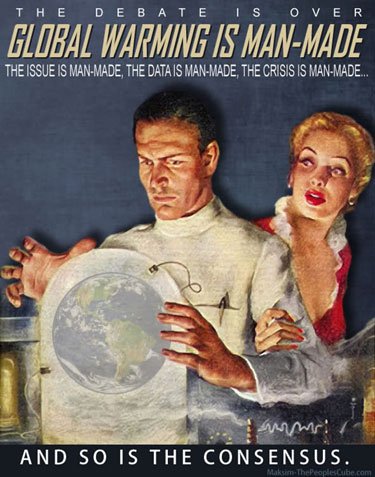
Larry Solomon explains how you get a 97% scientific consensus in favor of AGW.
How do we know there’s a scientific consensus on climate change? Pundits and the press tell us so. And how do the pundits and the press know? Until recently, they typically pointed to the number 2500 – that’s the number of scientists associated with the United Nations Intergovernmental Panel on Climate Change. Those 2500, the pundits and the press believed, had endorsed the IPCC position.
To their embarrassment, most of the pundits and press discovered that they were mistaken – those 2500 scientists hadn’t endorsed the IPCC’s conclusions, they had merely reviewed some part or other of the IPCC’s mammoth studies. To add to their embarrassment, many of those reviewers from within the IPCC establishment actually disagreed with the IPCC’s conclusions, sometimes vehemently.
The upshot? The punditry looked for and recently found an alternate number to tout – “97% of the world’s climate scientists†accept the consensus, articles in the Washington Post and elsewhere have begun to claim.
This number will prove a new embarrassment to the pundits and press who use it. The number stems from a 2009 online survey of 10,257 earth scientists, conducted by two researchers at the University of Illinois. The survey results must have deeply disappointed the researchers – in the end, they chose to highlight the views of a subgroup of just 77 scientists, 75 of whom thought humans contributed to climate change. The ratio 75/77 produces the 97% figure that pundits now tout.
The two researchers started by altogether excluding from their survey the thousands of scientists most likely to think that the Sun, or planetary movements, might have something to do with climate on Earth – out were the solar scientists, space scientists, cosmologists, physicists, meteorologists and astronomers. That left the 10,257 scientists in disciplines like geology, oceanography, paleontology, and geochemistry that were somehow deemed more worthy of being included in the consensus. The two researchers also decided that scientific accomplishment should not be a factor in who could answer – those surveyed were determined by their place of employment (an academic or a governmental institution). Neither was academic qualification a factor – about 1,000 of those surveyed did not have a PhD, some didn’t even have a master’s diploma.
To encourage a high participation among these remaining disciplines, the two researchers decided on a quickie survey that would take less than two minutes to complete, and would be done online, saving the respondents the hassle of mailing a reply. Nevertheless, most didn’t consider the quickie survey worthy of response – just 3146, or 30.7%, answered the two questions on the survey:
1. When compared with pre-1800s levels, do you think that mean global temperatures have generally risen, fallen, or remained relatively constant?
2. Do you think human activity is a significant contributing factor in changing mean global temperatures?
The questions were actually non-questions. From my discussions with literally hundreds of skeptical scientists over the past few years, I know of none who claims that the planet hasn’t warmed since the 1700s, and almost none who think that humans haven’t contributed in some way to the recent warming – quite apart from carbon dioxide emissions, few would doubt that the creation of cities and the clearing of forests for agricultural lands have affected the climate. When pressed for a figure, global warming skeptics might say that human are responsible for 10% or 15% of the warming; some skeptics place the upper bound of man’s contribution at 35%. The skeptics only deny that humans played a dominant role in Earth’s warming.
—————————————
Bob Webster discusses why climate science is an anything but disinterested activity.
Many people cannot imagine why some scientists (whom the media claim to be a “consensus”, as if that were meaningful when considering scientific theory) would act dishonorably to their profession by participating in a scam the magnitude of the human-caused-global-warming (AGW) hoax.
The answer is not complicated. In fact, the answer is rooted in the survival instinct all humans possess and is akin to the “publish or perish” maxim of scientific researchers. And I do not refer to the survival instinct in the sense that we need to survive “human-caused-global-warming.” No, it is all about funding and the survival of budget cuts.
Those who benefit from the flow of enormous government grants and funding (in universities and government agencies) to study a perceived problem (AGW) have been charged with providing guidance to politicians. In other words, the continued receipt of study funds is dependent upon an ever-increasing concern about the magnitude of the “problem” (in this case, AGW).
Is it any surprise that these researchers continue to find evidence of human-caused-global-warming when, in fact, the planet appears to be cooling over the past 10 or so years, perhaps significantly? As of the beginning of 2011, there has still not been one scientific study to ever identify a human component of climate change. None. Never.
To create the illusion of recent warming, ground station temperature data have been manipulated without explanation or sound scientific basis. This has been going on both at the US’s GISS (James Hansen’s handiwork) and at the UK’s CRU (Phil Jones of “Climategate” fame). Neither Hansen nor Jones can provide legitimate justification for their data manipulations that are a matter of partial record (original data has been “lost”, so the record is incomplete). Hansen arrogantly alters ground station records to create the appearance of warming where none has occurred (in fact, in some locations cooling has been altered to give the appearance of warming!).
Should it come as any surprise that these government-paid “scientists” would manufacture “evidence” to support their continued accumulation of funds and power?
Judah Cohen, Columbia Ph.D. and Director of Seasonal Forecasting at Atmospheric and Environmental Research, Inc., in his New York Times editorial, amusingly titled “Bundle Up, It’s Global Warming,” demonstrates impressive sophistical ingenuity as he explains how colder weather and more snow is really ultimately caused by Global Warming.
As global temperatures have warmed and as Arctic sea ice has melted over the past two and a half decades, more moisture has become available to fall as snow over the continents. So the snow cover across Siberia in the fall has steadily increased.
The sun’s energy reflects off the bright white snow and escapes back out to space. As a result, the temperature cools. When snow cover is more abundant in Siberia, it creates an unusually large dome of cold air next to the mountains, and this amplifies the standing waves in the atmosphere, just as a bigger rock in a stream increases the size of the waves of water flowing by.
The increased wave energy in the air spreads both horizontally, around the Northern Hemisphere, and vertically, up into the stratosphere and down toward the earth’s surface. In response, the jet stream, instead of flowing predominantly west to east as usual, meanders more north and south. In winter, this change in flow sends warm air north from the subtropical oceans into Alaska and Greenland, but it also pushes cold air south from the Arctic on the east side of the Rockies. Meanwhile, across Eurasia, cold air from Siberia spills south into East Asia and even southwestward into Europe.
That is why the Eastern United States, Northern Europe and East Asia have experienced extraordinarily snowy and cold winters since the turn of this century. Most forecasts have failed to predict these colder winters, however, because the primary drivers in their models are the oceans, which have been warming even as winters have grown chillier. They have ignored the snow in Siberia. …
The reality is, we’re freezing not in spite of climate change but because of it.
Of course, this kind of argumentation is basically futile. Anyone not determined to believe will inevitably reflect that an ingenious theorist could just as cleverly provide the opposite kind of explanation, say, for instance, that cooler temperatures make most living organisms more active by creating greater requirements of energy expenditure to obtain food and stay warm enough to survive. All this increased organic activity inevitably creates increased friction with molecules of gas in the earth’s atmosphere and with the surface of the planet, and friction produces heat. More cold leads to more effort to seek animal warmth from members of the same species, and thus occurs more reproduction. Increased organic populations produce more friction. And so we see that a trend of gradually increasing warmer weather is really just a false epiphenomenon confusing our perception of the true reality: that we are entering the same New Ice Age predicted by the climate savants during the 1970s.
Anyone can do “heads I win, tails you lose” science.
The real test of science is not actually: just how glib are you? Can you explain away results contradicting your theory? And can you get your theory published by the New York Times? The real measure is: can you actually predict anything?
Holiday travelers found themselves stranded at Heathrow Airport, schools closed all over Britain, sporting events were canceled, and life generally ground to a halt due to snow-blocked highways, stalled train lines, and bitter cold.
How well did the Warmist Met Office and the East Anglia Climate Research Unit do in providing guidance for British officials, especially as compared to typically warming-skeptical meteorologists? Disastrously badly is the answer.
[A]s recently as late October the Met Office was predicting that we should expect an “unusually dry and mild winterâ€. This was news to every independent weather forecaster in the world from Joe Bastardi to Piers Corbyn who have been predicting a harsh winter for months.
But the Met Office of course knew better thanks to its spiffy new £33 million IBM supercomputer (90 per cent funded, of course, by the taxpayer) whose precognitive powers are so great, it is said that on a good day with a fair wind behind it and can very nearly match the track record of the dead celebrity Paul the Octopus. And of course, it’s this very same computer which is responsible for so many of the “projections†– not even “predictionsâ€, note, but “projections†– of Anthropogenic Climate Doom so lovingly detailed on its taxpayer-funded website.
————————————————–
The Global Warming Policy Foundation posts a series of Met Office predictions and reality checks. The most amusing features a major reversal from late October this year.
Met Office 2010 Forecast: Winter To Be Mild Predicts Met Office
Daily Express, 28 October 2010: IT’S a prediction that means this may be time to dig out the snow chains and thermal underwear. The Met Office, using data generated by a £33million supercomputer, claims Britain can stop worrying about a big freeze this year because we could be in for a milder winter than in past years… The new figures, which show a 60 per cent to 80 per cent chance of warmer-than-average temperatures this winter, were ridiculed last night by independent forecasters. The latest data comes in the form of a December to February temperature map on the Met Office’s website.
Reality Check: December 2010 “Almost Certain” To Be Coldest Since Records Began
The Independent, 18 December 2010: December 2010 is “almost certain” to be the coldest since records began in 1910, according to the Met Office.
————————————————–
John Hinderaker, at Power-Line, reminds us that, a decade ago, the experts at the University of East Anglia Climate Research Unit were predicting sadly that snow in Britain would soon become only a memory.
Britain’s winter ends tomorrow with further indications of a striking environmental change: snow is starting to disappear from our lives.
Sledges, snowmen, snowballs and the excitement of waking to find that the stuff has settled outside are all a rapidly diminishing part of Britain’s culture, as warmer winters – which scientists are attributing to global climate change – produce not only fewer white Christmases, but fewer white Januaries and Februaries. …
According to Dr David Viner, a senior research scientist at the climatic research unit (CRU) of the University of East Anglia,within a few years winter snowfall will become “a very rare and exciting event”.
“Children just aren’t going to know what snow is,” he said.