Category Archive 'New York Times'
02 Nov 2006

From the Friday New York Times, we learn that some of the captured Iraqi documents, recently made available for public scrutiny on the Internet, contained technical details of atomic weapons production whose availability on-line alarmed arms control officials.
The Times published all this as an indictment of the public release of captured Iraqi documents.
The director of national intelligence, John D. Negroponte, had resisted setting up the Web site, which some intelligence officials felt implicitly raised questions about the competence and judgment of government analysts. But President Bush approved the site’s creation after Congressional Republicans proposed legislation to force the documents’ release…
Some intelligence officials feared that individual documents, translated and interpreted by amateurs, would be used out of context to second-guess the intelligence agencies’ view that Mr. Hussein did not have unconventional weapons or substantive ties to Al Qaeda. Reviewing the documents for release would add an unnecessary burden on busy intelligence analysts, they argued.
But the Times overlooks the fact that this kind of detailed technical information about an Iraqi Weapons of Mass Destruction Program specifically confirms the Bush Administration’s causus belli, against which elite media (like the Times), and the most influential sectors of the Intelligence Community have so successfully waged a campaign of denial.
Does not the very existence of documents providing factual information of the highest relevance to the most vital public debate of the last three years, concealed by powerful elements of the Intelligence Community, perhaps prejudiced on policy issues, or possibly motivated (as some suspect) by partisanship, demand “second-guessing?”
Hat tip to Matt Drudge.
26 Oct 2006
Michelle Malkin asked that miserable prevaricating worm Byron Calame (who makes his living as a fraud, apologizing for, and defending, the New York Slimes’ lies, treason, and arrogance, while posing as a supposed in-house representative of public criticism) exactly what he meant by saying that he had allowed the vicious criticism of The Times by the Bush administration to trigger [his] instinctive affinity for responding as he did in the case of the Times-published SWIFT leak, last July. (What Calame did, of course, was kiss up to his employer, and dismiss all criticism from the outside public, as always.)
That pillar of journalistic integrity Calame took a few days to think about it and replied: “I was referring to criticism of the article that has been amply documented in a wide range of published reports.”
There is the New York Times in a nutshell: too cowardly and dishonest to try to defend what it publishes in an open dialogue, taking refuge behind its own pomposity and self-importance.
Reading Byron Calame makes me want to go out and buy a parakeet, so I could line the bottom of the bird cage with his column.
Previous Post
23 Oct 2006
Whited sepulchre Byron Calame needed to ponder for four months before coming to the astonishing conclusions, that:
1) The Federal Government’s international banking data surveillance program was legal.
2) No abuses of private date have occurred.
3) The program really was secret.
Banking Data: A Mea Culpa
Since the job of public editor requires me to probe and question the published work and wisdom of Times journalists, there’s a special responsibility for me to acknowledge my own flawed assessments.
My July 2 column strongly supported The Times’s decision to publish its June 23 article on a once-secret banking-data surveillance program. After pondering for several months, I have decided I was off base. There were reasons to publish the controversial article, but they were slightly outweighed by two factors to which I gave too little emphasis. While it’s a close call now, as it was then, I don’t think the article should have been published.
Those two factors are really what bring me to this corrective commentary: the apparent legality of the program in the United States, and the absence of any evidence that anyone’s private data had actually been misused. I had mentioned both as being part of “the most substantial argument against running the story,” but that reference was relegated to the bottom of my column.
The source of the data, as my column noted, was the Society for Worldwide Interbank Financial Telecommunication, or Swift. That Belgium-based consortium said it had honored administrative subpoenas from the American government because it has a subsidiary in this country.
I haven’t found any evidence in the intervening months that the surveillance program was illegal under United States laws. Although data-protection authorities in Europe have complained that the formerly secret program violated their rules on privacy, there have been no Times reports of legal action being taken. Data-protection rules are often stricter in Europe than in America, and have been a frequent source of friction.
Also, there still haven’t been any abuses of private data linked to the program, which apparently has continued to function. That, plus the legality issue, has left me wondering what harm actually was avoided when The Times and two other newspapers disclosed the program. The lack of appropriate oversight — to catch any abuses in the absence of media attention — was a key reason I originally supported publication. I think, however, that I gave it too much weight.
In addition, I became embarrassed by the how-secret-is-it issue, although that isn’t a cause of my altered conclusion. My original support for the article rested heavily on the fact that so many people already knew about the program that serious terrorists also must have been aware of it. But critical, and clever, readers were quick to point to a contradiction: the Times article and headline had both emphasized that a “secret” program was being exposed. (If one sentence down in the article had acknowledged that a number of people were probably aware of the program, both the newsroom and I would have been better able to address that wave of criticism.)
What kept me from seeing these matters more clearly earlier in what admittedly was a close call? I fear I allowed the vicious criticism of The Times by the Bush administration to trigger my instinctive affinity for the underdog and enduring faith in a free press — two traits that I warned readers about in my first column.
The Times Public Editor, however, chose not to acknowledge:
4) That surveillance of international financial transfer data is a vitally important tool in combating terrorism.
5) That the unauthorized disclosure of secret information compromising national security in time of war constitutes espionage and treason.
———————————–
One really has to admire the monumental arrogance and unmitigated gall of the New York Times in appointing a sycophantic worm like Calame to that bogus and ersatz Ombudsman position. When the Times commits treason, its in-house watchdog slumbers contentedly for four months, then buries an apology at the bottom of his weekly column, grudgingly admitting he was “off base.” Though, it is now, as it was then, in his view, “a close call” whether the Times ought to compromise a vital counter-terrorism program (and betray its country). We readers have to understand, though, that Calame warned us when he started as Ombudsman that he was prejudiced, prejudiced in favor of The New York Times, which Calame has the astonishing mental ability to transform from the sleekest and fattest of all fat cats into “the underdog.”
We commented disfavorably on Calame’s initial support of Times’ treason here referring accurately to Byron Calame as an example of the type of invertebrate that leaves a trail on the sidewalk.
————————————-
Michelle Malkin makes the important point (which I happened to overlook) that Calame justifies his prejudice in the Times’ favor on the basis of “the vicious criticism of The Times by the Bush administration,” and she wonders appropriately, just what vicious criticism was that? Then she reviews what the president and other administration officials actually said, exposing the emptiness, the fundamental fraudulence, of Mr. Calame’s rhetoric very nicely.
17 Oct 2006

Perhaps just a bit envious of the acclaim won by Jonathan Franzen’s recent novel The Corrections, also in last Sunday’s Times Book Review, Daniel Mendelsohn does his level best to savage Jonathan Franzen’s latest miscellaneous writings collection The Discomfort Zone.
Mendelsohn goes so far as to indict Franzen for insufficient Alzu-Karl-Braun-lichkeit.
This illumination that “The Discomfort Zone” provides about the origins of that persona helps explain, in turn, a wider failing in Franzen’s work: its lack of humanizing softness…
What can you do with someone who professes to love “Peanuts” but doesn’t understand a word of it? “The Discomfort Zone” features an odd but suggestive paean to the creator of the comic strip that, more than anything else in American popular culture for many decades, celebrated the comic side of something Franzen professes to know a lot about: discomfort — the sheer, poignant, foolish awkwardness that comes with being human. Recounting the unappealing facts of Schulz’s biography, Franzen emphasizes that the cartoonist was a difficult, embittered, resentful man — the kind of person who still seethed over perceived insults he’d received four decades before. Yet the author is quick to defend Schulz — the, um, artistically brilliant, tormented, somewhat geeky Midwestern offspring of Scandinavian parents — as a hero of Art. “To keep choosing art over the comforts of normal life … is the opposite of damaged.”
Franzen’s insistence on seeing this repugnant person as an ideal is, no doubt, what leads him to his wrongheaded interpretation of the comic strip itself. “Almost every young person experiences sorrows,” he rightly points out at the beginning of his exegesis of “Peanuts” — a sentence that gives you hope that the geeky child still hiding inside the adult Franzen is going to admit that, like everyone else, he loved “Peanuts” because he, too, identified with the perpetual awkward, perpetually failed, and yet just as perpetually optimistic Charlie Brown. But no: for Franzen, who, even as a child, “personally enjoyed winning and couldn’t see why so much fuss was made about the losers,” the real hero of “Peanuts” is not the “depressive and failure-ridden” Charlie Brown, but the grandiose beagle, Snoopy: “the protean trickster,” as Franzen calls him, “the quick-change artist who … before his virtuosity has a chance to alienate you or diminish you” can be “the eager little dog who just wants dinner.” But Snoopy’s self-proclaimed virtuosity does, in the end, alienate and diminish: he’s amusing, with his epic grudge against the Red Baron (and the Van Gogh and the spiral staircase he lost when his doghouse burned down), precisely because he represents the part of ourselves — the smugness, the avidity, the pomposity, the rank egotism — most of us know we have but try to keep decently hidden away. Franzen, like most of us, is very likely an awkward combination of Charlie and Snoopy; the difference being that whereas most of us think of ourselves as Charlie with a bit of Snoopy, Franzen clearly doesn’t mind coming off as a whole lotta Snoopy with the barest soupçon of Charlie: a person, as this lazy and perverse book demonstrates, whose very admissions of weakness, of insufficiency, smack of showboating, of grandiose self-congratulation. For my part, I’ll stick with Charlie. Who, after all, wants the company of a character so self-involved he doesn’t even realize he’s not human?
My sympathies are with Snoopy, and Franzen. I haven’t actually read the new book, but I’ve read other reviews, reviews quoting the usual sort of conformist intelligentsia condescension concerning George W. Bush, and I’d say Franzen could use a larger component of Snoopy to replace the undesirable liberal Lucy in his makeup.
17 Oct 2006
Henry Alford, on the back page of the Sunday New York Times Book Review, assembled various real obituary quotations into mock obituaries for Impossible Author (male) and Difficult Writer (female). In case you didn’t believe him, he footnoted the quotations.
Example:
[Impossible] himself began writing in the 1940’s, locking himself in a stall in the men’s room in the subway. Making his base of operations the Angle bar at 42nd Street and Eighth Avenue, he sold drugs at times and himself at others, not always with notable success.
16 Oct 2006
Back in the first half of the last century, too frequently the pillars of the community, and their allies in the fourth estate, stereotyped and scapegoated the Negro, and then celebrated every lynching as a victory for justice and law and order. Then, as now, a small minority of skeptics saw through the falsehood and hypocrisy so eagerly embraced by opportunistic pols, the conformist mob, and the slimey priesthood of dead tree pulp.
The identity of the victims of mob mentality and the forms of lynching have changed, but the basic process of a passionate embrace of irrational accusation precisely because it provides a yearned for excuse to punish some living representative of a hated stereotype, the vindictive pursuit and punishment of the unhappy victim drafted to serve as scapegoat, and the whole ugly affair egged on and encouraged by the press sinking to the lowest level of emotionalism, group hatred, and prejudice has not changed.
In Rape, Justice, and the “Times”, Kurt Anderson excoriatingly, and deservedly, reviews the Duke rape story, the prosecutor’s, and the New York Times’ behavior.
As a young writer at Time, whenever I’d hear “That story’ll write itself,” I wanted to reach for my revolver. The line, delivered with bluff cheer, suggests that good material makes good writing easy, which isn’t true. Its premise is the very wellspring of hackdom: The more thoroughly some set of facts reinforces the relevant preconceptions, caricatures, clichés, and conventional wisdom, the easier it makes life for everyone, journalists as well as their audiences. Most people want to be told what they already know. And in a world of murky moral grays, who doesn’t sometimes relish a black-and- white tale, with villains to loathe, victims to pity, injustice to condemn?
Thus the enthralling power of the Duke lacrosse-team story when it broke last spring. As a senior Times alumnus recently e-mailed me, “You couldn’t invent a story so precisely tuned to the outrage frequency of the modern, metropolitan, bien pensant journalist.” That is: successful white men at the Harvard of the South versus a poor single mother enrolled at a local black college, jerky superstar jocks versus $400 out-call strippers, a boozy Animal House party, shouts of “nigger,” and a three-orifice gangbang rape in a bathroom.
The story appalled us good-hearted liberal metropolitans, but absolutely galvanized the loopy left at Duke. One associate professor, Wahneema Lubiano, could barely disguise her glee. “The members of the team,” she wrote in a blog, “are almost perfect offenders” because they’re “the exemplars of the upper end of the class hierarchy … and the dominant social group on campus.”
Furthermore, she wrote, “regardless of the ‘truth’ ”—that is, regardless of whether a rape occurred—“whatever happens with the court case, what people are asking is that something changes.”
26 Sep 2006
In order to counter the Pouting Spooks’ weekend leak of highly selective excerpts of last Spring’s National Intelligence Estimate, obviously intended to provide a nice pre-election front page Sunday lead, President Bush will be declassifying key portions of the report.
The Wall Street Journal this morning argued that he ought to release the whole thing (with some reactions).
In the meantime, (the non-Pouting) Spook86 offers some details from the report contradicting the Sunday paper’s spin.
The quotes printed below–taken directly from the document and provided to this blogger–provide “the other side” of the estimate, and its more balanced assessment of where we stand in the War on Terror (comments in italics are mine).
In one of its early paragraphs, the estimate notes progress in the struggle against terrorism, stating the U.S.-led efforts have “seriously damaged Al Qaida leadership and disrupted its operations.” Didn’t see that in the NYT article.
Or how about this statement, which–in part–reflects the impact of increased pressure on the terrorists: “A large body of reporting indicates that people identifying themselves as jihadists is increasing…however, they are largely decentralized, lack a coherent strategy and are becoming more diffuse.” Hmm…doesn’t sound much like Al Qaida’s pre-9-11 game plan.
The report also notes the importance of the War in Iraq as a make or break point for the terrorists: “Should jihadists leaving Iraq perceive themselves to have failed, we judge that fewer will carry on the fight.” It’s called a ripple effect.
More support for the defeating the enemy on his home turf: “Threats to the U.S. are intrinsically linked to U.S. success or failure in Iraq.” President Bush and senior administration officials have made this argument many times–and it’s been consistently dismissed by the “experts” at the WaPo and Times.
And, some indication that the “growing” jihad may be pursuing the wrong course: “There is evidence that violent tactics are backfiring…their greatest vulnerability is that their ultimate political solution (shar’a law) is unpopular with the vast majority of Muslims.” Seems to contradict MSM accounts of a jihadist tsunami with ever-increasing support in the global Islamic community..
The estimate also affirms the wisdom of sowing democracy in the Middle East: “Progress toward pluralism and more responsive political systems in the Muslim world will eliminate many of the grievances jihadists exploit.” As I recall, this the core of our strategy in Afghanistan and Iraq.
Quite a contrast to the “doom and gloom” scenario painted by the Times and the Post.
23 Aug 2006
The mind frequently boggles at the mendacity of leftwing journalists. But Greg Mitchell, of Editor & Publisher, wins the blue ribbon first prize for the most insolently and shamelessly prevaricating column we’ve seen in a long time. Glenn Greenwald’s title, one is forced to observe, is in serious danger.
Mitchell has actually published an editorial in defense of the MSM and the Lebanon Fautographers. He calls the latter “brave.” (It is evidently dangerous to photograph people posing by burning garbage dumps or to use the Photoshop clone tool too much.) And he sneers at the bloggers who demonstrated many instances of fraud as “risk(ing) nothing but carpal tunnel syndrome.”
I was looking forward with interest to see if he had the unmitigated gall to try to defend any individual example of fauxtography. He wisely avoids trying in the case of Adnan Hajj; but, mirabile dictu! he does find cases he’s prepared to try to spin.
Here’s just one typical example of blog hysteria in their attacks on what some of them call “fauxtography.”
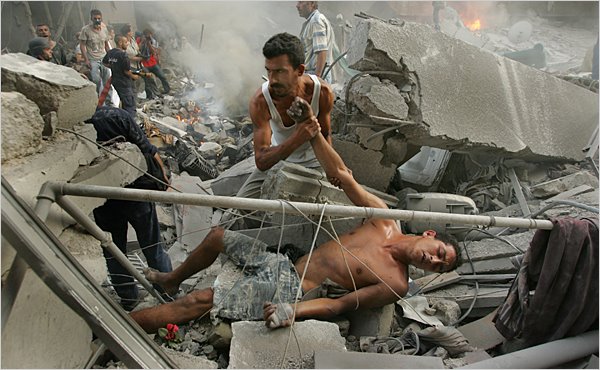
An image captured by one of The New York Times’ most acclaimed photographers, Tyler Hicks, that appeared in the paper and in a gallery at its Web site, showed a young man being pulled from the wreckage of a collapsed building after the Israeli attack on Qana that killed at least 28, including 16 or more children. Eagled-eyed bloggers soon found, on other news sites, images of the same man darting about the same disaster scene, trying to rescue people.
So, in their usual manner, they put 1 and 1 together and got 2 much: One blog after another charged that this man, after doing his rescue work, was planted on the pile, as a bomb victim, by Hezbollah, probably with the cooperation of Tyler Hicks, who then sent the manipulated photo around the world. The Times, as usual, was denounced by the rightwing bloggers for pro-terrorist and/or anti-American bias.
Even the popular, non-political site Gawker joined in, under the headline, “Times War Photos Artfully Staged, Directed.”
Well, there was, indeed, something wrong with the Times presentation. On the Web, though not in print, it suggested that the man had been blasted in the Israeli attack. In fact, the Times quickly found out — and corrected its Web caption — that the man fell down and got hurt in his rescue efforts. This simple explanation for the chronology was too much for some of the bloggers who continued questioning the incident, despite all the evidence to the contrary.
Others in the mainstream keep citing it too. As recently as this past Sunday, a Boston Herald editorial still had the man in the Hicks photo posing for the camera, then getting up and running around. It said the Times had “issued a correction” — without mentioning that it related to the caption about how he got hurt, not about it being a bogus photo.
But all of this was inevitable. Many bloggers appear ignorant of time-stamping and the fact that photos are often posted on Web sites out of sequence.

The Model: Gangsta Hat Guy

Pieta of Gangsta Hat Guy
Is that so? The poor chap fell down and injured himself in the course of his heroic rescue activities, knocking himself unconscious, but managing to land completely surrounded by debris, and miraculously –while falling– taking off his gangsta hat, and tucking it carefully under his arm!
Be sure to watch this video discussing the techniques of Pallywood agitprop.
Now whom do you find credible, dear readers? Greg Mitchell or Gateway Pundit who wrote the original exposé?
It should get funnier. Mitchell promises a follow-up Part II. I can’t wait.
18 Aug 2006
Orin Kerr, at the Volokh Conspiracy, responds to the left’s most dishonest blogger‘s rantings over criticisms of Judge Anna Diggs Taylor’s NSA opinion by the Washington Post (and others), observing:
the Administration is giving the program only a very partial defense in its public documents, so there is a lot more that we don’t know. (For example, I teach and write in the area of the Fourth Amendment, and my view is that I don’t know enough of the facts to know if the program violates the Fourth Amendment.
Professor Kerr has identified the most interesting feature of the NSA flap. The December 16, 2005 New York Times leaked NSA story accused the Bush administration of “monitoring,” a term subsequently rhetorically upgraded to “spying,” and ultimately to “eavesdropping,” on international phone calls and email messages “within the United States” without warrants.
The Bush Administration’s accusers knew that they were taking a very serious step by divulging the existence of one or more top secret National Security programs, and they not surprisingly chose merely to apply partisan and inflammatory characterizations without ever specifically describing what it was that they were pointing to with feigned outrage.
Since all this is secret, no one outside certain intelligence agencies and the upper reaches of the US Government really knows who is doing what, when, or to whom. It is really as if all it required was for Messrs. Risen and Lichtblau to write a story saying “the Bush Administration is secretly violating the law,” some unidentified persons said “by doing bad things,” and the left faithfully falls into zombified lockstep, and begins shouting cries of pain and outrage in chorus.
A key problem is no one has ever been identified anyone who has ever experienced a known wrong, or a perceived consequence of any kind, from whatever it is that NSA might, or might not, be doing.
Can the Constitution really be violated, or the law be broken, by persons unknown secretly peforming unknown acts devoid of discernible effect?
The left obviously thinks that George W. Bush is just intrinsically unconstitutional, and that he breaks the law just by being in office, and their grasp of so much of the MSM allows them to create an echo-chamber alternative reality in which the liberal articles of faith -which everybody knows- seem very real, however tenuous their relationship to mere diurnal reality.
01 Aug 2006
AP reports:
Federal prosecutors investigating a leak about a terrorism funding probe can see the phone records of two New York Times reporters, a federal appeals court ruled Tuesday.
A panel of the 2nd U.S. Circuit Court of Appeals overturned on a 2-1 vote a lower court’s ruling that the records were off limits unless prosecutors could show they had exhausted all other means of finding out who spoke to the newspaper…
The case involved stories written in 2001 by Times reporters Judith Miller and Philip Shenon that revealed the government’s plans to freeze the assets of two Islamic charities, the Holy Land Foundation and the Global Relief Foundation.
Prosecutors claimed the reporters’ phone calls to the charities seeking comment had tipped the organizations off about the government investigation.
28 Jul 2006

The New York Times reports that the process of bringing pouting spooks to justice for disclosing vital National Security programs to journalists in an effort to gain partisan political advantage is finally underway.
A federal grand jury has begun investigating the leak of classified information about intelligence programs to the press and has subpoenaed a former National Security Agency employee who claims to have witnessed illegal activity while working at the agency.
The former employee, Russell D. Tice, 44, of Linthicum, Md., said two F.B.I. agents approached on Wednesday and handed him the subpoena, which requires him to testify next Wednesday before a grand jury in Alexandria, Va.
The subpoena, which Mr. Tice made public on Friday, says the investigation covers “possible violation of federal criminal laws involving the unauthorized disclosure of classified information.” It specifically mentions the Espionage Act.
Tice was still spouting combative complaints about “persecution of whistle-blowers.” We’ll see if Tice keeps up that sort of talk after he’s read the charges on his indictment, and is aware of just what kind of sentences he is facing.
Background on Tice here.
18 Jul 2006
Reuters reports:
The New York Times Co. plans to narrow the size of its flagship newspaper and close a printing plant, resulting in the loss of 250 jobs, the company said in a story posted on its Web site late on Monday.
The changes, set to take place in April 2008, include the closure of a printing plant in Edison, New Jersey. The company will sublet the plant and consolidate its regional printing facilities at a plant in Queens, the paper said.
The newspaper will be narrower by 1 1/2 inches. The redesign will result in the loss of 250 production jobs, the company said.
The New York Times said it expected the changes to result in savings of $42 million.
The narrower format, offset by some additional pages, will reduce the space the paper has for news by 5 percent, Executive Editor Bill Keller said in the article.
Heartbreaking news, isn’t it?
You’d think they could just adopt an Arabic-language format, and increase sales to their natural readership.
Your are browsing
the Archives of Never Yet Melted in the 'New York Times' Category.
/div>

Feeds
|