Category Archive 'Photography'
22 Mar 2014

A German soldier gives a comrade a light with his flamethrower.
Via You’re Not Bulletproof.
22 Mar 2014



My Modern Met:
Bobby-Jo Clow encountered a [cheetah] cub [which] began walking towards her Landrover while on safari at the Serengeti National Park in Tanzania. Instead of panicking, the photographer, who happens to double as the Tanzania Zoo’s elephant keeper, embraced the moment. She kept calm as the young cheetah climbed onto the open sun-roof, dangled its paws in front her face and sniffed her hair. Luckily, Clow had a camera handy and documented the chance meeting.
The results are crystal-clear shots of a curious cat. We see the lanky cub approach the vehicle and peer into the car, first standing on its hood before moving to get a better view. His looks of wonder and later trepidation show us that he is not completely fearless, yet really has the urge to explore. Although similar behavior can be seen in a house cat, the images reinforce that this is a wild animal. As Clow leaned forward to capture the perfect shot, the movement caused the cheetah to hiss and bare its teeth.
Not very bright human behavior. Wild animals are interesting, but they actually do not reciprocate your affection and are perfectly capable of deciding you are lunch. Fortunately, this was only a cheetah and a cub. The lady did get amusing photos, though.
Hat tip to Ratak Monodosico.
21 Mar 2014

Beth Mantel sent this photo of herself to Horse & Hound:
“Just thought you may like this photo of my horse Dora (Caoimhes Delight) out with the Berks and Bucks on Sunday 16 March at West Wycombe jumping this awesome hedge. Think I’m now ready for Bechers Brook!”
04 Mar 2014

Persian soldiers pose with the straw-stuffed heads of Turkmen chiefs delivered to Tehran, c. 1911 source: Wikimedia commons.
Via Fred Lapides.
28 Feb 2014

The always-rewarding Madame Scherzo yesterday published this Tumblr image which, in the manner of Tumblr images commonly was totally unidentified.
I am afflicted with an excess of curiosity, and began searching, finding out eventually that this is a photograph of unknown source of the ruined Abbey of San Galgano. More photos here.

St. Galgano
St. Galgano and his Abbey, it turns out, have one heck of a story.
Galgano Guidotti was born in 1148, the son of a minor noble, and one of those punk, no-good young knights constantly looking for trouble and worldly pleasures. One day when he least expected it, Archangel Michael appeared before him and showed him the way to salvation, and kindly provided him with directions as well. Next day, Sir Galgano announced that he was going to become a hermit and took up residence in a cave. His friends and relatives ridiculed him, and Dionisia, his mother, bade him to wear his expensive nobleman’s clothes and at least pay a last visit to his fiancée. On his way there, his horse reared, throwing Galgano. Spitting road dust, he suddenly felt as if he was being lifted to his feet by an invisible force, and a seraphic voice and a will he was unable to resist led him to Monte Siepi, a rugged hill close to his home town of Chiusdino.
The voice bade him to stand still and look at the top of the hill; Galgano saw a round temple with Jesus and Mary surrounded by the Apostles. The voice told him to climb the hill, and while doing so, the vision faded. When he reached the top the voice spoke again, inviting him to renounce his loose, easy living. Galgano replied that it was easier said than done, about as easy as splitting a rock with a sword. To prove his point, he drew his blade and thrust at the rocky ground. With an ease that would impress even cinderblock-splitting sword dealers at Renaissance fairs, the sword penetrated the living bedrock to the hilt. Galgano got the message, and took up permanent residence on that hill as a humble hermit. He led a life in poverty, visited by the occasional peasant looking for a blessing. He befriended wild animals, and once, when the Devil sent an assassin in the guise of a monk, the wild wolves living with Galgano attacked the killer and, according to legend, “gnawed his bones.”
Galgano Guidotti died in 1181, at the age of 33 years, and was canonized four years later. His funeral was a major event, attended by bishops and three Cistercian abbots, including one who had got lost while on his way to Rome. The next year, the Bishop of Volterra gave Monte Siepi to the Cistercian monks, aware that they would build a shrine to Galgano’s memory. They began building in 1185, erecting a round chapel that became known as the Cappella di Monte Siepi, on the hill above the main abbey, with the sword forming the centerpiece.
The Cappella offers a breathtaking view of the Abbey, the neighboring buildings and the beautiful surrounding countryside. Galgano’s body was for some reason lost after the funeral, although his head, which is said to have grown golden curls for many years following his death, was placed in one side chapel, and the chewed bones of the arms of the assassin in another. Saint Galgano’s head is preserved as a relic in the Museo dell’Opera del Duomo in Siena, while the skeletal arms are still in place. The crowds of pilgrims were so numerous that the Cistercians were authorized to build another monastery named after the Saint a short distance away. It was to be one of the most beautiful Gothic buildings in Italy, and one of the Cistercians’ two largest Italian foundations. The monastery soon became both powerful and respected. Monks from San Galgano were appointed to high offices throughout Tuscany. In the 14th century, a Gothic side chapel was added to the original Romanesque Cappella, and in the 18th century a rectory was added. The side chapel has the remains of some frescoes by Ambrogio Lorenzetti, including a faint picture of Galgano offering the sword in the stone to Saint Michael. The Abbey was sacked by the (in)famous English mercenary captain Sir John Hawkwood and his White Company, and by 1397 the abbot was its only inhabitant. The Abbey deteriorated over the centuries, becoming the impressive ruins seen today.

Galgano’s sword in the stone.
25 Feb 2014

My Science Academy:
Xico volcano sits at the extreme southern end of the Mexico City megalopolis. For a geologically significant chunk of time, this area was underwater, drowned by Lake Chalco. The lake began to dry out in the 1300s, and Aztec fishermen settled along its coastline hereabouts. In the nineteenth century, the government drained the lake entirely; the fishermen were awarded communal land grants and told to become farmers.
Farming became intensive in the 1970s, when corporate agriculturists and desperate landless peasants struck illegal or quasi-legal deals with the communal organizations and wrested control of the rich volcanic soil. Thousands and thousands of families poured into the region, hoping for work. Farmers climbed over the rim of the volcano and plowed fields inside the crater. Xico the town sprawled right up to the ramparts of Xico the crater and appears likely to soon engulf it; in 2005, the population of the municipality was 330,000.
And 9 more.
Hat tip to Ratak Monodosico.
18 Feb 2014
Just faster than one other photographer.

From grand.
13 Feb 2014

Hat tip to Vanderleun.
26 Jan 2014

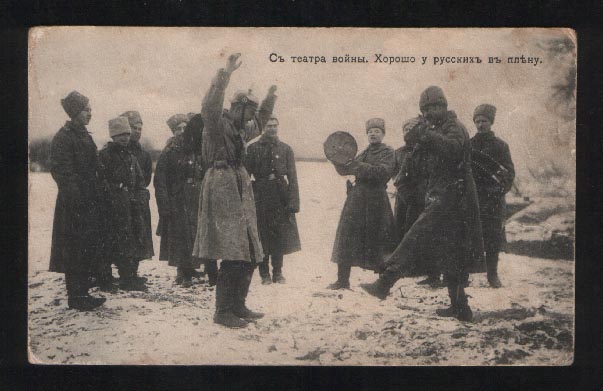
Russian Cossacks -provide friendly hospitality to a German Prisoner of War.
The original source seems to have been a Russian postcard.
Via Madame Scherzo.
22 Jan 2014

The Tumblr image seems to come ultimately from here.
Hat tip to Madame Scherzo.
17 Jan 2014

This baby animal has markings rather like those found on baby wild boars. Can you identify the critter? It actually took me a couple of tries to figure it out.
answer
Your are browsing
the Archives of Never Yet Melted in the 'Photography' Category.
/div>

Feeds
|