Category Archive 'The Elect'
27 Aug 2010


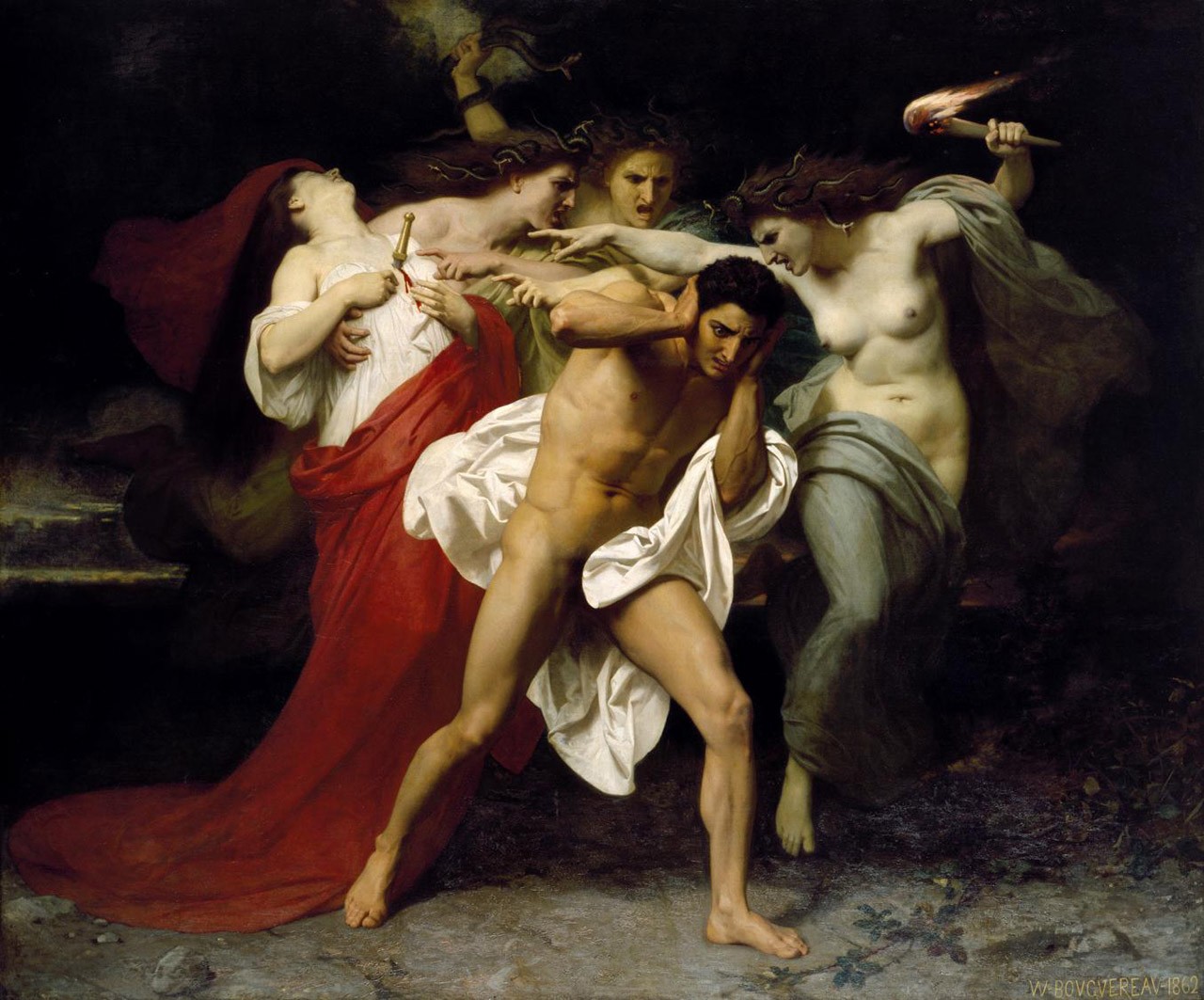
Willem-Adolphe Bouguereau, Liberal Democrat Pursued By the Furies, 1862, Chrysler Museum of Art
Rich Lowery explains how the democrat minority lucked into control of both electoral branches of government and then proceeded to self destruct.
The frustrations of minority status can drive a political party batty.
The temptation is to substitute belligerence for thought, insist on a self-destructive purity, lash out at the American public and question the wisdom and viability of the country’s institutions. Indulging in these tendencies almost always makes a party’s position worse rather than better.
The Obama Democrats may be the first party to engage in this self-defeating behavior — borne of a frustrated desperation — while holding the presidency and both houses of Congress by substantial margins.
Through an accident of timing (a national election coinciding with a financial crisis) and the exhaustion of the Bush-DeLay Republicans (who lost power almost by default), liberals took the commanding heights of the federal government while remaining a minority disposition in our national life. In short, they became a rump majority.
Through President Obama’s alchemy, these temporarily enlarged congressional numbers were supposed to be transformed into a permanent realignment. It hasn’t worked out, obviously.
In the last 20 months, Democrats have had the power to do almost everything they want, except command the allegiance of the public. That has made them and their allies feel embattled, isolated and perpetually aggrieved. They act like a forlorn minority at the same time they control every lever of elective power in Washington.
The ultimate source of the Democrats’ discontent is quite simple: They’ve lost independents. In 1994, in taking Congress, Republicans won independents by 14 percentage points. In 2006, in taking it back, Democrats won independents by 18 points. In the latest Gallup survey, Republicans lead among independents by 11 points. …
The pollster.com average of Obama’s approval rating among independents is a dismal 37.9 percent. This meltdown should have launched a thousand agonized liberal op-eds, conferences and strategy papers on how to win back the center. If, that is, liberalism had any realistic sense of its limits.
In the midst of a catastrophic loss of the middle, Obama’s supporters exhort him to get more angry, insistent and ambitiously liberal. Having already pushed for a bridge too far, they want to go farther still. When they can’t, they conclude it’s a damning indictment of Obama’s failure of nerve and the nation’s ungovernablility.
There’s little acknowledgment that the country is in a different place than they are. To the extent there is, so much worse for the country, which is condemned for its backwardness and intolerance. The majority is not just wrong on immigration enforcement and the Ground Zero mosque, it’s contemptible. Who knew that the American public would get accused of bigotry more often after electing an African-American president than before?
As former Bush speechwriter Peter Wehner writes, liberals “are expressing deepening alienation from our nation and turning on the American people with a vengeance.” They thought they had a mandate from heaven in 2008 and can’t bear the thought that they deluded themselves. They’ve gone from triumphalism to a petulant and uncomprehending tantrum in less than two years. The rump majority looks more exhausted by the day.
27 Aug 2010
The single most annoying thing about liberals is their false claim to intellectual superiority founded not on the merits of their arguments and analysis but on their long-term successful domination and near monopoly of certain institutions and professions conferring exceptional power and prestige.
They never really win any debates, but rely on their ability to shout down and, as Charles Krauthammer describes, marginalize their opposition with smears.
Liberalism under siege is an ugly sight indeed. Just yesterday it was all hope and change and returning power to the people. But the people have proved so disappointing. Their recalcitrance has, in only 19 months, turned the 40-year liberal ascendancy that James Carville predicted into a full retreat.
Ah, the people, the little people, the small-town people, the “bitter” people, as Barack Obama in an unguarded moment once memorably called them, clinging “to guns or religion or” — this part is less remembered — “antipathy toward people who aren’t like them.”
That’s a polite way of saying: clinging to bigotry. And promiscuous charges of bigotry are precisely how our current rulers and their vast media auxiliary react to an obstreperous citizenry that insists on incorrect thinking.
Resistance to the vast expansion of government power, intrusiveness and debt, as represented by the Tea Party? Why, racist resentment toward a black president.
Disgust and alarm with the federal government’s unwillingness to curb illegal immigration, as crystallized in the Arizona law? Nativism.
Opposition to the most radical redefinition of marriage in human history, as expressed in Proposition 8 in California? Homophobia.
Opposition to a 15-story Islamic center and mosque near Ground Zero? Islamophobia.
Now we know why the country has become “ungovernable,” last year’s excuse for the Democrats’ failure of governance: Who can possibly govern a nation of racist, nativist, homophobic Islamophobes?
Note what connects these issues. In every one, liberals have lost the argument in the court of public opinion. Majorities — often lopsided majorities — oppose President Obama’s social-democratic agenda (e.g., the stimulus, ObamaCare), support the Arizona law, oppose gay marriage and reject a Ground Zero mosque.
What’s a liberal to do? Pull out the bigotry charge, the trump that pre-empts debate and gives no credit to the seriousness and substance of the contrary argument.
—————————–
Laura Ingraham denounces the same pattern of liberal behavior and calls for genuine debate. 2:23 video
18 Aug 2010
But, of course, there is no court case, no legislative or judicial process, no actual involvement of the US Constitution at all. We have instead the occult operations of the infinitely labyrinthine and corrupt zoning and building permit processes of New York City doing whatever it is they do outside of our observation and understanding, and we have the sideline sport of Americans forming up into teams rooting for and against the construction of an Islamic victory monument within the no-longer-present shadow of the fallen World Trade Center towers. The fashionable community of treason is passionately determined to prove their moral superiority by defending the rights of our overseas enemies to raise the banner of the crescent and the serpent over Lower Manhattan, and normal Americans are –as usual– appalled at the insolence and disloyalty of our elite. I find this particular rehearsal of a by-now-only-too-familiar comedy amusing though, because the outcome and comparative strengths of the opposing factions are only too obvious. The Ground Zero Mosque will never be erected. And the community of liberal lemmings will discover, too late, that all that they accomplished was to drive a few more nails in the coffin of everything they hold dear by a particularly effective demonstration in front of the entire country of exactly how demented and offensive they really are.
13 Aug 2010

Mayor Bloomberg and reputable members of the establishment in general view people objecting to the erection of mosque and Islamic cultural center in the vicinity of the fallen World Trade Center towers as bigots and yahoos, who irrationally insist on blaming the overwhelmingly larger body of moderate Muslims for the crimes committed by a small number of unrepresentative extremists.
The Muslim religious leader behind the Ground Zero Mosque project is Imam Feisal Abdul Rauf. The defense of the Ground Zero Mosque project is intimately associated with
the identification of Abdul Rauf as a moderate Muslim, a reasonable representative of a different religious denomination who is not our enemy and who does not deserve to bear any sort of guilt for Islamic extremism or acts of terrorism.
Yet, Imam Abdul Rauf has made a number of somewhat controversial public statements.
On September 29, 2001, a mere nineteen days after the attacks, when asked by CBS if the U.S. deserved the attacks, Rauf answered: “I wouldn’t say that the United States deserved what happened. But the United States’ policies were an accessory to the crime that happened.”
The interviewer inquired how the US was “an accessory,” and Abdul Rauf replied, “Because we have been accessory to a lot of innocent lives dying in the world. In fact, in the most direct sense, Osama bin Laden is made in the USA.”
In a June interview this year with WABC radio in New York, Abdul Rauf evaded answering whether he agreed with the U.S. State Department’s designation of Hamas as a terrorist organization. “I’m not a politician. I try to avoid the issues. The issue of terrorism is a very complex question.”
Clifford D. May offers this completely devastating rejoinder.
No, actually, it’s quite simple: Whatever your grievances, you do not express them by murdering other people’s children. Not accepting that proposition does not make you a terrorist. But it disqualifies you as an anti-terrorist and identifies you as an anti-anti-terrorist.
A thought experiment: I am grieved by Saudi policies — for example, Saudi religious discrimination, oppression of women, and persecution of homosexuals. If I were to express these grievances by blowing up a Saudi kindergarten, do you think Imam Feisal would say (1) the Saudi Royal family must share responsibility for the carnage, and (2) whether or not I had committed an act of terrorism is a “very complex question�
How can well-educated, sophisticated people apply such a preposterous double-standard in their thinking that they will perform gymnastic contortions to defend and apologize for a Muslim community leader with all sorts of unsavory personal connections and instantly exclude from legitimate discussion anyone who would criticize the symbolism of the Ground Zero Mosque project or question the bona fides of its organizer?
May explains:
[M]ulticulturalism and moral relativism, doctrines devoutly embraced by the intellectual classes, render “everything the equal of everything else.†As a consequence, some very smart people have “lost the ability to make the most elementary distinctions.†Except one: They reflexively regard those from the Third World as virtuous and those from the West as steeped in blame, shame, and guilt.
So if Imam Feisal says he’s a moderate, he must be a moderate. Why read his books or inquire into what he preaches in his mosque or with whom he associates on his frequent trips to Saudi Arabia, Malaysia, and other exotic locales? Would we ask such questions of a Baptist minister building a church near Ground Zero?
11 Aug 2010
Tony Blankley says it’s time for Americans to put our self-appointed rulers, the urban pseudo-intellectual community of fashion, in its place. Register and be sure to vote in November. Let’s restore democracy and take America back.
A foul and dangerous brew is heating up that is composed of: (1) The economic collapse that started in 2008; (2) the radical, “fundamentally transforming” left-wing agenda of the government; and, (3) the thwarting of the public will — with glee — by the entrenched, non-elected powers (in the courts, media, colleges and government bureaucracies) as they get into the face and under the skin of the cultural and political majority.
It is insufferable (and will not long be suffered) to be lectured to and imposed upon by a ruling class that loathes our nation’s history, values and accomplishments; by those who are not, in fact, our genuine betters. They are neither better educated nor more profoundly morally versed.
In fact, they are our intellectual and moral inferiors — not superiors. Constantly grinning Supreme Court Justice Elena Kagan didn’t think the Declaration of Independence’s proclamation that human beings “are endowed by their Creator with certain unalienable rights” should in any way affect her understanding of our constitutional rights — presumably, if any.
Part of the building danger derives from the fact that Americans now tend to self-select our news, opinion and entertainment sources based on our political beliefs and cultural and religious preferences. As a result, the nation no longer shares a common database of civic reality. Many liberals have no sense of how deep and roiling this no-longer-just-conservative passion is. Or they assume it involves some small, mendacious, ideological faction rather than a broad-based, nonideological, building national majority, which it does.
08 Aug 2010
Historian Victor Davis Hanson points out that the past explains how America got where it is today.
If one were to survey the elite campuses around 1975 and talk to those in law school, poly sci, or the humanities, then imagine them 35 years later as our elite leaders in government, the media, the universities, the foundations, and the arts, one could pretty much expect what we now have.
The present symptoms that characterize both our popular culture and current governance — shrill self-righteousness; abstract communalism juxtaposed with concrete pursuit of the aristocratic good life; race/class/gender cosmic sermonizing with private school and Ivy league for the kids; crass and tasteless public expression; a serial inability to take responsibility for one’s actions; the bipartisan mega-deficits; the inability to cut pensions and social security for the baby boomers — from the trivial to the fundamental, all derive from a bankrupt cohort that came of age in the sixties and seventies.
We see the arrested adolescence and hypocrisy that come from that sermonizing generation, whether in Al Franken’s puerile face-making, the ideologically driven suicide at Newsweek, the steady destruction of the New York Times, John Kerry’s tax-avoiding yacht, the Great Gatsby Clinton wedding, Michelle on the Costa del Sol, Nancy Pelosi’s jet, Tim Geithner’s tax skipping, or the constant race-card playing of a Charles Rangel and Maxine Waters. Yes, one walk across the Yale or Stanford campus circa 1975, and one could see pretty clearly what sort of culture that bunch would create when it came of age and was handed power.
30 Jul 2010

Rep. Barney F. Bourbon
Richard Fernandez identifies the international aspects of the thesis of Angelo Codevilla’s recent important essay.
Niall Ferguson is touring Australia warning that the end of American dominance may be imminent and sudden. Somehow the ideas in Codevilla’s essay are popping up everywhere, whether people have read it or not. Ferguson describes how rapidly empires can fall.
The Bourbon monarchy in France passed from triumph to terror with astonishing rapidity. The sun set on the British Empire almost as suddenly. The Suez crisis in 1956 proved that Britain could not act in defiance of the US in the Middle East, setting the seal on the end of empire.
But those things happen only to the denizens of history. People who live in the today usually think they are different. So despite evidence of dramatic change, people who have spent their whole lives among the policy certainties of the postwar period find it difficult to accept they may have to build a world of their own from first principles. Ferguson asks his audience: “what would you do in a world without America? Has the question even crossed your mind?â€
Australia’s post-war foreign policy has been, in essence, to be a committed ally of the US. But what if the sudden waning of American power that I fear brings to an abrupt end the era of US hegemony in the Asia-Pacific region? Are we ready for such a dramatic change in the global balance of power? Judging by what I have heard here since I arrived last Friday, the answer is no. Australians are simply not thinking about such things.
But if the Australians are not thinking about it, the Chinese are certainly preparing for it. The Wall Street Journal recently noted that Beijing objected to the right of US naval vessels to exercise in the Yellow Sea, despite the fact that they are international waters. At least they used to be. Waters are only international if kept so by a powerful navy committed to the freedom of the seas. People sometimes forget that treaties reflect realities rather than create them, no matter what the European Union may think. …
[Caroline Glick observes that] “[j]ust as US bureaucrats, journalists, politicians and domestic policy wonks tend to combine forces to perpetuate and expand the sclerotic and increasingly bankrupt welfare state, so their foreign policy counterparts tend to collaborate to perpetuate failed foreign policy paradigms that have become writs of faith for American and Western elites.†In other words, when it comes down to funding politics or funding defense, fund politics. Ferguson made the same point more starkly: “it is quite likely that the US could be spending more on interest payments than on defense within the next decade.â€
If the love of money is the root of all evil, the lack of it is the cause of the fall of empires. Ferguson gave some examples:
Think of Spain in the 17th century: already by 1543 nearly two-thirds of ordinary revenue was going on interest on the juros, the loans by which the Habsburg monarchy financed itself.
Or think of France in the 18th century: between 1751 and 1788, the eve of Revolution, interest and amortisation payments rose from just over a quarter of tax revenue to 62 per cent.
Finally, consider Britain in the 20th century. Its real problems came after 1945, when a substantial proportion of its now immense debt burden was in foreign hands. Of the pound stg. 21 billion national debt at the end of the war, about pound stg. 3.4bn was owed to foreign creditors, equivalent to about a third of gross domestic product.
Alarm bells should therefore be ringing very loudly indeed in Washington, as the US contemplates a deficit for 2010 of more than $US1.47 trillion ($1.64 trillion), about 10 per cent of GDP, for the second year running.
But alarm bells aren’t ringing in Washington. The entire alarm system has been disabled, disconnected, perhaps scrapped. Anyone who wants to turn it back on will have to root through the dumpster to see if any usable parts can still be retrieved. No better symptom of the absence of alarms is the genuine astonishment of Charles Rangel that it is illegal to break the law. Almost as a matter of course he concealed hundreds of thousands of dollars in income, used Congressional letterhead to solicit donations for private causes, took four rent controlled apartments for himself. Innocently. He probably didn’t think he was doing anything wrong. Things had been so sweet, so long that even after he was offered the chance to negotiate his way out of 13 separate violations of House rules and federal statutes he simply refused to believe it was happening.
Like Brecht’s fictional Atlantean who “the night the seas rushed in … still bellowed for their slaves,†the members of what Codevilla called the “ruling class†can’t believe it is happening. They still want their last dollar, their last perk. Literally, no matter what. “Massachusetts Congressman Barney Frank caused a scene when he demanded a $1 senior discount on his ferry fare to Fire Island’s popular gay haunt, The Pines, last Friday. Frank was turned down by ticket clerks at the dock in Sayville because he didn’t have the required Suffolk County Senior Citizens ID. A witness reports, ‘Frank made such a drama over the senior rate that I contemplated offering him the dollar to cool down the situation.’â€
The worst thing about the ferry incident is the possibility that if the witness had really offered Frank the dollar he might actually have taken it. Automatically; out of conditioning, like a Pavlovian dog. The culture in which the chairman of the House Financial Services Committee rose to power is one in which it is OK to blithely borrow more money than the entire defense budget can service and yet refuse to spend one whole dollar of his own money. The ethos of that world can be captured in one phrase: “don’t you know who I am?â€
26 Jul 2010
Conservatives’ favorite metaphor is Munich; liberals’ is Vietnam.
As the Obama Administration continues sinking into disrepute, Neal Gabler, in the Boston Globe, points to the same kind of smug Ivy League hubris that persistently failed in Vietnam as being responsible for the current administration’s woes.
Just like the New Frontiersmen so thoroughly trashed in David Halberstam’s book, Team Obama has demonstrated a “we know better” approach to policy which is distancing them farther and farther from the general perspective of the country.
[According to David Halberstam, the Kennedy and Johnson administration Brahminate] “were men more linked to one another, their schools, their own social class and their own concerns than they were linked to the country,’’ which meant that their sense of the public good was always subordinate to their sense of their own brilliance.
Above all, the best and the brightest believed in their own infallibility. They distrusted politics almost as much as they distrusted the proletariat because politics was about compromise and satisfying ninnies (us) who they felt were much beneath them. They were cold, logical, bloodless, and deeply pragmatic. They considered liberal idealists fools, and emotion a weakness. They knew best, which made them extremely intimidating. They failed because they didn’t think they could possibly be wrong.
In many ways, Obama was a sucker for this kind of coldblooded, upper-crust approach to policy and the elitism that went with it. Half-white, half-black, half-American, half-African, part Kansan, part Hawaiian, middle class and transient, Obama made the primary plaint and question of his book, “Dreams From My Father’’: Where do I belong? That question was posed as one of racial identity, but in the end, whether he fully realized it or not, Obama found himself not in black culture or white culture but in the culture of the best and the brightest. That’s where he belonged. That’s where he seemed to feel most comfortable.
So it is really no surprise that he has packed his administration with what one might call The Best and the Brightest 2.0 — people who are as dispassionate and rational and suspicious of emotion as the president prides himself as being: a bunch of cool, unflappable customers. (The exceptions are Vice President Joe Biden and chief of staff Rahm Emanuel.) Like The Best and the Brightest 1.0, these folks — guys like Larry Summers, outgoing budget director Peter Orszag, and Tim Geithner, on the economic side; and William J. Lynn 3d, deputy secretary of defense, and James Steinberg, deputy secretary of state, on the foreign side — are Ivy-educated, confident, and implacable realists and rationalists. Like their forebears, they have all the answers, which is why they have been so unaccommodating of other suggestions on the economy, where economists have been pressing them for more stimulus, or on Afghanistan, where the president keeps doubling down his bets.
The difference between 1.0 and 2.0 is that 2.0 are not all Protestant, white males sprung full-blown from the Establishment as 1.0’s fathers and their fathers’ fathers were. Like Obama himself, they are by and large onetime middle-class overachievers who made their way into the Ivy League and then catapulted to the top levels of class and power by being . . . well, the best and the brightest. But in elitism as in religion, no one is more devout than a convert, and these people, again like Obama, all having been blessed by the Ivy League, also embrace Ivy League arrogance and condescension. On this, the Republican critics are right: The administration exudes a sense of superiority.
So what difference does it make if our policy-makers think they are above criticism? As Halberstam shows in “The Best and the Brightest,’’ people who are concerned not with the fundamental rightness of something but with its execution, because the rightness is assumed; people who see what they want to see rather than what is; people who see things in terms of preconceptions rather than of human conduct; people who are incapable of admitting error; people who lack skepticism and the capacity to grow beyond their certainties are the sorts of people who are likely to get us in trouble — whether it is an ever-lengthening war in Afghanistan or ever-deepening economic distress here at home. After all, we’ve been there once before.
I think the similarity Gabler identifies of a dogged advance into political destruction on the basis of a mistaken sense of Ivy League superiority is dead on, but there is the difference that those establishment experts of nearly 50 years ago were merely conventionally liberal in the same basically empty and purely formal way that they were also Episcopalians or Congregationalists or Presbyterians.
The Obama Administration’s determination to pursue a massive expansion of spending and of governmental expansion in defiance of an economic crisis represents the opposite of 1960s liberal pragmatism. Its hubris is not merely the hubris of the well born, the well-connected, and the talented. Theirs is the hubris of the enlightened initiate of the left’s theory of History, of the committed believer in the ideology of socialism and statism which is today more radical, and even more deeply entrenched in America’s elite universities, than it was so long ago.
Robert McNamara and McGeorge Bundy believed their policies would succeed and they would win. The Obama Administration is willing to die on the barricades in order to leave behind socialized American health care.
17 Jul 2010
Angelo M. Codevilla wonders how long two-thirds of America can possibly be ruled by a well-entrenched elitist third.
Never has there been so little diversity within America’s upper crust. Always, in America as elsewhere, some people have been wealthier and more powerful than others. But until our own time America’s upper crust was a mixture of people who had gained prominence in a variety of ways, who drew their money and status from different sources and were not predictably of one mind on any given matter. The Boston Brahmins, the New York financiers, the land barons of California, Texas, and Florida, the industrialists of Pittsburgh, the Southern aristocracy, and the hardscrabble politicians who made it big in Chicago or Memphis had little contact with one another. Few had much contact with government, and “bureaucrat” was a dirty word for all. So was “social engineering.” Nor had the schools and universities that formed yesterday’s upper crust imposed a single orthodoxy about the origins of man, about American history, and about how America should be governed. All that has changed.
Today’s ruling class, from Boston to San Diego, was formed by an educational system that exposed them to the same ideas and gave them remarkably uniform guidance, as well as tastes and habits. These amount to a social canon of judgments about good and evil, complete with secular sacred history, sins (against minorities and the environment), and saints. Using the right words and avoiding the wrong ones when referring to such matters — speaking the “in” language — serves as a badge of identity. Regardless of what business or profession they are in, their road up included government channels and government money because, as government has grown, its boundary with the rest of American life has become indistinct. Many began their careers in government and leveraged their way into the private sector. Some, e.g., Secretary of the Treasury Timothy Geithner, never held a non-government job. Hence whether formally in government, out of it, or halfway, America’s ruling class speaks the language and has the tastes, habits, and tools of bureaucrats. It rules uneasily over the majority of Americans not oriented to government.
The two classes have less in common culturally, dislike each other more, and embody ways of life more different from one another than did the 19th century’s Northerners and Southerners — nearly all of whom, as Lincoln reminded them, “prayed to the same God.” By contrast, while most Americans pray to the God “who created and doth sustain us,” our ruling class prays to itself as “saviors of the planet” and improvers of humanity. Our classes’ clash is over “whose country” America is, over what way of life will prevail, over who is to defer to whom about what. The gravity of such divisions points us, as it did Lincoln, to Mark’s Gospel: “if a house be divided against itself, that house cannot stand.”
A must read.
30 May 2010
David Brooks, who effectively embodies the New York Times idea of what a conservative ought to be, draws upon that firm foundation of learning elite schools (in his case, University of Chicago) provide members of the establishment commentariat like himself, clears his throat and begins the chin stroking, contrasting the French Enlightenment (radical people Brooks disapproves of) with “the British Enlightenment and Edmund Burke” (read: David Books himself).
When I was in college I took a course in the Enlightenment. In those days, when people spoke of the Enlightenment, they usually meant the French Enlightenment — thinkers like Descartes, Rousseau, Voltaire and Condorcet. …
But there wasn’t just one Enlightenment, headquartered in France. There was another, headquartered in Scotland and Britain and led by David Hume, Adam Smith and Edmund Burke. …
Paine saw the American and French Revolutions as models for his sort of radical change. In each country, he felt, the revolutionaries deduced certain universal truths about the rights of man and then designed a new society to fit them.
Burke, a participant in the British Enlightenment, had a different vision of change. He believed that each generation is a small part of a long chain of history. We serve as trustees for the wisdom of the ages and are obliged to pass it down, a little improved, to our descendents. That wisdom fills the gaps in our own reason, as age-old institutions implicitly contain more wisdom than any individual could have.
Burke was horrified at the thought that individuals would use abstract reason to sweep away arrangements that had stood the test of time. He believed in continual reform, but reform is not novelty. You don’t try to change the fundamental substance of an institution. You try to modify from within, keeping the good parts and adjusting the parts that aren’t working.
If you try to re-engineer society on the basis of abstract plans, Burke argued, you’ll end up causing all sorts of fresh difficulties, because the social organism is more complicated than you can possibly know. We could never get things right from scratch.
Then along comes Kathy Kattenburg, who cruelly demonstrates just how superficial is Brooks’ intellectual veneer, how weak his grasp of actual facts, and (as Burke would have said) how muddled his understanding and has fun delivering this well-deserved comeuppance.
Hat tip to Bird Dog.
26 May 2010

In a characteristic performance, President Obama held another meeting with Republican senators in one more search for the kind of bipartisanship which would consist of Republicans supporting his policies. When Republicans pointed to his own partisanship, Obama became angry and proceeded to scold his opponents.
The Politico:
Senators and other sources inside the meeting described the gathering as “testy†and “direct†— and Sen. Bob Corker (R-Tenn.) accused Obama of acting two-faced by asking for GOP support on regulatory reform only to push forward with a bill supported mainly by Democrats. Others felt that the meeting may have made already tense relations between the two parties even worse.
“The more he talked, the more he got upset,” Sen. Pat Roberts (R-Kan.) said. “He needs to take a valium before he comes in and talks to Republicans and just calm down, and don’t take anything so seriously. If you disagree with someone, it doesn’t mean you’re attacking their motives — and he takes it that way and tends then to lecture and then gets upset.â€
There may be doubts about Obama’s American citizenship, but regarding his membership in the self-infatuated liberal elite, there can be no doubt whatsoever. He shares the establishment perspective that there is only one legitimate political position on any issue: its own. If you don’t agree with Obama, if you don’t support his regulatory and redistributionist policies, you are a bad person. If you criticize him, you are in bad faith.
25 May 2010
Tea Party Protests, Republicans in Congress voting no, and democrats losing elections are really coming to represent altogether too much dissent for our friends on the left. Last week, Woody Allen wished aloud that Obama could be dictator for “a few years” so that “he could do a lot of good things quickly.
This week, Thomas Friedman, on Meet the Press, expressed the same kind of frustration with votes in Congress, checks and balances, and public opposition to the “good things” and “right solutions” which he understands with his own privileged insight to be necessary and desirable.
MR. FRIEDMAN: Well, David, it’s been decimated. It’s been decimated by everything from the gerrymandering of political districts to cable television to an Internet where I can create a digital lynch mob against you from the left or right if I don’t like where you’re going, to the fact that money and politics is so out of control—really our Congress is a forum for legalized bribery. You know, that’s really what, what it’s come down to. So I don’t—I, I—I’m worried about this, it’s why I have fantasized—don’t get me wrong—but that what if we could just be China for a day? I mean, just, just, just one day. You know, I mean, where we could actually, you know, authorize the right solutions, and I do think there is a sense of that, on, on everything from the economy to environment. I don’t want to be China for a second, OK, I want my democracy to work with the same authority, focus and stick-to-itiveness. But right now we have a system that can only produce suboptimal solutions.
Hat tip to the Barrister.
/div>
Feeds
|