Category Archive 'The Intelligentsia'
07 Feb 2010

Gerard Alexander, an associate professor of politics at the University of Virginia, identifies four liberal methods of denying the legitimacy of conservative political victories which are still consistently employed to avoid intellectual engagement.
Every political community includes some members who insist that their side has all the answers and that their adversaries are idiots. But American liberals, to a degree far surpassing conservatives, appear committed to the proposition that their views are correct, self-evident, and based on fact and reason, while conservative positions are not just wrong but illegitimate, ideological and unworthy of serious consideration. Indeed, all the appeals to bipartisanship notwithstanding, President Obama and other leading liberal voices have joined in a chorus of intellectual condescension.
It’s an odd time for liberals to feel smug. But even with Democratic fortunes on the wane, leading liberals insist that they have almost nothing to learn from conservatives. Many Democrats describe their troubles simply as a PR challenge, a combination of conservative misinformation — as when Obama charges that critics of health-care reform are peddling fake fears of a “Bolshevik plot” — and the country’s failure to grasp great liberal accomplishments. “We were so busy just getting stuff done . . . that I think we lost some of that sense of speaking directly to the American people about what their core values are,” the president told ABC’s George Stephanopoulos in a recent interview. The benighted public is either uncomprehending or deliberately misinformed (by conservatives).
This condescension is part of a liberal tradition that for generations has impoverished American debates over the economy, society and the functions of government — and threatens to do so again today, when dialogue would be more valuable than ever.
Read the whole thing.
01 Feb 2010
King Banaian, Chairman of the Econ Department at St. Cloud State, discusses at Hot Air the indignation of the bien pensants at the failure of the peasantry to bow down and accept gratefully the socialism that every liberal intellectual knows is good for them.
The notion that we know enough to know what is in someone else’s best interest is [a] fallacy, and I have found over the succeeding decades there are many academics that fall into it. Applied in the political sphere, it takes the form of “why does the public not understand what we are trying to do?†We heard it in President Obama’s State of the Union address last week in his claim that his failure on health care was “not explaining it more clearly to the American people.†It characterizes the thoughts of Thomas Frank in “What’s the Matter With Kansas?,” a book that I found alternately patronizing and pathetic, arguing that it must be false consciousness or hypnotizing demagoguery that leads the working class of Kansas, once home of agricultural Wobblies, to now vote consistently conservative.
That meme is now everywhere. David Brooks calls tea partiers anti-intellectual and Frank Rich calls them comatose. Responding to the election of Scott Brown, the BBC carries a column by David Runciman, a British academic political scientist of high birth (how else to describe someone whose Wikipedia entry notes his viscountcy?) that cannot understand why town halls are filled with people repulsed by Democrats health care reform. It’s to help them, dears!
But it is striking that the people who most dislike the whole idea of healthcare reform – the ones who think it is socialist, godless, a step on the road to a police state – are often the ones it seems designed to help.
In Texas, where barely two-thirds of the population have full health insurance and over a fifth of all children have no cover at all, opposition to the legislation is currently running at 87%.
Instead, to many of those who lose out under the existing system, reform still seems like the ultimate betrayal.
Why are so many American voters enraged by attempts to change a horribly inefficient system that leaves them with premiums they often cannot afford?
My friend Marty Andrade tweeted this link with the comment “But I stole this for you,†says the plunderer. “Why do you not take it? Why do you not vote for me?†But it is not so much the politician but the wonk, the analyst who makes such pretty plans, that finds himself exasperated by the failure of the public to appreciate them. No place does this happen more than in academia, particularly in America, where as I’ve argued before the academic does not often travel in either the working class circles or in those the successful businesspeople.
Read the whole thing.
22 Jan 2010
The Boston Globe reports from Amherst:
They filed in and out of coffeehouses, all but crying in their cappuccinos, barely touching their carrot cake muffins, still in shock that Scott Brown – a Republican! – had been elected to the US Senate in the state that pioneered universal health care, legalized same-sex marriage, and normally sends 12 Democrats to Congress.
In the days since the unthinkable happened, diehard Democrats have been forced to confront results that suggest Massachusetts votes much the way rest of the country does – blue on the edges with a big red swath in the middle. They have grappled with the possibility that the Commonwealth, until this week viewed by the much of the country as an outpost of extreme liberalism, may not be all that. And that has left them blue – in the other meaning of the word – over Martha Coakley’s defeat.
There is no better place to sense that mood than Amherst and Cambridge, two outposts of extreme liberalism in Massachusetts. They share a self-effacing nickname – “The People’s Republic.’’ They share (along with Provincetown) the distinction of being the most pro-Coakley communities, having handed her 84 percent of the vote. And they share the shock.
“I’m upset. I’m heartbroken. I just hate the idea that the Republicans have just won,’’ said Nick Seamon, owner of The Black Sheep, a bakery/bastion of liberalism on Main Street in Amherst. Yesterday, Seamon served up one of his best-selling Republican Party cookies (“because they are full of fruits and nuts’’), and summed up the jolt delivered by the vote.
“We tend to be a little insulated here. We don’t spend a lot of time in Central Massachusetts, or wherever they voted for whatever his name was,’’ Seamon said.
Across the Commonwealth, the Democrats’ dejection was no less palpable at the 1369 Coffee House in Inman Square.
“In Cambridge I’m surrounded by disappointed and upset people now so I’m not feeling that isolated,’’ Annabel Gill, shift manager at 1369, said Wednesday as she fashioned an elegant leaf design in the foam of a skim milk latte. “But it is a little unsettling to realize that more people in this state want to vote [Republican] than I would have suspected, so that does make me feel a little isolated.’’
This week, Coakley supporters in Cambridge gazed at the electoral aftermath beyond the Republic’s blue horizon and saw a political landscape they barely recognized.
—————————————————–
How liberal is Amherst? So liberal, reports the Telegraph, that the town has actually voted to welcome Guantanamo Detainees.
[The same Amherst is the first town] in the country to pass a resolution welcoming detainees from the prison on the US naval base on Cuba.
Amherst remains a liberal hot spot in a state that until the shock election of Republican Scott Brown to succeed Edward Kennedy in the Senate was regarded as reliably Democratic. …
Amherst wants to welcome any former terror suspects who have been cleared for release into its general population of 34,874.
It has set its sights on two men in particular who are languishing in Guantánamo unable prevented from returning to their home countries by the likelihood of maltreatment.
Ravil Mingazov, a former ballet dancer in the Russian army, said he was persecuted by the authorities because of his conversion to Islam. He travelled to Afghanistan in 2001 before his arrest in Pakistan in early 2002.
Also handed over to the Americans in Pakistan was Ahmed Belbacha, a 40-year-old Algerian accountant. Though deemed not to be a threat by the Pentagon in 2005, he asked to stay in Guantánamo because he so feared torture by his country’s security services. His lawyer has said he “would love to move to Amherst”.
Send them all to Amherst.
20 Jan 2010

In 1972, reacting to the landslide victory of Richard Nixon over George McGovern, film critic Pauline Kael renownedly protested: “How can that be? No one I know voted for Nixon!”
Megan McArdle offers some timely advice to dumbfounded members of the community of fashion on how to deal with defeat.
In 2004, the day after George Bush was re-elected, New York was a sullen place. At lunch, I sat next to one of my favorite New York liberals in brooding silence for a while, and then her sadness and rage suddenly erupted.
“I just didn’t realize,” she said, “that America hated me.”
What do you say to that? America didn’t hate her; America didn’t know her. America mostly wasn’t thinking about her. Yes, I’ve no doubt that the more tribal political partisans were cackling at the thought of grieving New York liberals (and in 2006, their liberal counterparts were prowling the internet for pleasurable nuggets of schadenfreude–no, don’t deny it, I physically watched them do it.) But most people hadn’t been thinking about my companion when they voted. They’d been thinking about themselves. They’d been trying to do, in their own hamfisted and probably ignorant way, the best thing for themselves and their country.
I’ve got a fine sense of deja vu after reading this on Andrew’s page:
I simply cannot grasp what motivates these people, what compels them to thwart even the smallest attempts to clean up the enormous destruction they wrought under Bush and Cheney. Irresponsible, hateful, mendacious, sleazy, destructive – these words do not even begin to describe them.
Saying that you “cannot grasp” what motivates others is supposed to indicate their utter moral turpitude, I suppose. And in the case of say, people who rape children, yes, it’s true: I cannot grasp it. Can’t imagine. Don’t want to.
But when you’re using it as a dodge to avoid grappling with the opinion of well over half your fellow countrymen, this won’t do. Being unable to imagine what the majority of Americans might be thinking doesn’t indicate a problem with them. It suggests you kind of need to get out more. Ask around. If there’s one thing any American is always happy to share, it’s his opinion.
But for the shut-ins, and those who are too busy with their needlepoint, I have a useful little shortcut that you can use to try and understand why this vast, pulsating blob of undifferentiated evildoers might be opposing the Democrats’ health care agenda: they think it’s a bad idea.
That’s not so hard to imagine, is it? You have had ideas, and you have opposed the bad ideas of others. You have experience in the domain, so to speak. Think of it as sort of a visualization device.
The next time you are trying to imagine why the people who disagree with you are actively promoting the destruction of all that is good in the universe, grab a soothing cup of mint tea, put your feet up on a comfy pillow, and then close your eyes and imagine what those people would look like campaigning against something that is a very bad idea. 99 times out of a hundred, you’ll find that they look . . . well, exactly like they look when they’re campaigning against your idea. And suddenly the whole thing is no longer so inexplicable, isn’t it?
I mean, we all know that that’s ridiculous, because you have never in your life been wrong about any major question, or had a bad idea of your own, which is why you are so fabulously wealthy and married to the first person you ever dated, who is even now smiling at you in blissful perfection from the arms of your four flawless children. But they don’t know that, you see. As I think I’ve mentioned, they haven’t met you. They won’t know anything about you until you finally accept that Nobel Peace Prize. So you’ll have to content yourself with understanding that while you, personally, may never be in error, other well meaning people sometimes are. And then still other well-meaning people have to get up off the sofa and point this out, lest they lead the entire nation astray.
This does not require arguing that the people who oppose you are right. Obviously, if you thought that, they wouldn’t be opposing you. It just requires a little more empathy, a little less tribalism.
11 Jan 2010
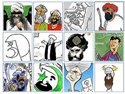
The courage of the elite: Metropolitan Museum prudentially removes images of Mohammed and renames Islamic Galleries.
———————————————————-
High rise buildings in Mecca make it evident that roughly 200 mosques are pointing in the wrong direction.
———————————————————-
Crime pays in Norway.. Foreigners qualify for welfare after a year in jail. If they serve three years, they get health benefits and qualify for old age pension. Hat tip to the News Junkie.
———————————————————-
Lawsuit begins in California federal court contending that the US Constitution mandates Gay Marriage. Wouldn’t Gouverneur Morris be surprised?
———————————————————-
Obama postpones State of the Union address in order to avoid preempting season opener of Lost.
05 Jan 2010
David Brooks is unhappy that ordinary Americans are so ungrateful as to reject the gracious willingness of their betters to take charge of the country, correct its failings, and run their lives for them.
The public is not only shifting from left to right. Every single idea associated with the educated class has grown more unpopular over the past year.
The educated class believes in global warming, so public skepticism about global warming is on the rise. The educated class supports abortion rights, so public opinion is shifting against them. The educated class supports gun control, so opposition to gun control is mounting.
The story is the same in foreign affairs. The educated class is internationalist, so isolationist sentiment is now at an all-time high, according to a Pew Research Center survey. The educated class believes in multilateral action, so the number of Americans who believe we should “go our own way†has risen sharply.
A year ago, the Obama supporters were the passionate ones. Now the tea party brigades have all the intensity.
The tea party movement is a large, fractious confederation of Americans who are defined by what they are against. They are against the concentrated power of the educated class. They believe big government, big business, big media and the affluent professionals are merging to form self-serving oligarchy — with bloated government, unsustainable deficits, high taxes and intrusive regulation. …
The Obama administration is premised on the conviction that pragmatic federal leaders with professional expertise should have the power to implement programs to solve the country’s problems. Many Americans do not have faith in that sort of centralized expertise or in the political class generally.
In the near term, the tea party tendency will dominate the Republican Party. It could be the ruin of the party, pulling it in an angry direction that suburban voters will not tolerate. But don’t underestimate the deep reservoirs of public disgust. If there is a double-dip recession, a long period of stagnation, a fiscal crisis, a terrorist attack or some other major scandal or event, the country could demand total change, creating a vacuum that only the tea party movement and its inheritors would be in a position to fill.
Personally, I’m not a fan of this movement. But I can certainly see its potential to shape the coming decade.
Being an educated sort of person myself, I find it remarkable that the positions of the community of fashion “educated” class, amounting to Luddite Catastrophism, Hedonism (tinged by a covert eugenic impulse), Appeasement, and Pacifism, really all represent extremist, self-indulgent, fantastical, and intellectually indefensible ideas, universally rejected by the mainstream traditions of Natural Science and Moral and Political Philosophy.
Education seems to have succeeded in inculcating a sense of group identity, featuring a habitual reliance on conformity as a status marker, but it has obviously not succeeded in the generality of its beneficiaries in producing people able to distinguish between established science and unverifiable models. It has produced a prominent and recognizable portion of the population with an exaggerated sense of self-entitlement and an overweening confidence in its own expertise, which at the same time demonstrates a complete inability not only to learn from history, but even to remember more than a couple of years into the past.
Our soi disant educated class typically has none of the fruits of education, beyond that produced by effective training in sophistry: skill in the manipulation of words, symbols, and ideas. Ordinary Americans commonly have a profound intellectual advantage over today’s educated elites in the possession of character and an independence of mind capable of rejecting the impulses of fashion. Ordinary Americans see through Global Warming because they have common sense. What passes for education in Mr. Brooks’s view of the world is the willing subordination of independent thought in favor the echo chamber consensus found in the establishment media. Bow to the Times’, the New Yorker’s, the New York Review of Books’ authoritative positions and perspectives and you are educated.
Some education.
30 Dec 2009
Arnold Kling explains why liberals so often make no sense, why liberal political propositions are advanced so commonly in complete indifference to the facts. Liberal politics typically operate principally as an identity marker. People express liberal positions as a way of indicating and affirming their own memberships in the community of fashion, as a way of identifying themselves as part of the national elite.
Although empiricism has become a standard philosophy in the West, dogma persists. I believe that the main reason that non-verifiable ideas survive is that they serve as trust cues. People still need to demonstrate their commitment to membership in groups, and recitation of dogma is a low-cost method of doing so.
[Nicholas] Wade [in Before the Dawn] writes,
“Modern states now accomplish by other means many of the early roles performed by religion, which is why religion has become of less relevance in some societies. But because the propensity for religious belief is still wired into the human mind, religion continues to be a potent force in societies that still struggle for cohesion.” (p. 164)
This raises the possibility that political beliefs serve primarily as trust cues. For example, those who favor an increase in the minimum wage are sending trust cues to people on the Left, and those who oppose an increase in the minimum wage are sending trust cues to people on the Right.
The actual consequences of raising the minimum wage are rarely discussed. In other words, political debates often ignore what I call Type C arguments (from empiricism) and turn instead to type M arguments, which accuse one’s opponent of belonging to an outcast group. The reason for this is that people are not trying to persuade each other rationally. Instead, they are using trust cues to indicate that failure to agree implies excommunication from the group.
The Last Psychiatrist makes the same point:
The NYT is a blog pretending to be a newspaper. It’s for adults, or people who want to pretend they’re adults, who remember as kids that reading the Times meant something that they’d now like to apply to themselves. Now it’s Bandwagon of the Month reporting: anyone see any global warming articles recently? Bush is suppressing them, I guess.
So the problems it describes must always be of the form: “the other guys who are not you are bad.” That’s widley perceived as liberal bias, though that’s not accurate. It’s “not you” bias.
Hat tips to Dr. Joy Bliss and Karen L. Myers.
12 Dec 2009

Phelim McAleer, director and producer of Not Evil Just Wrong (2008) attempted to ask Stanford University Professor Stephen H. Schneider some questions about the Climategate scandal during a press briefing at the climate change conference in Copenhagen.
As soon as McAleer’s question is recognized as critical, Professor Schneider’s assistant sends a pretty young female UN employee to try to take away the microphone from McAleer, while using her cell phone to summon security.
Schneider snarls in response: “I don’t make comments on redacted emails presented to me by people whose values I don’t trust. … What I can say is that private communications which people have between each other are certainly not public documents.”
McAleer is just trying to ask a followup question, when he is interrupted by Schneider’s assistant breaking in (inaudibly on the video). Schneider responds, “I agree. We’ll make it short.”
There is to be no followup. An armed UN Security Guard soon appears, menacing McAleer and his cameraman, and McAleer is ejected.
1:35 video
Hat tip to Big Government.
09 Dec 2009

Sarah Palin: crazed hick or naughty child in New Yorker’s caricature?
Back in September, Sam Tanenhaus published a slender book titled, in a note of hopeful optimism, The Death of Conservatism.
Alas! Barack Obama is sinking in the polls, populist critics like Glenn Beck have had a field day exposing the controversial aspects of his appointees, the progressive impetus is faltering in the halls of Congress, and prospects for the kinds of champions of “the civic sector” that Tanenhaus admires are looking dim in upcoming elections.
With characteristic even-handedness, the liberal New Yorker turned to Conservatism expert Tanenhaus for its “review” of Sarah Palin’s memoir “Going Rogue.”
What Tanenhaus really delivers is an in-print liberal temper tantrum, trashing Palin up, down, and sideways, sinking frequently to the level of the high school “in crowd” savaging the non-cool kid from the not-rich family who got above herself. Carried away by his indignation at the nerd Palin, from the wrong side of the nation’s geography and class structure, daring to sit down at the lunch table reserved for the cultural equivalent of cheer leaders and football players, Tanenhaus openly reveals what liberals really think (in their most secret little hearts): Sarah Palin represents the erasure of any distinction between the governing and the governed.
Unlike our liberal friends, we conservatives think the American Revolution erased that distinction. In today’s America, the successors to Jefferson and Madison and Jackson, the people who really believe in the equality of the individual before the law, the people who believe that people from outside the ranks of the national Establishment may be worthy and capable of holding high office, are Republicans.
Today’s liberals are a strange combination of the Secret Six, the Narodnaya Volya, and every high school’s ruling clique. Like the 19th century radical Abolitionists with whom they explicitly identify, Liberals believe they are morally and intellectually more enlightened than Americans generally, and perceive grave and fundamental sins (retrospectively, Slavery and segregation and other forms of inequality; contemporaneously, the absence of National Health Care and the profanation of the Natural World) blemishing America, which they feel entitled to correct regardless of what any or all of the rest of us happen to think about it. Like the 19th century underground radical conspirators, and despite the Fall of the Soviet Union, they still consider themselves a Vanguard of the Left, empowered by History to bring society as it currently exists forcibly into a Utopian future, characterized by an enormously expanded Statism benificently presided over by an elite intelligentsia (i.e. themselves).
On a more mundane level, like any high school clique, they feel entitled to rule, and they demand deference, on the basis of status. Tanenhaus refers to “distinction,” which he summarizes as consisting of skill, experience, intellect but, as we saw in the 2008 campaign, in which the record of the most popular and successful governor in the nation was compared disfavorably by every liberal evaluator of “distinction” to a candidate whose only meaningful accomplishments were a (possibly ghost-written) post-Law School memoir and the campaign then still underway, that skill, experience, and intellect tend to be qualities varying greatly in the eye of the beholder. A captious critic could easily observe that the election of Barack Obama proves just how easily the top lunch-table clique can be seduced by such superficialities as glibness and a good announcer’s voice.
22 Sep 2009
Michael Barone admires the liberal establishment’s recent efforts to marginalize dissent.
I would submit that the president’s call for an end to “bickering” and the charges of racism by some of his supporters are the natural reflex of people who are not used to hearing people disagree with them and who are determined to shut them up.
This comes naturally to liberals educated in our great colleges and universities, so many of which have speech codes whose primary aim is to prevent the expression of certain conservative ideas and which are commonly deployed for that purpose. (For examples, see the Website of the Foundation for Individual Rights in Education, which defends students of all political stripes.) Once the haven of free inquiry and expression, academia has become a swamp of stifling political correctness.
Similarly, the “mainstream media” — the old-line broadcast networks, The New York Times, etc. — present a politically correct picture of the world. The result is that liberals can live in a cocoon, an America in which seldom is heard a discouraging word. Conservatives, in contrast, find themselves constantly pummeled with liberal criticism, on campus, in news media, and in Hollywood TV and movies. They don’t like it, but they’ve gotten used to it. Liberals aren’t used to it and increasingly try to stamp it out.
Read the whole thing.
If we study the vocabulary of the American elite, we find that strange things have happened to the English language. Slavish conformity of thought, readiness to bow to conventional opinion, credulous acceptance of popular alarms, willingness to embrace crude simplifications, and firm refusal to question supposed authority and pretended expertise are continually cited as evidencing sound judgment and good education. Skepticism and questioning the authority of media culture is, on the other hand, extremist, polarizing, and ignorant. Our contemporary political culture basically turns language inside out. The most craven conformist mouthing empty platitudes (Albert Gore) is praised for wisdom and bravery, and anyone attempting to subject a received prescription to scrutiny or analysis (Sarah Palin, Rush Limbaugh) is intrinsically unintelligent.
20 Sep 2009
Michael Medved, back at college, used to be a liberal. Michael got wiser as he grew older.
Some partisans on the left… (resist being described as unpatriotic), insisting that they love the United States just as much as any right winger. The distinction, progressives regularly aver, involves their affection for a perfected America that might, through hope and change, come into existence sometime in the future, or else their nostalgic reverence for an America that once was, but ceased to exist through some malevolent influence (greedy businessmen, the religious right, conniving conservatives, take your pick).
Anyone with a modicum of experience in human relations will tell you that a devotion based on what your love object might become, or may have been in the past, is a suspect and toxic form of affection. If, in a moment of insecurity, a wife asks a husband, Honey, do you love me? the last thing she wants to hear is, Actually, I love the idea of you if you changed completely. In other words, its not advisable to tell the woman in your life that you’d adore her if she’d only lose fifty pounds, submit to liposuction and breast augmentation surgery, get a new set of gleaming white caps for her teeth, and complete a post graduate degree so she’d offer more intriguing conversation.
18 Sep 2009
Arnold Kling sees the culture wars spinning further and further out of control and experiences despair.
I think the long-term significance of what is going on, both at the progressive end and at the Tea Party end of the political spectrum, is an open rupture. In the 1960’s, a Hubert Humphrey or Robert Kennedy could connect with uneducated white voters. The idea of blowing them off was unthinkable, if only because they were such a large majority of the voting population at the time.
Now, the elitism of President Obama and his supporters has reached in-your-face levels. They have utter contempt for the Tea Party-ers, and the Tea-Party-ers know it.
I wouldn’t want the Tea Party-ers at the faculty picnic, either. But my sense of class solidarity with Obama and other educated progressives does not make me want to see them exercise power. If anything, being a member of the educated elite and knowing knowing them as well as I do makes me share the Tea Party-ers’ fears.
I come back to my view that this is white, small-town America making its last stand. However, I think, also, that the progressive elite is making a last stand. My guess is that doubts are mounting among many independent voters about whether they want such a highly-charged politics. I am sticking with my bet that the Democrats will hold onto their House and Senate majorities as well as the Presidency through the elections of 2016, but relative to six months ago I feel that I am depending more on Republican incompetence than overall political trends to win that bet.
One could argue that this country is on the verge of a crisis of legitimacy. The progressive elite is starting to dismiss rural white America as illegitimate, and vice-versa. I see the chances of both sides losing as much greater than the chance of either force winning.
Your are browsing
the Archives of Never Yet Melted in the 'The Intelligentsia' Category.
/div>
Feeds
|



