Category Archive 'The Left'
09 Sep 2010

Andrew McCarthy expresses the view, which I share, that the American people have gotten tired of hearing about how much deference we need to pay to the sensibilities of Muslims.
A tectonic shift is in motion: How fitting that its focal point is Ground Zero, the inevitable fault line between Islam and the West.
Only the blink of an eye ago, uttering the unpleasant truth that in terms of doctrine there is no such thing as “moderate Islam†resulted in one’s banishment from what our opinion elites like to call the “mainstream,†by which they mean the narrow-minded, viciously defended circle of their own pieties and fictions. You could say it, but your skin had better have an extra coat or two of thick: You were in for a fusillade of rage, the likes of which our candor-phobic elites would never dream of unleashing at our Islamist enemies — no matter how clearly those enemies announced their intention to destroy us.
The fusillade still comes, but now its blows only glance. The elites and their mainstream have been exposed as frauds: Being on the wrong side of enough 70-30 issues will do that to you.
Read the whole thing.
01 Sep 2010

Daniel Greenfield, from across the border in Canada, looks at, and reflects upon, the American mainstream media’s determined self destruction.
Whether it’s Newsweek being sold to the husband of a Democratic congresswoman for a dollar, or ABC deciding to turn This Week into a BBC program by turning it over to Christiane Amanpour, last week the dying media itself provided us with two examples of why it’s dying.
By choosing radicalism over readers, the media continues narrowing its own readership and viewership, pursuing ideological purity, not only over integrity, but even over its own profits and future viability.
Take ABC’s news division, which has always been notorious for its political radicalism and distaste for the average American viewer.
Whether it was Peter Jennings comparing American voters to “a nation two-year olds†throwing a tantrum for voting in a Republican congress in 1994 (expect this metaphor to make a comeback after these midterm elections) or Ted Koppel turning the names of dead servicemen into an anti-war statement (Koppel was the alternative candidate to take over This Week), this has been the ABC way. But turning over This Week to Christiane Amanpour is part of the growing blend of ABC News and the BBC.
The question though is who is Christiane Amanpour meant to appeal to? To viewers who wanted another foreign talking head snootily reading the news at them, not to them. Who were desperately longing for an ABC News on air personality sympathetic to Islamic terrorists? And why would those people even bother with ABC News, when they already have the BBC.
The problem with the American media is that it doesn’t speak to Americans. That’s why FOX News is successful, and CNN is in the basement. Network news exists underwritten by medication and mutual fund commercials, and even so it’s losing money. ABC News is making severe cutbacks even while cutting Amanpour a 2 million dollar paycheck for a show hardly anyone watches anymore. …
And that is why the media is doomed. By putting politics over profitability, the media left alienated viewers and readers exactly during the critical transition period when it needed them most. And the worse its fortunes grow, the more radical its politics have become.
Ruling out NewsMax as a buyer, while selling Newsweek to the husband of a Democratic congresswoman for a dollar (still more than it’s worth) will allow it to keep grinding along for a time as a source of lifestyle tips and left wing rants. It is however only a matter of delaying the inevitable. The media cannot survive as a pity project. Not while it is alienating its remaining viewers and readers. And even a government bailout cannot sustain a financially unsustainable industry. And finally there are only so many jobs available at PBS and NPR.
When the left turned magazines, newspapers and TV news into its own bully pulpit, they helped drive away consumers, while locking up those same publications and broadcasts into a liberal ghetto, that was still not liberal enough for them. As print publications increasingly turn their websites into masses of blogs, it becomes hard to tell the difference between Time Magazine, Foreign Policy and the New York Times—and the Huffington Post and Daily Kos. All of them have angry left wing bloggers denouncing Republicans, America and Israel. The difference is that the official media outlets have more prominent names like Joe Klein or Robert Mackey blogging for them.
The Journalist scandal is the tip of the iceberg that shows just how thin the line between the press and the policies that they advocate really is. But that’s not news to anyone. The liberal media is not some right wing talking point, poll after poll shows most of people who read newspapers and watch the news have come to that conclusion on their own. Because while the media elite may sneer at them, the public knows quite well what they stand for. And the more the media goes left, the less the public trusts it. …
The left’s hijacking of American culture has turned institutions into rags and rubble, and it will only get worse. Because the left does not know when to stop. Does not understand that it should stop. That is why left wing revolutions that do succeed, eventually culminate in multiple levels of purges that exterminate many of the original revolutionaries, or send them off to fight and die somewhere else, turning them into convenient martyrs who look good on blood-red T-shirts.
Read the whole thing.
Hat tip to the Barrister.
01 Sep 2010
As the fatal election in November inevitably approaches, Rob Long notes that the left is gradually moving past Denial to the second stage.
It’s all part of the Kubler-Ross model, the Five Stages of Grief. Now they’re turning to Stage Two: Anger. Angry at the voters, at Fox News, at Obama himself.
Next up: Bargaining. I’m not sure when that’s going to start — probably a few weeks after Labor Day. But as always, what we’re all waiting for is Stage Four: Depression.
Stage Five is Acceptance, but I’m not holding my breath for that one.
29 Aug 2010
In the Wall Street Journal, James Taranto, responds to the recent editorial by Charles Krauthammer, to explore even further the pathologies of “the snobbery of the cognitive elite.”
The Ground Zero mosque is an affront to the sensibilities of ordinary Americans. “The center’s association with 9/11 is intentional and its location is no geographic coincidence,” as the Associated Press has reported. That Americans would find this offensive is a matter of simple common sense. The liberal elites cannot comprehend common sense, and, incredibly, they think that’s a virtue. After all, common sense is so common.
The British philosopher Roger Scruton has coined a term to describe this attitude: oikophobia. Xenophobia is fear of the alien; oikophobia is fear of the familiar: “the disposition, in any conflict, to side with ‘them’ against ‘us’, and the felt need to denigrate the customs, culture and institutions that are identifiably ‘ours.’ ” What a perfect description of the pro-mosque left.
Scruton was writing in 2004, and his focus was on Britain and Europe, not America. But his warning about the danger of oikophobes–whom he amusingly dubs “oiks”–is very pertinent on this side of the Atlantic today, and it illuminates how what are sometimes dismissed as mere matters of “culture” tie in with economic and social policy:
The oik repudiates national loyalties and defines his goals and ideals against the nation, promoting transnational institutions over national governments, accepting and endorsing laws that are imposed on us from on high by the EU or the UN, though without troubling to consider Terence’s question, and defining his political vision in terms of universal values that have been purified of all reference to the particular attachments of a real historical community.
The oik is, in his own eyes, a defender of enlightened universalism against local chauvinism. And it is the rise of the oik that has led to the growing crisis of legitimacy in the nation states of Europe. For we are seeing a massive expansion of the legislative burden on the people of Europe, and a relentless assault on the only loyalties that would enable them voluntarily to bear it. The explosive effect of this has already been felt in Holland and France. It will be felt soon everywhere, and the result may not be what the oiks expect.
There is one important difference between the American oik and his European counterpart. American patriotism is not a blood-and-soil nationalism but an allegiance to a country based in an idea of enlightened universalism. Thus our oiks masquerade as–and may even believe themselves to be–superpatriots, more loyal to American principles than the vast majority of Americans, whom they denounce as “un-American” for feeling an attachment to their actual country as opposed to a collection of abstractions.
Yet the oiks’ vision of themselves as an intellectual aristocracy violates the first American principle ever articulated: “We hold these truths to be self-evident, that all men are created equal . . .”
This cannot be reconciled with the elitist notion that most men are economically insecure bitter clinging intolerant bigots who need to be governed by an educated elite. Marxism Lite is not only false; it is, according to the American creed, self-evidently false. That is why the liberal elite finds Americans revolting.
27 Aug 2010

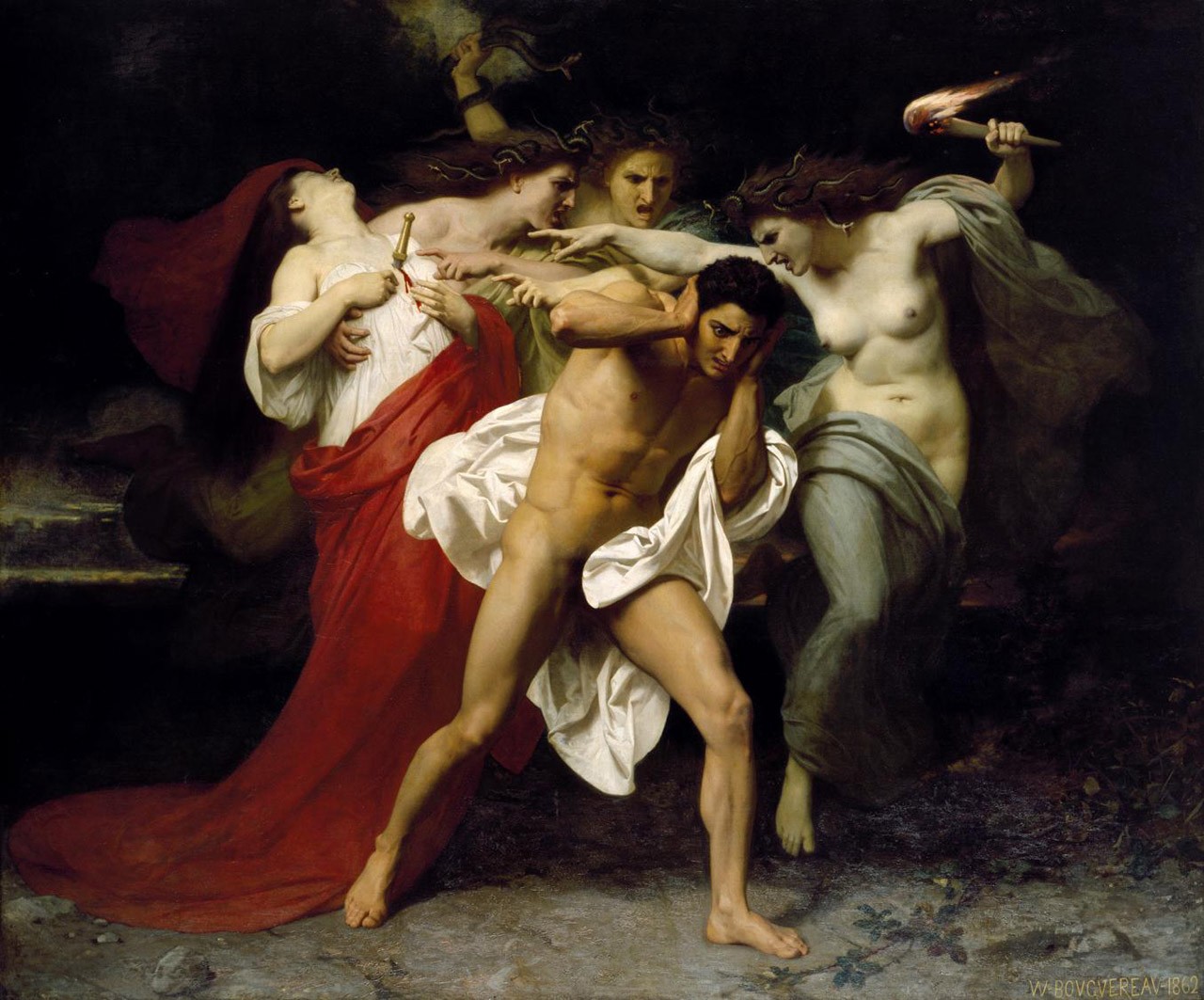
Willem-Adolphe Bouguereau, Liberal Democrat Pursued By the Furies, 1862, Chrysler Museum of Art
Rich Lowery explains how the democrat minority lucked into control of both electoral branches of government and then proceeded to self destruct.
The frustrations of minority status can drive a political party batty.
The temptation is to substitute belligerence for thought, insist on a self-destructive purity, lash out at the American public and question the wisdom and viability of the country’s institutions. Indulging in these tendencies almost always makes a party’s position worse rather than better.
The Obama Democrats may be the first party to engage in this self-defeating behavior — borne of a frustrated desperation — while holding the presidency and both houses of Congress by substantial margins.
Through an accident of timing (a national election coinciding with a financial crisis) and the exhaustion of the Bush-DeLay Republicans (who lost power almost by default), liberals took the commanding heights of the federal government while remaining a minority disposition in our national life. In short, they became a rump majority.
Through President Obama’s alchemy, these temporarily enlarged congressional numbers were supposed to be transformed into a permanent realignment. It hasn’t worked out, obviously.
In the last 20 months, Democrats have had the power to do almost everything they want, except command the allegiance of the public. That has made them and their allies feel embattled, isolated and perpetually aggrieved. They act like a forlorn minority at the same time they control every lever of elective power in Washington.
The ultimate source of the Democrats’ discontent is quite simple: They’ve lost independents. In 1994, in taking Congress, Republicans won independents by 14 percentage points. In 2006, in taking it back, Democrats won independents by 18 points. In the latest Gallup survey, Republicans lead among independents by 11 points. …
The pollster.com average of Obama’s approval rating among independents is a dismal 37.9 percent. This meltdown should have launched a thousand agonized liberal op-eds, conferences and strategy papers on how to win back the center. If, that is, liberalism had any realistic sense of its limits.
In the midst of a catastrophic loss of the middle, Obama’s supporters exhort him to get more angry, insistent and ambitiously liberal. Having already pushed for a bridge too far, they want to go farther still. When they can’t, they conclude it’s a damning indictment of Obama’s failure of nerve and the nation’s ungovernablility.
There’s little acknowledgment that the country is in a different place than they are. To the extent there is, so much worse for the country, which is condemned for its backwardness and intolerance. The majority is not just wrong on immigration enforcement and the Ground Zero mosque, it’s contemptible. Who knew that the American public would get accused of bigotry more often after electing an African-American president than before?
As former Bush speechwriter Peter Wehner writes, liberals “are expressing deepening alienation from our nation and turning on the American people with a vengeance.” They thought they had a mandate from heaven in 2008 and can’t bear the thought that they deluded themselves. They’ve gone from triumphalism to a petulant and uncomprehending tantrum in less than two years. The rump majority looks more exhausted by the day.
27 Aug 2010
The single most annoying thing about liberals is their false claim to intellectual superiority founded not on the merits of their arguments and analysis but on their long-term successful domination and near monopoly of certain institutions and professions conferring exceptional power and prestige.
They never really win any debates, but rely on their ability to shout down and, as Charles Krauthammer describes, marginalize their opposition with smears.
Liberalism under siege is an ugly sight indeed. Just yesterday it was all hope and change and returning power to the people. But the people have proved so disappointing. Their recalcitrance has, in only 19 months, turned the 40-year liberal ascendancy that James Carville predicted into a full retreat.
Ah, the people, the little people, the small-town people, the “bitter” people, as Barack Obama in an unguarded moment once memorably called them, clinging “to guns or religion or” — this part is less remembered — “antipathy toward people who aren’t like them.”
That’s a polite way of saying: clinging to bigotry. And promiscuous charges of bigotry are precisely how our current rulers and their vast media auxiliary react to an obstreperous citizenry that insists on incorrect thinking.
Resistance to the vast expansion of government power, intrusiveness and debt, as represented by the Tea Party? Why, racist resentment toward a black president.
Disgust and alarm with the federal government’s unwillingness to curb illegal immigration, as crystallized in the Arizona law? Nativism.
Opposition to the most radical redefinition of marriage in human history, as expressed in Proposition 8 in California? Homophobia.
Opposition to a 15-story Islamic center and mosque near Ground Zero? Islamophobia.
Now we know why the country has become “ungovernable,” last year’s excuse for the Democrats’ failure of governance: Who can possibly govern a nation of racist, nativist, homophobic Islamophobes?
Note what connects these issues. In every one, liberals have lost the argument in the court of public opinion. Majorities — often lopsided majorities — oppose President Obama’s social-democratic agenda (e.g., the stimulus, ObamaCare), support the Arizona law, oppose gay marriage and reject a Ground Zero mosque.
What’s a liberal to do? Pull out the bigotry charge, the trump that pre-empts debate and gives no credit to the seriousness and substance of the contrary argument.
—————————–
Laura Ingraham denounces the same pattern of liberal behavior and calls for genuine debate. 2:23 video
11 Aug 2010
Tony Blankley says it’s time for Americans to put our self-appointed rulers, the urban pseudo-intellectual community of fashion, in its place. Register and be sure to vote in November. Let’s restore democracy and take America back.
A foul and dangerous brew is heating up that is composed of: (1) The economic collapse that started in 2008; (2) the radical, “fundamentally transforming” left-wing agenda of the government; and, (3) the thwarting of the public will — with glee — by the entrenched, non-elected powers (in the courts, media, colleges and government bureaucracies) as they get into the face and under the skin of the cultural and political majority.
It is insufferable (and will not long be suffered) to be lectured to and imposed upon by a ruling class that loathes our nation’s history, values and accomplishments; by those who are not, in fact, our genuine betters. They are neither better educated nor more profoundly morally versed.
In fact, they are our intellectual and moral inferiors — not superiors. Constantly grinning Supreme Court Justice Elena Kagan didn’t think the Declaration of Independence’s proclamation that human beings “are endowed by their Creator with certain unalienable rights” should in any way affect her understanding of our constitutional rights — presumably, if any.
Part of the building danger derives from the fact that Americans now tend to self-select our news, opinion and entertainment sources based on our political beliefs and cultural and religious preferences. As a result, the nation no longer shares a common database of civic reality. Many liberals have no sense of how deep and roiling this no-longer-just-conservative passion is. Or they assume it involves some small, mendacious, ideological faction rather than a broad-based, nonideological, building national majority, which it does.
08 Aug 2010
Historian Victor Davis Hanson points out that the past explains how America got where it is today.
If one were to survey the elite campuses around 1975 and talk to those in law school, poly sci, or the humanities, then imagine them 35 years later as our elite leaders in government, the media, the universities, the foundations, and the arts, one could pretty much expect what we now have.
The present symptoms that characterize both our popular culture and current governance — shrill self-righteousness; abstract communalism juxtaposed with concrete pursuit of the aristocratic good life; race/class/gender cosmic sermonizing with private school and Ivy league for the kids; crass and tasteless public expression; a serial inability to take responsibility for one’s actions; the bipartisan mega-deficits; the inability to cut pensions and social security for the baby boomers — from the trivial to the fundamental, all derive from a bankrupt cohort that came of age in the sixties and seventies.
We see the arrested adolescence and hypocrisy that come from that sermonizing generation, whether in Al Franken’s puerile face-making, the ideologically driven suicide at Newsweek, the steady destruction of the New York Times, John Kerry’s tax-avoiding yacht, the Great Gatsby Clinton wedding, Michelle on the Costa del Sol, Nancy Pelosi’s jet, Tim Geithner’s tax skipping, or the constant race-card playing of a Charles Rangel and Maxine Waters. Yes, one walk across the Yale or Stanford campus circa 1975, and one could see pretty clearly what sort of culture that bunch would create when it came of age and was handed power.
30 Jul 2010

Rep. Barney F. Bourbon
Richard Fernandez identifies the international aspects of the thesis of Angelo Codevilla’s recent important essay.
Niall Ferguson is touring Australia warning that the end of American dominance may be imminent and sudden. Somehow the ideas in Codevilla’s essay are popping up everywhere, whether people have read it or not. Ferguson describes how rapidly empires can fall.
The Bourbon monarchy in France passed from triumph to terror with astonishing rapidity. The sun set on the British Empire almost as suddenly. The Suez crisis in 1956 proved that Britain could not act in defiance of the US in the Middle East, setting the seal on the end of empire.
But those things happen only to the denizens of history. People who live in the today usually think they are different. So despite evidence of dramatic change, people who have spent their whole lives among the policy certainties of the postwar period find it difficult to accept they may have to build a world of their own from first principles. Ferguson asks his audience: “what would you do in a world without America? Has the question even crossed your mind?â€
Australia’s post-war foreign policy has been, in essence, to be a committed ally of the US. But what if the sudden waning of American power that I fear brings to an abrupt end the era of US hegemony in the Asia-Pacific region? Are we ready for such a dramatic change in the global balance of power? Judging by what I have heard here since I arrived last Friday, the answer is no. Australians are simply not thinking about such things.
But if the Australians are not thinking about it, the Chinese are certainly preparing for it. The Wall Street Journal recently noted that Beijing objected to the right of US naval vessels to exercise in the Yellow Sea, despite the fact that they are international waters. At least they used to be. Waters are only international if kept so by a powerful navy committed to the freedom of the seas. People sometimes forget that treaties reflect realities rather than create them, no matter what the European Union may think. …
[Caroline Glick observes that] “[j]ust as US bureaucrats, journalists, politicians and domestic policy wonks tend to combine forces to perpetuate and expand the sclerotic and increasingly bankrupt welfare state, so their foreign policy counterparts tend to collaborate to perpetuate failed foreign policy paradigms that have become writs of faith for American and Western elites.†In other words, when it comes down to funding politics or funding defense, fund politics. Ferguson made the same point more starkly: “it is quite likely that the US could be spending more on interest payments than on defense within the next decade.â€
If the love of money is the root of all evil, the lack of it is the cause of the fall of empires. Ferguson gave some examples:
Think of Spain in the 17th century: already by 1543 nearly two-thirds of ordinary revenue was going on interest on the juros, the loans by which the Habsburg monarchy financed itself.
Or think of France in the 18th century: between 1751 and 1788, the eve of Revolution, interest and amortisation payments rose from just over a quarter of tax revenue to 62 per cent.
Finally, consider Britain in the 20th century. Its real problems came after 1945, when a substantial proportion of its now immense debt burden was in foreign hands. Of the pound stg. 21 billion national debt at the end of the war, about pound stg. 3.4bn was owed to foreign creditors, equivalent to about a third of gross domestic product.
Alarm bells should therefore be ringing very loudly indeed in Washington, as the US contemplates a deficit for 2010 of more than $US1.47 trillion ($1.64 trillion), about 10 per cent of GDP, for the second year running.
But alarm bells aren’t ringing in Washington. The entire alarm system has been disabled, disconnected, perhaps scrapped. Anyone who wants to turn it back on will have to root through the dumpster to see if any usable parts can still be retrieved. No better symptom of the absence of alarms is the genuine astonishment of Charles Rangel that it is illegal to break the law. Almost as a matter of course he concealed hundreds of thousands of dollars in income, used Congressional letterhead to solicit donations for private causes, took four rent controlled apartments for himself. Innocently. He probably didn’t think he was doing anything wrong. Things had been so sweet, so long that even after he was offered the chance to negotiate his way out of 13 separate violations of House rules and federal statutes he simply refused to believe it was happening.
Like Brecht’s fictional Atlantean who “the night the seas rushed in … still bellowed for their slaves,†the members of what Codevilla called the “ruling class†can’t believe it is happening. They still want their last dollar, their last perk. Literally, no matter what. “Massachusetts Congressman Barney Frank caused a scene when he demanded a $1 senior discount on his ferry fare to Fire Island’s popular gay haunt, The Pines, last Friday. Frank was turned down by ticket clerks at the dock in Sayville because he didn’t have the required Suffolk County Senior Citizens ID. A witness reports, ‘Frank made such a drama over the senior rate that I contemplated offering him the dollar to cool down the situation.’â€
The worst thing about the ferry incident is the possibility that if the witness had really offered Frank the dollar he might actually have taken it. Automatically; out of conditioning, like a Pavlovian dog. The culture in which the chairman of the House Financial Services Committee rose to power is one in which it is OK to blithely borrow more money than the entire defense budget can service and yet refuse to spend one whole dollar of his own money. The ethos of that world can be captured in one phrase: “don’t you know who I am?â€
21 Jul 2010
Roger Simon reads the Journolist emails and is appalled at the mediocrity of it all.
These quotes from a private list of soi-disant liberal journalists read like outtakes from some notebook stolen from a proto-Trotskyite home for the aged — and not one of them is faintly clever. What a bunch of fuddy-duddys. Yes, I know Strong was being selective for his own purposes, but still … these guys are writers? Hunter Thompson not. For that matter, Roger Kimball not.
But forget the paucity of imagination and style, what about the group think? These are the independent minds that seek to mold our culture and political lives? Nowhere to be found is an original thought – unless you count accusing Karl Rove of racism as a brainstorm.
Well, we have had the generation gap and tons of other gaps. Now Journolist reveals we have an “elitism gap.†Gone are the days of the Algonquin Round Table to be replaced by a cabal of humdrum mediocrities on a listservr plotting how to justify the racist ravings of a reactionary theocrat.
17 Jul 2010
Angelo M. Codevilla wonders how long two-thirds of America can possibly be ruled by a well-entrenched elitist third.
Never has there been so little diversity within America’s upper crust. Always, in America as elsewhere, some people have been wealthier and more powerful than others. But until our own time America’s upper crust was a mixture of people who had gained prominence in a variety of ways, who drew their money and status from different sources and were not predictably of one mind on any given matter. The Boston Brahmins, the New York financiers, the land barons of California, Texas, and Florida, the industrialists of Pittsburgh, the Southern aristocracy, and the hardscrabble politicians who made it big in Chicago or Memphis had little contact with one another. Few had much contact with government, and “bureaucrat” was a dirty word for all. So was “social engineering.” Nor had the schools and universities that formed yesterday’s upper crust imposed a single orthodoxy about the origins of man, about American history, and about how America should be governed. All that has changed.
Today’s ruling class, from Boston to San Diego, was formed by an educational system that exposed them to the same ideas and gave them remarkably uniform guidance, as well as tastes and habits. These amount to a social canon of judgments about good and evil, complete with secular sacred history, sins (against minorities and the environment), and saints. Using the right words and avoiding the wrong ones when referring to such matters — speaking the “in” language — serves as a badge of identity. Regardless of what business or profession they are in, their road up included government channels and government money because, as government has grown, its boundary with the rest of American life has become indistinct. Many began their careers in government and leveraged their way into the private sector. Some, e.g., Secretary of the Treasury Timothy Geithner, never held a non-government job. Hence whether formally in government, out of it, or halfway, America’s ruling class speaks the language and has the tastes, habits, and tools of bureaucrats. It rules uneasily over the majority of Americans not oriented to government.
The two classes have less in common culturally, dislike each other more, and embody ways of life more different from one another than did the 19th century’s Northerners and Southerners — nearly all of whom, as Lincoln reminded them, “prayed to the same God.” By contrast, while most Americans pray to the God “who created and doth sustain us,” our ruling class prays to itself as “saviors of the planet” and improvers of humanity. Our classes’ clash is over “whose country” America is, over what way of life will prevail, over who is to defer to whom about what. The gravity of such divisions points us, as it did Lincoln, to Mark’s Gospel: “if a house be divided against itself, that house cannot stand.”
A must read.
12 Jul 2010
Gallup polling reveals widespread public uncertainty about the “progressive” political label — a label recently embraced by no less than Supreme Court nominee Elena Kagan. While Kagan described her political views as “generally progressive” during her Senate confirmation hearings, fewer than half of Americans can say whether “progressive” does (12%) or does not (31%) describe their own views. The majority (54%) are unsure.
Allow me to clear it up for you, fellow Americans.
The Progressive Movement was originally a post-Civil War American political popular movement in favor of statism, regulation, and general (so-called) reform.
The earlier expressions of the Progressive impulse involved the creation of a Civil Service, the gradual expansion of state and federal regulations, the creation of new regulatory bodies, and the licensing of professions. Antitrust legislation, alcohol and drug prohibition, the Income Tax followed.
In recent years, particularly since the West learned of Communist massacres in Cambodia, China crushed demonstrations in favor of democracy in Tiananmen Square, and the Soviet Union fell, persons on the extreme left have become uncomfortable with describing themselves as Marxists or socialists. Radicals never liked being referred to as mere liberals. They despise liberals as dupes, fellow travelers, and useful idiots. And even “liberal,” since the days of Jimmy Carter, has become widely regarded in America as a pejorative and its successful application to someone a potential political liability.
Aspiration to major political office is intrinsically incompatible with describing oneself as a radical or a revolutionary, so the preferred term of art has become “Progressive.”
The progress that progressives are in favor of is directly down the path Friedrich Hayek referred to as “the Road to Serfdom,” toward ever more statism, ever more regulation, ever more redistribution, socialism, and coercion, supposedly resulting in the ultimate triumph of the rule of experts and a world in which the calculative power of human reason will have abolished tragedy, poverty, inequality, all of the ills to which flesh is heir and all the consequences of human vice and folly.
As Edmund Burke observed: “In the groves of their academy, at the end of every vista, you see nothing but the gallows.”
If Americans recognized exactly what Progressives really are, they would not be getting elected to much of anything or confirmed to Supreme Court seats.
/div>

Feeds
|