Category Archive 'The Right Stuff'
28 Dec 2013

Lt. Gen. Hubert de la Poer Gough
“It so happened that I was in command of ‘A’ Squadron and brought it to parade five minutes before time. Goughy* appeared at 9.00 am and had his trumpeter sound ‘Squadron Leader’. We all galloped up and saluted, and he addressed us as follows. ‘Good morning, gentlemen. I noticed 1 squadron on parade this morning five minutes early. Please remember that it is better to be late rather than early. The former shows a sense of sturdy independence and no undue respect for higher authority, the latter merely shows womanish excitement and nervousness. Go back to your squadrons.’”
*”Goughy” = http://en.wikipedia.org/wiki/Hubert_Gough
— From the memoirs of Brigadier Sir Edward Beddington (1884-1966), late of the 16th Lancers.
Hat tip to John Brewer.
01 Nov 2013


The Guardian has the story of an 80-Year-Old who fought a bear and was tossed off a cliff and still survived.
An octogenarian versus a hungry Russian bear. It was a confrontation that could have ended only one way, and yet shepherd Yusuf Alchagirov was sitting upright in bed this week and happily munching on the three traditional pies his family had baked in celebration at his survival.
The bear approached Alchagirov, 80, in a raspberry field in the southern Russian region of Kabardino-Balkaria last week, but despite his age, Alchagirov showered kicks and headbutts on the bear and managed to knock it off balance.
The bear, apparently irritated by the feisty shepherd, tossed him off a cliff and sauntered away, said Alchagirov in an interview with local television. He was hospitalised with bruises, bite wounds and four broken ribs, but was spared a mauling, and released within a few days. It is not known whether the bear suffered any lasting injuries.
“I got off easy. It would have killed me if I’d chickened out,” Alchagirov said.
24 Sep 2013

The Daily Mail reports that a former Royal Marine, carrying a concealed handgun, happened to be drinking coffee in the Nairobi Mall at the time of the terrorist attack and was able to lend a hand, entering the mall’s interior repeatedly to lead as many as a hundred civilians to safety.
A former marine emerged as a hero of the Nairobi siege yesterday after he was credited with saving up to 100 lives.
The ex soldier was having coffee at the Westgate mall when it was attacked by Islamists on Saturday.
With a gun tucked into his waistband, he was pictured helping two women from the complex.
His story emerged as sporadic gunfire continued to ring out from inside the mall early today as Kenyan security forces battled Al Qaeda-linked terrorists into a fourth day. …
The former soldier is said to have returned to the building on a dozen occasions, despite intense gunfire.
A friend in Nairobi said: ‘What he did was so heroic. He was having coffee with friends when it happened.
‘He went back in 12 times and saved 100 people. Imagine going back in when you knew what was going on inside.’
Sources said the soldier was in the Royal Marine and now lives in Kenyan. He cannot be named for security reasons.
The British military regularly train and operate out of Kenya, and have been involved in tracking UK citizens involved with hardline Islamists in Somalia and Yemen.
Former members work with both the UK and Kenyan governments and security firms across East Africa.
Memeorandum describes him as an off-duty member of the British elite Special Air Service (SAS).
08 Sep 2013

Charles Godefroy taking his Nieuport 11 “Bébé†through the Arc de Triomphe in Paris on August 7th, 1919.
Wikipedia:
For the occasion of the victory parade on the Champs Élysées on 14 July 1919, marking the end of hostilities in World War I, the military command ordered the airmen to participate “on foot†– like the infantry. This was a provocation to the pilots, who regarded themselves as “heroes of the airâ€. At a meeting in the “Fouquet†bar located on the Champs Élysées, a group of aviators decided to address this affront by selecting one of them to fly through the Arc de Triomphe during the parade. The choice fell on Jean Navarre, who had twelve air victories and was considered to be an ace among the fighter pilots. However, Navarre was killed in a practice flight on 10 July. With 500 flying hours, Charles Godefroy considered himself experienced enough to take over the task, which excited the young aviator. With his close companion, the journalist Jacques Mortane, he inspected the Arc de Triomphe several times to examine the air route and the air currents; then he began to practice at the bridge over the Small Rhône at Miramas.
On 7 August 1919, three weeks after the victory parade, under cover of secrecy and dressed in his warrant officer uniform, Charles Godefroy took off at 7.20 a.m. from the airfield of Villacoublay in a biplane “Nieuport 11 Bébé†(Bébé = baby – because of its low wing span of 24.67 ft / 24’8’’ or 7.52 m). He reached the Porte Maillot shortly thereafter. Coming from the west, he circled the Arc de Triomphe twice and began the approach along the Avenue de la Grande-Armée. He gathered speed and forced the plane down and through the Arc. He did not have much clearance – the width of the Arc is 47.57 ft / 47’6’’ (14.50 m). He passed at a low level over a tram in which passengers threw themselves to the ground, and many passers-by ran away frightened. Godefroy flew over the Place de la Concorde before returning to the airfield, where his mechanic checked over the engine. No one at the airfield had taken any notice of the flight, which had lasted half an hour.
The journalist Jacques Mortane had the whole event filmed and photographed. Articles have been published in many newspapers. The film screening was banned by the Commissioner of Police. Godefroy stayed officially in the background, but his name could not be kept secret for long. The authorities disapproved of the event and were afraid of it being imitated, but Godefroy escaped with only a warning.
Hat tip to Ratak Monodosico.
07 Sep 2013

Via 4Gifs.
25 Aug 2013

Lieutenant Colonel John Malcolm Thorpe Fleming “Jack” Churchill, DSO & Bar, MC & Bar (16 September 1906 – 8 March 1996), nicknamed Fighting Jack Churchill and Mad Jack, was a British soldier who fought throughout the Second World War armed with a longbow, and a Scottish broadsword. He was known for the motto “any officer who goes into action without his sword is improperly armed.”
Wikipedia:
In May 1940 Churchill and his unit, the Manchester Regiment, ambushed a German patrol near L’Epinette, France. Churchill gave the signal to attack by cutting down the enemy Feldwebel (sergeant) with a barbed arrow, becoming the only British soldier known to have felled an enemy with a longbow in WWII. After fighting at Dunkirk, he volunteered for the Commandos.
Churchill was second in command of No. 3 Commando in Operation Archery, a raid on the German garrison at Vågsøy, Norway on 27 December 1941. As the ramps fell on the first landing craft, Churchill leapt forward from his position and played a tune on his bagpipes, before throwing a grenade and running into battle in the bay. For his actions at Dunkirk and Vågsøy, Churchill received the Military Cross and Bar.
In July 1943, as commanding officer, he led 2 Commando from their landing site at Catania in Sicily with his trademark Scottish broadsword slung around his waist, a longbow and arrows around his neck and his bagpipes under his arm, which he also did in the landings at Salerno. Leading 2 Commando, Churchill was ordered to capture a German observation post outside of the town of La Molina, controlling a pass leading down to the Salerno beach-head. He led the attack by 2 and 41 Commandos, infiltrated the town and captured the post, taking 42 prisoners including a mortar squad. Churchill led the men and prisoners back down the pass, with the wounded being carried on carts pushed by German prisoners. He commented that it was “an image from the Napoleonic Wars.” He received the Distinguished Service Order for leading this action at Salerno.
In 1944 he led the Commandos in Yugoslavia, where they supported Josip Broz Tito’s Partisans from the Adriatic island of Vis. In May he was ordered to raid the German held island of BraÄ. He organized a “motley army” of 1,500 Partisans, 43 Commando and one troop from 40 Commando for the raid. The landing was unopposed but on seeing the eyries from which they later encountered German fire, the Partisans decided to defer the attack until the following day. Churchill’s bagpipes signalled the remaining Commandos to battle. After being strafed by an RAF Spitfire, Churchill decided to withdraw for the night and to re-launch the attack the following morning. The following morning, one flanking attack was launched by 43 Commando with Churchill leading the elements from 40 Commando. The Partisans remained at the landing area; only Churchill and six others managed to reach the objective. A mortar shell killed or wounded everyone but Churchill, who was playing “Will Ye No Come Back Again?” on his pipes as the Germans advanced. He was knocked unconscious by grenades and captured.[9] He was later flown to Berlin for interrogation and then transferred to Sachsenhausen concentration camp.
In September 1944 Churchill and a Royal Air Force officer crawled under the wire, through an abandoned drain and attempted to walk to the Baltic coast. They were captured near the coastal city of Rostock, a few kilometres from the sea. In late April 1945 Churchill and about 140 other prominent concentration camp inmates were transferred to Tyrol, guarded by SS troops. A delegation of prisoners told senior German army officers they feared they would be executed. An army unit commanded by Captain Wichard von Alvensleben moved in to protect the prisoners. Outnumbered, the SS guards moved out, leaving the prisoners behind. The prisoners were released and after the departure of the Germans, Churchill walked 150 kilometres (93 mi) to Verona, Italy where he met an American armoured force.
As the Pacific War was still on, Churchill was sent to Burma, where the largest land battles against Japan were being fought. By the time Churchill reached India, Hiroshima and Nagasaki had been bombed and the war ended. Churchill was said to be unhappy with the sudden end of the war, saying: “If it wasn’t for those damn Yanks, we could have kept the war going another 10 years.
24 Aug 2013
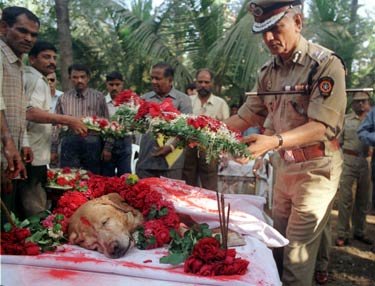
Parachutiste Francais forwarded the above photo with the caption:
UN BEL HOMMAGE POUR UN VRAI HÉROS !
Ce chien s’appel Zanjeer.
Il a sauvé des millers de vies pendant la série d’attentats à Bombay en Mars 1993 en détectant plus de 3,329 kgs d’explosifs RDX, 600 détonateurs, 249 Grenades à main et 6406 sous munitions.
Il a été enterré avec les honneurs.
—————————
trans.
A fitting homage for a true hero.
The dog was named Zanjeer [meaning “metal chain” in Persian].
He saved thousands of lives following a series of attacks in Bombay in March 1993 by detecting 3,329 kg. of RDX explosive, 600 detonators, 249 hand grenades, and 6406 rounds of live ammunition.
He was buried with honors.
—————————
Zanjeer (1992-2000) was a Golden Labrador who worked as a bomb detecting dog for the Bombay Police. He died of cancer in 2000 at age 8, and was buried with full honors by the Bombay Police.
The above photograph began going viral last March around the time of the twentieth anniversary of the Bombay attacks.
HuffPo ran a story at the time.
31 Jul 2013

Last Saturday:
For the 5k at the Venetian Festival in Charlevoix, [Michigan] Lcpl [Lance Corporal] Kerr opted to run the event wearing boots and utes [utilities] and carrying a ruck sack. Several minutes after the other Marines he was with had finished, Lcpl Kerr still had not crossed the line. They feared his extreme level of motivation may have caused him injury and/or fatigue resulting in him dropping out of the race. Moments before they ran back through the course to recover their fellow Marine, Lcpl Kerr came around the last turn along with this small boy. The boy had become separated from those who he had started the race with. He asked Lcpl Kerr, “Sir? Will you please run with me?â€. Throughout the course, Lcpl Kerr urged him on when the boy wanted to give up and ensured that the boy saw the course to completion where he was reunited with his party. By his unwavering commitment to help those in need through his ability to inspire others by his unequivocal level of motivation, Lcpl Kerr reflected great credit upon himself and was keeping in the highest traditions of the United States Marine Corps.
Hat tip to Seal of Honor via Madame Scherzo.
14 Jul 2013

“I felt no pain, but I certainly never thought for a moment that I would come out alive. I was rather calm, as a matter of fact, except for a tremendous and wildly pleasant thrill I felt, knowing that I was battling for my life.”
Carl Akeley (1864-1926), whose innovative taxidermy made possible the modern Natural History museum’s realistic displays, is renowned in African Big Game lore for coming out of top in a one-on-one contest with a leopard.
Badass of the Week describes the encounter:
[O]ne evening [in 1896] after a long day of hunting and observing wildlife in Somalia. Akeley was headed back to the spot where he’d bagged a hyena and a bigass warthog earlier in the day, but when he got there all he saw was a couple of big bloody streaks leading off into a thick brush. Akeley froze, realizing what was happening, and when a noise came from the brush, he raised his rifle and fired to try and scare it off. Suddenly, out of the thicket came this gigantic fucking leopard screaming towards him teeth-first like a psychotic killer cat being launched out of a horrible predator-launching cannon. Unable to get his weapon back around quickly enough, Akeley dropped his gun and threw his arm up just in time to prevent the vicious beast from ripping out his throat. The leopard latched on to Akeley’s left hand, chomping down with all its might, and kicking at him with its back legs like a rabid 80-pound feral housecat intent on brutally mutilating him beyond recognition and burying his body in the back yard. When his attempts to pull his hand out of the leopards’ jaws only made the creature bite down harder, Akeley, locked in a life or death fistfight with one of the most perfect predators nature ever created, did one of the most insane things ever – he punched his fist further into the leopard’s mouth.
Yes, you are reading that correctly. Carl Akeley, noted philanthropist and respected wildlife conservationist, punched a fucking leopard in the esophagus from the inside. The leopard gagged, Akeley pulled his hand out, and then he took the thing, bodyslammed it to the ground, and jumped on it with both knees, crushing it to death. Akeley, bleeding profusely from horrific wounds on both hands, clawed to shit, still recovering from a recent battle with malaria, and barely able to stand, then picked up the leopard (despite a shattered hand), threw it over his shoulder, walked back to camp with it, and taxidermized it for a museum exhibit.
Hat tip to Vanderleun.
16 May 2013
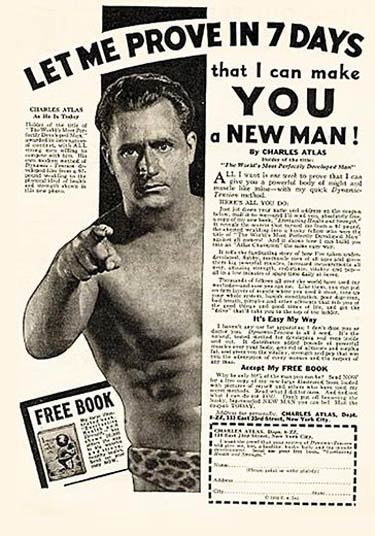
Maybe if you libs worked out more…
The Daily Mail reports (what many of us already knew):
Men who are physically strong are more likely to have right wing political views
Weaker men more likely to support welfare state and wealth redistribution
Link may reflect psychological traits that evolved in our ancestors
Strength was a proxy for ability to defend or acquire resources…
Men who are physically strong are more likely to take a right wing political stance, while weaker men are inclined to support the welfare state, according to a new study.
Researchers discovered political motivations may have evolutionary links to physical strength.
Men’s upper-body strength predicts their political opinions on economic redistribution, according to the research.
16 May 2013

Tiger Again Coming To The Charge
The actual story referred to in the title of Lieut.-Colonel Frank Sheffield’s How I Killed the Tiger (1902) amounts to only 36-pages (including numerous, highly evocative, illustrations), but even the second edition is not easy to find and will cost you something in the neighborhood of $100.
But we happily live in the age of marvels, in which even such esoteric treasures are already scanned in and sitting there available in electronic form at the touch of a fingertip.
Col. Sheffield’s yarn is quite a story.
I would not myself want to take on a fully grown Bengal Tiger with an unreliable percussion fowling piece, even if I had a couple of General John Jacob’s explosive bullets in my pocket. But, if I had been so foolhardy as to do so and wound up once knocked down and mauled by a tiger, I’d like to hope that –like Col. Shefield–, faced with another charge, I’d still have “some kick in me” and stand there, Bowie knife in hand, “determined to make a hard fight for it.”
“How I Killed the Tiger” text
“How I Killed the Tiger” plates
Hat tip to Karen L. Myers.
Your are browsing
the Archives of Never Yet Melted in the 'The Right Stuff' Category.
/div>

Feeds
|





