Category Archive 'WWII'
05 Jan 2015


Haynes King, Jealousy and Flirtation, 1874, Victoria & Albert Museum.
Every once in a blue moon, Quora has an amusing and informative answer to a question.
Asked for a small act which might prevent WWII, Jon Davis responds:
I’d give a flower to a very particular young lady at a very particular moment in time.
This would have to be a very particular young lady, of course. Given the consequences of the choice, it had better also be a very particular flower. But either way, I would give a flower to a lady.
This young woman would a be very important girl in history, because at the time I would meet her, she should rightly be meeting someone else. If I were to succeed in gaining her attention, the attention of one girl history only remembers as a footnote, and even that for only a few short minutes, history would never have been the same.
As I said, this girl must be special, so special that there is no other girl like her in the world. She must be the Duke of Cleveland’s daughter. The time would have to be around 1837.
Read the whole thing.
09 Dec 2014

Lieutenant Cesar Baza, Philippine Army Air Corps (1915 – 12 December 1941)
Richard Fernandez had a very nice Pear Harbor day posting.
[L]iberty is the building block of history; the primitive element of biography. It is perhaps even the building block of reality. Without choice — free will — everything is mechanical sound and fury. To understand this clearly, recall that today marks the 73rd anniversary of the bombing of Pearl Harbor, a moment now on the furthest fringe of living memory. Suppose the significance of that long-ago day consists not in the physical events which occurred, as if the bombs were just rocks tumbling down the hillside of some mountain, but in the things that were chosen that day.
Our telescopes are turned outward seeking Dyson Spheres in the vast reaches of the cosmos for proof of life. Yet I have on my hard drive the picture of a man long ago dead, part of a group of fliers who rose in [horribly obsolete -JDZ] Boeing P-26 Peashooters to challenge Zeros over Batangas province on December 12, 1941. The pilot did not survive the day. In some modern cosmology there is multiverse where he landed safely; just as there is one where all the battleships at Pearl Harbor rode out the day peacefully at anchor. There is a multiverse where America surrendered to Japan. But while those multiverses may exist in potential, the universe we have, through the operation of choice is the one where the flag flies, unvanquished to this day. But that particular today had its price. To purchase it the pilot could not land and the proud warships were forbidden to live out the day.
26 Aug 2014
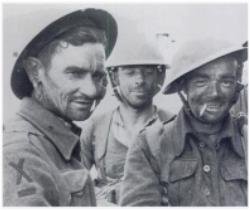
Daniel Hannan, Conservative MP, in the Telegraph.
My favourite World War II story is of the Highlander who, observing the rout on the beaches of Dunkirk, tells his sergeant: ‘If the English give in, too, this could be a long war.’
23 Jun 2014
 
Left: Standartenführer Joachim Peiper commanding 1st SS Panzer Regiment during WWII; Right: Peiper, aged 61, shortly before his murder in 1976.
For I am a man under authority, having soldiers under me: and I say to this man, Go, and he goeth; and to another, Come, and he cometh; and to my servant, Do this, and he doeth it.
–Matthew 8:9.
Reid Mitchell is a resident of New Orleans and author of a book on the history of Mardi Gras. He is best known as a Civil War historian. Mitchell taught American Studies at the University of Hong Kong as a Visiting Fulbright Professor during the 2005 academic year.
His only novel, A Man Under Authority, now out-of-print, was published in paperback by a small press publisher in 1997.
The man under authority is an aged, never specifically identified by name or nationality, Colonel (clearly directly modeled on Joachim Peiper), living in poverty in retirement in a former enemy country, eking out a modest living with translations.
The Colonel receives a letter (written, with characteristic American arrogance or linguistic ineptitude, in English) offering him a highly remunerative job as technical advisor to a film crew making a movie about his most famous battle, a battle in which he unsuccessfully led an armored assault force attempting to make a strategic breakthrough behind enemy lines.
Not unappreciative of the irony and implicit humiliation of his position, the elderly Colonel accepts the assignment, hoping to use the money to give a little pleasure to his wife.
Mitchell’s novel depicts the Colonel’s last campaign as another final desperate attempt, this time with self-awareness and the maintenance of personal dignity, rather than the Meuse River and the Allied fuel reserves, as his unreachable goal, with the infirmities of age, modern Philistinism, and his own historical status as the defeated as his adversaries.
Arriving at the production site, the Colonel finds that the film crew are using the same chateau, now a hotel, which had been his own headquarters during the famous operation. But the choice highest tower room in the oldest part of the castle this time belongs to the female director, not to him. His role, this time, will not be that of commander, but that of curiosity, ornamental credential, and bemused spectator. Nonetheless, the Colonel finds himself able to maintain his Stoicism and even, on occasion, to employ his long-disused habit of command.
06 Jun 2014
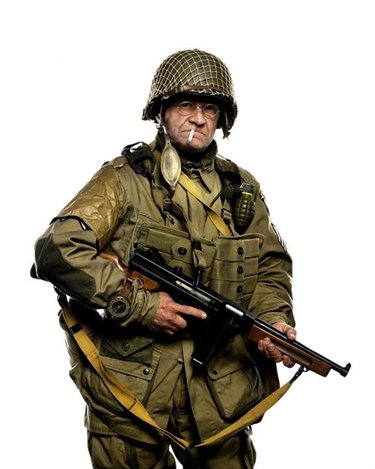
93-year-old Jim Martin yesterday successfully parachuted into Normandy wearing all the same equipment he wore 70 years ago when he jumped as part of the preliminary bridgehead seizing operations leading up to the D-Day Normandy Invasion.
Click2Houston:
“I’m feeling fine,” Martin told reporters moments after landing in a French field. “… It was wonderful, absolutely wonderful.”
Martin was part of the U.S. 101st Airborne Division that parachuted down over Utah Beach in their bid to retake France and, eventually, the rest of Europe from Nazi Germany. They actually touched down in enemy-controlled territory a night before what’s referred to as D-Day.
His jump Thursday in the same area was different and — despite his being 93 years old now — a whole lot easier.
“It didn’t (compare),” Martin said, “because there wasn’t anybody shooting at me today.” …
Seven decades later, Martin did it again — not fighting a bloody war but at least reliving his role in a military campaign that changed the course of history. Others joined him in this now daytime jump, though he was the only one from his generation.
This time, he said that he wasn’t scared because, “once you get in the plane, you forget everything.” Bored would be more like it.
As he told reporters afterward, “To tell you the truth, riding around in the plane is boring. It’s when you get off the plane, that’s when it gets exciting … But there’s no fear to it. It’s just something you do.”
Martin admitted that he was motivated by “a little bit of ego, (to show that) I’m 93 and I can still do it.”
26 May 2014

WWII Victory Medal
All of my grandparents’ sons and one daughter, now all departed, served.
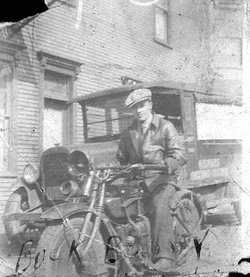
Joseph Zincavage (1907-1998) Navy
(No wartime photograph available, but he’s sitting on a Henderson Motorcycle in this one.)
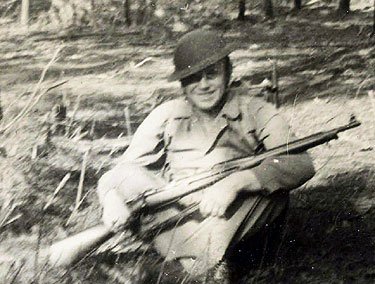
William Zincavage (1914-1997) Marine Corps

Edward Zincavage (1917-2002) Marine Corps

Eleanor Zincavage Cichetti (1922-2003) Marine Corps
26 May 2014
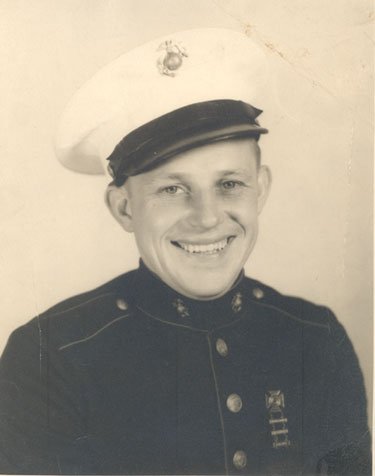
William G. Zincavage, Fall 1942, after graduating Marine Corps Boot Camp
Military Police, North Carolina, Fall 1942
First Amphibious Corps, Third Marine Division, Special Troops:
Solomon Islands Consolidation (Guadalcanal), Winter-Spring 1943
New Georgia Group Operation (Vella LaVella, Rendova), Summer 1943
Third Amphibious Corps, Third Marine Division, Special Troops:
Marianas Operation (Guam), Summer 1944
Fifth Amphibious Corps, Third Marine Division, Special Troops:
Iwo Jima Operation, February-March 1945 (Navy Unit Commendation)
North American Campaign Medal
Asiatic-Pacific Campaign Medal with Four Bronze Stars
Good Conduct Medal
——————————————————–
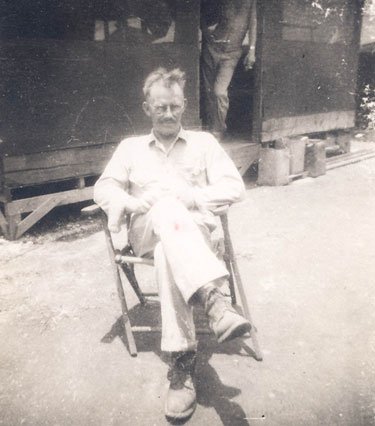
While recovering from malaria after the Battle of Iwo Jima, he looked 70 years old.
——————————————————–
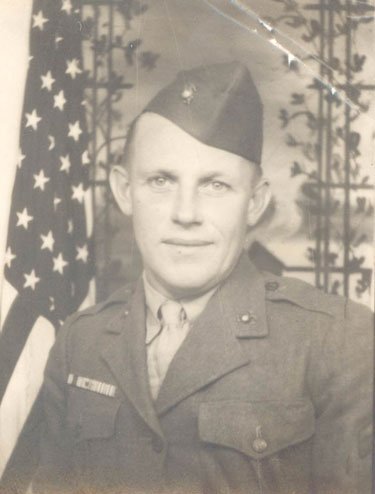
But he was back to normal in December of 1945, when this photo was taken shortly before he received his discharge.
23 Apr 2014
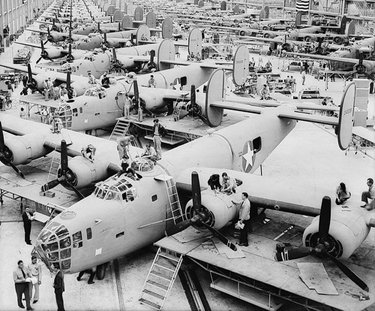
Rare:
During the 3 1/2 years of U.S. involvement, here’s what we manufactured:
8 battleships, 22 aircraft carriers, 48 cruisers, 349 destroyers, 420 destroyer escorts, 203 submarines, 4 million tons of merchant ships, 100,000 fighters, 98,000 bombers, 24,000 transport aircraft, 58,000 training aircraft, 93,000 tanks, 257,000 artillery pieces, 105,000 mortars, 3,000,000 machine guns, 2.5 mil military trucks 16.1 million men in uniform, and we developed the atomic bomb.
Simply astounding.
“During this same period of time, three and a half years, it should be noted that Obama couldn’t put together a functioning website,†Neal Boortz commented.
22 Mar 2014

A German soldier gives a comrade a light with his flamethrower.
Via You’re Not Bulletproof.
/div>

Feeds
|