Naomi Wolf is a member of Yale’s Class of 1984, who in 2004 published a spectacularly self-important, much-ado-about-nothing article in New York magazine claiming that one of Yale’s most illustrious English professors had once placed his hand above her knee. The university’s failure to avenge appropriately an alleged unwanted advance on her say-so alone, Wolf wrote, shook her confidence in Yale as an institution. She has been wanting to get even, apparently since 1983, and now’s her chance.
ABC News has a short segment on the sexual harassment complaint against Yale.
The ABC reporters fail to remark that 12 complaining feminists (including alumnae), seconded by a small supportive chorus of 4 poofters, do not represent a terribly significant portion of a student population of roughly 12,000 or of an alumni community of a few hundred thousand.
Both the (October, 2010) misogynistic chants so vulgar that prim ABC could not replay them (which went “No means yes. Yes means anal.”) and the (January 2008) “derogatory signs” outside the Yale Women’s Center which were the alleged tipping point that prevented Hannah Zeavin from having “Bright College Years” were fraternity initiation ordeals, inflicted respectively by Delta Kappa Epsilon and Zeta Psi.
Ms. Zeavin clearly tips very slowly, over a period of years, and her Yale education has clearly done little for her skills at hermeneutics. If Ms. Zeavin were a better interpreter of meanings, she would grasp the fact that fraternity initiations are ordeals intended to demonstrate the pledge’s worthiness for admission to membership by his voluntary undergoing humiliation and suffering. The misogynistic chants and sign were, obviously, intended to embarrass and inflict discomfort on the initiates, so one must be awfully dense to interpret them as authentic representations of the political views and moral sentiments of those pledges. If DEKE sent them out chanting, “I’m a conventional, politically correct Ivy League undergraduate who supports Barack Obama,” there would have been no ordeal to it at all.
Hannah Zeavin and her fellows, who chose to make a federal case out of nothing, are either viciously irresponsible and malicious or as dumb as a bag full of hammers. Which is it, womynists?
It is the absence of such public manifestations of protective authority which bother her, it seems. “No one has ever been expelled for rape and there have been 41 years of coeducation.” Zeavin observes. It is, I think, generally known that some authentic rapes have occurred at Yale. Several were committed by intruders from the nearby inner city underclass community. A major explosion of new security measures, locked gates, cameras everywhere, buses to Science Hill, followed. I think I can recall hearing, many years ago, of an authentic rape by one undergraduate of another, but rather than expulsion, I would expect that such an incident would have led to arrest and incarceration. The removal of that kind of offender from society would tend to render his expulsion from Yale beside the point.
The university naturally avoids publicizing attacks and assaults on students, so reliable statistics and detailed factual accounts are unlikely to be readily available to the leaders of Yale feminism.
The final evidence of an intolerably hostile atmosphere for women at Yale was another trivial politically incorrect scandal from 2009, an anonymous email ranking 53 freshmen women in order of attractiveness. Obviously, a federal injunction needs to be issued commanding Yale men to stop making comparative judgments about female Yale undergraduates’ sexual attractiveness, and if Yale men persist and ignore that federal order, Barack Obama can federalize the Connecticut National Guard and send soldiers with rifles and bayonets to stop male students from checking out the available female talent.
Captain Algernon: “The Royal Ministry of Culture will need to investigate the atmosphere of this opera house to make certain that ladies may equally enjoy the performances.
[Yale] University is under investigation by the United States Department of Education’s Office for Civil Rights stemming from an alleged mishandling of several instances of sexual misconduct in recent years.
The Office for Civil Rights will open an investigation into the University “for its failure to eliminate a hostile sexual environment on campus, in violation of Title IX†— which prohibits discrimination or exclusion from education programs — according to a press release by the complainants sent to the News Thursday afternoon. Yale administrators said they have not yet received a copy of the complaint and cannot comment.
The measure comes after 16 Yale students and alumni filed a formal complaint March 15 informing the Office for Civil Rights about Yale’s breach of Title IX by citing a slew of “inadequate response[s]†to public episodes of sexual misconduct on campus, such as the controversial Delta Kappa Epsilon chanting incident on Old Campus last fall.
“We have tried so many avenues,†complainant Hannah Zeavin ’12 told the News Thursday. “We exhausted every internal process [available at Yale].â€
—————————-
Alumna Presca Ahn (Branford ’10) details the unspeakable outrages that drove sixteen of Yale’s daughters to turn Mother Yale in.
On March 15, 16 students and recent alumnae of Yale filed a Title IX complaint with the Department of Education’s Office of Civil Rights; I was one of them. The signatories were a diverse group, representing men and women, current students and recent graduates, those who have been involved in campus feminism and those who have not. The complaint itself was a detailed and heavily sourced 26-page document that outlined incidents of sex-based harassment and intimidation that have occurred at Yale every year for the past seven years, and argued that these incidents — and the University’s inadequate response to them — have resulted in a hostile educational environment for women at Yale. …
For the past seven years, Yale has demonstrated… tolerance towards harassment of women: in 2004, when fraternity members stole (and photographed themselves wearing) four t-shirts from the annual Take Back the Night Clothesline Project, in which past victims of rape record their testimonies on t-shirts and display them; in 2005, when a new class of fraternity pledges stole 20 more of the t-shirts; in 2006, when yet another class of pledges gathered by the Yale Women’s Center and chanted, “No means yes! Yes means anal!â€; in 2007, when over 150 Medical School students wrote a letter of protest about the conditions of sexual harassment on campus in which eight specific instances of sexual assault were cited; in 2008, when Zeta Psi pledges posed in front of the Yale Women’s Center with a poster reading, “We Love Yale Sluts,†photographed themselves in the pose, and disseminated the photo on Facebook; in 2009, when anonymous male students at Yale authored and circulated a “Preseason Scouting Report†e-mail that rated incoming freshman women according to how many beers it would take to have sex with them, and listing their names, hometowns and residential colleges; and this past October, when DKE pledges congregated on Old Campus chanting, “No means yes! Yes means anal!†and “My name is Jack, I’m a necrophiliac, I f— dead women and fill them with my semen.â€
So what do we mean when we say that Yale is a hostile environment for women? What we don’t mean is that every female student at Yale has experienced sexual harassment or assault. What we mean is that the University has consistently demonstrated an attitude of tolerance for highly public acts of misogyny and sexual aggression. Female undergraduates see their peers call them “Yale sluts†and hear still other peers chant that “no means yes.†They live with the knowledge that the University has failed to punish those peers for sexual harassment. It takes little imagination to understand the effect of this kind of atmosphere on female students’ ability to engage in campus life on a basis of safety and equality.
Oh me! oh my! Stolen t-shirts! Frat members displaying “Yale Sluts” posters… and on Facebook, too! DKE pledge chanting slogans which were crude!
And no one was expelled or conspicuously punished and ostracized for politically incorrect expressions in mocking and parodistic contexts. It is easy to understand how the failure of President Levin personally to horsewhip those rowdy and insensitive fraternity men inevitably drove Yale’s womynist leaders to drop a dime on their alma mater.
After all, as a lot of Old Blues warned back when Kingman Brewster started talking about coeducating the place in the 1960s, many womyn are just to emotionally frail, too politically refined and sensitive, to bear uncouth, oppositional speech or mocking expressions of political incorrectness.
Such females may suffer untoward intellectual confusion, ideological indignation, and hyper-emotional distress. They may suffer from feelings of persecution and harassment. Thus, a real sector of the female community cannot possible function at an equal level in a university environment which naturally and inevitably features high-spirited young men, and in which ideas and perspectives are intended to be challenged, ridiculed, and vigorously contested. Some of these poor lambs are simply too delicate, too frail, too easily upset for all that.
Females of this kind need protection. As we see, some 16 unhappy Yale womynists felt vulnerable and persecuted, simply because their preferred ideological positions had been mocked or derided on several occasions in the course of a period of years, and no masculine protector had come forward to avenge them. In the end, they had to turn to the ultimate alternative masculine surrogate, Big Brother himself.
I was talking about all this with one of my pre-coeducation friends from Bones and DKE, just this afternoon.
“I warned you that this kind of thing was bound to happen.” Tripp observed, taking another sip of his gin-and-tonic. “Political ideas and higher education just mess up some female heads. They become fanatical and they egg one another on. Sexual frustration, of course, is endemic among politicized females. And the combination of sexual frustration and their hormonal cycle leads directly to delusions of victimization, paranoia, and vicious and destructive behavior. Imagine complaining about Yale to the Federal Government! It’s the behavior of a cad and a bounder, but for a politicized feminist it’s par for the course. That radical Brewster sowed the seeds, and Levin is reaping the harvest.”
Richard Kahlenberg, in the Chronicle of Higher Education, reviews a book by Toronto sociologist Ann L. Mullen, looking at the differences in student demographics, life style, academic major, and expectations between Yale and Southern Connecticut State University, a nearby former Normal School (i.e., a teacher’s training school) upgraded in recent years to university status.
Mullen examines two four-year colleges located within two miles of one another: Yale University and Southern Connecticut State University. In racial terms, the two institutions are not all that different. Yale is 69 percent white, while Southern is 70 percent white. But as Mullen finds in interviews with 50 Yale students and 50 Southern students, the class divide is significant, and that difference has enormous implications for the attitudes, experiences, and expectations of students.
Mullen’s insightful new book, Degrees of Inequality, notes that Southern students tend to be the sons and daughters of “shopkeepers, secretaries, teachers, and construction workers,†about half of whom never completed college. By contrast, about 80 percent of Yale students sampled had parents with BA’s, two-thirds had some form of graduate education, and more than half came from the top 15 percent by income nationally. These students often “arrived on the back of tremendous childhood advantages.â€
Among the advantages, she writes, were high parental expectations. In interviews, she writes, it was clear that most Yale students “never actually decided to go to college; it was simply the next step in their lives, one not requiring a rationale.†Although less than one percent of four- year college students attend Ivy League institutions, for some Yale students interviewed, “it was a question of which one.†She writes, “It is not simply that they aspired to attend the most elite institutions; rather, they planned on it.
Southern students, by contrast, made a conscious decision to pursue higher education and then mostly chose Southern based on “cost and convenience.†Neither factor was mentioned by a single Yale student. Over 90 percent of Yale students were from out of state, while over 90 percent of Southern students came from in-state. The Southern students never thought of applying to Yale, and the Yale students have never even heard of Southern.
The differences in opportunities and outlooks of Yale and Southern are then amplified once they reach college, Mullen finds. Yale, founded 300 years ago, has a $15-billion endowment “about two thousand times greater†than the endowment of Southern, which became a four-year institution in 1937 and became part of the Connecticut State University system in 1983.
The economic chasm between the schools and their students also drives profound differences in the experiences at each institution. To save money, only about one-third of Southern students live on campus and only 24 percent participate in extracurriculars, as many have to work 20-30 hours a week. By contrast, almost all students at Yale live on campus, and 67 percent participate in extracurriculars, from playing tennis to singing a capella.
Asked what they value most about college, Yale students tended to mention learning from friends and peers and participating in extracurricular activities. Southern students were only half as likely as Yale students to mention peers and friends.
Academic pursuits also differ greatly. Deciding on a college major is usually portrayed as a matter of individual choice, Mullen notes, but economic constraints are strongly felt. “For the Southern students,†she says, “majors represented not bodies of knowledge or academic disciplines, but rather occupational fields.†By contrast, Yale students were “quite cognizant†that their Ivy League degrees made the field of study chosen less important. One student told Mullen, “I’m getting a diploma with four letters Y-A-L-E on it. I should be able to have the sky be my limit.â€
Surprise, surprise! Professor Mullen discovers the third-oldest and one of the most competitive colleges in the country attracts a more affluent and more cosmopolitan student body with larger ambitions and wider career options than those of students attending the local neighborhood’s uncompetitive teacher’s college.
Certainly a lot of Yale students come from more affluent and better educated family backgrounds, but comparing Yale and Southern most meaningfully would have to be done on the basis of academic talent. Southern’s students have average SAT scores in the 480-490 range on the three parts of the current test. Yale quotes different 25%/75% figures, which indicate that only 25% of Yale students got under 700 on any of the three parts of the SAT, and another 25% got 780 to 800. Yale admits around 7.5% of applicants these days. Southern admits 71% of applicants.
Yale students have different majors and different career options from students at Southern Conn, not because Yalies have inherited clout, but because they are, on the average, a great deal more academically competent and competitive.
In my day, Southern and Yale did interact a bit socially, most commonly via contact within the Connecticut Intercollegiate Student Legislature (CISL). Yalies dated girls from Southern, and I knew some people who married them.
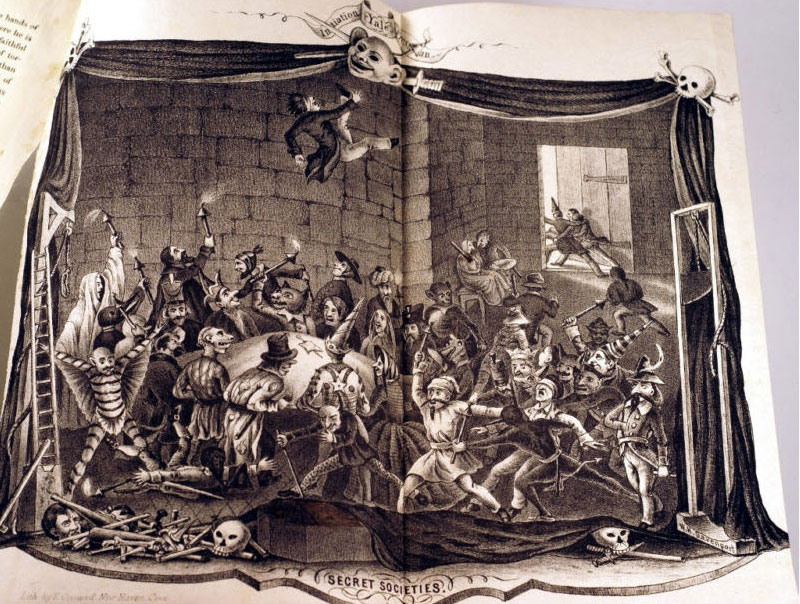
Typical Yale secret society initiation (clothed phase) (click on image for larger version.)
This year’s February 19th Pundits’ initiation party apparently featured slightly heavier drinking than usual. A student informant (who knows if he was telling the truth?) told the Yale Daily News that five attendees wound up at Yale-New Haven Hospital and six others at Yale’s Department of University Health.
11 out 50 attendees rendered so hors de combat by drinking that they had to seek medical attention? Not just impressive, Homeric really. Vital positions have been taken in military engagements whose memories echo through history with lower percentage casualties.
The same person (who could possibly be just a little prone to exaggeration) also told the YDN that he saw “a member of the Pundits forcing attendees to kiss each other and that a Pundit forced a male friend’s face onto another’s penis.”
Three Dog Night clearly composed this little number after one of the Pundits’ parties.
———————————————
This year’s Pundits initiation party rapidly achieved national news coverage.
A pundit is an expert, a vendor of influential, nay, determinative opinions. According to Wikipedia, it even seems most probable that the common vernacular use of the term pundit has “its origins in a Yale University society known as “The Pundits” which, founded in 1884, developed a reputation for including among its members the school’s most incisive and humorous critics of contemporary society. … Several members of the society have also gone on to become leading political pundits, including Pulitzer Prize-winning author and energy expert Daniel Yergin. Other notable Yale Pundits include A. Whitney Griswold, Lewis H. Lapham and Joe Lieberman.”
The founder of the Pundits, as an undergraduate at Yale, was the illustrious William Lyon Phelps (1865-1943), who went on to become essentially the leading Humanities scholar in the United States in his day, and a long-time, enormously admired professor at Yale. Billy Phelps was, in fact, the original prototype of the star professor, whose lectures were so witty, so brilliant, and entertaining, that attendance at his course became known as a not-to-be-missed feature of the Yale undergraduate experience. Phelps was in the first half of the last century what Vincent Scully was when I was an undergraduate.
The Pundits (founded in 1884) doubtless did not originally hold naked parties, but contented themselves with assembling the wittiest and most brilliant members of the Senior Class for a weekly dinner at Mory’s, and participating in a series of elaborate pranks and lampoons intended to deflate pomposity and pretension.
When I was an undergraduate, late 1960s-early 1970s, the Pundits had become moribund and inactive. They seem to have been revived in the late 1970s, during a period in which a reaction to all the leftwing piety and politically correct cant of the Vietnam era set in and Yale undergraduates began once again reveling in undergraduate life, throwing parties, and reviving fraternities and other social organizations.
My Yale informants tell me that it was Yale’s oldest a capella singing group, the Society of Orpheus and Bacchus, founded in 1938 and usually referred to as “The SOBs,” which began throwing regular naked parties during the late 1980s. The Pundits, known earlier for lobster-and-champagne lunches on the steps of Sterling Memorial Library, had some kind of ties to the SOBs and, from them, acquired the custom of the naked party.
I found, via the Yale Daily News, a Hustler article published in 2007, by a-then-sophomore describing the Pundits taking advantage of Ivy League naked parties hitting the national media to spoof the New York Times.
[W]hen the New York Times called, the Pundits weren’t about to cooperate. One of the nation’s most prestigious newspapers wanted to do a story about them, but the tricksters just did what they do best—they fucked with someone’s mind. Assigned to get a firsthand account of a naked party at Yale, Times reporter Rachel Aviv contacted the Pundits. They would later bring her to a real one, but not before throwing a special shindig on her behalf. Mr. E’s eyes light up recounting the story: “Instead of a lot of people drinking and mingling in a dark, well-decorated room, we brought her to a brightly lit library in which just a couple dozen of us were sitting around and playing board games.
After the Taboo, Uno, Scrabble, etc. were concluded, we did some naked charades and then, to top it off, some naked trust falls off a table.†Likewise, Ms. Aviv’s story on the seedy underbelly of an Ivy League school was collapsing faster than Judy Miller could say, “WMDs.†The Times reporter had to be freaking out, but maybe she was just confounded by the intensity of naked charades. The evening’s coup de grâce came when the revelers gathered into groups of three to eight, distributed condoms and left. The bewildered journalist could do nothing but struggle to jot down a few notes and then slide her pants back on. The Pundits, explains one tall and impeccably dressed member, “make sure there’s never a moment when everything’s okay.â€
If the Pundits were fucking with the media’s mind back in 2007 on the naked-parties-at-Ivy-League-schools meme, why, I wonder, do not reporters this year worry that those mischievous Pundits may be playing mind games with them again?
Undergraduate binge-drinking, hazing rituals, and naked parties are all ingredients perfectly calculated to make journalists sit up and beg the same way ham affects my basset hound.
It may very well be that this year’s Pundits’ initiation party scandal is just one more of the nation’s leading prankster organizations elaborate satirical spoofs.
William Lyon Phelps (1865-1943), founder of the Pundits.
Sam MacDonald gives a nice compliment to a particular Yale undergraduate organization.
I honestly think that if I ever were to take a sharp right turn, I would very much prefer to send my kids to Brown than to one of the strongly “conservative†colleges. Just to challenge them. I don’t think kids are THAT malleable. For heaven’s sake, half of the conservative movement is run by members of Yale’s Party of the Right. They somehow managed to emerge from the indoctrination unscathed.
Change. When I entered Yale as a freshman, back during the Consulate of Plancus, we thought that we were living in the Age of Marvels, occupying the privileged throne at the very summit and pinnacle of human technological civilization, because we could (nearly) all arrive at college armed with brand, spanking new Royal electric portable typewriters.
The image of Nathan Hale skillfully cutting goose quills to suitable points for penning his Yale examinations in Attic Greek did not fail to cross our minds, as we reveled in possession and use of Coerasable Bond typing paper and found ourselves able to compose our assigned essays with crisp and languidly easy electronic keystrokes, not even needing to pound our way through them on then already-old-fashioned manual typewriters.
I had one acquaintance from so humble a background that he laboriously hand-wrote his first assigned paper, producing a 150-page dialogue between Socrates and the Nihilist in response to an assigned 5-page paper on the Theaetetus.
I believe Yale issues every entering freshman these days with his own Apple notebook PC. (I was reflecting on this just now, and feeling a bit of pity for the Yalies of today who will discover eventually that the real world typically gets by with cheaper PCs, running Windows.)
I am unusually in touch with modern life for someone of my advanced years. I have loads of Yale undergraduate friends (from Yale conservative organizational circles) on Facebook, so I enjoy a privileged access to life in 2011.
I was highly amused to discover that Yale undergraduates today remain keen optimizers, and express their own perfection of life opportunities these days by compensating for the limited social acquaintance representing the inevitable price of overachieving tooledness by employing an Internet service to supply random luncheon connections with equally lonely strangers.
Miserable, isolated (probably premed), and unhappy (and at Yale)? Try YaleLunch.com (in beta).
And, if it is all too much to bear and you need to vent. Or if, alternatively, things are going perfectly swimmingly and you desire to gloat, drop by YALE FML and share your anonymous one-line descriptions of your personal metaphysical state. Your contemporaries will respond with words of wisdom and expressions of heartfelt sympathy along the lines of this posted response. (which, since the database of that beta seems not to be working, I will explain reads: NO ONE GIVES A F*CK.)
This week, the Yale Glee Club is having its own reunion timed to coincide with the anniversary of the organization’s founding in February of 1861. The Midnight at Yale feature tries to put the Glee Club’s longevity into proper perspective.
If your only exposure to choral music has been listening to Carmina Burana in Super Bowl commercials, please allow us to point out that we existed 106 years prior to the first Super Bowl and 74 years before Carmina Burana was composed.
That got us thinking.
1861 was, of course, the beginning of the American Civil War.
Theodore Roosevelt turned three in 1861, and Sigmund Freud turned six.
The Pony Express was in full swing.
The flush toilet was patented.
Russian Tsar Alexander II abolished serfdom.
Italy was unified.
Kansas was admitted as the 34th state in the Union
In 1862, the Internal Revenue Service was founded and Claude Debussy was born.
The Brahms Requiem is eight years younger than the Yale Glee Club.
Wagner’s Tristan is three years younger.
The entire planethood of Pluto, from discovery to dismissal, is a subset of the Glee Club’s existence.
I had a few drinks last night, so I don’t actually remember how it was that I stumbled upon this amusing 2005 article in the New Journal by Adriane Quinlan providing a tour d’horizon of the best t shirt slogan expressions of the traditional Yale-Harvard football rivalry.
Sigma Alpha Epsilon’s pledges sell shirts “to raise money for their pledge project—usually an improvement to the infrastructure of the house. “For example,†said Fraternity president Billy Deitch, “rebuilding the basement bar.†Two years ago the frat put out one of the most successful shirts in recent memory, the front of which argued, “You’d have to be crazy to go to Harvard…†and the back of which provided evidence: a picture of Unabomber Ted Kaczynski, Harvard Class of 1962. A later shirt was more minimal in design, “VE-RI-DUM,†which Branford Senior Jonathan Breit claimed as his favorite game shirt: “Everything is perfect: the number of syllables, the latin-esque ending of ‘dum,’ the fact that ‘dumb’ is misspelled. It just works.â€
How do Ivy League universities make sure that they are only admitting reliable conformist tools these days? By incorporating loyalty oaths to liberal group think and political correctness in the application process.
Glen Ricketts and Peter Wood describe the college applications diversity essay in the latest National Association of Scholars newsletter.
The CAO [Common Application Online] at Yale, for example, asks prospective students:
A range of academic interests, personal perspectives, and life experiences adds much to the educational mix. Given your personal background, describe an experience that illustrates what you would bring to the diversity in a college community, or an encounter that demonstrated the importance of diversity to you.
That’s virtually identical with what you can expect to find at dozens of other institutions, where “diversity†is cultivated with tedious uniformity.
Let’s weigh this question. The first sentence simply asserts that the “range of academic interests, personal perspectives, and life experiences†adds to the “educational mix.†Few people would doubt that, and the sentence is no doubt written to command bland assent. But if we force it to stand up for inspection, it displays a remarkable intellectual slovenliness. When we go to college, we do indeed benefit from encountering people with views and experiences other than our own. But that encounter depends on something else: a shared commitment to the broader purposes of education. The enlivening “mix†that Yale would like to foster requires students, at some level, to put aside differences at least long enough to consider one another’s views.
The “diversity†doctrine doesn’t necessarily prevent that deeper sharing from taking place, but it does cut against it and urges students instead to huddle inside their pre-chosen identities. The Yale CAO question is the first of a long series of subtle steps that teach students to lead with their particularities and to cultivate a kind of group vanity.
The second sentence in the assignment (“Given your personal background, describe an experience that illustrates what you would bring to the diversity in a college community, or an encounter that demonstrated the importance of diversity to you.â€) is a masterpiece of question-begging. What of the student who has slowly and painfully worked his way out of psychological isolation or social alienation to achieve a sense of identification with the larger community? Such a person would seem to have no acceptable answer to the task of explaining “the importance of diversity†to his own life. Would the Yale admissions office look favorably on the student who answered, “I have found ‘diversity’ to be a cudgel by which self-appointed elites attempt to enforce their preferences over others. Diversity to me has been the experience of having my individuality denied, suppressed, and demeaned. It is a word that summarizes a smarmy form of oppression that congratulates itself on its high-mindedness even as it enforces narrow-minded conformity.â€
No, any student really seeking admission to Yale wouldn’t say such a thing. But chances are very good that a great many students harbor insights very much like that. They know their ethnic or racial categorization, their socio-economic status, and other such characteristics matter far more to admissions offices than their actual thoughts about who they are.
These “diversity†essay questions are never innocent. They are a tool to keep college applicants aligned with the dominant ideology on campus, which continues to favor group categorizations over both individuality and the broader claims of shared community.
I would not have gotten in in the current era. No doubt about it.
I would have written a belligerent and full-throated denunciation of group identity and privileges, ruthlessly pointing out its inconsistencies, contradictions, and hypocrisies, making the argument for intellectual diversity, and I suppose I would have attended some very different college from Yale.
Newly appointed Yale deans this fall: W. Marichal Gentry, dean of student affairs and associate dean of Yale College, and Shelly C. Lowe, the University’s first assistant dean for Native American affairs and director of the Native American Cultural Center.
In an email to the entire Yale student body, Dean of Student Marichal Gentry reminded students that “consensual sex can be gloriousâ€. We’re used to getting emails about staying safe, saving the Yale Police phone number in our phones, and to always call for help, especially around the biggest drinking weekends of the year. The past two years we have received very standard emails about Spring Fling, Harvard-Yale, and Halloween, but this one definitely caught the eye. With unusually eloquent prose for Dean Gentry he reminded us,
A few years ago when we introduced the idea that consensual sex could be glorious, it seems that was a surprise to many. Consensual sex is having the sex you want, something you can say “yes†to, not something you’re afraid to say “no†to. Glorious consensual sex is something given, not taken, something shared not endured: something that makes you smile the next day, not something that hurts psychologically, emotionally or physically.
The philosopher can hardly avoid laughing at the 180 degree reversal of the Puritan establishment’s position on carnal activity on the part of the persons it supervises in loco parentis.
Yet, plus ça change, plus c’est la même chose, the annoying tone and conscribed perspective of the cant of indulgence differs only in puerility from the earlier cant of continence.
Yale has acquired a treasure in Dean Gentry. To mark the inauguration of one’s term in office by delivering via email a sermon to the water advising it to run downhill represents a gift for inadvertent comedy amounting to genius.
And I’m doubly grateful to Mr. Gentry for bringing it to my information, via his university appointment press release, that Yale now boasts a dean in charge of Native American Affairs. Who would have imagined that Yale actually had Native American Affairs? We are not Dartmouth, after all.
Sing, Eris, Goddess of Discord, the joys of Diversity!



 , notes that Southern students tend to be the sons and daughters of “shopkeepers, secretaries, teachers, and construction workers,†about half of whom never completed college. By contrast, about 80 percent of Yale students sampled had parents with BA’s, two-thirds had some form of graduate education, and more than half came from the top 15 percent by income nationally. These students often “arrived on the back of tremendous childhood advantages.â€