Archive for November, 2007
11 Nov 2007


The Daily Mail yesterday (10 Nov 2007) reported:
When the U.S. Navy deploys a battle fleet on exercises, it takes the security of its aircraft carriers very seriously indeed.
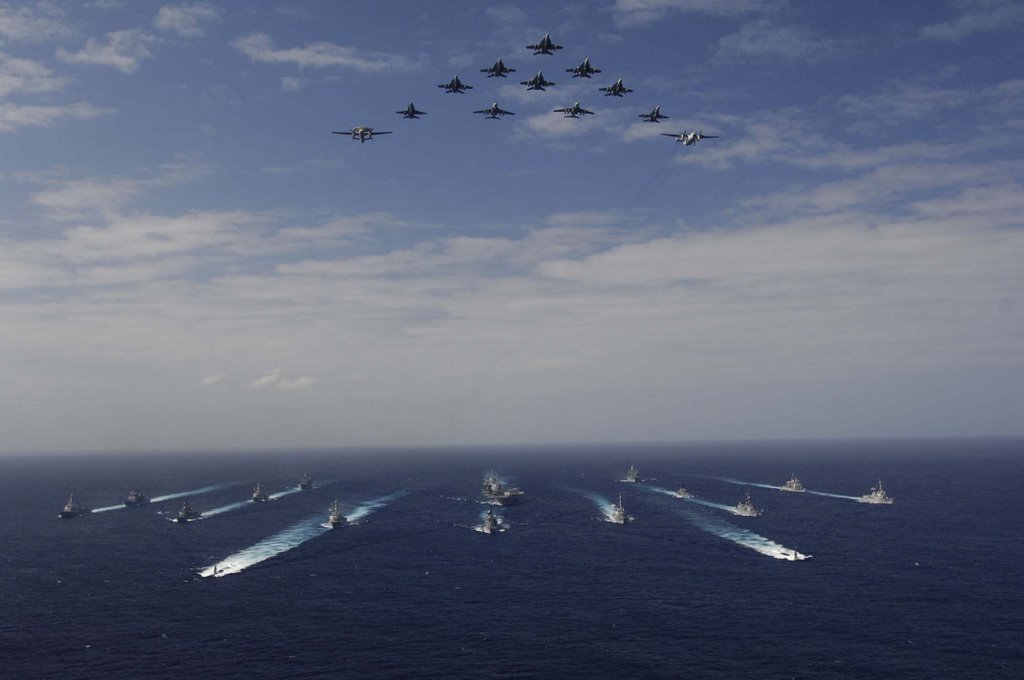
At least a dozen warships provide a physical guard while the technical wizardry of the world’s only military superpower offers an invisible shield to detect and deter any intruders.
That is the theory. Or, rather, was the theory.
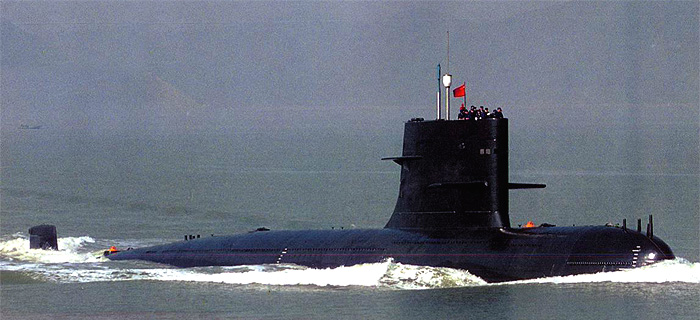
American military chiefs have been left dumbstruck by an undetected Chinese submarine popping up at the heart of a recent Pacific exercise and close to the vast U.S.S. Kitty Hawk
– a 1,000ft supercarrier with 4,500 personnel on board.
By the time it surfaced the 160ft Song Class diesel-electric attack submarine is understood to have sailed within viable range for launching torpedoes or missiles at the carrier.
According to senior Nato officials the incident caused consternation in the U.S. Navy.
The Americans had no idea China’s fast-growing submarine fleet had reached such a level of sophistication, or that it posed such a threat.
One Nato figure said the effect was “as big a shock as the Russians launching Sputnik” – a reference to the Soviet Union’s first orbiting satellite in 1957 which marked the start of the space age.
The incident, which took place in the ocean between southern Japan and Taiwan, is a major embarrassment for the Pentagon.
The lone Chinese vessel slipped past at least a dozen other American warships which were supposed to protect the carrier from hostile aircraft or submarines.
And the rest of the costly defensive screen, which usually includes at least two U.S. submarines, was also apparently unable to detect it.
According to the Nato source, the encounter has forced a serious re-think of American and Nato naval strategy as commanders reconsider the level of threat from potentially hostile Chinese submarines.
It also led to tense diplomatic exchanges, with shaken American diplomats demanding to know why the submarine was “shadowing” the U.S. fleet while Beijing pleaded ignorance and dismissed the affair as coincidence.
Analysts believe Beijing was sending a message to America and the West demonstrating its rapidly-growing military capability to threaten foreign powers which try to interfere in its “backyard”.
The People’s Liberation Army Navy’s submarine fleet includes at least two nuclear-missile launching vessels.
Its 13 Song Class submarines are extremely quiet and difficult to detect when running on electric motors.
Commodore Stephen Saunders, editor of Jane’s Fighting Ships, and a former Royal Navy anti-submarine specialist, said the U.S. had paid relatively little attention to this form of warfare since the end of the Cold War.
He said: “It was certainly a wake-up call for the Americans.
“It would tie in with what we see the Chinese trying to do, which appears to be to deter the Americans from interfering or operating in their backyard, particularly in relation to Taiwan.”
What is particularly interesting is that a nearly identical incident occurred one year ago 26 October 2006 involving a Chinese Song-class submarine and the same U.S.S. Kitty Hawk.
Also discussed by Spook86.

Photo hopefully not taken from Chinese submarine
10 Nov 2007
Thomas F. Madden in his New Concise History of the Crusades:
For a thousand years after the death of the Prophet, the Dar al-Islam, the Islamic world, continued to wage jihad successfully against the Dar al-harb, the abode of war. In that time Muslim armies conquered three-quarters of the Christian world, despite the efforts of generations of crusaders to halt or turn back the relentless advance. An impartial observer at the time might well have concluded that Christendom was a doomed remnant of the ancient Roman Empire, destined to be supplanted by the more youthful and energetic religion and culture of Islam. Yet that observer would have been wrong. Within Europe new ideas were brewing that would have dramatic and unprecedented repercussions not just in the Mediterranean, but across the entire world. Born out of a unique blend of faith, reason, individualism, and entrepreneurialism, those ideas produced a rapid increase in scientific experimentation with immediately practical applications. These included such world-changing devices as the printing press, gunpowder weaponry, and ocean-going vessels. By the seventeenth century European wealth and power was growing exponentially. Europeans were entering a new and unprecedented age.
It is one of the most remarkable events in history that the Latin West, an internally divided region seemingly on the brink of conquest by a powerful empire, suddenly burst forth with amazing new energy, neutralizing its enemies and expanding across the globe. Amazingly, the specter of advancing Muslim armies, which for centuries had posed such danger, no longer constituted a serious threat. Indeed, as the gaze of Europeans spanned new global horizons, they soon forgot that such a threat had existed at all. The Muslim world was no longer viewed as a dread enemy, but simply one more backward culture. From that perspective the medieval crusades seemed distant and unnecessary—a discarded artifact from the childhood of a civilization.
10 Nov 2007
Matthew J. Frank discusses the interesting question of whether Republicans should trust the former New York mayor’s recent “conversions.”
“Isn’t it better that I tell you what I really believe instead of pretending to change all of my positions to fit the prevailing wind?â€
So asked Rudy Giuliani at the “Values Voter Summit,†on October 20. It’s a powerful rhetorical question. Simultaneously Giuliani declared that flip-flopping and pandering are beneath him, and intimated that he is superior to his leading rival, Mitt Romney, who is famous for having changed his mind on the subject of abortion rights. I’m no waffler, no quick-change artist when I face a different constituency, says Rudy. “I believe trust is more important than 100% agreement.†And so Hizzoner has made trust the currency of his campaign, and he links trust to consistency: I’m the same guy yesterday, today, tomorrow, and the day after that.
By now you get the picture. Mayor Giuliani’s latter-day assurances on the abortion issue are thin and insubstantial, and appear to be made to endure for just as long as it takes to get the Republican nomination. So far I believe the phrase “right to life†has never passed his lips, and I’m not sure it can. It’s hard to imagine Giuliani as the party’s nominee even continuing to talk about the abortion issue after he achieves that status, if he could get away with it.
But would he get away with it? Giuliani’s pandering in all directions on this issue, his evident lack of a guiding moral or legal principle on the issue, is tailor-made for attack by Hillary Clinton’s campaign. We can hear her now in a head-to-head debate: “Which is it, mayor? Do your ideal ‘strict constructionist’ judges strike down a woman’s right to choose, or not? Which do you want to see happen? Where are you on this issue?†Does Rudy then betray a career-long support of abortion rights — or the platform of his party — or stick bumptiously to his well-rehearsed mantra of “don’t-care strict constructionism� Surely the Democrats are already relishing the opportunity they’ll have to make him dance even faster.
Why do we worry about the flip-flopper or the panderer in political campaigns? Because we wonder whom to trust, to be sure. But also because we want our own party’s candidates to be as invulnerable as possible to attack by the opposition party. A lot of pro-lifers want desperately to trust Rudy Giuliani, and are willing to put the fate of the right-to-life cause in his hands because they believe he’s the man who can beat Hillary Clinton. But even if that trust is wisely given (a big if indeed), on this issue, compared to almost anyone else in the GOP field — Mitt Romney most certainly included — Rudy Giuliani is the most vulnerable candidate the Republicans could make their standard-bearer.
I don’t myself care much about the abortion issue. (I’m not really planning on having any personally.) But I care a great deal about Gun Control, on which issue Giuliani’s record is utterly abysmal, and Hizzoner’s recent supposed conversion on the subject does not impress me in the least. If they nominate Giuliani, I’ll be voting Third Party.
10 Nov 2007
The New York Times chronicles the frightening encounters of today’s typical urban wussies with THE COUNTRY.
When Evan Gotlib and his fiancée, Lindsey Pollack, bought a three-bedroom cottage surrounded by pine trees in rural Sharon, Conn., they couldn’t wait to flee their cramped Manhattan studio on weekends to spend their days dozing in a hammock and barbecuing on their brand new 42,000 B.T.U., 60-burger-capacity Weber grill.
But being city people, they did what anyone looking to “get away from it all†would do first, before they even spent the night: they paid $3,000 for a home-security system complete with motion detectors, a one-touch intercom that connects to fire and police dispatchers and an emergency hand-held remote-control device they could leave on the bedside table at night. “I know it sounds ridiculous now that I talk about it, but I just feel safer sleeping with the remote control,†Mr. Gotlib, a 32-year-old corporate sales director for Time Inc. Media Group, confessed, “because those deer are aggressive.â€
For many urban sophisticates who trade the big city’s drunken crowds, blaring sirens and claustrophobic living spaces for bucolic second homes on weekends, the very solitude of mountains and forests that drew them in the first place can turn into a nerve-jangling — and sometimes costly — source of anxiety. As much as they adore their country houses, these harried homebodies quail at the thought of stepping out into the pitch-black night or meeting some wild animal or armed local in the woods.
Often their attempts at assuaging those fears are met with disbelief and ridicule from their more well-adjusted family members and friends.
“New York thinking applied to nature equals paranoia,†said Augusten Burroughs, the author of the memoir “Running with Scissors,†from his country house on the outskirts of Amherst, Mass., which he and his partner, Dennis Pilsits, built three years ago. Since then, Mr. Burroughs, 42, has poured several book advances into what he calls his “prison in the trees†in an effort to defend his rustic outpost “from nature in all its malicious glory.†This includes installing an $8,000 lightning protection system and spending $2,000 on various military-grade “tactical illumination devices†— flashlights — and even a pair of night-vision goggles, thanks to some terrifying encounters with nocturnal neighbors.
Late one recent night, Mr. Burroughs had gone out to check the mailbox when he saw two green, glittering eyes, triangular ears “and the general impression of height†in the shadows. When the creature began to walk toward him, Mr. Burroughs ran into the garage, fearing for his life. “Our skinny, gym-polished urban bodies are no match for anything that scratches its back on a tree,†he said. “Whatever it was, it was both curious and unafraid — two traits one does not admire in wildlife when one is alone in the dark.â€..
That hyper-vigilance is a normal reaction to the fear induced by the darkness and silence of the country, said Dr. Julie Holland, an assistant professor of psychiatry at the New York University School of Medicine, who owns a weekend home in Pawling, N.Y. “In the city, the street lights are on at 3 in the morning, and you have this sense that if you call the police or the front desk of your luxury high-rise someone will help you,†she said. “There is something inherently unnatural and vulnerable about humans being in social isolation, because out there no one can hear you scream.â€
It took Dr. Holland and her husband, Jeremy Wolff, a photographer, a while to get over that anxiety. Even so, encounters with armed hunters are always unsettling, even for a seasoned second-home owner. After disturbing a camouflaged fellow in a tree during a family hike last autumn, Mr. Wolf wrote a letter to the hunting club that leases the land beside his, asking members to “please make sure your bullets don’t cross my property lines.â€
And then there was the time he came across a shooting range on his neighbor’s land. So does Mr. Wolff, 48, think there is a difference between himself and the people who live in the country full time?
“I feel I’m more of an intellectual artist and they’re kind of machine people,†he said. “Everyone has their own backhoe up there, and their kids have A.T.V.’s and motorboats. And they all have guns, which scares me.â€
Read the whole thing, and laugh.
Hat tip to Steve Bodio.
10 Nov 2007

Daily Mail:
Teachers at a primary school have been ordered to dress up as Muslims to promote multi-culturalism.
The West Midlands school is belatedly celebrating the Muslim festival of Eid and told its pupils and teachers to don traditional Muslim dress for the day.
All 257 pupils, most of whom are Christians, and 41 teachers – two of whom are Muslims – dressed up.
A morning assembly was held to mark the event and an afternoon party was strictly for women only, because Muslim husbands object to wives mixing with other men.
Sally Bloomer, head of Rufford primary school in Lye, West Midlands, told The Sun: “I have not heard of any complaints. It’s all part of a diversity project to promote multi-culturalism.”
But a relative of one of the staff reportedly said: “Who would put their job on the line? They have been told they have to embrace the day to show their diversity. But they are not all happy.”
The British National Party’s Home Affairs correspondent observes
I imagine that Rufford Primary School in Lye in the West Midlands will be one of schools that are not going to celebrate a traditional Christmas this year.
Via Red Planet Cartoons and Death By 1000 Papercuts.
10 Nov 2007

Founded November 10, 1775.
——————————
Maj. Gen. John A. Lejeune’s Birthday Message
RPS ORDERS
No. 47 (Series 1921)
HEADQUARTERS U.S. MARINE CORPS
Washington, November 1, 1921
759. The following will be read to the command on the 10th of November, 1921, and hereafter on the 10th of November of every year. Should the order not be received by the 10th of November, 1921, it will be read upon receipt.
(1) On November 10, 1775, a Corps of Marines was created by a resolution of Continental Congress. Since that date many thousand men have borne the name “Marine”. In memory of them it is fitting that we who are Marines should commemorate the birthday of our corps by calling to mind the glories of its long and illustrious history.
(2) The record of our corps is one which will bear comparison with that of the most famous military organizations in the world’s history. During 90 of the 146 years of its existence the Marine Corps has been in action against the Nation’s foes. From the Battle of Trenton to the Argonne, Marines have won foremost honors in war, and is the long eras of tranquility at home, generation after generation of Marines have grown gray in war in both hemispheres and in every corner of the seven seas, that our country and its citizens might enjoy peace and security.
(3) In every battle and skirmish since the birth of our corps, Marines have acquitted themselves with the greatest distinction, winning new honors on each occasion until the term “Marine” has come to signify all that is highest in military efficiency and soldierly virtue.
(4) This high name of distinction and soldierly repute we who are Marines today have received from those who preceded us in the corps. With it we have also received from them the eternal spirit which has animated our corps from generation to generation and has been the distinguishing mark of the Marines in every age. So long as that spirit continues to flourish Marines will be found equal to every emergency in the future as they have been in the past, and the men of our Nation will regard us as worthy successors to the long line of illustrious men who have served as “Soldiers of the Sea” since the founding of the Corps.
JOHN A. LEJEUNE,
Major General Commandant
————————————-
The Magic of “a Few Good Men”
————————————-
A story: The Old Corps
Tun Tavern, Philadelphia, Pennsylvania
November 10th 1775
Captains Nicholas and Mullens, having been tasked by the 2nd Continental Congress to form 2 battalions of Marines, set up the Corps’ first recruiting station in the tavern.
The first likely prospect was, in typical recruiters fashion, promised a “life of high adventure in service to Country and Corps”. And, as an extra bonus: If he enlisted now he would receive a free tankard of ale….
The recruit gladly accepted the challenge and, receiving the free tankard of ale, was told to wait at the corner table for orders.
The first Marine sat quietly at the table sipping the ale when he was joined by another young man, who had two tankards of ale.
The first Marine looked at the lad and asked where he had gotten the two tankards of ale?
The lad replied that he had just joined this new outfit called the Continental Marines, and as an enlistment bonus was given two tankards of ale.
The first Marine took a long hard look at the second Marine and said, ” it wasn’t like that in the old Corps”
09 Nov 2007
Vin Suprynowicz remembers the Autumn of 1942, when one Marine and one Navy ship changed the course of WWII.
One Hill, One Marine:
World War Two is generally calculated from Hitler’s invasion of Poland in 1939. But that’s a eurocentric view. The Japanese had been limbering up their muscles in Korea and Manchuria as early as 1931, and in China by 1934. By 1942 they’d devastated every major Pacific military force or stronghold of the great pre-war powers: Britain, Holland, France, and the United States. The bulk of America’s proud Pacific fleet lay beached or rusting on the floor of Pearl Harbor. A few aircraft carriers and submarines remained, though as Mitchell Paige and his 30-odd men were sent out to establish their last, thin defensive line on that ridge southwest of the tiny American bridgehead on Guadalcanal on Oct. 25, he would not have been much encouraged to know how those remaining American aircraft carriers were faring offshore. …
As Paige — then a platoon sergeant — and his riflemen set about carefully emplacing their four water-cooled Brownings, it’s unlikely anyone thought they were about to provide the definitive answer to that most desperate of questions: How many able-bodied U.S. Marines does it take to hold a hill against 2,000 desperate and motivated attackers?
The Japanese Army had not failed in an attempt to seize any major objective since the Russo-Japanese War of 1905. Their commanders certainly did not expect the war to be lost on some God-forsaken jungle ridge manned by one thin line of Yanks in khaki in October of 1942. …
..the American forces had so little to work with that Paige’s men would have only the four 30-caliber Brownings to defend the one ridge through which the Japanese opted to launch their final assault against Henderson Field, that fateful night of Oct. 25.
By the time the night was over, “The 29th (Japanese) Infantry Regiment has lost 553 killed or missing and 479 wounded among its 2,554 men,” historian Lippman reports. “The 16th (Japanese) Regiment’s losses are uncounted, but the 164th’s burial parties handle 975 Japanese bodies. … The American estimate of 2,200 Japanese dead is probably too low.”
Among the 90 American dead and wounded that night were all the men in Mitchell Paige’s platoon. Every one. As the night wore on, Paige moved up and down his line, pulling his dead and wounded comrades back into their foxholes and firing a few bursts from each of the four Brownings in turn, convincing the Japanese forces down the hill that the positions were still manned.
The citation for Paige’s Congressional Medal of Honor picks up the tale: “When the enemy broke through the line directly in front of his position, P/Sgt. Paige, commanding a machinegun section with fearless determination, continued to direct the fire of his gunners until all his men were either killed or wounded. Alone, against the deadly hail of Japanese shells, he fought with his gun and when it was destroyed, took over another, moving from gun to gun, never ceasing his withering fire.”
In the end, Sgt. Paige picked up the last of the 40-pound, belt-fed Brownings — the same design which John Moses Browning famously fired for a continuous 25 minutes until it ran out of ammunition at its first U.S. Army trial — and did something for which the weapon was never designed. Sgt. Paige walked down the hill toward the place where he could hear the last Japanese survivors rallying to move around his flank, the gun cradled under his arm, firing as he went.
The weapon did not fail.
Coming up at dawn, battalion executive officer Major Odell M. Conoley first discovered the answer to our question: How many able-bodied Marines does it take to hold a hill against two regiments of motivated, combat-hardened infantrymen who have never known defeat?
On a hill where the bodies were piled like cordwood, Mitchell Paige alone sat upright behind his 30-caliber Browning, waiting to see what the dawn would bring.
One hill: one Marine.
————————————————–
One ship:
Admiral Bull Halsey himself broke a stern War College edict — the one against committing capital ships in restricted waters. Gambling the future of the cut-off troops on Guadalcanal on one final roll of the dice, Halsey dispatched into the Slot his two remaining fast battleships, the USS South Dakota and the USS Washington, escorted by the only four destroyers with enough fuel in their bunkers to get them there and back.
In command of the 28-knot battlewagons was the right man at the right pla4ce, gunnery expert Rear Adm. Willis A. “Ching Chong China” Lee. Lee’s flag flew aboard the Washington, in turn commanded by Captain Glenn Davis.
Lee was a nut for gunnery drills. “He tested every gunnery-book rule with exercises,” Lippman writes, “and ordered gunnery drills under odd conditions — turret firing with relief crews, anything that might simulate the freakishness of battle.”
As it turned out, the American destroyers need not have worried about carrying enough fuel to get home. By 11 p.m. on Nov. 13, outnumbered better than three-to-one by a massive Japanese task force driving down from the northwest, every one of the four American destroyers had been shot up, sunk, or set aflame, while the South Dakota — known throughout the fleet as a jinx ship — managed to damage some lesser Japanese vessels but continued to be plagued with electrical and fire control problems.
“Washington was now the only intact ship left in the force,” Lippman writes. “In fact, at that moment Washington was the entire U.S. Pacific Fleet. She was the only barrier between (Admiral) Kondo’s ships and Guadalcanal. If this one ship did not stop 14 Japanese ships right then and there, America might lose the war. …
On Washington’s bridge, Lieutenant Ray Hunter still had the conn. He had just heard that South Dakota had gone off the air and had seen (destroyers) Walke and Preston “blow sky high.” Dead ahead lay their burning wreckage, while hundreds of men were swimming in the water and Japanese ships were racing in.
“Hunter had to do something. The course he took now could decide the war. ‘Come left,’ he said, and Washington straightened out on a course parallel to the one on which she (had been) steaming. Washington’s rudder change put the burning destroyers between her and the enemy, preventing her from being silhouetted by their fires.
“The move made the Japanese momentarily cease fire. Lacking radar, they could not spot Washington behind the fires. …
“Meanwhile, Washington raced through burning seas. Everyone could see dozens of men in the water clinging to floating wreckage. Flag Lieutenant Raymond Thompson said, “Seeing that burning, sinking ship as it passed so close aboard, and realizing that there was nothing I, or anyone, could do about it, was a devastating experience.’
“Commander Ayrault, Washington’s executive officer, clambered down ladders, ran to Bart Stoodley’s damage-control post, and ordered Stoodley to cut loose life rafts. That saved a lot of lives. But the men in the water had some fight left in them. One was heard to scream, ‘Get after them, Washington!’ ”
Sacrificing their ships by maneuvering into the path of torpedoes intended for the Washington, the captains of the American destroyers had given China Lee one final chance. The Washington was fast, undamaged, and bristling with 16-inch guns. And, thanks to Lt. Hunter’s course change, she was also now invisible to the enemy.
Blinded by the smoke and flames, the Japanese battleship Kirishima turned on her searchlights, illuminating the helpless South Dakota, and opened fire. Finally, standing out in the darkness, Lee and Davis could positively identify an enemy target.
The Washington’s main batteries opened fire at 12 midnight precisely. Her new SG radar fire control system worked perfectly. Between midnight and 12:07 a.m., Nov. 14, the “last ship in the U.S. Pacific Fleet” stunned the battleship Kirishima with 75, 16-inch shells. For those aboard the Kirishima, it rained steel.
In seven minutes, the Japanese battleship was reduced to a funeral pyre. She went down at 3:25 a.m., the first enemy sunk by an American battleship since the Spanish-American War. Stunned, the remaining Japanese ships withdrew. Within days, Yamamoto and his staff reviewed their mounting losses and recommended the unthinkable to the emperor — withdrawal from Guadalcanal.
But who remembers, today, how close-run a thing it was — the ridge held by a single Marine, the battle won by the last American ship?
In the autumn of 1942.
Via the Barrister.
Earlier “Ching” Lee posting.
09 Nov 2007
George Friedman of Stratfor suggests that Western readers get past the simplistic sloganeering of the Western bien pensant press, and look at the realities of the situation in Pakistan in the light of History.
The British withdrawal created a state called Pakistan, but no nation by that name. What bound its residents together was the Muslim faith — albeit one that had many forms. As in India — indeed, as in the Muslim world at the time of Pakistan’s founding — there existed a strong secularist movement that focused on economic development and cultural modernization more than on traditional Islamic values. This secularist tendency had two roots: one in the British education of many of the Pakistani elite and the second in Turkish founder Mustafa Kemal Ataturk, who pioneered secularism in the Islamic world.
Pakistan, therefore, began as a state in crisis. What remained of British rule was a parliamentary democracy that might have worked in a relatively unified nation — not one that was split along ethnic lines and also along the great divide of the 20th century: secular versus religious. Hence, the parliamentary system broke down early on — about four years after Pakistan’s creation in 1947. British-trained civilian bureaucrats ran the country with the help of the army until 1958, when the army booted out the bureaucrats and took over.
Therefore, if Pakistan was a state trying to create a nation, then the primary instrument of the state was the army. This is not uniquely Pakistani by any means, nor is it unprincipled. The point that Ataturk made — one that was championed in the Arab world by Egypt’s Gamal Abdul Nasser and in Iran by Reza Pahlavi — was that the creation of a modern state in a traditional and divided nation required a modern army as the facilitator. An army, in the modern sense, is by definition technocratic and disciplined. The army, rather than simply an instrument of the state, therefore, becomes the guarantor of the state. In this line of thinking, a military coup can preserve a constitution against anti-constitutional traditionalists. …
Although the British tradition of parliamentary government fell apart in Pakistan, one institution the Britons left behind grew stronger: the Pakistani army. The army — along with India’s army — was forged by the British and modeled on their army. It was perhaps the most modern institution in both countries, and the best organized and effective instrument of the state. As long as the army remained united and loyal to the concept of Pakistan, the centrifugal forces could not tear the country apart.
Musharraf’s behavior must be viewed in this context. Pakistan is a country that not only is deeply divided, but also has the real capacity to tear itself apart. It is losing control of the mountainous regions to the indigenous tribes. The army is the only institution that transcends all of these ethnic differences and has the potential to restore order in the mountain regions and maintain state control elsewhere.
09 Nov 2007
Liberals like Paul Krugman deny that there is any such thing as Islamofascism.
There isn’t actually any such thing as Islamofascism — it’s not an ideology; it’s a figment of the neocon imagination. The term came into vogue only because it was a way for Iraq hawks to gloss over the awkward transition from pursuing Osama bin Laden, who attacked America, to Saddam Hussein, who didn’t.
Raymond Ibrahim, editor of the Al Qaeda Reader, a collection of texts and documents produced by the leaders of the Islamic extremist movement, compares the statements and positions of Al Qaeda to Hitler’s Mein Kampf.
Ibrahim:
How is The Al Qaeda Reader similar to Mein Kampf? A single sentence from the introduction of the 1999 edition of Mein Kampf, published by Mariner Books, goes a long way in answering this question: “He [Hitler] had made his ultimate goals clear in Mein Kampf as early as 1926: rearmament, the abolition of democracy, territorial expansion, eugenics, the ‘elimination’ of the ‘Jewish threat’†(Mein Kampf, xv).
The Al Qaeda Reader dwells on, if not obsesses over, four of these same five “ultimate goals†of Hitler—everything but eugenics, which is a temporal byproduct of 19th century pseudo-scientific racial theories. But al-Qaeda’s writings certainly dwell on dealing with the “Jewish threat,†overthrowing the “pagan religion†of democracy, both territorial re-conquests (from Palestine to Andalusia) and territorial expansion (to the whole world), as well as rearmament. Even more telling, the “fascistic†tone of Mein Kampf—ridicule and contempt for modernity and peace, praise for heroism and martyrdom, condemnation of promiscuity and lax mores—saturates The Al Qaeda Reader. Indeed, that there are many similarities is best represented by the fact that the German words “mein kampf†translate to “jihad-iâ€â€”or, “my jihadâ€â€”in Arabic.
Read the whole thing.
09 Nov 2007
Houston Chronicle:
WASHINGTON — The Supreme Court will discuss gun control today in a private conference that soon could explode publicly.
Behind closed doors, the nine justices will consider taking a case that challenges the District of Columbia’s stringent handgun ban. Their ultimate decision will shape how far other cities and states can go with their own gun restrictions.
“If the court decides to take this up, it’s very likely it will end up being the most important Second Amendment case in history,” said Dennis Henigan, the legal director for the Brady Campaign to Prevent Gun Violence.
Henigan predicted “it’s more likely than not” that the necessary four justices will vote to consider the case. The court will announce its decision Tuesday, and oral arguments could be heard next year.
Lawyers are swarming.
Texas, Florida and 11 other states weighed in on behalf of gun owners who are challenging D.C.’s strict gun laws. New York and three other states want the gun restrictions upheld. Pediatricians filed a brief supporting the ban. A Northern California gun dealer, Russell Nordyke, filed a brief opposing it. ..
The Second Amendment says, “A well-regulated Militia, being necessary to the security of a free State, the right of the people to keep and bear arms shall not be infringed.”
Gun-control advocates say this means that the government can limit firearms ownership as part of its power to regulate the militia. Gun ownership is cast as a collective right, with the government organizing armed citizens to protect homeland security.
“The Second Amendment permits reasonable regulation of firearms to protect public safety and does not guarantee individuals the absolute right to own the weapons of their choice,” New York and the three other states declared in an amicus brief.
Gun-control critics contend that the well-regulated militia is beside the point, and say the Constitution protects an individual’s right to possess guns.
Last March, a divided appellate court panel sided with the individual-rights interpretation and threw out the D.C. ban.
The ruling clashed with other appellate courts, creating the kind of appellate-circuit split that the Supreme Court likes to resolve. The ruling obviously stung D.C. officials, but it perplexed gun-control advocates.
If D.C. officials tried to salvage their gun-control law by appealing to the Supreme Court — as they then did — they could give the court’s conservative majority a chance to undermine gun-control laws nationwide.
On the one hand, the movement of legal scholarship in recent decades towards acknowledgment of the real meaning of the Second Amendment based on the historical content of the political theory of the period and numerous statements by the framers argues that Supreme Court consideration would necessarily recall the Second Amendment fully from exile, and produce nationwide enforcement of an individual right to keep and bear arms.
But, on the other hand, realism notes that the consequence of overturning every form of state and local gun prohibition, and very possibly the National Firearms Act of 1934 which effectively prohibited private possession of fully-automatic weapons are bound to seem highly unpalatable to most justices. Moreover, these days, intensely combative, ideologically charged decisions have a strong tendency to result in 5-4 decisions, turning upon the (commonly European-informed) private moral intuitions of Justice Anthony Kennedy.
On the whole, given the opportunity of having the fate of an important but widely disputed, Constitutional right decided, potentially for many decades, effectively by Justice Kennedy alone, I’d rather wait for a different Court.
08 Nov 2007
Al Gore has declined to debate Global Warming skeptics, so Junk Science brings the debate to him by presenting replies from a number of prominent scientific climate skeptics in this 8:52 video.
The same Junk Science is also offering a $125,000 prize to anyone who can prove, in a scientific manner, that humans are causing harmful global warming.
08 Nov 2007
John Coleman, meteorologist and founder of the Weather Channel, denounces Global Warming in no uncertain terms. He’s right, too.
It is the greatest scam in history. I am amazed, appalled and highly offended by it. Global Warming; It is a SCAM. Some dastardly scientists with environmental and political motives manipulated long term scientific data to create in allusion of rapid global warming. Other scientists of the same environmental whacko type jumped into the circle to support and broaden the “research†to further enhance the totally slanted, bogus global warming claims. Their friends in government steered huge research grants their way to keep the movement going. Soon they claimed to be a consensus.
Environmental extremists, notable politicians among them, then teamed up with movie, media and other liberal, environmentalist journalists to create this wild “scientific†scenario of the civilization threatening environmental consequences from Global Warming unless we adhere to their radical agenda. Now their ridiculous manipulated science has been accepted as fact and become a cornerstone issue for CNN, CBS, NBC, the Democratic Political Party, the Governor of California, school teachers and, in many cases, well informed but very gullible environmental conscientious citizens. Only one reporter at ABC has been allowed to counter the Global Warming frenzy with one 15 minutes documentary segment.
I do not oppose environmentalism. I do not oppose the political positions of either party. However, Global Warming, ie Climate Change, is not about environmentalism or politics. It is not a religion. It is not something you “believe in.†It is science; the science of meteorology. This is my field of life-long expertise. And I am telling you Global Warming is a non-event, a manufactured crisis and a total scam. I say this knowing you probably won’t believe a me, a mere TV weatherman, challenging a Nobel Prize, Academy Award and Emmy Award winning former Vice President of United States. So be it.
I have read dozens of scientific papers. I have talked with numerous scientists. I have studied. I have thought about it. I know I am correct. There is no run away climate change. The impact of humans on climate is not catastrophic. Our planet is not in peril. I am incensed by the incredible media glamour, the politically correct silliness and rude dismissal of counter arguments by the high priest of Global Warming.
In time, a decade or two, the outrageous scam will be obvious. As the temperature rises, polar ice cap melting, coastal flooding and super storm pattern all fail to occur as predicted everyone will come to realize we have been duped. The sky is not falling. And, natural cycles and drifts in climate are as much if not more responsible for any climate changes underway. I strongly believe that the next twenty years are equally as likely to see a cooling trend as they are to see a warming trend.
/div>

Feeds
|