This Day in Literature remembers that Ernest Hemingway placed the barrels of that London Best-Grade 12 gauge Boss against his forehead 52 years ago today, counts up the suicides in the Hemingway family, and quotes granddaughter Lorian Hemingway:
I had visited my grandfather’s grave in Ketchum the summer I had caught the marlin, arriving at the small hillside cemetery on a scalding July day, a half-finished fifth of vodka in one hand, a filter-tip cigar in the other. I’d made my way to the simple marble slab marked by a white cross, and stood swaying over the marker for a long time, expecting epiphany, resolution, a crashing, blinding flash of insight…. I wanted to say something of value to the old man, perhaps that I had met a dare he had set forth by example, but nothing came. The neck of the bottle grew hot in my hand. I tipped it to my mouth, taking a long swig, then poured the rest, a stream of booze, clear as Caribbean waters, at the head of the marker. “Here,†I said, “have this,†and walked away.
Alex Mayyasi tells us all about the IIT Entrance Exam.
The admissions test for the Indian Institutes of Technology, known as the Joint Entrance Examination or JEE, may be the most competitive test in the world. In 2012, half a million Indian high school students sat for the JEE. Over six grueling hours of chemistry, physics, and math questions, the students competed for one of ten thousand spots at India’s most prestigious engineering universities.
When the students finish the exam, it is the end of a two plus year process. Nearly every student has spent four hours a day studying advanced science topics not taught at school, often waking up earlier than four in the morning to attend coaching classes before school starts.
The prize is a spot at a university that students describe without hyperbole as a “ticket to another life.†The Indian Institutes of Technology (IITs) are a system of technical universities in India comparable in prestige and rigor to the Massachusetts Institute of Technology or the California Institute of Technology. Alumni include Sun Microsystems co-founder Vinod Khosla, co-founder of software giant Infosys Narayana Murthy, and former Vodafone CEO Arun Sarin. Popular paths after graduation include pursuing MBAs or graduate degrees at India’s and the West’s best universities or entertaining offers from McKinsey’s and Morgan Stanley’s on-campus recruiters.
Government subsidies make it possible for any admitted student to attend IIT. The Joint Entrance Exam is also the sole admissions criteria – extracurriculars, personal essays, your family name, and, until recently, even high school grades are all irrelevant. The top scorers receive admission, while the rest do not.
This means that the test can vault students from the lowest socioeconomic background into the global elite in a single afternoon. Entire families wait outside the test center, as involved in the studying and test process as the children they pin their hopes on. In extreme cases, parents have sold their land to pay tutors to coach their children for the JEE.
Only two percent of students will be rewarded for their hard work. In 2012, Harvard accepted 5.9% of applicants. Top engineering schools MIT and Stanford had acceptance rates of 8.9% and 6.63%. The acceptance rate at the IITs, as represented by the pass rate in the JEE, was 2%. Every year, when the results are announced and the media swarms the accepted students, 490,000 students receive disappointing news.
You sit in a room with hundreds of test takers and look around and smile because, personally, you enjoy these kinds of tests, and besides, you have a private contest going with yourself. You mean to try to be finished with the test before anybody else, so that you can stand up, hand in the answer sheet, and theatrically leave, with dozens of eyes looking on at you with hatred.
Snowden’s in the basement
Surfing on the Internet
I’m on the pavement
Thinking about the gubmint
The spook in the trench coat
Kicked out, laid off
Says he’s got a bad cough
Wants his mortgage paid off
Ya better look out kid
It was somethin you did
God knows when
But they’ll Google you again
You better duck down the alley way
Lookin’ for a new friend
A man in a coolie cap
In a pawn pen
Wants eleven eleven dollar bills
you only got ten.
Greenie comes fleet foot
Face full of black soot
Talkin’ that the heat put
Plants in his bed but
The phone’s tapped anyway
Guardian says that many say
They wanna break it late May
Orders from the NSA are in
You better look out kid
Don’t matter what you say they did
You gonna get hit
You walkin on your tip toes
Don’t try, ‘No Doz’
Stay away from the
suckers with the fiber optic fire hose
Keep a clean nose
Watch the plain clothes
You don’t need a weather man
To know which way the wind blows.
Tim Parks, in the Bedwetters’ Review of Books, tries connecting some writers’ careers and characteristic themes with the manner and occasion of their deaths.
I expect it would have been too easy to discuss poor old Papa Hemingway and his 12 gauge Boss, but he did offer an amusing take on old Bill Faulkner.
[L]et’s consider William Faulkner.
Throughout his life, when asked for biographical details Faulkner would begin by saying he was the great grandson of the Old Colonel, a man renowned for his courage, temper, energy, and vision. And a writer to boot. In contrast Faulkner saw his own father as a nobody and a loser, an opinion he seemed to share with his mother, to whom he remained close throughout his life, having coffee with her most afternoons and never missing a family Christmas if he could help it. From his earliest days he was eager to present himself as bold and courageous, inventing in 1918 a bizarre story of having crashed a warplane while celebrating the end of the war. For years he affected a limp supposedly resulting from the crash, though at the time he had never piloted a plane at all. His brother was actually wounded in the war. Faulkner’s first novel focuses on a soldier returning home a hero, but so badly wounded that he dies.
Like Thomas Hardy, Faulkner eventually invented a fictional territory of his own where his novels could all take place in relation to each other. Acts of courage in Yoknapatawpha County—usually a very physical, manly courage, but also the courage to claim the woman you really desire—end up, as in Hardy’s novels, in wounds, disaster, and death. Like Hardy, Faulkner married a woman he was eager to betray but never able to walk out on. Community in the South is presented as a tremendous insuperable burden that one can neither escape nor overcome. The only freedom available is the freedom, the courage, to live slightly apart, not to engage, with the world or women, like Ike McCaslin, hero of The Bear.
Over the years Faulkner’s writing became both a solution to and a representation of the conflicting impulses that tormented him. His stylistic experimentalism became an act of courage in itself, allowing him to criticize the genuinely war-wounded and mythically courageous Hemingway for lacking the fortitude to write courageously, or to risk failure. Yet Faulkner’s experimentation is never liberating: his prose gives us the impression of a wild, would-be heroic energy pushing through an impossibly dense medium, shoving aside negative after negative to reach the brief respite of a positive verb, losing itself in a heavy slime of ancestors and ancient wrongs. It is not a world in which one could hope to become the courageous man Faulkner wished to be. From the black community, Faulkner told a friend, we can learn “resignation.â€
One major difference between the patterns that guide Hardy’s and Faulkner’s writing is the latter’s relationship with alcohol, which, more than a mere disinhibitor making courage possible, becomes a sort of courage in itself. However adventurous and ferociously provocative, his writing was not enough to satisfy Faulkner’s need to feel courageous. Throughout his life he drank epically, heroically. In the hunting camp that is the setting of The Bear we hear that
the bottle was always present, so that after a while it seemed to him that those fierce instants of heart and brain and courage and wiliness and speed were concentrated and distilled into that brown liquor which not women, not boys and children, but only hunters drank, drinking not of the blood they had spilled but some condensation of the wild immortal spirit, drinking it moderately, humbly even, not with the pagan’s base hope of acquiring the virtues of cunning and strength and speed, but in salute to them.
Whisky and writing intertwine throughout Faulkner’s life, feeding each other, blocking each other, never allowing him to achieve any stability, always acting out a salute to other men he feared he could not resemble. By the time he was fifty the end seemed inevitable. There are only so many times one can dry out in a clinic and fall drunk off a horse. It was actually something of a miracle that Faulkner outlived his dear mother for a year before one more courageous binge, one more salute to the truly brave, as he saw it, did him in, aged sixty-five.
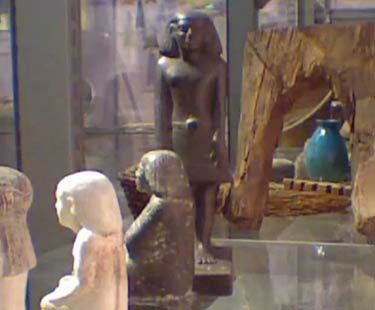
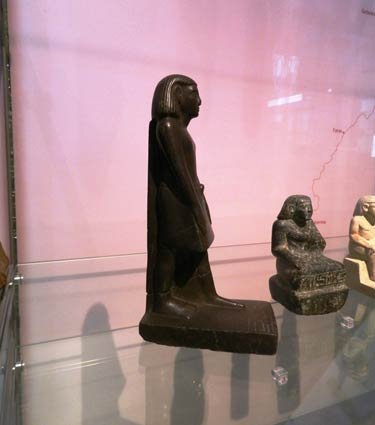
An ancient Egyptian statue in a British museum has sparked debate after it was captured on video seemingly rotating on its own.
The 10-inch tall statue of Neb-senu has been on display at the Manchester Museum in Manchester, England, for 80 years but it was only recently that museum staff noticed the statue moving.
“Most Egyptologists are not superstitious people. I wondered who had changed the object’s position without telling me,†the museum’s curator, Campbell Price, told the U.K.’s Sun. “But the next time I looked, it was facing in another direction–and a day later had yet another orientation.â€
With his curiosity piqued, Price returned the statue of the Egyptian idol to its original position in a locked glass case and set up a camera to film the statue over an 11-hour period. The resulting time-lapse video, Price says, shows the statue moving on its own.
Other experts attribute the rotation to a more scientific reasoning, such as subtle vibrations that cause the statue to move.
“The statue only seems to spin during the day when people are in the museum,†Carol Redmount, associate professor of Egyptian archeology at the University of California, Berkeley, told ABC News. “It could have something to do with its individual placement and the individual character of the statue.â€
The statue, made from serpentine, shows what is likely an official with “priestly duties,†according to Price, wearing a shoulder-length wig and knee-length kilt.