Hat tip to Karen L. Myers.
1929 Stutz Model M Coupe
1929 Stutz Model M Coupe, Automobiles, Bizarre, Stutz

1929 Stutz Model M with coupe coachwork by Lancefield of London.
Old Car Reports’ Car of the Week is the A.K. Miller 1929 Stutz Model M Coupe.
The story of A.K. Miller is legendary, even outside of Stutz collecting. The Vermont collector was born in 1906 and developed a taste for fine cars — what would be considered Classic cars today — and began gathering them when they were used cars. Commensurate with his frugal ways, Miller stored his valuable collection in dirt-floor wood sheds and lean-to’s on the primitive East Orange, Vt., farm he shared with his wife, Imogene.
Although great Peerless, Cadillac and Rolls-Royce cars passed through Miller’s hands, it was Stutz he preferred. A 1917 Stutz was Miller’s first car, and he occasionally drove it until he died in 1993. The other cars in Miller’s 40-some-vehicle collection were often parked on makeshift “wood stump†jack stands and left to gather dust while surrounded by spare Stutz parts. Miller would sometimes trade these parts, but he drove a hard bargain to his financial benefit and the misfortune of his fellow trader. It was not until his wife died in 1996 that it became clear what exactly was hidden in the wilds of Vermont, and more than car collectors were interested.
The Millers had essentially lived as recluses on their simple homestead. They had no children, and they had almost no paper trail. Their collection had been known to only a few outsiders, and the handful of people allowed to visit rarely caught a glimpse of more than a car or two. Only visitors from foreign lands were typically offered more than a peek, supposedly because Miller could be assured they were not from the IRS. Indeed, Miller had lived so far off the grid he was able to avoid paying state and federal taxes. He and his wife were also hiding more than cars and income — they had buried or otherwise hid millions of dollars in gold bullion and silver ingots around their property.
After Imogene’s passing, the Millers’ fortune captured the attention of car and tax collectors, and an auction was held by Christie’s, after which the IRS was to receive its due. Police scouted the property leading up to the auction to stop the shovels and metal detectors of treasure hunters, and the curious eyes and hands of car enthusiasts. When the auction was held Sept 7-9, 1996, about 35 “barn find†Stutz motor cars crossed the block, most fetching far more than their pre-sale estimates in front of a standing-room-only crowd.
One of the stand-outs in that sale was a special 1929 Stutz Model M with coupe coachwork by Lancefield of London. Lancefield often bodied Rolls-Royce and Bentley chassis, but it also held an association with Stutz of Indianapolis, Ind. The aluminum-sheathed Lancefield coupe body sat low on the Stutz chassis, thanks in part to a worm gear drive setup, but was made to look lower with Lancefield’s tear drop step plates and trademark low roof, cycle-type front and rear fenders and dozens of louvers that ran the length of the apron that masked the frame sides. In deep black, the masterpiece was sinister.
“They only built five of these coupes,†said Richard Mitchell, the Lancefield-bodied Stutz coupe’s present owner. “Two were sold to the Woolworth Brothers and this is one of the two. Of the two cars, only this one was supercharged. There is no record of the others; this is the lone ranger.â€
1996 New York Times article
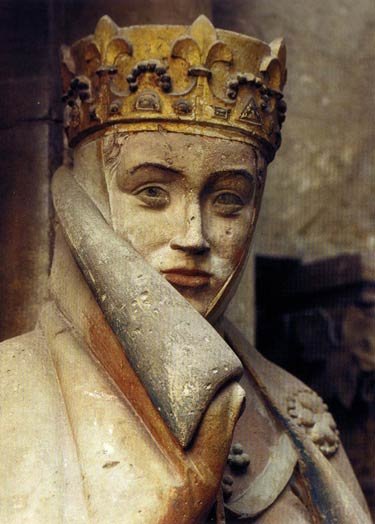
“Most Beautiful Woman of the Middle Ages”
Gothic Period, Middle Ages, Naumberg Cathedral, Sculpture

Naumberg Master, Uta von Ballenstedt (c. 1000 — after 23 October, 1046) Margravine of Meissen, wife of Eckard II, one of twelve founders of the Naumberger Cathedral of Sts. Peter and Paul, Mid-13th century.
The statue of Uta von Ballenstedt has been called the image of “the most beautiful woman of the German Middle Ages,” and was designated a model of ideal German art, “an Aryan Madonna” by the Nazis.
Hat tip to Ratak Monodosico.
Japanese Archer
Japanese Archery, Photography

Photo taken by Elstner Hilton in Japan between 1914 and 1918.
Hat tip to Madame Scherzo.
Death of a Poet
Krzystof Kamil Baczynski, Poetry, Poland, WWII, Warsaw Uprising

Krzystof Kamil Baczynski (1921-1944)
My Polish correspondents have been remembering the anniversary (two days ago) of the death of Krzystof Kamil Baczynski, one of the greatest Polish poets of the last century, on the 4th day of the Warsaw Uprising at the mere age of 23.
Baczynski served in the Polish Resistance (Armia Krajowa) in which he fought with Battalion Zoska, a reconnaissance/ranger battalion largely recruited from former Polish Boy Scouts. He served during the Warsaw Uprising in Battalion Parasol, an elite unit (also largely made up of former Boy Scouts), intended eventually to become part of a parachute brigade, which specialized in attacks on the Gestapo.
Zbigniew Czajkowski-Dabczynski, in his book Dziennik Powstanca (Diary of an Insurgent), gives a detailed report of his death:
It was then that I saw Krzysztof for the last time, because they left for a new position at Palac Blanka [in the Warsaw Old Town area] without me. That day I heard from a buddy that he was hunting Germans with great success from the ruins of the Opera House. The next day a call came for a first-aid patrol to come help a wounded in the Palac Blanka. Not having much to do I joined them. At his post, in a corner room, we found Krzysztof lying on a Persian rug with a huge wound in his head. [He had been shot by a German sniper.] He was dead. Nurses carried the body over to the City Hall (next door). That same evening the funeral was held. It was rather solemn. The grave was dug in the City Hall courtyard. Some sixty people, soldiers, officers, civilians, were present. Someone said a few words. The body was lowered to the grave. We all sang the National Anthem, then the grave was filled.”
The Polish writer and critic, Stanislaw Pigon, had this to say at the news of Baczynski’s death: “What can we do? We belong to a nation whose lot it is to shoot at the enemy with diamonds.”
His pregnant wife Barbara, the subject of the famous erotic poems, was killed September 1st.
—————————————-
Biała magia
StojÄ…c przed lustrem ciszy
Barbara z rękami u włosów
nalewa w szklane ciało
srebrne kropelki głosu.
I wtedy jak dzban – Å›wiatÅ‚em
zapełnia się i szkląca
przejmuje w siebie gwiazdy
i biały pył miesiąca.
Przez ciała drżący pryzmat
w muzyce białych iskier
łasice się prześlizną
jak snu puszyste listki.
Oszronią się w nim niedźwiedzie,
jasne od gwiazd polarnych,
i myszy się strumień przewiedzie
płynąc lawiną gwarną.
Aż napełniona mlecznie,
w sen siÄ™ powoli zapadnie,
a czas melodyjnie osiÄ…dzie
kaskadÄ… blasku na dnie.
Więc ma Barbara srebrne
ciało. W nim pręży się miękko
biała łasica milczenia
pod niewidzialną ręką.
4 I 1942
—————————————-
(translated by Alex Kurczaba)
White Magic
Standing before the mirror of silence
with her hands in her hair,
Barbara pours into her glass body
silver droplets of her voice.
And then like a jar
she fills with light and glasslike
filters stars through herself
and the white dust of the moon.
Through the quivering prism of her body
in the music of white sparks
minks will glide past
like fluffy leaves of sleep.
Hoarfrost will coat the bears in it
brightened by polar stars
and a stream of mice will weave through
flowing in a loud avalanche.
Until filled up with milk
she’ll slowly sink into sleep
as melodically time will settle at the bottom
in a cascade of glare.
And so Barbara has a silver body. In it
the white mink of silence stiffens softly
under an unseen arm.
—————————————-
Read aloud in Polish:
—————————————-
Quotation of the Day
Hunting, Sitting Bull

Thathanka Iyotake, “Sitting Bull” (1831-1890)
I will remain what I am until I die, a hunter, and when there are no buffalo or other game I will send my children to hunt and live on prairie mice.
— Sitting Bull to James M. Walsh, inspector in the Northwest Territory of the Royal Canadian Mounted Police, at a conference on March 23, 1879.
Face of the Day
Natural History, Peregrine Falcon, Photography
Hat tip to Ratak Monodosico.
Hemingway’s Idea of Heaven
Amusement, Ernest Hemingway
Burguete, Navera.
July 1 [1925] –Dear Scott –
We are going in to Pamplona tomorrow. Been trout fishing here. How are you? And how is Zelda?
I am feeling better than I’ve ever felt — haven’t drunk any thing but wine since I left Paris. God it has been wonderful country. But you hate country. All right omit description of country. I wonder what your idea of heaven would be — A beautiful vacuum filled with wealthy monogamists. All powerful and members of the best families all drinking themselves to death. And hell would probably an ugly vacuum full of poor polygamists unable to obtain booze or with chronic stomach disorders that they called secret sorrows.
To me a heaven would be a big bull ring with me holding two barrera seats and a trout stream outside that no one else was allowed to fish in and two lovely houses in the town; one where I would have my wife and children and be monogamous and love them truly and well and the other where I would have my nine beautiful mistresses on 9 different floors and one house would be fitted up with special copies of the Dial printed on soft tissue and kept in the toilets on every floor and in the other house we would use the American Mercury and the New Republic. Then there would be a fine church like in Pamplona where I could go and be confessed on the way from one house to the other and I would get on my horse and ride out with my son to my bull ranch named Hacienda Hadley and toss coins to all my illegitimate children that lined the road. I would write out at the Hacienda and send my son in to lock the chastity belts onto my mistresses because someone had just galloped up with the news that a notorious monogamist named Fitzgerald had been seen riding toward the town at the head of a company of strolling drinkers.
Well anyway were going into town tomorrow early in the morning. Write me at the / Hotel Quintana
Pamplona
Spain
Even stuff like this is such a pleasure to read.
Hat tip to the Dish.