Helen Andrews casts a jaundiced look at The New Ruling Class in Hedgehog Review.
Meritocracy began by destroying an aristocracy; it has ended in creating a new one. …
Not since the Society of the Cincinnati has a ruling elite so vehemently disclaimed any resemblance to an aristocracy. The structure of the economy abets the elite in its delusion, since even the very rich are now more likely to earn their money from employment than from capital, and thus find it easier to think of themselves basically as working stiffs. As cultural consumers they are careful to look down their noses at nothing except country music. All manner of low-class fare—rap, telenovelas, Waffle House—is embraced by what Shamus Rahman Khan calls the “omnivorous pluralism†of our elite. “It is as if the new elite are saying, ‘Look! We are not some exclusive club. If anything, we are the most democratized of all groups.’â€
Khan’s Privilege: The Making of an Adolescent Elite at St. Paul’s School is a fascinating document, because he seems to have been genuinely surprised by what he found when he returned to his old boarding school to teach for a year. Khan, the grandson of Irish and Pakistani peasants, worked his way to a Columbia University professorship in sociology via St. Paul’s and Haverford College. So he thought he knew meritocrats—but today’s breed gave him a bit of a fright. For one thing, they proved to be excellent haters. Consider how they talk about a legacy student whose background can be inferred from the pseudonym Khan gives him, “Chase Abbottâ€:
After seeing me chatting with Chase, a boy I was close with, Peter, expressed what many others would time and again: “that guy would never be here if it weren’t for his family.… I don’t get why the school still does that. He doesn’t bring anything to this place.†Peter seemed annoyed with me for even talking with Chase. Knowing that I was at St. Paul’s to make sense of the school, Peter made sure to point out to me that Chase didn’t really belong there.… Faculty, too, openly lamented the presence of students like Chase.
“Openly lamentedâ€! Poor Chase. This hatred is out of all proportion to the power still held by the Chases of the school, which is almost nil. Khan discovers that the few legacy WASPs live together in a sequestered dorm, just like the “minority dorm†of his own schooldays, and even the alumni “point to students like Chase as examples of what is wrong about St. Paul’s.†No, the hatred of students like Chase feels more like the resentment born of having noticed an unwelcome resemblance. It is somehow unsurprising to learn that Peter’s parents met at Harvard.
Of course, Peter is not at St. Paul’s because his parents went to Harvard; as he makes clear to Khan, he is there because of his hard work and academic achievement. Here we have the meritocratic delusion most in need of smashing: the notion that the people who make up our elite are especially smart. They are not—and I do not mean that in the feel-good democratic sense that we are all smart in our own ways, the homely-wise farmer no less than the scholar. I mean that the majority of meritocrats are, on their own chosen scale of intelligence, pretty dumb. Grade inflation first hit the Ivies in the late 1960s for a reason. Yale professor David Gelernter has noticed it in his students: “My students today are…so ignorant that it’s hard to accept how ignorant they are.… [I]t’s very hard to grasp that the person you’re talking to, who is bright, articulate, advisable, interested, and doesn’t know who Beethoven is. Had no view looking back at the history of the twentieth century—just sees a fog. A blank.†Camille Paglia once assigned the spiritual “Go Down, Moses†to an English seminar, only to discover to her horror that “of a class of twenty-five students, only two seemed to recognize the name ‘Moses’.… They did not know who he was.â€
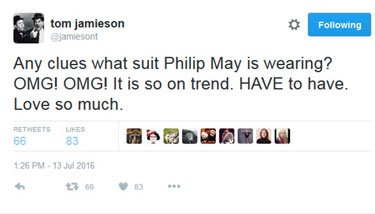
News of Theresa May’s accession to Prime Minister was eclipsed yesterday in some quarters by gushings over her husband Philip’s well-tailored, single-button blue suit.
Theresa May became Britain’s new prime minister, but her husband’s big fashion moment stole the show.
Stepping into the limelight as First Man, Philip May showcased a sexy navy suit with a flourish of pinstripe.
Britain’s new Prime Minister Theresa May speaks outside 10 Downing Street in central London on July 13, 2016 on the day she takes office following the formal resignation of David Cameron. Theresa May took office as Britain’s second female prime minister on July 13 charged with guiding the UK out of the European Union after a deeply devisive referendum campaign ended with Britain voting to leave and David Cameron resigning. / AFP PHOTO / OLI SCARFFOLI SCARFF/AFP/Getty Images
Theresa May’s speech in full as she becomes Prime Minister
A single fastened button at the waist helped show off his fantastic figure and a pale blue tie brought out the colour of his eyes.
Round glasses perched on his nose accentuated his amazing bone structure – no doubt one of the assets he used to help him to bag his wife.
—————————————–
Mr. May’s haberdashery has evidently been attracting complimentary attention in the media for some time. Marie Claire actually devoted a feature to his suits and ties, noting approvingly that he frequently coordinates his outfits with hers.
Jasmin Nahar, at Buzz Feed UK, is envious of the PM:
A man who can dress himself and has a job? Where do I sign up?
After more than three years as a fugitive, Edward Snowden is now in CIA custody, an Agency press release states. Sources inside the Agency claim that Snowden was captured in the early hours of the morning while walking the streets of Moscow’s Arbat District, where he was ambushed by an extraordinary rendition team illegally operating on Russian soil.
According to Agency sources, who wish to remain unnamed, Snowden was lured out in the middle of the night by a Very Rare Pokemon placed just a few hundred feet from where American intelligence agents suspected him to be staying. Earlier this week, communications operations against Snowden had revealed him to be an avid player of the social smartphone game Pokemon Go, which encourages players to physically travel to various locations around them in order to retrieve in-game rewards and battle with Pokemons and other players.
The Pokeball containing Snowden is now believed to be undergoing secure transport to the Black Pokemon Center in an undisclosed location for entirely legal and pleasant interrogation procedures. Extraordinary precautions will be necessary to ensure that Snowden and Chelsea Manning, also being held at the Center, do not battle, as the Agency wishes to prevent any further evolution.
James Taranto, in the Wall Street Journal, delivered a devastating rebuke to Justice Ruth Bader Ginsburg’s recent political indiscretions in the course of a New York Times interview.
Ginsburg’s comments about Trump, which were somewhat vague if you read them closely, were less objectionable than many of the other things she said in the same interview. She also damned the Senate for declining to take up the high-court nomination of Judge Merrick Garland: “ ‘That’s their job,’ she said. ‘There’s nothing in the Constitution that says the president stops being president in his last year.’ â€
That’s literally true, but there’s also nothing in the Constitution that says the Senate stops being the Senate under any circumstances. Ginsburg is making a one-sided political argument and framing it as a constitutional mandate. Which, come to think of it, isn’t that different from her approach to jurisprudence. National Review’s Ed Whelan offers a backhanded compliment: “Let’s give her credit . . . for exposing, once again, how nakedly political she is.†…
It gets worse still. Liptak asked Ginsburg if there are “cases she would like to see the court overturn before she leaves it.†Her answer: “I’d love to see Citizens United overturned.†In that 2010 First Amendment case, the Federal Election Commission unsuccessfully claimed it had the authority to criminalize the distribution of a film critical of Hillary Clinton, whom Ginsburg has now implicitly endorsed for the presidency.
She also told Liptak that District of Columbia v. Heller (2008), which established that the Second Amendment’s guarantee of the right to keep and bear arms guarantees the right to keep and bear arms, was “a very bad decision,†adding (in Liptak’s words) “that a chance to reconsider it could arise whenever the court considers a challenge to a gun control law.†Lipsky reports that “the Times . . . seemed to want to protect Ginsburg from the fallout from this error of judgment, deleting it from the article until sharp-eyed readers called out the paper and the lines were restored.â€
There’s no indication that Liptak asked Ginsburg if she also has designs on the Third Amendment. But if you wake up one morning and find a strange soldier on your couch, don’t say we didn’t warn you.
And that’s not all, folks. Ginsburg went on to reveal confidential information about the court’s deliberations during the term just ended. She disclosed how the late Justice Antonin Scalia voted in two cases on which the court deadlocked, and she asserted that Justice Elena Kagan would have joined the 4-3 majority to uphold racial discrimination in Fisher v. University of Texas, from which Kagan recused herself. “If Justice Kagan had been there, it would have been 5 to 3,†Ginsburg asserted.
So, to sum up: Ginsburg, in an on-the-record interview, took political positions on the presidential election and a Senate confirmation, indicated that she intends in future cases to vote to curtail constitutional rights, and violated the secrecy of the Supreme Court conference room.
Vladimir Putin has sacked every single commander in Russia’s Baltic fleet in what has been described as a ‘Stalin-style’ purge.
Up to 50 officers of the fleet were fired alongside Vice Admiral Viktor Kravchuk and his chief of staff Rear Admiral Sergei Popov after they reportedly refused to follow orders to confront Western ships.
Reports in Russia also suggested the purges followed an alleged cover-up of a submarine accident, flaws in recruitment and military construction projects.
It comes amid an undisclosed number of other senior officers of the fleets have been fired over serious flaws in combat training and their failure to take proper care of personnel.
The purges’ scope and publicity make them highly unusual for the Russian military, which usually removes senior officers in a more subtle way.
It is particularly unexpected as it follows Putin’s visit to the Baltic fleet last year in Kalingrad, during which he praised its performance.
However, there has been speculation the drastic measures were prompted after the US Navy ship the USS Donald Cook was ‘buzzed’ by Russian fighter bombers in April, which was meant to be part of a series of confrontations against Western ships in the Baltic.
But international affairs analyst Peter Coates told news.com.au: ‘But the Russian Baltic Fleet, however, refused to follow such dangerous orders – hence Putin’s retaliation against his own naval officers.
Meanwhile after news of the sackings were announced, the Moscow Times noted that ‘not since Stalin’s purges had so many officers been ousted at once.’
An archaeological discovery announced on Sunday in Israel may help solve an enduring biblical mystery: where did the ancient Philistines come from?
The Philistines left behind plenty of pottery. But part of the mystery surrounding the ancient people was that very little biological trace of them had been found — until 2013.
That’s when archaeologists excavating the site of the biblical city of Ashkelon found what they say is the first Philistine cemetery ever discovered. They say they have uncovered the remains of more than 200 people there.
The discovery was finally unveiled Sunday at the close of a 30-year excavation by the Leon Levy Expedition, a team of archaeologists from Harvard University, Boston College, Wheaton College in Illinois and Troy University in Alabama.
The team is now performing DNA, radiocarbon and other tests on bone samples uncovered at the cemetery, dating back to between the 11th and the 8th centuries B.C., to help resolve a debate about the Philistines’ geographical origins. The archaeologists have not announced any conclusions, saying they are taking advantage of recent advances in DNA testing to get the most accurate results.
The discovery of a sizable cemetery, with over 210 individuals, at a site conclusively linked to the Philistines, was a “critical missing link†that allows scholars “to fill out the story of the Philistines,†said Master, a professor of archaeology at Wheaton College.
The cemetery, discovered just outside the ancient city walls and dated to between the 11th and 8th centuries BCE — a period associated with the rise of the Israelites — may contain thousands of individuals, providing an abundance of material to study, he said.
With that broad a population, “we’re going to be able to reconstruct what the Philistines as a group were like,†Master said.
The announcement was timed to coincide with the opening of an Israel Museum exhibit showcasing finds spanning 6,000 years from Ashkelon at the Rockefeller. Among the items on display are 3,800-year-old city gates, gold and silver jewelry demonstrating its commercial prominence, and a Roman marble slab etched with Crusader and Fatimid inscriptions.
Throughout much of its 22 layers of settlement, Ashkelon was a “great seaport,†situated on the Mediterranean and on the main coastal trade route,†Harvard University’s Larry Stager, co-director of the dig, said. It was significantly larger than cities inland during the Bronze and Iron Age, with 10-12,000 people, because it could sustain greater population through commerce.
Ashkelon was one of the five main Philistine cities for six centuries — , along with Gaza, Ashdod, Gath and Ekron — from the 1100s BCE down to Ashkelon’s destruction by Babylonian king Nebuchadnezzar’s army in 604 BCE.
“We’ve uncovered their houses, we’ve uncovered their trading networks, we’ve uncovered all aspects of their culture,†Master said. With the discovery of the cemetery, “we’re finally going to see the people themselves.â€
“There have been other random finds of people caught in Philistine destruction on occasion,†he explained, “but nothing like this. No systematic example of what they thought about death and how they treated people in that process.â€
Isolated graves containing Philistine style pottery were thought to be possible examples of their practices, but the few cases were not enough to convince most scholars.
“What we needed for a Philistine cemetery was to find a large one that was directly connected to one of the cities we know as a Philistine city,†Master said. “And Ashkelon is exactly that.â€
Scholars believe the Philistines were among a number of tribes of non-Semitic peoples who migrated across the Mediterranean — possibly from modern Greece and Turkey — and settled the Canaanite coast in the early Iron Age.
As the Republican National Convention prepares to kick off next week in Cleveland, there is a lot of confusion and controversy over the question of whether delegates to the convention are “bound†to vote for any particular candidate as a result of primary or caucus results, or state party directions.
The controversy stems from the fact that a large number of delegates believe they cannot in good conscience vote for presumed nominee Donald Trump, while the confusion stems from either a misunderstanding of the history and rules of the Republican National Convention, or more recently a blizzard of misinformation and misdirection coming from those who wish delegates were bound
Here are the facts about delegates to the Republican National Convention and efforts to bind their vote according to primary results or instructions from their state party.
Republican delegates to the national convention have always been unbound by national party rules, with the single exception. The issue was decisively settled in 1876 when delegates voted 395 to 353 to uphold past rulings stating that delegates could not be bound to vote against their conscience. Following the vote, the chairman of the convention summarized the party’s position by saying “[I]t is he right of every individual member thereof to vote his individual sentiments.â€
In the following convention in 1880, rules committee chair James A. Garfield, who wound up winning the nomination himself on the 36th ballot and the White House that fall, wrote what is today Rule 37(b) of the temporary rules of the convention. This rule was enacted specifically to provide a mechanism that would ensure every delegate was unbound and free to vote their conscience, and it gave every delegate the right to challenge his delegation’s announced vote on the floor of the convention and have his vote recorded as he wished.
In rejecting the binding of delegates, both the 1876 and 1880 conventions were embracing what had been the understanding of previous conventions dating back to 1856, the first Republican National Convention. At both 1860 and 1868 conventions, some delegations arrived with instructions or recommendations from their state conventions on which candidate to vote for, and at both conventions the right of delegates to ignore those directions and vote their consciences was upheld.
The Republican National Convention has also historically rejected the idea that state laws could bind delegates any more than state party rules or directions could. The very first time delegates were supposedly bound by state law was at the 1912 convention.
Both the Illinois and Oregon delegations announced that state law dictated how they were to vote, but that some delegates did not want to vote as ordered. In the same way the Republican convention had always rejected any sort of binding, those delegates were allowed to vote according to their consciences and ignore state law. The Oregon delegation made similar announcements in 1916 and 1920, and each time delegates were allowed to ignore state law and vote their consciences.
Although some claim it is “illegal†for delegates to defy state laws instructing them how to vote, the U.S. Supreme Court held in two cases nearly forty years ago that state laws could not trump national party rules. Part of their reasoning was that political parties must be free from government control, particularly in matters as important as who the party’s nominee would be, delegate selection, and how delegates could vote.
A careful reading of the rules passed by the 2012 Republican National Convention proves this to be the common understanding and practice of the party. Rules 14 and 16, which govern the election and selection of delegates to the convention, include several references to the fact that the national convention is free to ignore state law, including two occasions where rules begin with the phrase “No state law shall be observed…â€
And Rule 16(b)(1) stipulates that state party rules take precedence over state laws governing the election and selection of delegates, and that national party rules take precedence over both. So clearly the national party does not accept that state laws can supersede either state or national party rules.
The only time delegates have been bound by primary results or anything else was in 1976, when the campaign of President Gerald Ford pushed through a rule requiring votes from nineteen states with laws purporting to bind delegates be announced and recorded as if those laws were valid. It was widely understood at the time those laws were unconstitutional as a result of a recent Supreme Court ruling, but the rule was sufficient to bind delegates’ votes for the first time in Republican National Convention history. …
In short, the history of the Republican National Convention proves that delegates have always, with the exception of 1976, been free to vote their conscience, and the rule that has protected this right over the last 136 years remains part of the temporary rules of the 2016 convention. The U.S. Supreme Court’s rulings on the issue also make clear that delegates are free to ignore state laws purporting to bind them, and the one national party rule purporting to bind delegates expires at the start of the convention.
These facts make clear that all delegates are completely unbound and free to vote their conscience on any and all matters that come before them, including the first ballot to decide the party’s nominee for president. No rule change is needed to unbind delegates, so long as the party stands by its 160-year history (aside from the blemish of 1976) protecting this important right.
———————-
The Washington Post reported that a federal judge in Richmond ruled on Monday that Virginia can’t require Republican National Convention delegates to back Donald Trump.
U.S. District Judge Robert Payne said the Virginia state law requiring delegates who oppose Mr. Trump to vote for him next week at the party’s convention creates “a severe burden†on First Amendment rights.
But Judge Payne explicitly avoided weighing in on whether Republican National Committee rules requiring convention delegates to follow the results of their states as dictated by state and national party rules. Judge Payne said he “lacks jurisdiction to adjudicate†the broader unbinding question.
The Republican Party’s rules explicitly state that they take precedent over state laws and state party rules.
Judge Payne’s ruling has no impact on the rules of the GOP convention, which will be determined by the convention’s Rules Committee when it begins meeting Thursday.
When I was younger, you could find barrels of them in gun stores selling for $35. Nobody wanted them. Their ungainly full-length stocks seemed to have been fashioned from old telephone poles and there is this great big hunk of crude iron dividing the stock into two parts just above the trigger. They have a huge, ugly monstrosity of a magazine hanging out the bottom, and though it is removable, it is not actually intended to be changed or removed, which makes the whole thing a kind of material self-contradiction.
All in all, they look to have been made by subterranean morlocks, a species with no previous acquaintance with firearms, to be as cheap, crude, and inexpensive as possible. The US Springfield is in comparison beautiful. To the American eye, these things simply do not look like a rifle is supposed to look. You cannot make a fine-looking sporter out of one of them whatever you do. And, finally, they fire a rimmed cartridge which has nothing especially positive going for it and which is decidedly inferior to the .30-06. There was just plain never any reason you’d want to own one.
Time, though, has a way of changing things.
Back then, most American shooters turned up their noses at Model 1911 .45 Automatics. Americans liked revolvers. The military .45 was considered loose, sloppy, and intrinsically inaccurate compared to a Smith & Wesson sixgun that functioned like a fine watch. Time went by, Jeff Cooper evangelized, custom gunsmiths accurized them, and target shooters started winning matches with them. As WWII receded into history, the handgun that the marines used to break Banzai charges at Bloody Ridge on Guadalcanal began suddenly to seem bathed in glory. Everybody wanted one.
The same sort of thing has been happening more recently to the old SMLE. It used to be part of the untouchable category, along with Mosins, Arisakas, and Mannlicher Carcanos, of surplus clunkers useless for making into sporters that nobody particularly wanted to own. Now, it is becoming widely regarded as “the best fighting rifle” (the Springfield being described as “the best target rifle” and the Mauser 98 as “the best hunting rifle”) of the Great War.
Bloke-in-the-Range’s video is amateurishly produced, to say the least. (It breaks in the middle because his camera suddenly runs out of battery power.) But I think it is actually, nonetheless, well worth watching, because he makes the best case for the SMLE that I have yet heard.
I picked one up recently at a local farm auction. Now I’m equipped for the Apocalypse. I’ve got myself a modern rapid-fire assault rifle, 1917-style.