Stacey Patton, obviously an assistant professor of multimedia journalism at Morgan State University purely on the basis of racial favoritism, in the Washington Post, blames all the problems and misbehavior of Black America on white people and rejects Hillary Clinton’s recent call for reconciliation and national unity.
Asking black people to participate in this reconciliation process … suggests that we bear responsibility in this mess. But we didn’t invent the concept of race. We didn’t create and don’t sustain institutionalized racism. And we surely don’t benefit from it.
Rhetorical calls for unity won’t address the fundamental sources of inequality: mass incarceration, employment discrimination, militarized policing, the school-to-prison pipeline, divestment in communities of color, political disenfranchisement, displacement of poor and working-class people of color from gentrifying cities. The emphasis on unity makes no room for discussion about growing white resentment and feelings of victimization, and it presumes that black folks bear responsibility for the entrenched problem of a “colorblind†white America that denies racism even exists.
And while Clinton may not have intended it this way, what the message of unity winds up doing is blaming communities of color for failing to assimilate, rather than acknowledging that the very fabric of this nation is built upon a diabolical, calculated and constantly evolving system of racism.
It’s really time for major national newspapers to stop pandering, and granting legitimacy and publication space, to this kind of offensive, insolent, and infantile leftist poppycock.
Pimps and drug dealers are not criminals because somebody else discriminated against them in employment. The illiterate underclass is the underclass because its members prefer the pursuit of intoxication and sex to gainful employment, not because somebody else took away their upper-middle class professional status. The world does not owe inner-city communities of thugs living in state-supplied housing who’ve ruined their own neighborhoods outside investment.
The author’s own history demonstrates that very modest cooperation with the universal free education system in this country will currently easily gain African Americans status and employment well above their actual deserts.
Ms. Patton’s expressed world-view constitutes a pathological, self-defeating fantasy of perennial victimization, and is really nothing other than one more manifestation of the long-entrenched African-American habit of using Angry Black Person dramaturgy to elevate their own personal status and to shakedown more free goodies from the liberal suckers in charge of the system. These days, if Ms. Patton writes enough of this kind of thing in sufficiently hysterical tones containing precisely this kind of bold-faced insult and accusation, white liberal masochists at the Atlantic will probably give her a really well-paying and prestigious gig helping Ta-Nehisi Coates take another poke at whitey every month.
The local paper reports that the terrorist was “of Tunisian origin,†which surprises no one, of course. But since he was killed by police, President Obama may never know his real motive.
A French government committee has heard testimony, suppressed by the French government at the time and not released to the media, that the killers in the Bataclan tortured their victims on the second floor of the club.
Police witnesses in Parliament said they vomited when they saw the disfigured bodies.
Wahhabist killers apparently gouged out eyes, castrated victims, and shoved their testicles in their mouths. They may also have disemboweled some poor souls. Women were stabbed in the genitals – and all the torture was, victims told police, filmed for Daesh or Islamic State propaganda. For that reason, medics did not release the bodies of torture victims to the families, investigators said.
But prosecutors claimed these reports of torture were “a rumor†on the grounds that sharp knives were not found at the scene. They also claimed that maybe shrapnel had caused the injuries.
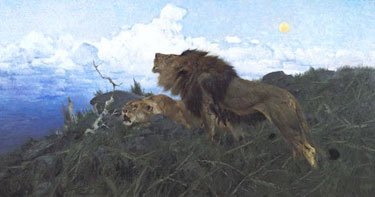
Friedrich Wilhelm “Lion†Kuhnert, as his contemporaries knew him, was born in Oppeln, Germany, in 1865. After beginning an apprenticeship at age 17, Kuhnert moved to Berlin in 1883 and studied with renowned animal painter Paul Meyerheim at the Berlin Academy of Arts. Kuhnert first traveled to Africa in 1891, going on safaris in the German and English colonial territories. He sketched and made field notes along the way, later turning them into impressive oil paintings in his Berlin studio.
A hunter as well as a painter, Kuhnert traveled to Africa annually to capture its wild animals in the flesh and on the canvas. Between Kuhnert’s extended visits to Africa, he returned to Germany and continued his wildlife studies, traveling throughout Europe in pursuit of its indigenous species, including red stag, elk, bison, wild boar, and moose.
It’s estimated that Kuhnert’s body of work once totaled 5,500 paintings. Today there are less than a thousand known works in existence. The remainder of his artwork was destroyed or lost in World War II.
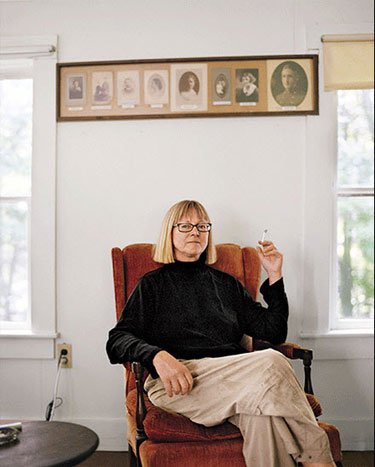
Helem DeWitt’s first novel, The Last Samurai, made a big splash when it was published, but the author had publishing problems. Time has gone by, and she is not yet rich. In fact, she is so broke that she is struggling with a dying laptop she cannot afford to replace, and when she tried to donate a second time to Bernie Sanders recently, her credit card was declined.
Christian Lorentzen, describes the author’s hard luck story in New York Magazine, reprinted by Vulture:
The Last Samurai was a sensation even before it appeared. The toast of the Frankfurt Book Fair in 1999, with rights sold to more than a dozen countries, the novel came out in 2000 to wide acclaim, sold in excess of 100,000 copies in English, and was nominated for several prizes. But for DeWitt, this was the beginning of a long phase of turmoil that still hasn’t abated. The book’s success was marred by an epic battle with a copy editor involving large amounts of Wite-Out; typesetting nightmares having to do with the book’s use of foreign scripts; what she describes as “an accounting error†that resulted in her owing the publisher $75,000 when she thought the publisher owed her $80,000; the agonies of obtaining permissions for the many outside works quoted in the novel, including Akira Kurosawa’s The Seven Samurai — which was the title of The Last Samurai until it was deemed legally impossible. …
When DeWitt talks about her artistic breakthroughs, she has a way of quickly turning to her travails with the publishing industry. “Of course, at that point I had never talked to an agent, so I had never had the kind of conversation where you have some hotshot agent saying, ‘No publisher will allow that.’ †DeWitt had earlier compared publishing to the pharmaceutical industry: The way drug companies suppress negative trial results in her view is similar to the way agents’ and editors’ failed deals are never reported, nor the way they stifle literary talent in the cradle. “There could be all these people out there having these ideas and being told, ‘No, no, no, no.’  
DeWitt has a keen interest in David Foster Wallace. The two writers have some important things in common: a rigorous academic background, an aesthetic of fracture, suicide as subject matter. She believes that if all had gone as smoothly as it could have with the publication of The Last Samurai, it would have been in the cohort of Infinite Jest. I took this to mean that she would have been considered a rival to Wallace and Jonathan Franzen for the unofficial title of Greatest American Novelist of Her Generation. Instead she sees herself as a writer who hasn’t yet fully emerged. “Plato did not have an editor,†she said. “Plenty of writers that we admire struggled along somehow without the help of Michael Pietsch,†referring to the editor of Infinite Jest. But it seemed to me that for all she had against the publishing world, DeWitt was still looking for a savior to rescue her — not unlike Ludo looking for a father. She disagreed: All she needed was a competent partner to put her books out without screwing them up and to pay her an advance she could survive on. (She had nice things to say about New Directions, but its advances are small.)
Mount Roraima, first described by the English explorer Sir Walter Raleigh in 1596, its 31 km2 (11.96 sq. miles) summit area is bounded on all sides by cliffs rising 400 metres (1,300 ft). The mountain serves as the triple border point of Venezuela (85% of its territory), Guyana (10%) and Brazil (5%).
This tabletop mountain is one of the oldest mountains on Earth, dating back two billion years when the land was lifted high above the ground by tectonic activity. The sides of the mountain are sheer vertical cliffs, with several waterfalls, making it nearly impossible to climb.