Christopher Taylor has pessimistic things to say about America’s politics. He thinks a nation with a culture like ours can only have the kind of national leadership we have.
Who wins what office makes no difference. Until the nation undergoes a tremendous shift at the basic, cultural level, elections will only pour more of the same on this country and every new election makes matters worse. And that cultural shift takes time, not elections.
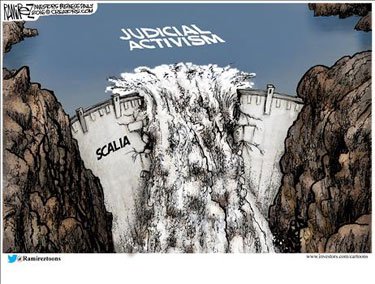
We’re at a point in this nation where the Supreme Court has been stuffed with a near-majority of members for whom the constitution is simply a set of words they can use to lever in anything the latest progressive positions hold. When a court has even a few judges who are utterly disinterested in constitution, wisdom, reason, justice, or sanity, that court ceases to have any validity whatseover. It has been corrupted to the point of being useless.
Arguments we have to get the right sort of politician in this position or that for The Judges ignores the utter destruction of the constitution and nation that has already been wrought by a supposed judicially sensible majority. After the utter abortion that was the Kelo vs New London decision, the court followed up with several horrendously decided trash cases which demonstrated that they cannot be trusted with power no matter who they are or what they claim about law.
Will a supreme court justice picked by a corrupt, horrible hag like Hillary Clinton be much worse than even a lying bozo like Donald Trump? Yes. But the bad is not a question of ruining the nation, its a question of how fast and in what direction. Its going that way anyway, its just a matter of how swiftly. …
There’s a phrase some use to describe this attitude: “let it burn.” Some misunderstand this as a call to destroy the nation. But its not. Its a call to step back and give up the fight because its going down either way. For years now I’ve been telling everyone to focus locally, on family, neighbors, local politics. Your home, your area, your town. Because the federal government is a write-off. There is no fixing it through any elections.
That’s what Let It Burn means; not “revolution!!!” but rather “its already burning and the firefighters know it won’t be saved.” Let it Burn recognizes that its already on fire. We’re past the point of preventing it. We cannot save this Republic, until we get past the hard times ahead and begin the slow, painful process of rebuilding.
I’m sorry. I don’t like it either. but that doesn’t make it any less true. And recognizing this doesn’t make me a crazy old man. Just a sad one.
“Posterity–you will never know how much it has cost my generation to preserve your freedom. I hope you will make good use of it.”
-John Quincy Adams
Sorry, John. We didn’t. We gave it a pretty good run for a while, but its over.
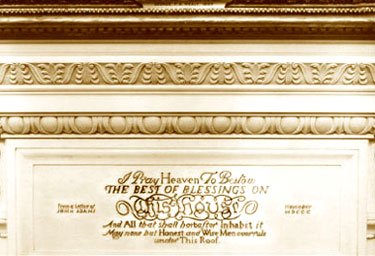
John Adams became the first president to move into and occupy the White House on 1 November 1800. On his second night in residence, he wrote the following prayer in a letter to his wife Abigail. President Franklin D. Roosevelt had Adams’ words carved on the fireplace mantel in the State Dining Room. Truman removed the carving. First Lady Jacqueline Kennedy had it restored to the State Room where it is still to be seen today.
I Pray Heaven To Bestow the Best of Blessings on THIS HOUSE and All that shall hereafter Inhabit it. May none but Honest and Wise Men ever rule under This Roof.
We, today, ought to follow President Adams’ wishes and vote only for Honest and Wise Men.
Detail, John Melhuish Strudwick, A Golden Thread, 1885, Tate Gallery.
This ought to be a locked-in-concrete, dead-certain Republican year. America has a two party system, and Americans have an instinctive habit of giving both sides a turn at the presidency. Unless the incumbent walks on water like Ronald Reagan, after 8 years, the American public is hankering for a change and typically turns the ball over to the other team.
Beyond that, running against Hillary is a lot like running against the mean old woman of every Blues song, who moreover seems likely any day to be indicted.
But, along comes Trumplestiltskin.
In Scenario 1, Trump wins nearly all the rest of the primaries. The GOP caves and gives him the rest of the votes he needs for the nomination, and then the Party splits. Movement conservatives, the people who nominated Barry Goldwater and elected Ronald Reagan, and the intellectuals (very possibly including the Neocons), conceivably including socially-moderate, but snobbish, Country Club Republicans take a hike. In significant sectors of the Party, voting for The Donald is just infra dig, and some contend that even Hillary would make a more responsible first magistrate. Trump loses, Hillary becomes President.
Scenario 2, Trump has a ceiling, getting a plurality of delegates on the first ballot, but no majority. Conservatives and GOP Establishmentarians will die in the last ditch before nominating Donald. The knives come out. Trump delegates are pulled away on subsequent ballots, and a brokered convention nominates Cruz or Rubio. Donald J. Trump is no sportsman. He immediately forms a Third Party, and in the election proceeds to pull all the numbskulls and Reagan democrats away from the GOP candidate. Hillary becomes President.
There is no scenario 3.
The Trumpkins are going to say: This isn’t fair. We’re having a Revolution, and the rest of you are supposed to get on board. Donald Trump is our only hope of Change. Change you can believe in. And the rest of us, the sane people, are going to make little circle next to our temples with our index fingers at the idea of turning all the power of the Presidency over to a totally-unprincipled, egomanaical airhead with the morals and manners of the most spoiled rich kid in the entire country. Some of us actually know what happened when they made Gaius Julius Caesar Augustus Germanicus, nicknamed “Caligula” (“Little Boots”) by the Army, Emperor. It was not pretty.
Timothy L. O’Brien explains how Trump blew his biggest real estate deal ever.
Through Trump’s rise, fall and rebirth, there was one major real estate project that he tried to keep. The tale of what happened to that property should be of interest to anyone looking for insight into how Trump might perform as president. It was a deal of genuine magnitude and would have put him atop the New York real estate market. And he screwed it up.
The deal involved Manhattan’s West Side Yards, a sprawling, 77-acre tract abutting the Hudson River between 59th and 72nd Streets and at the time the largest privately owned undeveloped stretch of land in New York City. The Yards were a vestige of the Penn Central Transportation Company, a failed railroad enterprise that, in 1970, filed what was then the biggest corporate bankruptcy in U.S. history. In the wake of that collapse, Trump leveraged his father’s ties to New York’s Democratic machine and local bankers to acquire pieces of Penn Central’s holdings, including the Yards, in the mid-1970s.
Unable to reach agreements with the city and community groups on how to develop the site, Trump let his option lapse in 1979. His Yards saga began in earnest in 1985, when he bought back the property from another developer for $115 million.
Trump’s plans for the property included office and residential space; a new broadcasting headquarters for NBC; a rocket-ship-shaped skyscraper that would have been the world’s tallest building and cast shadows across the Hudson River into New Jersey; and a $700 million property tax abatement from the city as an incentive to build it. The $4.5 billion project — which Trump called Television City — would have been New York’s biggest development since Rockefeller Center.
Like London’s Canary Wharf, begun a few years later, Television City promised to reshape a significant portion of a major urban center. “It’s an opportunity to build a city within the greatest city, and I don’t think anybody’s ever had that opportunity,†Trump said in an interview at the time.
With the property, financing and plans in place, a large part of what Trump needed to do to make Television City a reality was to bring together different stakeholders: locals (like the late actor Paul Newman) who wanted parks and a less imposing development, and a mayor, Ed Koch, who had his own outsize personality and who was trying to balance the city’s redevelopment with the needs of the area’s longtime residents.
Had Trump appeased these interests, he might have made the project a reality. Instead, the author of “The Art of the Deal†quickly became entangled in an epic, only-in-New-York round of public fisticuffs with Koch in the spring and summer of 1987. The brawl devolved into name-calling — and ultimately helped doom a deal that could have had vastly different results if Trump chose different tactics.
After learning that Koch was going to turn down his request for the $700 million abatement for Television City, Trump dashed off a letter to the mayor.
“For you to be playing ‘Russian Roulette’ with perhaps the most important corporation in New York over the relatively small amounts of money involved because you and your staff are afraid that Donald Trump may actually make more than a dollar of profit, is both ludicrous and disgraceful,†he wrote to Koch.
Koch wrote back to Trump, warning him to “refrain from further attempts to influence the process through intimidation.†Koch then held a press conference, during which he released the letters and said he wasn’t going to give Trump the abatement.
Trump doubled down, holding his own press conference and calling on Koch to resign. The battle played out in a carnivalesque stream on TV and on the front pages and gossip columns of newspapers.
Koch said Trump was “squealing like a stuck pig.†Trump said Koch’s New York had become a “cesspool of corruption and incompetence.†Koch said Trump was a “piggy, piggy, piggy.â€
Trump said the mayor had “no talent and only moderate intelligence†and should be impeached. “Ed Koch would do everybody a huge favor if he would get out of office and they started all over again,†he noted. “It’s bedlam in the city.â€
“The inertia starter †Schwungmasse †works by rotating a heavy mass at speed, once it reaches 60rpm a lever is pulled below the hand cranking arm, this pushes the drive pinion onto the fly wheel, making the engine rotate and start.”
It’s a Panzerkampfwagen VI, the Tiger I, named by Ferdinand Porsche.
On 21 April 1943, a Tiger I of the 504th German heavy tank battalion, with turret number 131, was captured on a hill called Djebel Djaffa in Tunisia. A 6-pounder solid shot from a Churchill tank of the British 48th Royal Tank Regiment hit the Tiger’s gun barrel and ricocheted into its turret ring, jamming its traverse and wounding the commander. The crew bailed out and the tank was captured. After repairs, the tank was sent to England for a thorough inspection.
The captured tank was officially handed over to the Bovington Tank Museum by the British Ministry of Supply on 25 September 1951. In June 1990, the tank was removed from display at the museum and work began on its restoration. This was carried out both by the museum and the Army Base Repair Organisation and involved an almost complete disassembly of the tank. The Maybach HL230 engine from the museum’s Tiger II was installed (the Tiger’s original Maybach HL210 had been sectioned for display), along with a modern fire-suppressant system in the engine compartment. In December 2003, Tiger 131 returned to the museum, restored and in running condition. This Tiger was used in the film Fury, the first time an original, fully mechanically operable Tiger I has appeared in a movie since World War II.
Eliot A. Cohen, in the American Interest, points out that Donald Trump is not the solution to America’s problems, he is really the most alarming symptom of the disease.
Politicians have, since ancient Greece, lied, pandered, and whored. They have taken bribes, connived, and perjured themselves. But in recent times—in the United States, at any rate—there has never been any politician quite as openly debased and debauched as Donald Trump. Truman and Nixon could be vulgar, but they kept the cuss words for private use. Presidents have chewed out journalists, but which of them would have suggested that an elegant and intelligent woman asking a reasonable question was dripping menstrual blood? LBJ, Kennedy, and Clinton could all treat women as commodities to be used for their pleasure, but none went on the radio with the likes of Howard Stern to discuss the women they had bedded and the finer points of their anatomies. All politicians like the sound of their own names, but can anyone doubt what Trump would have christened the Hoover Dam—or the Washington Monument?
That otherwise sober people do not find Trump’s insults and insane demands outrageous (Mexico will have to pay for a wall! Japan will have to pay for protection!) says something about a larger moral and cultural collapse. His language is the language of the comments sections of once-great newspapers. …
The current problem goes beyond excruciatingly bad manners. What we increasingly lack, and have lacked for some time, is a sense of the moral underpinning of republican (small r) government. Manners and morals maintain a free state as much as laws do, as Tocqueville observed long ago, and when a certain culture of virtue dies, so too does something of what makes democracy work. Old-fashioned words like integrity, selflessness, frugality, gravitas, and modesty rarely rate a mention in modern descriptions of the good life—is it surprising that they don’t come up in politics, either? …
The rot is cultural. It is no coincidence that Trump was the star of a “reality†show. He is the beneficiary of an amoral celebrity culture devoid of all content save an omnipresent lubriciousness. He is a kind of male Kim Kardashian, and about as politically serious. In the context of culture, if not (yet) politics, he is unremarkable; the daily entertainments of today are both tawdry and self-consciously, corrosively ironic. Ours is an age when young people have become used to getting news, of a sort, from Jon Stewart and Steven Colbert, when an earlier generation watched Walter Cronkite and David Brinkley. It is the difference between giggling with young, sneering hipsters and listening to serious adults. Go to YouTube and look at old episodes of Profiles in Courage, if you can find them—a wildly successful television series based on the book nominally authored by John F. Kennedy, which celebrated an individual’s, often a politician’s, courage in standing alone against a crowd, even a crowd with whose politics the audience agreed. The show of comparable popularity today is House of Cards. Bill Clinton has said that he loves it.
American culture is, in short, nastier, more nihilistic, and far less inhibited than ever before. It breeds alternating bouts of cynicism and hysteria, and now it has given us Trump.
Paul Kengor sums up the embarrassing spectacle which has constituted the Republican Presidential Nomination Campaign thus far
The whole thing is depressing. Consider, Rubio and Cruz, the two genuine conservative front-runners, are the hardworking sons of extraordinary immigrants from Cuba. They are quintessential American success stories. They are both solid Christian family men. And into the race comes a sudden self-proclaimed born-again conservative who laughs at them and eviscerates them, and is rewarded for it. It’s hard to watch.
All of which brings me back to Trump’s mastery of an altogether new campaign tactic of non-stop rapacious ridicule of opponents within one’s own party. The New Jersey casino founder brashly accused Ted Cruz of everything from being a closet Canadian citizen to cheating when the Donald lost Iowa. Schoolboy-like, Trump threatened lawsuits. Of late, he jumps in the sandbox and taunts Marco Rubio: “choker, choker!â€
Can you imagine Ronald Reagan doing this? Reagan’s “11th commandment†was never to speak ill of another Republican. Donald Trump’s commandment is to speak ill of every Republican.
Do Republicans want this as the party’s new face and standard-bearer? Apparently those on the Trump side do. Many of them even assume the insult-king’s persona, dealing with dissenters with similar levels of obnoxiousness, blow-torching Republicans in the way of their Donald.
The relic dating from the fifteenth century was sold for 297,600 pounds (376,833 euros –$410,361.72) to a Frenchman who wished to remain anonymous, said the spokesman for the Timeline auctions.
The opening bid was 14,000 pounds (19,051 euros — $20,746.06).
According to representatives of the auction house, Joan of Arc gave a detailed description of the ring during her interrogation at Rouen 17 March 1431. It contains the inscription Jhesus Maria and three engraved crosses.
The ring, accompanied by authentication documents, is kept in a wooden casket. After the execution of Joan, the precious object was worn by King Henry VII of England.
“The ring returns to France,” the spokesman for the auction house told reporters without revealing the name of the French citizen who acquired the relic.
The jewelery was sold by the son of Charles de Gaulle’s personal physician. Earlier, the French government had proposed to examine the possibility of buying this relic.
—————————————–
——————————————
——————————————
Timeline Auctions, Antiquities, 25 February 2016, Lot 1220
MEDIEVAL JOAN OF ARC DEVOTIONAL RING WITH CASKET AND DOCUMENTS
15th century AD
With a published Joan of Arc association dating back over a century, exhibited twice in France in the 1950s and in the Museum of Lancashire Millennium Exhibition, January to December 2000, this ring has a silver-gilt hoop with facetted outer face, expanding shoulders and two rectangular and angled fields to the bezel; the hoop with incised niello-filled florid lozenges and triangles, the design giving the appearance of three crosses, the ends of the shoulders with blackletter ‘I’ and ‘M’ (for ‘Iesus Maria’), the lateral faces with blackletter ‘IHS’ and ‘MAR’ (as abbreviations for Jesus and Maria); a small section inserted later to the hoop, sufficient possibly to enlarge it from a band suitable for a small, feminine finger to a larger male(?) hand; the degree of wear generally evident to the ring, including to the hoop insert, suggesting an extended period of wear, long after the date of making, perhaps indicative of the ring’s appeal as a talisman; contained in an antique, small oak casket in the form of an architectural reliquary with pitched and hipped lid, the ridge surmounted by a plain cross in iron, the box red velvet-lined, with a removable rectangular holder (the compartment beneath possibly having once held a small document or label), arranged to display the bezel and purpose-made to hold the ring, indicating the reverence in which the ring was already held when the box was made for it; the ring is very unusual in that the vast majority of rings with angled rectangular bezels have them engraved with pictures of saints rather than being inscribed (generally termed as iconographic rings); inscriptions on such rings are normally on the hoop part.
Accompanied by a professional drawing showing the ring extended, with the three crosses forming part of the design to the shank clearly depicted; also with publications, documents, press cuttings and correspondence including a photocopy of the 1917 Oates privately printed catalogue; a cuttings book containing an extract from the Sotheby’s sale of 1947 (including an image of the ring), with press cuttings from such publications as the Evening Standard, Daily Telegraph and Le Figaro at the time of that sale, followed by others (some illustrated, showing both ring and casket) including from English, American and French newspapers and periodicals in the 1950s, from when the ring was exhibited in France (at La Turbie and also at Rouen and Paris); associated correspondence with the mayor of La Turbie and further referring to the 500th rehabilitation anniversary exhibition; typescript research notes and a signed note by Cyril Bunt (dated 1949) discussing Cardinal Beaufort and the ring and its descent to Lady Morrell; papers relating to two interviews with the British Broadcasting Corporation (BBC) in 1953 and 1956; correspondence with the French embassy in London, shipping documents and permissions for the ring to be sent to France for exhibition; a photocopy of the last letter (with transcript) of Joan of Arc; the exhibition pamphlet for La Turbie (4 copies, 3 in English, 1 in French, 1952), the catalogue for the Jeanne d’Arc et Son Temps exhibition (Rouen and Paris, 1956); documents, including the mounted display caption, from the AD 2000 – The Story of Christianity in Lancashire exhibition at the Museum of Lancashire held in 2000; other correspondence of various dates from 1950s to 1980s regarding the ring, most of the letters with envelopes. Ring: 4.90 grams, 21mm overall, 18.27mm internal diameter (approximate size British Q, USA 8, Europe 17.49, Japan 17); casket: 127 grams total, 79 x 58 x 77mm (Ring: 3/4″ casket: 3 1/4 x 2 1/4 x 3″). Good condition; surfaces worn.
Provenance
Property of an Essex gentleman; inherited 1979 from Dr James Hasson of Harley Street, London; acquired Sotheby’s sale, 1 April 1947, lot 37; formerly in a private collection (1929-1947); previously with the F. A. Harman Oates collection (sold Sotheby’s, 20 February 1929, lot 21); earlier with Augustus John before 1914, the gift to him of Lady Ottoline Morrell; by descent, through the Cavendish-Bentinck family (Duke of Portland) from cardinal Henry Beaufort (1375-1447), who was present at the trial and execution of Joan of Arc in 1431; the ring stated by Joan at her trial to have been a gift from her parents. Supplied with a positive X-Ray Fluorescence metal analysis certificate.
A study has found that America’s millennials are skipping out on cereal because it’s simply too much of an inconvenience.
(Yes, the cold kind that requires little more than pouring something into a bowl and then pouring milk over it.)
An astonishing 40 percent of millennials surveyed said they reach for something else, like a smoothie or breakfast bar, reported by The New York Times.
One of the biggest problems was with the washing up. “Almost 40 percent of the millennials surveyed by Mintel for its 2015 report said cereal was an inconvenient breakfast choice because they had to clean up after eating it,” it reported.
Another factor included the fact that many consumers don’t want to start their day with processed grains.
——————————-
But they’ve solved the problem in Blighty. London now has a cereal cafe to save you all the effort of serving it and cleaning up yourself.
Located a stone’s throw from the similarly kooky cat cafe, Cereal Killer has 120 types of cereals from across the world on offer – and twelve varieties of milk to pour over them, from plain old semi-skimmed to strawberry and lactose free.
And at £3.50 for a large bowl, it’s set to make a killing.
After opening its doors for the first time at 7am yesterday, over 100 people turned up within three hours, eager to indulge in exotic American delicacies like Poppin’ Fruity Pebbles – a cereal loaded with tongue-tingling popping candy – and marshmallow-laden Lucky Charms.
For those desperate for an extreme sugar rush – or simply wanting to sidestep the dentist by rotting a rogue wisdom tooth directly out of their jaw – there’s also the option to add on extra toppings including chocolate chips, crushed Kinder hippos and fresh fruit – at 50p a time.
But you don’t have to be adventurous to eat here, you can still enjoy a small bowl of plain cornflakes – for the price of a 750g box from Sainsbury’s.
Cereal Killer, which stays open until 10pm for anyone who fancies a cold, milky dinner, is the brainchild of Belfast-born twins Alan and Gary Keery, 32.
The idea came to them during an afternoon stroll in London when they both fancied a bowl of cereal, but couldn’t get one anywhere.
“We’re celebrating cereal,” said Alan. “It totally baffled us that people eat cereal every day at home – but never outside the home. It’s crazy it’s never been done before.”