Archive for July, 2019
07 Jul 2019

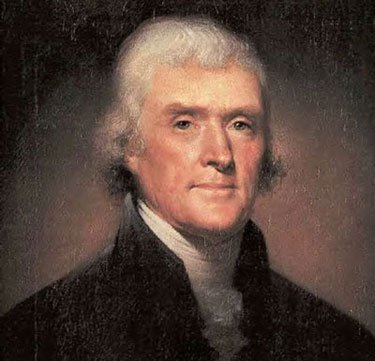
I know, from Yale circles, a prominent and well-respected writer of books about American history. Several years ago, he repeated Nature magazine’s lie about Thomas Jefferson being the father of Sally Hemmings’ children. I called him on it, and tried explaining the many reasons these allegations were probably false. He wouldn’t hear any of it. The consensus of the Establishment said so, so it must be so.
Ann Coulter is smarter than my friend from Yale, and deserves applause for sticking up for Jefferson’s reputation.
This Fourth of July, let’s look at the tactics used by the left to blacken the reputations of American heroes. To wit, the lie that the principal author of the declaration, Thomas Jefferson, fathered a child with his slave, Sally Hemings.
The charge was first leveled in 1802 by a muckraking, racist, alcoholic journalist, James Callender, who had served prison time for his particular brand of journalism. He had tried to blackmail Jefferson into appointing him postmaster at Richmond. When that failed, Callender retaliated by publicly accusing Jefferson of fathering the first-born son of Sally Hemings — or, as the charming Callender described her, “a slut as common as the pavement.â€
No serious historian ever believed Callender’s defamation — not Dumas Malone, Merrill Peterson, Douglass Adair or John Chester Miller. Not one. Their reasoning was that there was absolutely no evidence to support the theory and plenty to contradict it.
The Jefferson-Hemings myth was revived by feminists trying to elevate the role of women in history. …
Fawn M. Brodie got the ball rolling with her 1974 book, “Thomas Jefferson: An Intimate History,” which used Freudian analysis to prove Jefferson kept Hemings as his concubine and fathered all six of her children.
Brodie’s book was followed by Barbara Chase-Riboud’s 1979 novel “Sally Hemings,” a work that imagines Hemings’ interior life. When CBS announced plans to make a miniseries out of the novel, Jefferson scholars exploded, denouncing the project as a preposterous lie. The miniseries was canceled.
Finally, a female law professor, Annette Gordon-Reed, wrote “Thomas Jefferson and Sally Hemings: An American Controversy,” which accused professional historians of racism for refusing to defer to the “oral history†of Hemings’ descendants.
She said “racism,†so the historians shut up.
In 1998, a retired pathologist, Dr. Eugene Foster, performed a DNA test on the Y-chromosomes of living male descendants of Sally Hemings, as well as those from Jefferson’s paternal uncle. The Y-chromosome is passed from male to male, so, if the story were true, Hemings’ male descendants ought to have the Y-chromosome of the Jefferson male bloodline.
What the DNA tests showed was that Hemings’ firstborn son, Tom — the Tom whose alleged paternity was the basis for Callender’s accusation — was not related to any Jefferson male.
Foster’s study did establish that Hemings’ last-born son, Eston, was the son of some Jefferson male, but could not possibly say whether that was Thomas Jefferson or any of the other 25 adult male Jeffersons living in Virginia at the time, eight of them at or near Monticello.
For Eston to be Jefferson’s son, we have to believe that five years after being falsely accused of fathering a child with Hemings, Jefferson decided, What the heck? I may be president of the United States, but I should prove Callender’s slander true by fathering a child with my slave! No one will notice.
It would be as if five years after the Duke lacrosse hoax, one of the falsely accused players went out and actually raped a stripper — in fact, the same stripper.
Nonetheless, Nature magazine titled its article on the study “Jefferson Fathered Slave’s Last Child.†Hundreds of newspapers rushed to print with the lie, e.g.:
“Study: Jefferson, Slave Had Baby” — Associated Press Online, Nov. 1, 1998
“DNA Study Shows Jefferson Fathered His Slave’s Child” — Los Angeles Times, Nov. 1, 1998
“Jefferson Exposed” — Boston Globe, Nov. 3, 1998
Two months after these false “findings†had been broadcast from every news outlet where English is spoken, Foster admitted that the DNA had not proved Jefferson fathered any children by Sally Hemings, merely that he could have fathered one child. Only eight newspapers mentioned the retraction.
The science alone puts the odds of Thomas Jefferson fathering Eston at less than 15% — less than 4%, if all living Jefferson males are considered, not just the ones at Monticello.
All other known facts about Jefferson make it far less probable still.
There are no letters, diaries or records supporting the idea that Jefferson was intimate with Hemings, and quite a bit of written documentation to refute it, including Jefferson’s views on miscegenation and his failure to free Hemings in his will, despite freeing several other slaves.
In private letters, Jefferson denounced Callender’s claim — a denial made more credible by his admission to a sexual indiscretion that would have been more shameful at the time: his youthful seduction of a friend’s wife.
None of the private correspondence from anyone else living at Monticello credited the Hemings rumor, though several pointed to other likely suspects — specifically Jefferson’s brother, Randolph.
Eston was born in 1808, when Thomas Jefferson was 64 years old and in his second term as president. His brother Randolph was 52, and Randolph’s five sons were 17 to 24 years old. All of them were frequent visitors at Monticello.
While Jefferson was busy entertaining international visitors in the main house, Randolph would generally retire to the slave quarters to dance and fiddle. One slave, Isaac Granger Jefferson, described Randolph in his dictated memoirs thus: “Old Master’s brother, Mass Randall, was a mighty simple man: used to come out among black people, play the fiddle and dance half the night.â€
There is not a single account of Thomas Jefferson frequenting slave quarters. Nor did Jefferson take any interest in Hemings’ children. Randolph did, teaching all of Hemings’ sons to play the fiddle.
Randolph was an unmarried widower when Eston was conceived. After Randolph remarried, Hemings had no more children.
In response to DNA proof that only one of Hemings’ children was related to any Jefferson male — and her firstborn son was definitely NOT fathered by any Jefferson — the Thomas Jefferson Foundation, the Monticello Association and the National Genealogical Society promptly announced their official positions: Thomas Jefferson fathered all six of Hemings’ children! Guided tours of Monticello today include the provably false information that Jefferson fathered all of Hemings’ children.
So now you, at least, know the truth — not that it matters in the slightest. Happy Fourth of July!
07 Jul 2019

Last year, Varvel explained how Trump changed his mind and mine:
“[H]ow in the world did Trump change my mind? He started keeping those promises.”
06 Jul 2019

Marble Bust of Antoninus Pius, Emperor 138-161 A.D., British Museum.
Peter Quennell, The Wanton Chase — An Autobiography from 1939 (1980):
Here and elsewhere, I am often surprised to notice, the landscape of my life shows comparatively little change. I love the same pictures and, generally, the same books; and, both in painting and literature, I admire the same qualities. Human existence, the Etruscans maintained, was divided into seven-year periods; and, when the tenth had passed, the individual, having run through his allotted span, need expect no further signs from heaven. This, happily, I have so far found untrue. Flashes of illumination still descend; yet a single change has certainly occurred; as soon as one enters that ominous eighth decade, the prospect of one’s own death becomes, if not a morbid obsession, a regular preoccupation, obstinately lodged at the back of the mind, though the foreground may continue to be peopled with amusing and distracting fancies. What chiefly haunts one is less a primitive fear of death, the medieval timor mortis, than a problem that defies solution – how to accept the idea of nothingness and of one’s future non-existence. That idea, like the ‘black holes’ modern astronomers have located in the fabric of the universe, totally baffles the imagination; and, should one attempt to build up a detailed picture of some familiar friendly room –- books, chairs, eighteenth-century prints, a large window surrounded by broad leaves, and the window-sill on which a cat alighted –- but then deliberately exclude oneself, one feels a sudden touch of horror, so difficult is it think of the world surviving without one’s own invaluable aid.
I have long collected evocative ‘last words’ and the philosophic pronouncements of great men when they felt that death was drawing near; and my friend Alan Hodge, now himself dead -– he died, alas, while I was halfway through this chapter -– used to describe a revelatory conversation that, about 1955, he had had with Winston Churchill. Allan was then assisting him to produce his History of the English-Speaking Peoples, and often spent a working holiday at a villa in the South of France. His business was to prepare a series of drafts, on which the great man would then impose a fine sonority and Churchillian dignity; but, when that had been accomplished, they often dined together and, after dinner, sat beside the fire. The great man had passed his eightieth year, and his heroic life lay far behind him. His mood was sometimes pensive; and, one evening, the logs in the fire were damp, and spat reproachfully and hissed and smoked. The spectacle arroused him from a lengthy silence. ‘Curious’, he said, ‘to imagine oneself a log –- reluctant to be consumed -– but obliged eventually to give way. … Further than that his reverie did not go; but the effect it made was deeply solemn.
Sir Winston had still ten years to live; and among memorable last words, pronounced under the shadow of death itself, I particularly admire the farewell utterance of the Emperor Antoninus Pius, Hadrian’s adopted son, father of Marcus Aurelius, and one of the ‘good emperors’, the virtuous and industrious Antonines we were expected to admire at school. Gibbon, however, with his usual flippancy, makes gentle fun of Antoninus. At least, he remarks that, whereas the life of Hadrian had been ‘almost a perpetual journey’, and that he had ‘marched on foot, and bareheaded, over the snows of Caledonia, and the sultry plains of upper Egypt’, his successor seldom left home; ‘and during the twenty-three years that he directed the public administration, the longest journeys of that amiable prince extended no further than from his palace in Rome to the retirement of his Lanuvian villa.
Yet Antoninus, Gibbon freely admits, was a by no means idle ruler; at home he codified the Roman legal system; beyond the Italian frontier, he ‘diffused order and tranquility over the greatest part of the earth’. Nor was he a grim ascetic; ‘he enjoyed with moderation, the conveniences of his fortune, and the innocent pleasures of society’; and Gibbon adds, in a footnote, that he ‘was fond of theater, and not insensible to the charms of the fair sex’. He also appreciated the pursuits and pastimes of the Roman country gentleman; and on his estate, especially when the grapes were gathered, he liked attending rustic feasts. A tall, impressive man, he had a loud but pleasant voice, and was renowned for his civilitas, his unwillingness to take offense and his easy-going courtesy. The Emperor was even prepared to tolerate Christians – or so Christian writers themselves declared — although, if they were judicially accused and convicted, he might allow the law to take its course. His own religious faith was quietly conservative; he built and restored temples, and did his best to encourage the worship of the ancient Roman gods. Still practicing this calm and temperate philosophy, Antoninus reached his seventy-fifth year. Then, in the spring of 161 A.D., he, too, recognized the approach of death, and retired to his country house near Rome, where, at dinner, he ate some Alpine cheese, and woke up feverish next morning. On March 7, the Tribune of his bodyguard asked him to give the watchword of the day. ‘Aequanimitas’ he firmly answered, and withdrew into his private apartments, from which he never reappeared.
05 Jul 2019

Captain Federico Caprilli who revolutionized equitation in action.
05 Jul 2019

Sahil Handa, an intelligent young undergraduate, reports from the front-lines of the Snowflake Revolution at Harvard.
Much of the debate about campus culture would have you believe that the average college student is hellbent on tearing down the patriarchy. One wakes up in the morning, wallows in grievance, and proceeds to spend the day railing against the evils of privilege.
I attend Harvard University, one of the places most associated with such snowflakery. I also happen to be a brown British student who wears colorful Hawaiian shirts, dances to techno, acts in undergraduate theater, and listens to jazz. I say this not to brandish my victimhood credentials, nor to make any claims to artistic ability — I say it because these facts get me invited into liberal social circles that, unfortunately, most conservative commentators do not.
So, is the description accurate? In my experience, not particularly. I’d say it describes roughly 5 percent of the undergraduate population — a few hundred or so social-justice warriors who consider their mere survival on Harvard’s campus to be a form of triumphalist activism. These woke icons are overwhelmingly middle class, incredibly entitled, and extraordinarily outspoken. They respond to any virtue signal with finger snaps and use the word “problematic†in every other sentence. They see themselves as engaged in a perpetual war against a white, male, neoliberal blob — wrong opinions must be canceled, and insufficiently woke speakers ruined. Trump supporters are too far gone to bother persuading.
But most students do not subscribe to the madness. Contrarian conservatives repudiate it and find sanctuary in the Republican Club. Others are too focused on studying and partying to care. The majority stay silent and air their concerns in private, so that they won’t be forced to bear the inevitable social cost.
RTWT
04 Jul 2019
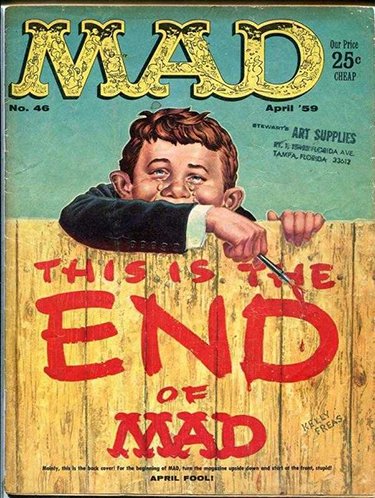
Mad Magazine, 1952 – 2019.
Brooklyn Vegan has sad news.
Mad magazine, which has been bringing the world satire and snappy comebacks to stupid questions for 67 years, will largely stop publishing new content after its next issue which is due this fall. There will still be regular issues of Mad but will feature “classic, best of and nostalgic content†with a new cover. Publisher DC Comics says there will still be end-of-year specials “which will always be new.†In this new form, Mad will also only be available in comic book stores and to subscribers.
Founded in 1952, Mad began as a comic before switching to a magazine format in 1955.
It must be becoming impossible to produce a humor magazine based on satire when real everyday events so frequently are even more preposterous.
03 Jul 2019

Today is the 156th Anniversary of the Third Day of the decisive Battle of Gettysburg.

Crossing the Emmitsburg Road
——————————————————–

“Give them cold steel.” — Brigadier General Lewis Armistead (February 18, 1817–July 3, 1863)
———————————————————
“Dr. Joseph Hold of the 11th Mississippi, Davis’ brigade, anticipated that the afternoon would be busy and set up his dressing station early in a shelter behind Seminary Ridge. . .When the cannonade opened and the Federals’ guns replied, stretcher bearers, crouching low, began bringing in the wounded. Among the first was an athletic young man with reddish golden hair, “a princely fellow,†the doctor called him, with a calm manner and a delightful smile, one of that gay, turbulent company that had left with the University Greys of Oxford to form Company A of the 11th Mississippi.
“The physician examined the left arm, cut off at the elbow, and offered encouragement.
“‘Why, doctor, that isn’t where I am hurt.’ The boy pulled back a blanket and showed where a shell had ripped deep across his abdomen, carrying away much that was vital. ‘I am in great agony,’ he said, still smiling. ‘Let me die easy, dear doctor.’
“But before the lad had drunk the cup containing the concentrated solution of opium, the doctor held up his right arm so he could write: ‘My dear mother. . .Remember that I am true to my country and my regret at dying is that she is not free. . .you must not regret that my body cannot be obtained. It is a mere matter of form anyhow. . .Send my dying release to Miss Mary. . .’ He signed, JERE S. GAGE, Co. A, 11 Miss. By that time, the letter was covered with blood.
“Then he raised his cup to a group of soldiers. ‘I do not invite you to drink with me,’ he remarked wryly, then with fervor, ‘but I drink a toast to you, the Southern Confederacy, and to victory’
* * *
“Then Pickett stood in front of his division and gave the final word ‘Charge the enemy and remember old Virginia.’ His voice was clear and strong as he spoke the order: ‘Forward! Guide center! March’ . . .
“‘I don’t want to make this charge,’ Longstreet declared emphatically. ‘I don’t believe it can succeed. I would stop Pickett now, but that General Lee has ordered it and expects it.’
“Further remarks showed he wanted some excuse for calling off the whole attack.
“But Longstreet and Alexander had lost control. As they talked, the turf trembled about them and the long line of grey infantry broke from the woods. First came Garnett’s Virginians, the general in front, his old blue overcoat buttoned tightly around his neck. Abreast was Kemper’s trim line marching majestically into the open fields, the fifes piping ‘Dixie,’ the ranks in nearly perfect alignment. Far to the left could be heard the drum rolls of the Carolina regiments – Pettigrew and Trimble were in motion. The hour of the generals had passed. The infantrymen from the Richmond offices and Pearisburg farmlands, the ‘greys’ from the halls of ‘Old Miss’ and the ‘flower of the Cape Fear section,’ had taken the Confederate cause into their hands.
* * *
“The assaulting column consisted of 41 regiments and one battalion. . .Nineteen of the regiments were from Virginia, 15 from North Carolina, 3 each from Tennessee and Mississippi, and one regiment and one battalion from Alabama.
* * *
“Garnett, with a big voice issuing from his frail body, road ahead of his line regulating the pace, admonishing his men not to move too rapidly. From the skirmish line, Captain Shotwell obtained one of the rare views of the Confederate advance: the ‘glittering forest of bright bayonets,’ the column coming down the slope ‘in superb alignment,’ the ‘murmur and jingle’ and ‘rustle of thousands of feet amid the stubble’ which stirred up a cloud of dust ‘like the dash of spray at the prow of a vessel.’
“In front of Pickett flew the blue banner of the Old Dominion with the motto, ‘Sic semper Tyrannis,†and the Stars and Bars of the Confederacy (the red battle flag with its blue cross not yet being in general use). The regimental flags flapped. A soft warm wind was blowing from the land they loved.â€
–Glenn Tucker, “High Tide at Gettysburg.”
03 Jul 2019

For every Southern boy fourteen years old, not once but whenever he wants it, there is the instant when it’s still not yet two o’clock on that July afternoon in 1863, the brigades are in position behind the rail fence, the guns are laid and ready in the woods and the furled flags are already loosened to break out and Pickett himself with his long oiled ringlets and his hat in one hand probably and his sword in the other looking up the hill waiting for Longstreet to give the word and it’s all in the balance, it hasn’t happened yet, it hasn’t even begun yet, it not only hasn’t begun yet but there is still time for it not to begin against that position and those circumstance which made more men than Garnett and Kemper and Armistead and Wilcox look grave yet it’s going to begin, we all know that, we have come too far with too much at stake and that moment doesn’t need even a fourteen-year-old boy to think This time. Maybe this time with all this much to lose than all this much to gain: Pennsylvania, Maryland, the world, the golden dome of Washington itself to crown with desperate and unbelievable victory the desperate gamble, the cast made two years ago.
—William Faulkner, Intruder in the Dust, 1948.
02 Jul 2019

Alex Henry .450 Double Rifle given by Queen Victoria to her personal attendant John Brown in 1873.
The Henry double rifle, commissioned by Queen Victoria as a Christmas present for John Brown, has been bought by the National Museum of Scotland and will be displayed in public for the first time this summer, from 26th June until November.
Scottish Field:
A gold plaque fitted into the butt of the.450 double-barrelled hammer rifle records that Queen Victoria presented it to John Brown as a Christmas gift in 1873. It was made that year in Edinburgh by noted Edinburgh gun maker Alexander Henry.
Dr Patrick Watt, curator of the exhibition, at National Museums Scotland, said: ‘This a tremendously significant acquisition for National Museums Scotland. It is a stunning object which shows directly the connection and the affection between Queen Victoria and John Brown.
‘The high-quality design and obvious expense of the gift highlights the position of trust and esteem in which the Queen held her loyal servant. …
John Brown had worked on the Balmoral estate since 1842, and rose in the Queen’s favour to special status as Her Majesty’s Highland Servant. After the death of her husband, Prince Albert, in 1861, Brown supported Queen Victoria in her grief. …
Brown died unexpectedly in 1883. Devastated by his loss, the Queen wrote to Brown’s brother Hugh, ‘we all have lost the best, the truest heart that ever beat!’

/div>
Feeds
|





