Archive for September, 2020
14 Sep 2020

Joseph Bottum ruefully reflects: “We are about as far from the election of John F. Kennedy as that election was from the death of Queen Victoria.
We are roughly as far from 1970s disco as disco was from the 1920s Jazz Age.”
13 Sep 2020


c. 1600-1610. A watch set in a single large Colombian emerald crystal of hexagonal form with a hinged lid. The dial plate (the hand is missing) is enamelled in translucent green.
Museum of London:
For almost 300 years a buried treasure lay undisturbed below one of London’s busiest streets. No one knew it was there until workmen started to demolish a timber-framed building in Cheapside near St Paul’s Cathedral, in June 1912. The property had stood on the site since the 17th century, but the cellars were older and lined with brick.
On 18 June 1912 workmen started to excavate the cellars with their picks, and while they were breaking up the floor, they noticed something glinting in the soil below. Quickly scraping the chalky soil aside, they realized that they had struck the remains of an old wooden casket, and to their immense delight a tangled heap of jewellery, gems and other precious objects came tumbling forth. They had uncovered what is now known and celebrated as The Cheapside Hoard the greatest cache of Elizabethan and early Stuart jewellery in the world and one of the most remarkable and spectacular finds ever recovered from British soil.
As a time-capsule of contemporary taste and the jewellers’ trade The Cheapside Hoard is unsurpassed, and it remains not only the most important source of our knowledge of Elizabethan and early Stuart jewellery in England because so little jewellery of this date has survived, but also provides unparalleled information on the international gem trade in an age of global conquest and exploration.
The Hoard was acquired by the London Museum in 1912 (which merged with the Guildhall Museum to form the Museum of London in 1976).
13 Sep 2020

(click on image for larger version)
13 Sep 2020

David Hume Monument, Edinburgh.
If I were Professor Peter Mathieson MBBS(Hons)(London), PhD(Cambridge), FRCP(London), FRCPE, FMedSci, Principal and Vice-Chancellor of the University of Edinburgh, before I renamed the David Hume Tower, I would read his Treatise of Human Nature (1739–1740), his Enquiries concerning Human Understanding (1748) and concerning the Principles of Morals (1751), his six volume History of England, and his posthumously published Dialogues concerning Natural Religion (1779), and I would compare Mr. Hume’s achievements and contributions to Humanity to my own and I would tremble with embarrassment at the very notion of such an insignificant contemporary pygmy and nobody as myself setting up in business to pass judgment on a demigod and giant, one of my own country’s greatest all-time thinkers and very possibly my university’s greatest single alumnus.
I would additionally have taken pains to read Adam Smith’s Letter on the Death of David Hume, which concludes:
I received the following letter from Doctor Black.
‘Edinburgh, Monday, 26th August, 1776.
Dear Sir,
Yesterday about four o’clock afternoon, Mr. Hume expired. The near approach of his death became evident in the night between Thursday and Friday, when his disease became excessive, and soon weakened him so much, that he could no longer rise out of his bed. He continued to the last perfectly sensible, and free from much pain or feelings of distress. He never dropped the smallest expression of impatience; but when he had occasion to speak to the people about him, always did it with affection and tenderness. I thought it improper to write to bring you over, especially as I heard that he had dictated a letter to you desiring you not to come. When he became very weak, it cost him an effort to speak, and he died in such a happy composure of mind, that nothing could exceed it.’
Thus died our most excellent, and never to be forgotten friend; concerning whose philosophical opinions men will, no doubt, judge variously, every one approving, or condemning them, according as they happen to coincide or disagree with his own; but concerning whose character and conduct there can scarce be a difference of opinion. His temper, indeed, seemed to be more happily balanced, if I may be allowed such an expression, than that perhaps of any other man I have ever known.
Even in the lowest state of his fortune, his great and necessary frugality never hindered him from exercising, upon proper occasions, acts both of charity and generosity. It was a frugality founded, not upon avarice, but upon the love of independency. The extreme gentleness of his nature never weakened either the firmness of his mind, or the steadiness of his resolutions. His constant pleasantry was the genuine effusion of good-nature and good humour, tempered with delicacy and modesty, and without even the slightest tincture of malignity, so frequently the disagreeable source of what is called wit in other men. It never was the meaning of his raillery to mortify; and therefore, far from offending, it seldom failed to please and delight, even those who were the objects of it.
To his friends, who were frequently the objects of it, there was not perhaps any one of all his great and amiable qualities, which contributed more to endear his conversation. And that gaiety of temper, so agreeable in society, but which is so often accompanied with frivolous and superficial qualities, was in him certainly attended with the most severe application, the most extensive learning, the greatest depth of thought, and a capacity in every respect the most comprehensive.
Upon the whole, I have always considered him, both in his lifetime and since his death, as approaching as nearly to the idea of a perfectly wise and virtuous man, as perhaps the nature of human frailty will permit.
I ever am, dear Sir,
Most affectionately your’s,
ADAM SMITH.
13 Sep 2020
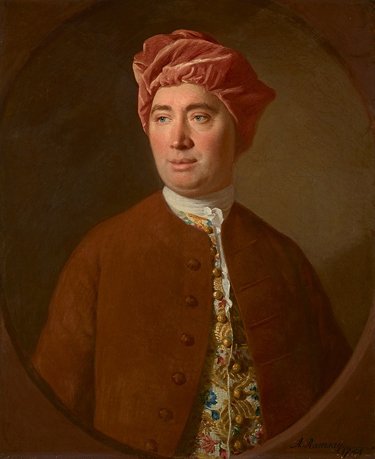
Irish Examiner:
The University of Edinburgh has renamed its David Hume Tower over the philosopher’s “comments on matters of raceâ€.
The building, which will be used as a student study space in the current academic year, will now be known as 40 George Square.
An online petition claiming David Hume “wrote racist epithets†was set up in the summer calling for the building to be renamed and has been signed more than 1,700 times.
The university announced the move in a statement on the work of its Equality and Diversity Committee and its Race Equality and Anti-Racist Sub-committee.
It said its work had been “energised†since the death in the US of George Floyd and campaigning by the Black Lives Matter movement.
“It is important that campuses, curricula and communities reflect both the university’s contemporary and historical diversity and engage with its institutional legacy across the world,†the statement said.
“For this reason the university has taken the decision to rename – initially temporarily until a full review is completed – one of the buildings in the central area campus.â€
It added: “The interim decision has been taken because of the sensitivities around asking students to use a building named after the 18th century philosopher whose comments on matters of race, though not uncommon at the time, rightly cause distress today.â€
It remains a mystery how, practically universally, the people who have risen to the top in the West’s most elite institutions are all such idiots and cowards that they will instantly surrender to the insolent and irrational demands of students intoxicated with a contemptible and pernicious ideology. Somehow it has happened that the responsibility for transmitting and preserving knowledge has been placed in the hands of people who are incapable of, and indifferent to the moral obligation of, distinguishing irrationality and barbarism from the fundamental values of liberal education.
Why aren’t there grownups in charge?
12 Sep 2020

Helen Dale’s review of Helen Pluckrose and James Lindsay’s Cynical Theories: How Activist Scholarship Made Everything about Race, Gender, and Identity in The Critic is a Must-Read item analyzing the real content of the Critical Theory rubbish that has recently come to dominate the American intellectual establishment.
At one point in Winnie-The-Pooh, Pooh and Piglet start to follow footprints in the snow. The pair think they belong to a creature called a “Woozleâ€. The tracks keep multiplying, and the two become increasingly confused, until — finally — Christopher Robin explains they’ve been following their own tracks in circles around a tree, and that Woozles aren’t real.
These days, if you go to university to read humanities and some social sciences — notably psychology and sociology — you’ll find yourself retracing Pooh and Piglet’s steps, hunting for Woozles that aren’t there.
You will encounter radical scepticism about whether objective knowledge or truth is obtainable, along with a commitment to the notion that real things — like sex and race — are culturally constructed. Your lecturers will impress upon you the idea that society is formed into identity-based hierarchies and knowledge is an effect of power. Your position on a league-table of oppressed identities determine what can be known and how it is known. If you disagree you will at least be marked down, and sometimes formally disciplined. Worse, there is no Christopher Robin to save you. It’s Woozles all the way down, and don’t you dare dissent. …
The shift from “it’s immoral to tell another culture’s story†to “it’s impossible to tell another culture’s story, but in any case, one shouldn’t try for moral reasons†is part of a process Pluckrose and Lindsay describe as “reificationâ€, which emerged after I’d left the ivory tower and commenced moving companies around and drafting commercial leases for a living. Once reified, postmodern abstractions about the world are treated as though they are real things, and accorded the status of empirical truth. Contemporary social justice activism thus sees theory as reality, as though it were gravity or cell division or the atomic structure of uranium.
The correspondence theory of truth holds that objective truth exists and we can learn something about it through evidence and reason. That is, things are knowable and we gain reliable information about them when our beliefs align with reality. It’s termed “the correspondence theory of truth†because a statement is considered true when it corresponds with reality and false when it doesn’t. Reality, of course, is the thing that does not change regardless of what you believe.
While advanced civilisations going back to classical antiquity employed this reasoning in selected areas (Ancient Rome to civil engineering and law, for example, or Medieval China to public administration), it’s only since the Enlightenment that it’s been applied consistently to nearly everything, at least in developed countries. It forms the foundation of modern scientific and administrative progress and accounts in large part for the safety and material comfort we now enjoy.
Reified “Theory†is no more and no less than a rejection of the correspondence theory of truth. There are no universal truths and no objective reality, only narratives expressed in discourses and language that reflect one group’s power over another. Science has no claim on objectivity, because science itself is a cultural construct, created out of power differentials, and ordered by straight white males. There are no arguments, merely identity showdowns; the most oppressed always wins.
And, because language makes the world, attempts by scholars in other disciplines and from across the political spectrum to do what I did and falsify Theory’s empirical claims are met not with reasoned debate but an accusation that those individuals are harming the oppressed or silencing the marginalised, because all someone higher up the hierarchical food chain is supposed to do when confronted by someone lower down is listen. That’s the point of telling people to “check their privilege†before they open their mouths.
RTWT
12 Sep 2020

———————————-

Vicky Osterweil explained the thesis of her new book, In Defense of Looting, recently to NPR:
The very basis of property in the U.S. is derived through whiteness and through Black oppression, through the history of slavery and settler domination of the country. Looting strikes at the heart of property, of whiteness and of the police. It gets to the very root of the way those three things are interconnected. And also it provides people with an imaginative sense of freedom and pleasure and helps them imagine a world that could be. And I think that’s a part of it that doesn’t really get talked about — that riots and looting are experienced as sort of joyous and liberatory.
A number of commentators have noted the consummate irony of her publisher’s author’s rights warning.
11 Sep 2020

A comment on the upcoming election by Tony Donadio (9-5-2020), posted on The John Galt Line Facebook groop.
Those treating it that way are making a serious mistake.
Understanding what’s truly on the line in November requires taking a broader cultural and political perspective than a focus on personalities. Particularly troubling are the very real threats to freedom of speech today, which is under direct assault by the political left.
I think it’s clear that America is now effectively facing civil war at the hands of a neo-Marxist insurgency. And I have to say that not appreciating that reality — especially on the part of some people who I think ought to know better — comes across to me as naive, tone-deaf, and lacking in awareness of what is actually happening in the nation’s culture and politics.
I want to make a “statement for the record” on what I think and where I stand on this. I wish I had more time to discuss it in detail, but I have projects due soon and will be too busy for the next few weeks to engage in much debate. So for now I’ll settle for simply listing a few examples of what I think we’re facing. There are a LOT more.
First, the democrats will pass a national version of AB5 (the PRO Act). Biden’s already endorsed it, and it will effectively make it illegal, everywhere, to work for yourself as an independent contractor. Instead your livelihood will be tied to a unionized “employer,” which will have the power to hold that “job” over your head if you don’t toe the line, and behave and speak as expected. In addition to being an attack on the right to earn your own living, this will be a direct assault on the freedom of speech.
The left has weaponized the intel and law enforcement agencies. This is not conjecture or a “right-wing conspiracy theory.” It’s a scandal that makes Watergate look like jay-walking, and the fact that the MSM has erected a wall of silence around it only makes it all the more damning. If they can use that power against a sitting president, they won’t hesitate to use it against anyone — including you and me. This is a profound and direct threat to freedom and the freedom of speech, and it dwarfs anything Trump has done or that we’ve seen from the right.
The left’s calls to “defund the police†will lead directly to de-facto censorship. That’s what happens when you neuter the social institution tasked with protecting citizens from violence and intimidation, and with maintaining law and order. When the anarchy of local gangs moves in to take its place, and people can be threatened, attacked, killed, or have their property taken or destroyed with impunity and without accountability for displeasing those gangs, then freedom of speech is dead and it’s time to go on strike.
And, of course, the left will, if given power again, pass single-payer, finally destroying the nation’s last vestige of freedom and self-determination in health care.
None of this is about treating Trump or the GOP as paragons of capitalism. I am not so much voting for them, but against the Democrats. But I do want to emphatically reject any attempt at equivocation or moral equivalence between the Republicans on the one hand, and a left that has embraced actual wage-slavery, violence in the streets, and the fascist weaponization of federal law enforcement. Yes, today’s right deserves criticism. It is not even in the same galaxy of bad as the Democratic party of 2020.
EDIT and Postscript: Here are some comments I’ve written elsewhere about this. I thought this would be a good place to collect them as well.
“The problem is that the Democrats have become a historically unique threat to the future of the republic. They weren’t even close to this bad at the time of the last presidential election. As I look at their actual policy platforms, and understand that they will put these into practice if they are given the power, I don’t see how I can do anything other than oppose them. However bad I may think Trump is, what the Democrats are proposing now is an open declaration of war on the rest of my life.â€
“Calling for a fight to defeat ‘Trumpism’ is waging a battle that is already long lost. That was my clear takeaway from what happened four years ago, and its scope is wider than just Trump and his supporters. As a result, I’ve come to regard the mission of ‘saving the right and the Republicans’ as a fool’s errand that is frankly divorced from a real-world appreciation of where they are as a political and intellectual movement. It’s earlier than you think.
“With respect, many people seem to be treating a presidential election as a method of culture-change intellectual activism. That is not only wrong, but I think it’s a hierarchy inversion. And because ‘Trumpism’ is a symptom of wider trends in our current culture, ‘defeating’ it will NOT save the right or bring it around to anything better. I think the Democrats, who are subject to the same cultural forces, have already demonstrated that. They responded to political loss by quadrupling down on precisely the worst elements of their platform, ideology, and naked power-lust.
“What I think all of this indicates is a need to start treating politics, at least for the time being and until we can make more pre-political headway in changing the culture, as a holding action designed to protect ourselves from the worst of the existential threats that we now face in the political landscape. And today, those are overwhelmingly coming from the Democrats and the left. That’s why I will be voting this November with the explicit goal of stopping them.”
11 Sep 2020

Ponden Hall apparently served as the inspiration for Emily Bronte’s Thrushcross Grange and Wuthering Heights, as well as Anne Bronte’s Wildfell Hall.
BBC:
A house thought to be the inspiration for Emily Bronte when writing 19th century classic Wuthering Heights is on sale for more than £1m.
Ponden Hall, in Stanbury, West Yorkshire, dates back to 1541 and played host to Bronte and her family during their childhood.
Several features of the property are said to have inspired her work.
In 2014, it was converted into a bed and breakfast which is currently run by owners Steve Brown and Julie Akhurst.
It is also believed to have inspired Anne Brontë’s novel, The Tenant of Wildfell Hall.
Sisters Emily and Anne, who began writing as children along with their sibling Charlotte, first came across Ponden Hall during the Crow Hill Bog Burst, a mudslide that occurred following heavy rainfall in September 1824.
While this was the girls’ first encounter with Ponden, they continued to visit, with the house providing inspiration for both Wuthering Heights and The Tenant of Wildfell Hall.
The library at Ponden, considered one of the finest in West Yorkshire and which boasted a Shakespeare first portfolio, was particularly appealing to the Brontes, who would often stop by to use it.
——————————–
Strutt and Parker has the listing.
Ponden Hall is a magnificent Grade II* Listed detached country house with the east end dating back to 1541 and the main house dating back to 1634. Steeped in history and with a fascinating historical connection to the Bronte family and their literature, Ponden Hall is widely accepted to be the inspiration for the interiors of both Wuthering Heights and Wildfell Hall.
The property features beautiful original details including exposed timber beams, vaulted ceilings and exposed stone work, creating a thoroughly unique and appealing living space. Currently run as an award-winning bed and breakfast, Ponden Hall sits in extensive grounds of approximately 4 acres with spectacular panoramic views over Ponden Reservoir and the open countryside beyond.
10 rooms, 7 bedroom, 2 baths, 5015 sq. ft. (466 sq. m.) 4 acres. Offers Over £1,000,000 ($1,280,000).
11 Sep 2020

Captain Rescorla in action at Ia Drang, Republic of Vietnam, 15 November 1965.
photograph: Peter Arnett/AP.
Born in Hayle, Cornwall, May 27, 1939, to a working-class family, Rescorla joined the British Army in 1957, serving three years in Cyprus. Still eager for adventure, after army service, Rescorla enlisted in the Northern Rhodesia Police.
Ultimately finding few prospects for advancement in Britain or her few remaining colonies, Rescorla moved to the United States, and joined the US Army in 1963. After graduating from Officers’ Candidate School at Fort Benning, Georgia in 1964, he was assigned as a platoon leader to Bravo Company of the 2nd Battalion, 7th Cavalry, Third Brigade of the 1st Cavalry Division (Airmobile). Rescorla’s serious approach to training and his commitment to excellence led to his men to apply to him the nickname “Hard Corps.”
The 2nd Battalion of the 7th Cavalry was sent to Vietnam in 1965, where it soon engaged in the first major battle between American forces and the North Vietnamese Army at Ia Drang.
The photograph above was used on the cover of Colonel Harold Moore’s 1992 memoir We Were Soldiers Once… and Young, made into a film starring Mel Gibson in 2002. Rescorla was omitted from the cast of characters in the film, which nonetheless made prominent use of his actual exploits, including the capture of the French bugle and the elimination of a North Vietnamese machine gun using a grenade.
For his actions in Vietnam, Rescorla was awarded the Silver Star, the Bronze Star (twice), the Purple Heart, and the Vietnamese Cross of Gallantry. After Vietnam, he continued to serve in the Army Reserve, rising to the rank of Colonel by the time of his retirement in 1990.
Rick Rescorla became a US citizen in 1967. He subsequently earned bachelor’s, master’s, and law degrees from the University of Oklahoma, and proceeded to teach criminal law at the University of South Carolina from 1972-1976, before he moved to Chicago to become Director of Security for Continental Illinois Bank and Trust.
In 1985, Rescorla moved to New York to become Director of Security for Dean Witter, supervising a staff of 200 protecting 40 floors in the South Tower of the World Trade Center. (Morgan Stanley and Dean Witter merged in 1997.) Rescorla produced a report addressed to New York’s Port Authority identifying the vulnerability of the Tower’s central load-bearing columns to attacks from the complex’s insecure underground levels, used for parking and deliveries. It was ignored.
On February 26, 1993, Islamic terrorists detonated a car bomb in the underground garage located below the North Tower. Six people were killed, and over a thousand injured. Rescorla took personal charge of the evacuation, and got everyone out of the building. After a final sweep to make certain that no one was left behind, Rick Rescorla was the last to step outside.
—————————————-

Directing the evacuation on September 11th.
Security Guards Jorge Velasquez and Godwin Forde are on the right.
photograph: Eileen Mayer Hillock.
Rescorla was 62 years old, and suffering from prostate cancer on September 11, 2001. Nonetheless, he successfully evacuated all but 6 of Morgan Stanley’s 2800 employees. (Four of the six lost included Rescorla himself and three members of his own security staff, including both the two security guards who appear in the above photo and Vice President of Corporate Security Wesley Mercer, Rescorla’s deputy.) Rescorla travelled personally, bullhorn in hand, as low as the 10th floor and as high as the 78th floor, encouraging people to stay calm and make their way down the stairs in an orderly fashion. He is reported by many witnesses to have sung “God Bless America,” “Men of Harlech, ” and favorites from Gilbert & Sullivan operettas. “Today is a day to be proud to be an American,” he told evacuees.
A substantial portion of the South Tower’s workforce had already gotten out, thanks to Rescorla’s efforts, by the time the second plane, United Airlines Flight 175, struck the South Tower at 9:02:59 AM. Just under an hour later, as the stream of evacuees came to an end, Rescorla called his best friend Daniel Hill on his cell phone, and told him that he was going to make a final sweep. Then the South Tower collapsed.
Rescorla had observed a few months earlier to Hill, “Men like us shouldn’t go out like this.” (Referring to his cancer.) “We’re supposed to die in some desperate battle performing great deeds.” And he did.
—————————————-
His hometown of Hayle in Cornwall has erected a memorial.

—————————————-
2,996 was a project put together by blogger Dale Roe to honor each victim of the September 11, 2001 attacks. 3,061 blogs committed to posting tributes to each victim. Never Yet Melted’s tribute was to Rick Rescorla, and is republished annually.
10 Sep 2020

Quality Wine, just to the left of Cutler’s. 1970s or 1980s photo with Broadway under construction.
A Yale friend forwarded today the New Haven Independent obituary for Elliot Brause, the genial owner of the long-time Yale community institution Quality Wine Store.
I know a good bit about wine, and I was recently reflecting just how much I learned, back in my student days, from Elliot’s selections. Really, I found myself ruefully noting, when you come right down to it, I’ve never known a better, more knowledgeable, more discerning, and more sophisticated wine merchant.
Kermit Lynch is pretty darn good, but he operates at a much more Olympian price level than Elliott used to, and Kermit (the toad!) won’t ship to Pennsylvania. There are, of course, good wine stores in New York City, but… again, for them, too, price is no particular object.
Elliott knew his audience and recognized that Yale undergraduates had lean purses and he skillfully filled his shelves with amazing bargains. Back then, German Rieslings were just as out of fashion as they are today, and Elliott made a point of laying in superb vintages of Qualitätsweins mit Prädikat with Spatleses and Ausleses offered for peanuts. I used to drink Schloss Eltz routinely, it was so cheap.
Even less expensive were hocks from the less prestigious Rheinpfalz region. Their prices were derisive.
It was from Elliott that I and my friends developed the habit of drinking May Wine, flavored with Woodruff (the Waldmeister) and strawberries in the Spring.
I remember, too, a particular “Quinta de Something” Port Vintage of 1940, which cost something like a piddling $7.50 a bottle back in the early 1970s. It was ambrosial.
I wish I could shop at Quality Wine today.
It was always a pleasure to do business with Elliott. He was cordial and avuncular and surrounded always by his enthusiastic corgis. If you were short of cash, Elliott would have no problem taking a check for $10 or $20 dollars over your purchase. He was essentially a member of the family and Quality Wine was a key and basic institution of Yale student life.
All that, of course, cut no mustard with the reptiles and invertebrates who operate the Yale Administration. When the greasy pols in Hartford raised back the drinking age to 21, Yale didn’t like its underclassmen having such convenient access to wine. And, in later years, Yale began making a point of micromanaging its retail rentals so as to grind out every minimal iota of higher income and status advantage.
A key part of Yale’s new strategy required wiping out all the old-time cherished and familiar retail institutions and replacing them with upmarket, high prestige, international brands whose shops would be required to remain open until 10 PM to help deter the street crime Yale had inadvertently invited via its own liberal politics.
An old news story, describes the fatal moment.
Yale’s Vice President for New Haven Affairs Bruce Alexander… gives us [the rationale behind] the act Yale has performed upon Broadway. From the article:
“Alexander said he was walking on York Street near Broadway and noticing litter and storefronts such as barbershops and liquor stores. Since Yalies went through the area on their way to the Yale Co-op, he thought it needed an upgrade.â€
Yalies, you see, did not need haircuts, used books (from Whitlock’s), music (from Cutler’s), or wine (from Elliot Brause). They needed Patagonia, J. Crew, Urban Outfiteers, and Apple.
So perished our beloved Quality Wine. Elliott gracefully retired. He is remembered with affection by all who knew him.
/div>

Feeds
|





