Archive for October, 2022
10 Oct 2022

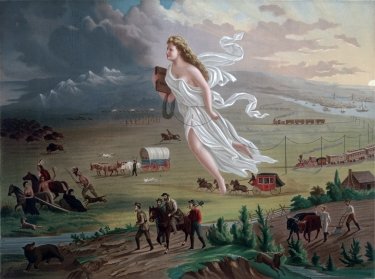
John Gast, American Progress, 1872, Autry Museum of the American West, Los Angeles, California.
Jeff Fynn-Paul debunks the leftist myth of European guilt.
[N]o matter who ‘discovered’ the New World, it is inevitable that a large proportion of New World inhabitants would have died within the first few decades after first contact. This is universally acknowledged by specialists in the field. The New World population was smaller and more homogenous than the Old World population. Thus, its people had less immunity to disease than the people of the Old World, where disease communities from Africa, Asia and Europe had been intermingling for millennia. Even though some European captains did try and spread smallpox around a few forts and villages from time to time, the effect of their efforts was almost negligible compared with the natural spread of disease. So the claims of genocide by disease have almost nothing to do with European actions, apart from their simply reaching the New World. And of course, Europeans of the time had no way of envisioning the continent-wide epidemic repercussions of their actions. Verdict: not guilty.
Let us also acknowledge that Native American society was just as warlike as any other in human history. The anthropologists’ vision of Native Americans as peace-pipe-smoking environmentalists which gained purchase in the 1970s has long since given way to a more Hobbesian portrait of pre-Columbian reality. In North America, most Natives were primitive farmers. This means that (with some exceptions) they had no permanent settlements: they farmed in an area for a few decades until the soil got tired, before moving on to greener pastures where the hunting was better and the lands more fertile. This meant that tribes were in constant conflict with other tribes. It also meant that chiefs were continually vying for power, creating confederations under themselves, and that the question of who owned the land was in a more or less constant state of flux. In most of North America, the idea that any one piece of land belonged to any one tribe, for more than 50 or 100 years, is therefore highly questionable. In short, if you looked at a map of Native Canada 200 years before Europeans arrived, it would have been entirely different. In the meantime, some groups of natives would have slaughtered, bullied or enslaved others. Should we not be grieving for those Native Canadians whose land was stolen by other Native Canadians? Or is that somehow OK? I don’t suppose there is an app for that.
The idea that the Europeans stole some land which had belonged in perpetuity to any one tribe is therefore ludicrous. The situation in most of North America was similar to northern Europe on the eve of the Germanic migrations, or western Europe as the Celts were moving across the landscape. Precisely to whom the land belonged in any given century at these periods in history was anyone’s guess. The very notion of property is a Greco-Roman invention which most cultures found foreign until quite recently. But Europeans of the time had little chance of grasping this difference. What the Europeans did in the New World was insert themselves into a fluid power struggle which had been ongoing for millennia. Many Native American chiefs were ready to pledge allegiance to the Great ‘Chief of the English’, as a political expedient, just as various English colonies sided with this or that Native American ‘Great Chief’. Despite a few sensational cases of duplicity, most of the time, Europeans tried to buy land from Indians, just like they would buy an acre of land in England. If the local chief assented to this and liked the price, where then was the crime? Many individual Europeans believed that according to the norms of both parties, they had legal usufruct to the land they were working. To judge this as theft is therefore anachronistic. As Europeans set up farming communities, and introduced guns to North America, Native American communities were forced to move further away from European lands as game retreated. The areas around white settlements were often empty for this reason, making the land seem all the more abandoned. Musket use by natives probably depleted animal stocks at a higher rate than previously, meaning that the very introduction of firearms might have spelled the doom of hunting and gathering in North America in the long run, even if the Europeans had otherwise left the country alone.
Another major structural issue is this: what precisely would our pious anthropology professors have had Europeans do with the New World once they found it?
This is not a joke. Political reality has a way of crashing in on the pipe dreams of liberal academics. The reality is, if the English had not colonized, then the French or the Dutch would have. If the Spanish had not colonized, the Portuguese would have. This would have shifted the balance of power at home, and any European country which had not colonized, would have been relegated to secondary status. And it is easy to overestimate the amount of control that European governments actually had. As soon as the New World was discovered, many fisherman and traders sailed across the Atlantic on their own, in hopes of circumventing tax authorities and scoring a fortune. Long before colonies were established in most regions, the New World was crawling with Europeans whose superior technology gave them an edge in combat. Nonetheless, it was extremely dangerous for Europeans to provoke fights with Native Americans, and most of them tried to avoid this when possible. In retrospect, one could in theory be impressed that so many European governments showed a genuine concern to rein in the worst excesses of their subjects, with an express eye to protecting the Indians from depredation. The logic was simple: they attempted to protect their subjects at home, in order to secure good order and a better tax base. So they would do the same to their subjects in the New World. For a long time, few Europeans harbored any master plan of pushing the Native Americans out of their own lands. In more densely populated regions such as Mexico, such an idea must have seemed an absurdity. Reality tends to occur ad hoc. Boundaries often took generations to move, and would have seemed fixed at the time. For several centuries, many Europeans assumed that they would long be a minority on the North American continent. In Mexico and Peru, they always have been.
RTWT
I think it is worth noting that none of those sanctimonious lefties telling Americand and Canadians that they are residing on land rightfully belonging to this or that “First People” tribe can be seen packing their bags and hopping on a plane back to Europe.
10 Oct 2022
———————————–
———————————–
10 Oct 2022

Christopher Columbus (detail), from Alejo Fernández, La Virgen de los Navegantes, circa 1505 to 1536, Alcázares Reales de Sevilla.
In his magisterial biography, Admiral of the Ocean Sea, 1942, Samuel Elliot Morrison observes:
[Christopher Columbus did] more to direct the course of history than any individual since Augustus Caesar. …
The voyage that took him to “The Indies” and home was no blind chance, but the creation of his own brain and soul, long studied, carefully planned, repeatedly urged on indifferent princes, and carried through by virtue of his courage, sea-knowledge and indomitable will. No later voyage could ever have such spectacular results, and Columbus’s fame would have been secure had he retired from the sea in 1493. Yet a lofty ambition to explore further, to organize the territories won for Castile, and to complete the circuit of the globe, sent him thrice more to America. These voyages, even more than the first, proved him to be the greatest navigator of his age, and enabled him to train the captains and pilots who were to display the banners of Spain off every American cape and island between Fifty North and Fifty South. The ease with which he dissipated the unknown terrors of the Ocean, the skill with which he found his way out and home, again and again, led thousands of men from every Western European nation into maritime adventure and exploration.
The whole history of the Americas stem from the Four Voyages of Columbus; and as the Greek city-states looked back to the deathless gods as their founders, so today a score of independent nations and dominions unite in homage to Christopher the stout-hearted son of Genoa, who carried Christian civilization across the Ocean Sea.
An annual post.
10 Oct 2022
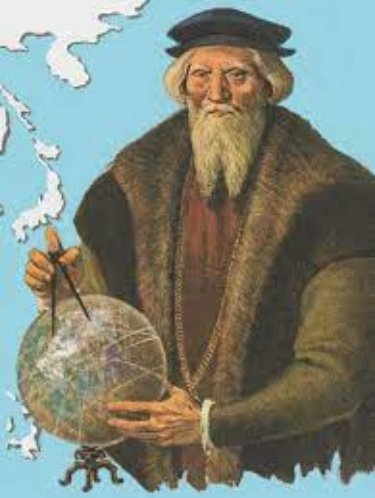
John Cabot
Glenn Reynolds links a 2005 posting from Jim Bennett that contends that America’s been celebrating the wrong Italian.
During the 19th century, Columbus was reinvented by Washington Irving and his successors as a sort of Yankee visionary entrepreneur before his time. His specific roots in time, space, and culture as a Genoese in the service of Spanish monarchs was downplayed; what was celebrated was his seeming prescience and capacity for self-reinvention.
In fact Columbus did have some such characteristics; entrepreneurism is often a leap into the unknown, and he was neither the first nor the last to set out to seek one thing and discover another, nor to venture on the basis of mistaken calculations and assumptions. There was, it is true, a certain Enron-like quality to his mileage calculations.
Subsequently, this useful narrative was seized upon and expanded by Catholic immigrant communities eager to demonstrate that Catholicism was not inconsistent with being American. Italian immigrant groups found Columbus a particularly appealing figure; here was an Italian Catholic already elevated to heroic status by the Americans they sought to join. Columbus Day became established as an American holiday, but for reasons and with symbolism quite different from those for which it is celebrated in Latin America..
Now, of course, Columbus Day is under attack as a holiday in the United States by the forces of political correctness. This is primarily an effect of the Calvinist Puritan roots of American progressivism. Just as Calvinists believed in the centrality of the depravity of man, with the exception of a miniscule contingent of the Elect of God, their secularized descendants believe in the depravity and cursedness of Western civilization, with their own enlightened selves in the role of the Elect.
I do not particularly sympathize with the demonization of Columbus Day by the politically correct, although I do not think the injustices suffered by our Siberian-American fellow immigrants should be glossed over. However, I think Columbus Day should be reconsidered as a U.S. holiday for a different reason. I am fundamentally in agreement with the Hispanosphere nationalists on one point: Columbus’s voyage was very specifically the initiation of the contact between Spain and Spanish America. Neither the settlement of Brazil nor of English-speaking North America were direct consequences of Columbus’s voyages, and would probably have happened had Columbus never returned with the news of his landing.
The Portuguese discovery of Brazil was, after all, the accidental by-product of their ongoing exploration of Africa. The English-speaking world, on the other hand, began its expansion into North America as a consequence of John Cabot’s voyage of 1497.
It makes more sense to think of the European encounters with the Americas as three distinct main streams: one was the Spanish movement to the Caribbean, Mexico, Peru, and ultimately other areas, stemming from Columbus’s voyage; another was the Portuguese movement to Brazil, which was intimately linked to their explorations of Africa predating Columbus; and the third was the stream of peoples from the British Isles and ultimately elsewhere to North America to found the nations of the North American Anglosphere. These three distinct streams founded the three principal cultural-linguistic communities of the Americas.
Although Cabot’s voyage to Newfoundland was undoubtedly spurred by news of Columbus’s voyages, the expanding English maritime enterprise would sooner or later have recapitulated the Viking achievements in the North Atlantic. There are interesting conjectures about prior voyages from the British Isles to North America before Columbus, from Bristol fishermen working the Grand Banks (not unlikely) to other, more speculative theories, such as Farley Mowat’s ideas about voyagers from the Orkneys preceding the Vikings in the Dark Ages.
Whatever the realities of these theories, it is the expansion of the cultures and traditions that form the template on which today’s societies in the U.S. and English Canada that we should commemorate. Columbus, whatever his merits and demerits may be, is in this regard beside the point. If Americans of Italian descent wish to point with pride to a predecessor in discovery, perhaps we should look at Giovanni Caboto, another Italian navigator. Moving to England, he adopted the English style of his name and became known to history as the discoverer … John Cabot.
Not only did Cabot’s discoveries spark the great stream of human migration that became the English-speaking New World, he was himself a precursor of the millions of Italians who crossed the Atlantic to North America and became part of the English-speaking world, to its and their own enrichment.
I do not join in the politically-correct denigration of Columbus. But I do raise the question of whether, by celebrating him rather than John Cabot, we of the Anglosphere may be celebrating the wrong Italian.
RTWT
The “District of Cabotia”? “Cabotia, the gem of the ocean!” I don’t think so.
08 Oct 2022

For some reason, the media did not publish a picture of Moose, the deceased Golden Retriever.
Even the NY Times is a bit amused at Urban fashionista liberals squabbling over the “correct” perspective to be taken when a minority crazy wino attacks a bourgeois female in the park and kills her dog.
Real-world ethics question: In a well-used city park, a man with a history of erratic behavior attacks a dog and its owner with a stick; five days later, the dog dies. The man is Black, the dog owner white; the adjoining neighborhood is famously progressive, often critical of the police and jail system. At the same time, crime is up in the neighborhood, with attacks by emotionally disturbed people around the city putting some residents on edge.
In a dog-loving, progressive enclave, where pushing law and order can clash with calls for social justice, what’s the right thing to do? How do you protect the public without furthering injustice against this man?
Here’s what happened in Park Slope, Brooklyn, when real-life residents faced this situation.
On Aug. 3, Jessica Chrustic, 40, a professional beekeeper, was walking her dog in Prospect Park a little after 6 a.m. when she saw a man rifling through the garbage outside the Picnic House. She had seen the man before — tall, with dreadlocks wrapped in a turban, carrying a long staff and often muttering to himself or cursing — and she usually kept her distance. But this morning there was no room to avoid him.
According to Ms. Chrustic, he started yelling about immigrants taking over the park, then grabbed a bottle of what she later concluded was urine and sloshed it at her and her dog. She tried to run away, but Moose, her 80-pound golden retriever mix, was straining toward the man, trying to protect her.
The man started swinging the stick, she said. One blow hit her, not seriously. Another connected solidly with the dog’s snout. Mary Rowland, 56, a hospital manager who was walking her dog nearby, said she heard the crack of wood on bone and came running toward them, screaming at the man to get away.
Both women called 911, and four patrol cars arrived within a few minutes. But by then, the man was gone. “Moose was bleeding from his mouth and pulling to get home,” Ms. Chrustic said. “My focus was just on caring for him.”
Ms. Chrustic was physically unhurt, but she was shaken. How could this happen in a park where she had never felt unsafe, even walking her dog late at night?
Moose had a shattered tooth that needed to be pulled. Ms. Chrustic posted a description of the encounter on the neighborhood social network Nextdoor, warning others about the man and asking them to report any sightings to the police. Her post elicited more than 280 comments in the coming weeks, mostly expressing sympathy. A total stranger on the forum offered to make her a bracelet with the name Moose on it.
But then the next weekend, Moose developed sepsis from a perforated intestine, caused by a blow Ms. Chrustic had not noticed. After emergency surgery, Moose died.
Weeks passed, and the man who attacked the dog was still at large. People on Nextdoor, working from Ms. Chrustic’s description, posted that they had seen him in one part of the park or another. Ms. Chrustic, who used to visit the park four times a day, now found it too traumatic to enter unless necessary.
She was especially frustrated that the man, who was well known to people in the park, had not been arrested. “You have a person who is walking around the park who is violent and needs to be removed,” she said. “He’s known by the community. It’s disheartening.”
It was a random incident that might once have been discussed by a group of dog owners. But now it had a forum for a much wider community, with arguments about policing, vigilantism, homelessness, mental health care and progressive obstinacy all feeding into a conversation that evolved beyond the crime that set it off.
“It’s complicated,” said S. Matthew Liao, a professor of bioethics, philosophy and public health at New York University. “It’s a conflict of values, between wanting security and social justice. Everybody has a responsibility in some ways.
“There are a bunch of issues here, a bunch of threats,” he added. “We can deal with them in a compassionate way, or a not compassionate way.” …
Nextdoor, which claims an average of 37 million users per week, started in 2010 with the promise of connecting people with their neighbors and neighborhoods. One slogan went, “When neighbors start talking, good things happen.”
One thing they talked about, a lot, was local crime. In Nextdoor forums for communities all over the country, this included suspected crime and sightings of “suspicious” characters, leading early critics to say that what the platform really propagated was white fear. After complaints about racial profiling in 2016, the company instituted diversity training for its operations staff and new protocols for posts about crime and safety. But even in 2020, Representative Alexandria Ocasio-Cortez characterized it as an outlet for privileged white people to vent criminal fantasies about their Black and brown neighbors. She tweeted, “@Nextdoor needs to publicly deal w/ their Karen problem.”
A Nextdoor spokesperson said the company enables users to report any posts that they find offensive or discriminatory, which are then reviewed by volunteer community moderators or staff members. In 2021, only 1 percent of posts were reported as hurtful or harmful; about half of these were removed.
When Ms. Chrustic posted about the attack, the first responses were mostly notes of condolence and support. People with dogs posted that they had seen the man in the same area where she was attacked — why weren’t the police arresting him? Donations poured in to offset her veterinary bills.
But gradually, other voices emerged. A vocal minority asked why Park Slope residents, mostly white, were calling for the police to take down a man who appeared to be homeless and emotionally disturbed. Others called the man a “monster,” a “predator” or a “psychopath.” As on other social media platforms, the most ardent voices made the most noise.
Martin Lofsnes, 52, a dancer and choreographer who moved out of the neighborhood in 2020, came across the conversation while trying to sell some stuff and was appalled by the vitriol directed at an impoverished man, and by what he called “this vigilante attitude.”
He urged people on the thread to put their emotions aside and consider “400 yrs of systematic racism which has prevented black people from building generational wealth through homeownership resulting in the extreme disparity we see today.” Arresting the man, he wrote, would solve none of that.
With all the affluence in Park Slope, he posted, maybe critics should raise money to help the man, not throw him to the lethal jail system, from which he would most likely emerge more dangerous, or not emerge at all.
RTWT
08 Oct 2022

London’s Mayor: Sadiq Khan.
Steerpike, in the London Spectator:
What an odd thing Sadiq Khan said following this morning’s stabbings in central London. Shortly before 10 a.m., three people were attacked by a man on a bike in Bishopsgate. The criminal is still at large, according to the Telegraph. This horrifying incident was no surprise to Londoners, so you would think that the Mayor would – from experience – strike the right chord. Instead, Khan had this to say:
“The good news is, it’s not a terror attack. And another piece of good news is the three victims of the stabbing are not in life-threatening situations, thank God. But it’s just a reminder of the dangers of carrying a knife…
Had anyone died this morning, would Khan really have suggested that it was ‘good news’ it wasn’t a terror attack? Just a regular stabbing? It’s not a thought Mr S thinks will be held by the families of those injured.
The Mayor also seemed to apportion blame to a sentient knife – and not, you know, the assailant. He continued: ‘We’ve seen this year, thankfully, we’ve actually seen a reduction in knife crime injuries, a reduction in knife crime injuries in those below 25.’ From a pretty high peak though, eh?
‘I’m determined to continue lobbying the government to reverse their cuts in policing and to reverse their cuts in young people,’ said Khan. Police budgets have, of course, increased by £3.8 billion since Khan took office.
RTWT
07 Oct 2022

Christopher Lee in “Horror of Dracula” (1958).
For years now, Joyce fans have held “Bloomsday” celebrations on June 16th, the date the events described in “Ulysses” were supposed to have taken place.
More recently, we have a substack allowing enthusiasts to follow, day-by-day more or less, the action in Bram Stoker’s classic vampire tale “Dracula.”
New York Times
Confined by the pandemic to his home in Lawrence, Kan., in the summer of 2020, Matt Kirkland pulled an old paperback of Bram Stoker’s “Dracula” from his bookshelf and decided to reread it.
“Being trapped in a castle, trying to get out, felt like it had a lot of parallels there,” he said.
He shared the epistolary novel with his 11-year-old daughter. As he read, Kirkland noticed the letters from the novel’s protagonist, Jonathan Harker, were also dated in the summer. He started to synchronize the readings to the dates on the letters, creating a sense that the events in the book were unfolding in real time, and heightening the drama for his daughter, who asked him daily for updates.
By the end of the year — with a lot of pandemic downtime in his hands — he’d decided to expand on the idea, creating “Dracula Daily,” a newsletter that sends a missive from Harker to subscribers’ inboxes following the book’s chronology. Kirkland queued up the posts and began sending them to subscribers in May 2021.
Count Dracula — a recluse plagued by yearning, a macabre flair for theatrics and existential loneliness — turned out to be an unlikely patron saint for the uncertain times, Kirkland said. The newsletter became a success and internet sensation: Subscribers found that serialization made the 125-year-old novel more accessible and created a community of readers at a time when many were looking for connection.
RTWT
Unfortunately, you’ll have to wait for May 3 for the beginning.
02 Oct 2022

President Obama appointed the first black female Librarian of Congress who, naturally, is a fan of Rap music, and who therefore invited rapper/flautist “Lizzo” to sound a few notes on a rare and valuable crystal flute presented to President Madison in 1813.
The grotesquely obese Lizzo performed enthusiastically and indecently attired, accompanying her flute performance with the kind of sexually-explicit movements referred to in the lamentable popular culture of today as “twerking.”
NPR, as you might expect, was overjoyed:
As all iconic moments go these days, it started with a simple social media exchange. Librarian of Congress Carla Hayden tweeted out an invitation for Lizzo to visit the world’s largest flute collection, housed at the Library of Congress in D.C.
“@Lizzo we would love for you to come see it and even play a couple when you are in DC next week,” Hayden tweeted. “Like your song they are “Good as hell [with a winking face emoji].”
The singer responded with gusto.
IM COMING CARLA! AND IM PLAYIN THAT CRYSTAL FLUTE!!!!! <link>
— FOLLOW @YITTY (@lizzo) September 24, 2022
After making a stop at the Library of the Congress to tour the collection and practice on a few instruments, Lizzo’s dream became reality when she got the chance to play the historic flute on stage Tuesday night. …
“You never know what you’re going to see with the U.S. Capitol Police!” the agency tweeted Wednesday morning. …
Handlers brought the flute onstage at Lizzo’s concert. She carefully accepted the instrument and carried it to the standing microphone, saying “it’s like playing out of a wine glass, so be patient.”
She performed on the flute, adding a few of her signature moves, of course, as the audience wildly cheered, and then Lizzo gave back the historical flute and ran back to her mic.
“B***h, I just twerked and played James Madison’s crystal flute from the 1800s,” she shouted. “We just made history tonight!”…
Lizzo took the time to thank the Library of Congress for “preserving our history and making history freaking cool.”
Video link.
I’m obviously a racist old fogey since I think placing a relic previously belonging to the Father of the Constitution in the hands of a popular entertainer of the lowest order who accompanies a performance with the kinds of dress and public behavior that for most of my own lifetime would have gotten her arrested is insulting to Mr. Madison, to the country’s history, and to decency and public morals. In a properly governed America, that librarian would be fired.
Today’s Jacobin “elite” culture, of course, absolutely delights in these kinds of revolutionary gestures. That culture systematically inverts all values. James Madison is an evil dead white man, who owned slaves. Lizzo is black and therefore the giant economy-size embodiment of everything great and admirable! For them, the profanation of Mr. Madison’s flute is “historic,” “an iconic moment,” and “freaking cool.” What an age we live in!
————————
Seeing someone like Lizzo disporting herself pantsless on stage reminds me of the story of the crusty old New Englander who spied an unusually ill-favored woman in church one Sunday, and remarked, loudly, “My God! that must be the ugliest woman in six counties!” “Hush!” admonished his offended wife. “You know the poor thing can’t help it.” “Yes, but, she could, by golly, stay home!”
/div>

Feeds
|