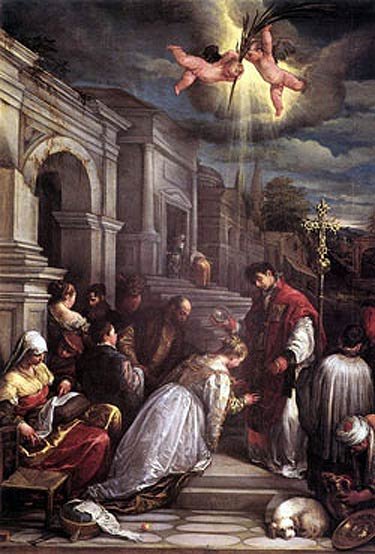
Jacopo Bassano, St Valentine Baptizing St Lucilla, 1575, oil on canvas, Museo Civico, Bassano del Grappa
The popular customs associated with Saint Valentine’s Day undoubtedly had their origin in a conventional belief generally received in England and France during the Middle Ages, that on 14 February, i.e., half way through the second month of the year, the birds began to pair. Thus in Chaucer’s Parliament of Foules we read:
For this was sent on Seynt Valentyne’s day
Whan every foul cometh ther to choose his mate.
For this reason the day was looked upon as specially consecrated to lovers and as a proper occasion for writing love letters and sending lovers’ tokens. Both the French and English literatures of the fourteenth and fifteenth centuries contain allusions to the practice. Perhaps the earliest to be found is in the 34th and 35th Ballades of the bilingual poet, John Gower, written in French; but Lydgate and Clauvowe supply other examples. Those who chose each other under these circumstances seem to have been called by each other their Valentines.
In the Paston Letters, Dame Elizabeth Brews writes thus about a match she hopes to make for her daughter (we modernize the spelling), addressing the favoured suitor:
And, cousin mine, upon Monday is Saint Valentine’s Day and every bird chooses himself a mate, and if it like you to come on Thursday night, and make provision that you may abide till then, I trust to God that ye shall speak to my husband and I shall pray that we may bring the matter to a conclusion.
——————————————–
From Robert Chambers, The Book of Days, 1869: Feast Day: St. Valentine, priest and martyr, circ. 270.
Valentine’s Day is now almost everywhere a much degenerated festival, the only observance of any note consisting merely of the sending of jocular anonymous letters to parties whom one wishes to quiz, and this confined very much to the humbler classes. The approach of the day is now heralded by the appearance in the print-sellers’ shop windows of vast numbers of missives calculated for use on this occasion, each generally consisting of a single sheet of post paper, on the first page of which is seen some ridiculous coloured caricature of the male or female figure, with a few burlesque verses below. More rarely, the print is of a sentimental kind, such as a view of Hymen’s altar, with a pair undergoing initiation into wedded happiness before it, while Cupid flutters above, and hearts transfixed with his darts decorate the corners. Maid-servants and young fellows interchange such epistles with each other on the 14th of February, no doubt conceiving that the joke is amazingly good: and, generally, the newspapers do not fail to record that the London postmen delivered so many hundred thousand more letters on that day than they do in general. Such is nearly the whole extent of the observances now peculiar to St. Valentine’s Day.
At no remote period it was very different. Ridiculous letters were unknown: and, if letters of any kind were sent, they contained only a courteous profession of attachment from some young man to some young maiden, honeyed with a few compliments to her various perfections, and expressive of a hope that his love might meet with return. But the true proper ceremony of St. Valentine’s Day was the drawing of a kind of lottery, followed by ceremonies not much unlike what is generally called the game of forfeits. Misson, a learned traveller, of the early part of the last century, gives apparently a correct account of the principal ceremonial of the day.
‘On the eve of St. Valentine’s Day,’ he says, ‘the young folks in England and Scotland, by a very ancient custom, celebrate a little festival. An equal number of maids and bachelors get together: each writes their true or some feigned name upon separate billets, which they roll up, and draw by way of lots, the maids taking the men’s billets, and the men the maids’: so that each of the young men lights upon a girl that he calls his valentine, and each of the girls upon a young man whom she calls hers. By this means each has two valentines: but the man sticks faster to the valentine that has fallen to him than to the valentine to whom he is fallen. Fortune having thus divided the company into so many couples, the valentines give balls and treats to their mistresses, wear their billets several days upon their bosoms or sleeves, and this little sport often ends in love.’
…
St. Valentine’s Day is alluded to by Shakspeare and by Chaucer, and also by the poet Lydgate (who died in 1440). …
The origin of these peculiar observances of St. Valentine’s Day is a subject of some obscurity. The saint himself, who was a priest of Rome, martyred in the third century, seems to have had nothing to do with the matter, beyond the accident of his day being used for the purpose. Mr. Douce, in his Illustrations of Shakspeare, says:
‘It was the practice in ancient Rome, during a great part of the month of February, to celebrate the Lupercalia, which were feasts in honour of Pan and Juno. whence the latter deity was named Februata, Februalis, and Februlla. On this occasion, amidst a variety of ceremonies, the names of young women were put into a box, from which they were drawn by the men as chance directed. The pastors of the early Christian church, who, by every possible means, endeavoured to eradicate the vestiges of pagan superstitions, and chiefly by some commutations of their forms, substituted, in the present instance, the names of particular saints instead of those of the women: and as the festival of the Lupercalia had commenced about the middle of February, they appear to have chosen St. Valentine’s Day for celebrating the new feast, because it occurred nearly at the same time.
This is, in part, the opinion of a learned and rational compiler of the Lives of the Saints, the Rev. Alban Butler.
It should seem, however, that it was utterly impossible to extirpate altogether any ceremony to which the common people had been much accustomed—a fact which it were easy to prove in tracing the origin of various other popular superstitions. And, accordingly, the outline of the ancient ceremonies was preserved, but modified by some adaptation to the Christian system. It is reasonable to suppose, that the above practice of choosing mates would gradually become reciprocal in the sexes, and that all persons so chosen would be called Valentines, from the day on which the ceremony took place.’
***********************************************
February 14th, prior to 1969, was the feast day of two, or possibly three, saints and martyrs named Valentine, all reputedly of the Third Century.
The first Valentine, legend holds, was a physician and priest in Rome, arrested for giving aid to martyrs in prison, who while there converted his jailer by restoring sight to the jailer’s daughter. He was executed by being beaten with clubs, and afterwards beheaded, February 14, 270. He is traditionally the patron of affianced couples, bee keepers, lovers, travellers, young people, and greeting card manufacturers, and his special assistance may be sought in conection with epilepsy, fainting, and plague.
A second St. Valentine, reportedly bishop of Interamna (modern Terni) was also allegedly martyred under Claudius II, and also allegedly buried along the Flaminian Way.
A third St. Valentine is said to have also been martyred in Roman times, along with companions, in Africa.
Due to an insufficiency of historical evidence in the eyes of Vatican II modernizers, the Roman Catholic Church dropped the February 14th feast of St. Valentine from its calendar in 1969.
Yale Professor Timothy Snyder has written a number of important books on the history of the Eastern European Borderlands and is the perfect authority to refute Vladimir Putin’s faux historical justifications for aggressive war.
In a talk with Tucker Carlson, Putin uttered sentences about the past. I will explain how Putin is wrong about everything, but first I have to make a point about why he is wrong about everything. By how I mean his errors about past events. By why I mean the horror inherent in the kind of story he is telling. It brings war, genocide, and fascism.
Putin has read about various realms in the past. By calling them “Russia,” he claims their territories for the Russian Federation he rules today.
Such nonsense brings war. On Putin’s logic, leaders anywhere can make endless claims to territory based on various interpretations of the past. That undoes the entire international order, based as it is upon legal borders between sovereign states.
In his conversation with Carlson, Putin focused on the ninth, tenth, and eleventh centuries. Moscow did not exist then. So even if we could perform the wishful time travel that Putin wants, and turn the clock back to 988, it could not lead us to a country with a capital in Moscow. Most of Russia’s present territory is in Siberia. Europeans did not control those Asian territories back then. On Putin’s logic, Russia has no claim today to the territories from which it extracts its natural gas and oil. Other countries would, and Russia’s national minorities would.
Putin provides various dates to make various claims. Anyone can do that about any territory. So the first implication of Putin’s view is that no borders are legitimate, including the borders of your own country. Everything is up for grabs, since everyone can have a story. Carlson asked Putin why he must invade Ukraine, and the myth of eternal Russia was the answer.
The second problem, after war, is genocide. After you decide a a country in the deep past is also somehow your country now, you then insist that the only true history is whatever seems to prove you right. The experiences of people who actually lived in the past and live in the present are “artificial” (to use one of Putin’s favorite words).
In the interview, and in other speeches during the war, Putin depends on a false distinction between natural nations and artificial nations. Natural nations have a right to exist, artificial ones do not.
But there are no natural nations. All nations are made. The Russia of tomorrow is made by the actions of Russians today. If Russians fight a lawless war of destruction in Ukraine, that makes them a different people than they might have been. This is more important than anything that happened centuries ago. When a nation is called “artificial,” this is justification for genocide. Genocidal language does not refer to the past; it changes the future. Read the rest of this entry »
Watching Tucker Carlson at work interviewing Vlad Grozny in his Kremlin lair is quite an experience. Tucker is 54 years old and still downright pretty. You kind of marvel that he is apparently straight. And, bow tie or four-in-hand, you have to give it to him, he makes an excellent tie. St. George School clearly grounds its graduates in at least some of the important fundamentals.
But when we watch Tucker go up against Vladimir Putin, the current Grand Duke of the Empire of Muscovy, self-made Tsar, and stone cold killer, we are bound to feel some astonishment at just how far out of his depth Tucker is.
Watching Putin delivering that lengthy and self-flattering version of the history of the Muscovite Despotism to the gapingly naive and historically clueless Tucker was more than a little sad and sent me struggling for a comparison case of the innocent bourgeois herbivore conversing with the monster predator who is, just for now, managing to refrain from making him into an amuse bouche.
One pictures Tucker as another Bilbo sitting and interviewing the Dragon Smaug about his current dwarf policies and his friction with the Rivertown. Or as Jonathan Harker listening to Count Dracula boast of his descent from Attila the Hun and victories over the Turk. I kept waiting to hear the howling of wolves nearby briefly interrupt the conversation, and expecting Putin to remark: “The Children of the Night! What music they make!”
But neither Bilbo nor Jonathan Harker were anywhere nearly as oblivious to the real nature of their interlocutor. Nor did either publish his own account, failing as Tucker Carlson does, to comment on the disingenuity of the Big Bad Wolf complaining of the possible installation of guard dogs at the neighboring sheep flock as an example of aggression against himself.
I suppose though that, had Tucker pointed out the irony of Putin’s demands that Ukraine “denazify” by banning praise of, or memorials to, various Ukrainian nationalists like Stepan Bandera who sided with Germany against Russia in WWII, when Putin’s Russia has never itself actually de-Bolshevized or repudiated the memory of the communists guilty of genocide and crimes against humanity on an even larger scale than Nazi Germany’s, in that event, poor Tucker might very possibly have found himself getting arrested like Even Gershkovich, charged with spying, and frog-marched to the Lubyanka or simply bumped off like Yevgeny Prigozhin and so many of the others who dared to offend Putin.
Interviewing monsters is a tricky business. One doesn’t want to die obviously, but one should also have reservations about lending aid and support.
Country Life celebrates Britain’s Worst Behaved Pets.I think this one’s the winner.
It’s awkward enough having your pet swipe other people’s meals, but it is quite another matter when they consume each other — especially in public. During one now legendary Sunday lunch hosted by the late Maj Tim Riley of Blencowe, Cumbria, his black labrador slunk into the dining room, where he proceeded to sick up a cat under a sideboard. Without breaking the conversation, Maj Riley got up and deftly placed his napkin over the remains. It had, we are told, a really bushy tail.
Eugyppius has a great story of the local renown of a brave poacher.
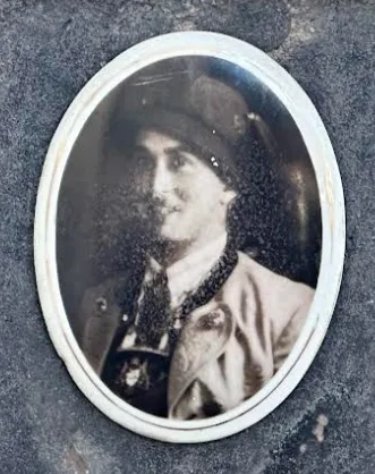
Hörmannsdorfer is a semi-forgotten local hero, who fought in World War II as a Heeresbergführer [Army Mountain Guide] only to return to a broken Germany. In the fall of 1948, when food was scarce, he dared to breach American prohibitions on bearing arms and hunting, and betook himself to the high Wildalpjoch in search of game.
There, he was spotted by a gamekeeper from Brannenburg, who shot him – as legend has it, in the back. It was the harsh if customary penalty for poaching. The gamekeeper, who thought he’d missed, left Hörmannsdorfer dead in the mountains, and it took the townspeople six days to find him. They brought his body back to the valley and gave him the most festive funeral in living memory. As Die Zeit reported in 1954:
The band played the poacher’s song “Ich schieß den Hirsch im wilden Forst.” Marksmen from all around paid their last respects to their comrade. As was the custom when a royal prince was born, firecrackers echoed from the mountains. Tyrolean poachers slipped across the border, and those who could sported fresh Gamsbärte in their hats from poached chamois, to mock the Brannenburg gamekeepers. Many vowed to avenge Hartl.
On Hörmannsdorfer’s gravestone they etched this defiant inscription:
Here rests our dear Hartl Hörmannsdorfer, who on 30 [November] 1948, at the age of 40 years, was shot by a cowardly forest warden while poaching.
The years passed; Hörmannsdorfer became a local legend and even the subject of a forgotten play called the “Poacher from Bayrischzell.”…
After the founding of the Federal Republic in 1949, the Brannenburg gamekeepers sued to have the inscription removed, on the grounds that it insulted their profession. The local court agreed, and ruled in 1954 that the verse and especially the adjective “cowardly” had to go.
From Die Zeit again:
After six years, the anger has faded. It’s just as well that the stone has been removed, people say, and anyway there should be peace in the cemetery. But Hartl will remain a hero of the people, no court or authority can change that, because in the eyes of the commoners he practised the fundamental rights of a free man and paid the highest price for it.
Eventually the townspeople replaced the stone, with the modified inscription you can read today and an awkward space where the word “cowardly” used to stand.
1. Ich schieß’ den Hirsch im grünen Forst, im tiefen Wald das Reh,
Den Adler auf der Klippe Horst, die Ente auf dem See;
Kein Ort, der Schutz gewähren kann, wo meine Büchse zielt!
|: Und dennoch hab’ ich harter Mann die Liebe auch gefühlt. :|
2. Kampiere oft zur Winterszeit in Sturm und Wetternacht,
Hab’ überreist und überschneit den Stein zum Bett gemacht;
Auf Dornen schlief ich wie auf Flaum, vom Nordwind unberührt
|: Und dennoch hat die harte Brust die Liebe auch gespührt. :|
3. Der wilde Falk ist mein Gesell, der Wolf mein Kampfgespann;
Der Tag geht mir mit Hundsgebell, die Nacht mit Hussa an;
Ein Tannreis schmückt statt Blumenzier den schweißbefleckten Hut
|: Und dennoch schlug die Liebe mir ins wilde Jägerblut. :|
4. O Schäfer auf dem weichen Moos, der du mit Blumen spielst,
Wer weiß, ob du so heiß, so groß wie ich die Liebe fühlst.
Allnächtlich über’m schwarzen Wald, vom Mondenschein umstrahlt,
|: Schwebt Königshehr die Lichtgestalt, wie sie kein Meister malt. :|
5. Wenn sie dann auf mich niedersieht, wenn mich ihr Blick durchglüht,
Da weiß ich, wie dem Wild geschieht, das vor dem Rohre flieht.
Und doch! mit allem Glück vereint, das nur auf Erden ist,
|: Als wenn der allerbeste Freund mich in die Arme schließt. :|
6. Ich sah den Freund dahingestreckt, gefällt von Ebers Zahn,
Ich hab’ ihn in das Gras gelegt und keine Träne rann.
Mit Hussa ging’s, mit Hundsgebell, ins stille Tal hinab,
|: Und dennoch hab’ ich harter Mann, geweint an Liebchens Grab. :|
7. Und wenn ich einst gestorben bin, und lieg’ im kalten Schrein,
Als braver Bursch, wie ich gelebt, will ich begraben sein.
Dann gebt mir auch mein Cerevis, den Schläger in die Hand,
|: Und schlingt mir um die kalte Brust das rot-weiß-grüne Band. :|
————————
1. I shoot the deer in the green forest, the deer in the deep forest,
The eagle on the cliff nest, the duck upon the lake;
No place that can provide protection where my rifle is aimed!
|: And yet, though I’m a hard man, I also have felt love. :|
2. Often camp in winter in storms and weather nights,
I traveled over and made the stone into a bed when covered in snow;
I slept on thorns as if on down, untouched by the north wind
|: And yet my hard chest also felt love. :|
3. The wild falcon is my companion, the wolf’s my battle teammate;
I spend the day with barking dogs, the night with Hussa;
Instead of flowers, a fir rice adorns the sweat-stained hat
|: And yet love struck into my wild hunter blood. :|
4. O shepherd on the soft moss, you who play with flowers,
Who knows if you feel love as hot, as big as I do.
Every night over the black forest, illuminated by the moonlight,
|: Königshehr floats the figure of light, as no master paints it. :|
5. When she looks down on me, when her gaze glows through me,
Then I know what happens to the wild animal that flees from the pipe.
And yet! united with all the happiness that is on earth,
|: As if my very best friend was hugging me. :|
6. I saw my friend stretched out, felled by Boar’s tooth,
I laid him on the grass and not a tear fell.
With Hussa we went down into the quiet valley with dogs barking,
|: And yet I, a hard man, cried at Darling’s grave. :|
7. And when I die once and lie in the cold shrine,
I want to be buried as a good boy like I lived.
Then give me my cerevis, the bat in my hand,
|: And wraps the red-white-green ribbon around my cold chest. :|
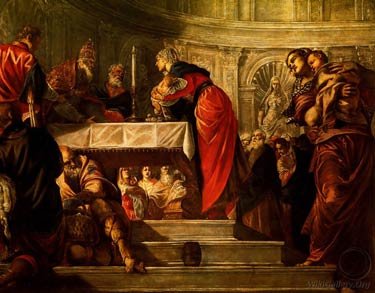
Tintoretto, Presentation of Jesus at the Temple, 1550-1555, Gallerie dell Accademi, Venice
From Robert Chambers, The Book of Days, 1869:
From a very early, indeed unknown date in the Christian history, the 2nd of February has been held as the festival of the Purification of the Virgin, and it is still a holiday of the Church of England. From the coincidence of the time with that of the Februation or purification of the people in pagan Rome, some consider this as a Christian festival engrafted upon a heathen one, in order to take advantage of the established habits of the people; but the idea is at least open to a good deal of doubt. The popular name Candlemass is derived from the ceremony which the Church of Rome dictates to be observed on this day; namely, a blessing of candles by the clergy, and a distribution of them amongst the people, by whom they are afterwards carried lighted in solemn procession. The more important observances were of course given up in England at the Reformation; but it was still, about the close of the eighteenth century, customary in some places to light up churches with candles on this day. Read the rest of this entry »
DOWN with rosemary and bayes,
Down with the mistleto,
Instead of holly, now up-raise
The greener box, for show.
The holly hitherto did sway;
Let box now domineere,
Until the dancing Easter-day,
Or Easter’s eve appeare.
Then youthful box, which now hath grace
Your houses to renew,
Grown old, surrender must his place
Unto the crisped yew.
When yew is out, then birch comes in,
And many flowers beside,
Both of a fresh and fragrant kinne
To honor Whitsontide.
Green rushes then, and sweetest bents,
With color oken boughs,
Come in for comely ornaments,
To re-adorn the house.
Thus times do shift; each thing his turn does hold;
New things succeed as former things grow o
The portraits have apparently come down in this room inside a building on High Street in New Haven.
The revolution of the oppressed underclass population belonging to the nuclear center of America’s national elite is busy these days purging its predecessors and putting Replacement Theory into action, reports the Atlantic.
Yale’s Eulogia Society, better known as “Skull and Bones,” was founded by General William Huntington Russell, Y 1833, who was himself a radical abolitionist and friend and supporter of the madman and murderous terrorist John Brown. What can one say, other than noting that the Revolution has a notorious habit of devouring its own?
Secret societies have long been the purest distillation of what makes Yale Yale. They are famous for their mysterious rituals, their arcane symbols, and the imprint they’ve left on the broader culture. Skull and Bones shows up, variously, in The Great Gatsby (the 2013 film version), Gossip Girl, and The Simpsons. It is among the wealthiest, most exclusive, most well-connected groups at one of the wealthiest, most exclusive, most well-connected universities in the country. Contemplating their own rarefied status, members of Yale’s secret societies aren’t entirely sure what to do with it. They face the question roiling America’s elite campuses taken to its logical extreme: whether the modern social-justice politics advanced by college students can coexist with the staggering selectivity and privilege that benefit those same students.
Skull and Bones, the oldest of Yale’s senior societies, was formed in 1832. The other groups, composed mainly of Bones rejects, followed soon after. The Ancient Eight societies each own private buildings, known as tombs, where members meet twice weekly for dinner, debate, and “bios”—a ritual in which members share their life histories. Membership is for seniors only. Every spring, the current members “tap” a group of Yale juniors to take their place the following fall. The clubs were originally intended to prepare Yale men for leadership beyond the university. At this, they have found extraordinary success, producing a stream of C-suite executives, diplomats, and politicos. The reputation of society alumni as kingmakers and masters of the universe guaranteed that students would always be hungry to join.
Until they weren’t. In the 1960s, secret societies were criticized for elitism and discrimination. They faced pressure to disband. Instead, they adapted. Skull and Bones admitted its first Black member in 1965, and in 1975 tapped the head of Yale’s recently founded gay-student organization. The pattern repeated two decades later, as the societies feared they were becoming irrelevant by clinging to their all-male identity. In 1991, the Bonesmen tapped their first Boneswomen. (Alumni who didn’t want women in their secret society retaliated by changing the locks on the tomb.)
Today, many of the societies continue to resist students’ most progressive demands. When the Bones class of 2019 took down the portraits, some of their predecessors were aghast. It was “bad manners,” a former member of the Bones alumni board who graduated from Yale in the 1960s told me. (I interviewed 12 current or recent members for this article, along with several members from earlier generations; many of them requested anonymity, citing confidentiality agreements.) Given that the society’s former members were overwhelmingly white, he argued, it didn’t make sense to criticize Skull and Bones for accurately portraying its own legacy. “Their historical protest was silly,” he said. Still, the Bones board tried to appease students by putting up photographs of nonwhite alumni alongside the portraits. This year, the former board member told me, the board will unveil the society’s first portrait of a Black alumnus. Similarly, Berzelius agreed to rename the Colony Foundation. Elihu, however, is keeping its name.
Reports of alumni-student schisms within Yale’s secret societies are nearly as old as the societies themselves. Every decade or so, especially when a member of the Bush family runs for president (George H. W. Bush was also a member), opinion writers argue that left-wing students have trampled the values that sustained societies. That makes it easy to miss a much more significant shift within these groups. Picture a member of Skull and Bones, or any of the other Ancient Eight secret societies, and you’ll probably conjure a preppy white guy who summers on the Cape. In fact, in recent years, the demographics of Yale’s most elite organizations have been utterly transformed. In 2020, Skull and Bones had its first entirely nonwhite class. (Every year, the society admits around 15 rising seniors; selections must be unanimous, and members have final say.) Many of the societies now have only one or two students each year who aren’t from historically marginalized groups.
Today, the idea of Skull and Bones selecting someone whose dad was a Republican president seems inconceivable. The so-called tap lines—the tradition guaranteeing that the football captain and the student-body president would end up in Bones—are long gone, and few descendants of alumni members get in. Instead, the secret societies affirmatively select for students who are the first in their family to attend college, who come from a low-income background, or who are part of a minority group. This has created something of a diversity arms race. “People are, intentionally or not, thinking, ‘Does this cohort have too many white people?’” said Ale Canales, a member of the Berzelius class of 2020.