Climate Map: Here and There Equivalents
Asia, Climate Map, Europe, North America


(click on image for larger version)
Choki: Sunrise at New Year
Eishosai Choki, Japanese Art, New Years Day, Ukiyoe
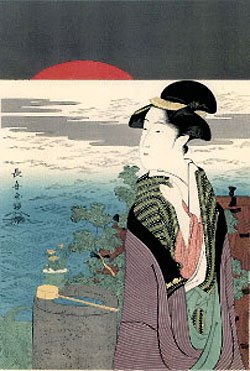
Eishosai Choki (fl. 1780s-1800s), Sunrise at New Year
A bijin (beautiful woman), presumably a courtesan, has risen early to greet the rising sun of the New Year at the waterfront at Fukagawa in Edo. The woman is adjusting the top of her kimono to protect against the chill of the early morning. In the lower-left is a blossoming fukujuso plant, emblematic of the New Year.
Auld Lang Syne
Auld Lang Syne, New Year's Eve
The Scottish Parliament (with the late Sean Connery present) sings Auld Lang Syne.
New Year’s Eve or Hogmanay
Hogmanay, New Year's Eve, Robert Burns

Robert Burns
NEW YEAR’S EVE, OR HOGMANAY
As a general statement, it may be asserted that neither the last evening of the old year nor the first day of the new one is much, observed in England as an occasion of festivity. In some parts of the country, indeed, and more especially in the northern counties, various social merry-makings take place; but for the most part, the great annual holiday-time is already past. Christmas Eve, Christmas-day, and St. Stephen’s or Boxing Day have absorbed almost entirely the tendencies and opportunities of the community at large in the direction of joviality and relaxation. Business and the ordinary routine of daily life have again been resumed; or, to apply to English habits the words of an old Scottish rhyme still current, but evidently belonging to the old times, anterior to the Reformation, when Christmas was the great popular festival:
-
Yule’s come and Yule ‘s gane,
And we hae feasted weel;
Sae Jock maun to his flail again,
And Jenny to her wheel.’
Whilst thus the inhabitants of South Britain are settling down again quietly to work after the festivities of the Christmas season, their fellow-subjects in the northern division of the island are only commencing their annual saturnalia, which, till recently, bore, in the license and boisterous merriment which used to prevail, a most unmistakable resemblance to its ancient pagan namesake. The epithet of the Daft [mad] Days, applied to the season of the New Year in Scotland, indicates very expressively the uproarious joviality which characterized the period in question. This exuberance of joyousness—which, it must be admitted, sometimes led to great excesses—has now much declined, but New-year’s Eve and New-year’s Day constitute still the great national holiday in Scotland. Under the 1st of January, we have already detailed the various revelries by which the New Year used to be ushered in, in Scotland. It now becomes our province to notice those ceremonies and customs which are appropriate to the last day of the year, or, as it is styled in Scotland, Hogmanay. Read the rest of this entry »
Corbet’s Couloir
Jackson Hole, Photography, Skiing, Wyoming

A ski run in Jackson Hole, Wyoming, where legendary skier Doug Coombs once skied. Photo by Bob Woodall.
Ça, bergers, assemblons-nous
Christmas Carols, France, Quebec, Raoul Jobin
Québecois tenor Raoul Jobin with choir.




