The New Republic, somewhat whimsically, decided to accept an article/personal memoir taking a poke at South Bend Mayor/democrat presidential candidate Pete Buttigieg from an unassimilated, arch homosexual perspective. After all, it can be a lot fun to listen to some witty queen dishing on another poof.
But currently ascendant Puritan sanctimony on the Left will tolerate not even favored identity group in-humor. The way the privilege of membership works, it seems, is that there is always some victim more privileged and protected than you. The victim group member who pokes fun at a fellow victim is instantly promoted to the Heterosexual White Male Oppressor category and deplatformed.
And poor Dale Peck was well and truly deplatformed. (Some straight Republican living in New York should take Dale out to a strip club for a beer, out of Solidarity.)
As is usual for me, it took me a couple of days to follow up on this little tempest in the journalistic establishment teapot, and yesterday when I went looking for the original article –to my surprise– it was really nowhere to be found. Like Lord Dunsany’s Athazar, King of Runazar, the Buttigieg piece was condemned, not only to die, but cease ever to have been.
I looked with Google.I tried Duck Duck Go. Those didn’t work, so I went to 4chan, then to 8chan. All those White Supremacists and shitlords were busy linking porn. No reference there. Frustrated, I thought I’d look for a link in Facebook, and, what do you know? a friend from Yale with ties to the “Playing for the Other Team” Community had posted the whole thing.
I’m against this kind of PC, little-finger-lifted-as-you-sip-your-tea censorship and enforced propriety, so, despite the limitations on my own sympathy for the author’s perspective, I feel obliged to post the whole thing myself, just to keep it available and to spite the Forces of Proper Thinking and Correct Speech. So, here goes.
———————–
My Yale friend introduced it, thusly:
“In which famed hatchet-man Worth David—I mean, Dale Peck—weighs in to tell you why nouvelle fague Mary Pete Buttfuck isn’t all that he’s cocked up to be.
This was originally posted in The New Republic, but the fat Bengali or someone got an advanced case of weenieitis.
For sheer homocidal glee, this thing is right up there with Gore Vidal’s Palimpsest. Mister Peck, we salute you!”
My Mayor Pete Problem
Sunday, July 14, 2019
One of the worst things I ever did happened in 1992. I was leaving the bar called The Bar (RIP) on Second Avenue and 4th Street to go to a party called Tattooed Love Child at another bar, Fez, located in the basement of Time Cafe (RIP x 2). TLC was held on Wednesdays (Thursdays?), and I often went to The Bar after work for a few hours so I wouldn’t have to go all the way home first. So it was probably 10-ish, and I know it was late winter/early spring because I was carrying a copy of the completed manuscript of my first novel Martin and John, which I’d just turned in to my publisher that very day. Which makes me 24 and old enough to know better. Or who knows, maybe this was exactly the age to learn this kind of lesson.
What happened was: I was halfway down 4th Street when I heard someone yelling. I turned to see a large fellow running after me. At first I wondered if I was getting gay-bashed. But even though this guy didn’t set off my gaydar he still didn’t seem particularly menacing. When he got closer I clocked the pleated khakis (this was the era of the ACT UP clone—Doc Martens, Levi’s tight or baggy, and activist T-shirts—which look I had embraced fully) and rust-colored Brillo hair. I love me a good ginger, but you gotta know how to style it, especially if it runs frizzy. And so anyway, this guy, whose name was Garfield but said I could call him Gar, told me he’d been in The Bar but had been too shy to talk to me and decided to try his luck on the street. As politely as I could, I told him I wasn’t interested. He asked me how I could know I wasn’t interested when I didn’t know him, which was an invitation for me to tell him that not only did he look like a potato, he dressed, talked, and ran like a potato. Alas, I chose not to indulge his masochistic invitation.
He asked where I was going and I told him. He asked if he could go with me and I told him he could go to Fez if he wanted but he shouldn’t think he was going with me. He came. I quickly learned that he’d mastered the art of speaking in questions, which put me in the awkward position of answering him or ignoring him, which made me feel rude even though I’d told him I wasn’t interested. When he found out I was a writer he got excited and said I must love the New Yorker! I told him I hated the New Yorker. He asked how I could hate the New Yorker and I told him that besides the fact that the New Yorker published shitty fiction (plus ça change, plus c’est la même chose), and the only gay fiction it published was assimilationist and boring, there was also the fact that an editor there (Dan Menaker, if we’re naming names) had rejected a story of mine by suggesting in his correspondence with my agent (by which I mean that he wasn’t embarrassed to write this down, let alone worried about repercussions) that psychological problems were preventing me from creating effective fiction. (By the way, fuck you, Dan.) None of which made any sense to Gar. The New Yorker was important so I must love it. I just didn’t know I loved it yet. Or something like that. At some point in this exchange I remember saying something along the lines of Look, I’m just going to apologize now, because it’s pretty clear that sooner or later I’m going to say something really offensive to you and your feelings are going to be hurt. I don’t want to do that, but you’re clearly not getting the fact that you and I don’t look at the world the same way, and you keep thinking that if you hang around long enough we’re going to find common ground, when all you’re really doing is making our differences that much clearer. He laughed at this, one of those confused/nervous/defensive laughs, and if I’d been more mature I would have been more blunt and told him to get lost. But I too was a little deluded. I thought he had to get the hint eventually. But although I understood pretty much everything else about him, I failed to reckon fully with his lack of self-respect.
I told him I hated the New Yorker.
So: we got to Fez, where I ran into my friend Patrick (Cox, I think, but it’s been a minute), who looked at me like, What are you doing with this weirdo? I wouldn’t let Gar buy me a drink and I did my best to exclude him from my conversation with Patrick but he still wouldn’t take a hint. He must have hung around for a good hour. My answers to his questions grew more and more peremptory. Bear in mind I wasn’t disagreeing with him or dismissing his opinions just to get rid of him: we really had absolutely nothing in common. But we both read the New Yorker and we were both gay and we both wore clothes to cover our nakedness so clearly we were birds of a feather. Finally he said he had to leave. He asked for my number. I remember Patrick laughing in his face, but maybe that’s just because I wanted to laugh in his face. I was like, Are you serious? And he was like, We have so much in common, we should get to know each other better! When I was fifteen years old a pedophile used that line on me in the Chicago bus station, and if I’m being honest I had more in common with the pedo, who was about 50, black, and urban, while I was a white teenager from rural Kansas, than I did with dear old Gar. I told him I wasn’t going to give him my phone number or accept his. He seemed genuinely shocked and hurt, which of course made me feel like shit, which of course made me mad, because why should I feel like shit when I’d spent all night trying to rebuff him? He asked what he would have to do to get me to go out with him. Without thinking, I said, Take a good look at yourself and your world, reject everything in it, and then get back to me. It was the kind of soul-killing line people are always delivering in movies but never comes off in real life, mostly because even the most oblivious, self-hating person usually has enough wherewithal to cut someone off before they’re fully read for filth. I believe I have indicated that Gar did not possess this level of self-awareness. His face went shapeless and blank as though the bones of his skull had melted. For one second I thought I saw a hint of anger, which might’ve been the first thing he’d done all night that I could identify with. Then he scurried away.
Now, I’ve said shitty things to people before and since, but this one’s always stuck with me, partly because, though I’m a peevish fellow, it’s rare that I speak with genuine cruelty, and when I do it’s because I’ve chosen to. This just came out of me. But mostly I remember it because I knew I’d seriously wounded this guy, which, however annoying and clueless he was, was never my intention. I was and still am a very ’90s kind of gay, which is to say that I believe in the brotherhood of homos and the strength of our community, that however different we are we’re all bound together by the nature of our desire and the experience of living in a homophobic world. When one of your brothers fucks up, you school him. Sure, you might get a little Larry Kramer about it, but you don’t go all Arya-and-the-Night-King on his ass.
I’m telling you this because it’s what popped into my head when I tried to pin down my distaste for Pete Buttigieg. Mary Pete and I are just not the same kind of gay. (For those of you wondering about “Mary Peteâ€: a couple of months ago I asked Facebook what the gay equivalent of Uncle Tom was, and this was the answer at which we collectively arrived.) But Mary Pete and I aren’t different in the same way that Gar and I were different. Gar and I had nothing in common. Mary Pete and I have a lot in common, but at a certain point we came to a fork in the road and I took the one less traveled and he took the one that was freshly paved and bordered by flowers and white picket fences and every house had a hybrid in the driveway and some solar panels on the ceiling, but discrete ones, nothing garish, nothing that would interfere with the traditional look of the neighborhood or the resale value of your home.
By which I mean: Mary Pete is a neoliberal and a Jeffersonian meritocrat, which is to say he’s just another unrepentant or at least unexamined beneficiary of white male privilege who believes (just as Jay Inslee believes he’s done more for women’s reproductive rights than Elizabeth Warren and Amy Klobuchar) that he can make life better for all those people who are not like him, not because he knows anything about their lives but because he’s smart and nice and well-meaning, and when smart nice well-meaning people run things everything works out for the best. That’s just, you know, logical. It’s like, science. Like Kirsten Gillibrand, he believes in “healthy capitalism,†which is a bit like saying you believe in “healthy cancerâ€: Yeah, you can (usually) treat it, but wouldn’t you rather be cured?
Pete and I are just not the same kind of gay.
Most of what I dislike about Mary Pete was expressed in this Current Affairs article, which does a good job of using his own words (mostly from, ugh, Shortest Way Home, his memoir pretending to manifesto) to damn him. Shortest Way Home conjures a young Harvard student who thinks the word “edgy†is sufficient to describe both proto-Dumpster fascist Lyndon LaRouche and Noam Chomsky. His description of Harvard Square takes in those actors who belong to the school; the homeless people who live there are invisible to him, or, even worse, not worth mentioning. He seems perfectly content to dismiss left-wing student activists as “social justice warriors†despite the fact that this phrase is paradigmatic in right-wing discourse. He speaks fondly of his time at McKinsey, a company regularly described as one of the most evil corporations in the world. He joined the military long after 9/11 could sort-of-but-not-really be invoked to justify the U.S. propensity to go to other countries and kill lots of people. By 2007 it was no longer possible to pretend that the wars in Afghanistan and Iraq were anything other than failed, murderous exercises in empire-building and/or revenge, but despite the fact that these were the only places he was likely to serve he signed up anyway. And though he loves to talk about the notes he left his family in case he didn’t come back, by all accounts his chances of seeing combat were as low as they could be—but boy, he sure got a lot of cute pictures in uniform out of it!
Every move is simultaneously cynical and morally oblivious. They’re the steps one takes not to learn about the world but to become a marketable political candidate (hmmm, what’s a good counter to the whole sleeps-with-men thing? I know: military service!) (side benefit: you’re surrounded by hot guys!) and if as a Harvard-educated Rhodes Scholar you decide not to be a captain of industry, then clearly the White House is where you belong. I mean, sure, he wants to make the world a better place. But the operative word in that sentence, just as it was with Bill Clinton, is “he,†not “world,†and “better,†for Mary Pete, is just the neoliberal variation of “make America great again,†which is to say that in Buttigieg’s version of American history the progressive ideals in the First, Thirteenth, and Nineteenth Amendments, in the Civil Rights Act and Roe v. Wade and marriage equality, are the only authentically American ideas, whereas slavery and Jim Crow and border security and defense of marriage campaigns and heartbeat laws are nothing but aberrations, glitches in the code rather than yin to liberalism’s yang, warp to its weft, a set of ivory chess pieces lined up across from a set of ebony chess pieces and equally powerful.
All this makes Mary Pete different from every other left-leaning neoliberal in exactly zero ways. Because let’s face it. The only thing that distinguishes the mayor of South Bend from all those other well-educated reasonably intelligent white dudes who wanna be president is what he does with his dick (and possibly his ass, although I get a definite top-by-default vibe from him, which is to say that I bet he thinks about getting fucked but he’s too uptight to do it). So let’s dish the dish, homos. You know and I know that Mary Pete is a gay teenager. He’s a fifteen-year-old boy in a Chicago bus station wondering if it’s a good idea to go home with a fifty-year-old man so that he’ll finally understand what he is. He’s been out for, what, all of four years, and if I understand the narrative, he married the first guy he dated. And we all know what happens when gay people don’t get a real adolescence because they spent theirs in the closet: they go through it after they come out. And because they’re adults with their own incomes and no parents to rein them in they do it on steroids (often literally). If Shortest Way Home (I mean really, can you think of a more treacly title?) makes one thing clear, Mary Pete was never a teenager. But you can’t run away from that forever. Either it comes out or it eats you up inside. It can be fun, it can be messy, it can be tragic, it can be progenitive, transformative, ecstatic, or banal, but the last thing I want in the White House is a gay man staring down 40 who suddenly realizes he didn’t get to have all the fun his straight peers did when they were teenagers. I’m not saying I don’t want him to shave his chest or do Molly or try being the lucky Pierre (the timing’s trickier than it looks, but it can be fun when you work it out). These are rites of passage for a lot of gay men, and it fuels many aspects of gay culture. But like I said, I don’t want it in the White House. I want a man whose mind is on his job, not what could have been—or what he thinks he can still get away with.
So yeah. Unlike my experience with Gar, I actually want to tell Mary Pete to take a good hard look at his world, at his experiences and his view of the public good as somehow synonymous with his own success, and I want him to reject it. I want to do this not because I have any particular desire to hurt his feelings, but because I made a similar journey, or at least started out from a similar place, and I was lucky enough to realize (thank you, feminism; thank you, ACT UP) that the only place that path leads is a gay parody of heteronormative bourgeois domesticity: the “historic†home, the “tasteful†decor (no more than one nude photograph of a muscular torso per room; statuary only if they’re fair copies of Greek or Roman originals), the two- or four- or six-pack depending on how often you can get to the gym and how much you hate yourself, the theatre (always spelled with an -re) subscription, the opera subscription, the ballet subscription, the book club, the AKC-certified toy dog with at least one charming neurosis and/or dietary tic, the winter vacation to someplace “tropical,†the summer vacation to someplace “cultural,†the specialty kitchen appliances—you just have to get a sous vide machine, it changed our life! Sorry, boys, that’s not a life, it’s something you buy from a catalog. It’s a stage set you build so you can convince everyone else (or maybe just yourself) that you’re as normal as they are. Call me a hick from the sticks, but I don’t want someone who fills out his life like he fills out an AP exam serving as the country’s moral compass. And no, I wouldn’t kick him out of bed.
Good thing I hadn’t closed that friend’s Facebook page. When I hit refresh, sure enough! the forces of Righteous Leftism had already eradicated it there, as well.
Gerald Warner is an English conservative with no sympathy for revolutionary celebrations.
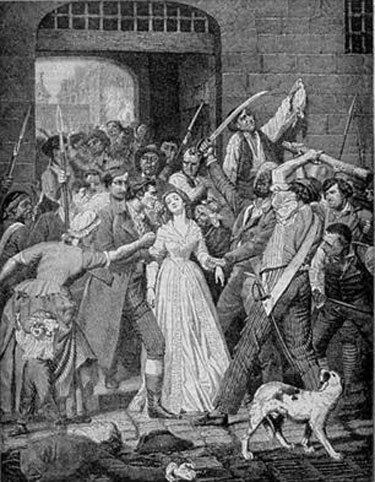
Pompous parades will today celebrate the event that triggered the French Revolution, that is to say, the most appalling bloodbath anterior to the Russian Revolution. Seven prisoners were released from the Bastille – four counterfeiters, an accomplice to murder and two lunatics – whose return to the community was hardly beneficial. The attack on the prison, reserved for the well-off, was orchestrated by the Marquis de Sade and Camille Desmoulins on behalf of the Nine Sisters masonic lodge.
There followed the September massacres, the marriages republicains in which people of opposite sexes were stripped naked and lashed together in obscene postures before being drowned, mothers forced to watch their children being guillotined and the massacre of 400,000 Catholic royalists – the majority of them women and children – in La Vendee. Sounds like the perfect excuse for a celebratory knees-up.
There are two countries called France. One is the sluttish Republic – “Marianne” – the other is the timeless, civilised doyen of Christendom, the nation of Clovis and St Louis, of the Valois and Bourbon kings, the Catholic and monarchic civilisation that fell with Charles X in 1830 but still defiantly survives in many enclaves. That pulse will beat quietly today while the heirs of the sans-culottes strut their stuff, proclaiming French nationalism under the figurehead of a Hungarian president and his Italian wife.
It is all hollow, even on their terms: the lodges and the heirs of the Jacobins have migrated to Brussels and are working on a more ambitious project, still aimed at the de-Christianisation of Europe and the elimination of freedom and tradition. France without its monarchy and the Church of which it was proudly termed the Eldest Daughter is a desert.
Today is when the posturing Pantaloons bedecked with tricolour sashes enjoy their 15 minutes of fame. God send, at some time in the future – however distant – the restoration of the glittering monarchy whose downfall in blood is so vulgarly celebrated today. Long live the present-day heir of the Bourbons, the Duc d’Anjou, rightful King of France. Vive Louis XX.
Long-time underground comix stars The Fabulous Furry Freak Brothers are about to emerge into the light with an eight-episode animated series, with help from key creative talent behind Rick & Morty, Silicon Valley and Workaholics, among others.
Gilbert Shelton, the Freak Brothers’ creator, will be an executive producer on the animated project. The show will be built around his comic’s original story lines, which follow the misadventures of three pharmacologically impaired non-siblings (and their cat) as they try to find more drugs, It is both celebration and satire of alternative culture, and remains a cult favorite. Freak Brothers comics have been translated into 14 languages with more than 40 million copies sold.
The Freak Brothers debuted in 1968 in The Rag, an Austin, Texas, alternative paper. Three years later, the first stand-alone Freak Brothers comics were published, with new issues from Shelton and eventual collaborators David Sheridan and Paul Mavrides arriving through1992, including runs in publications such as High Times and Playboy. Compilations of the work have been in print in one form or another ever since.
The eight 22-minute episodes of adult-oriented animation are expected to be ready by early next year. The project has not lined up distribution yet, but has enlisted a lengthy list of Hollywood veterans of notable TV and film projects.
There is a small category of films which failed in theatrical release, but which, when played and replayed on television, found their audience and proved themselves to be authentic heart-warming and important films striking a chord with a very wide audience and proving watchable again and again and again.
Kathy Shaidle pays tribute in a review to yet another wonderful case of the same phenomenon, Galaxy Quest (1999).
In a just world, O.J. Simpson would currently be serving the 24th year of a double life sentence; Ronald Reagan would have been president during America’s bicentennial instead of Gerald Ford — and Galaxy Quest would’ve earned half-a-billion bucks at the box office when it came out in 1999.
But inept and indifferent studio marketing (plus competition from another “sci-fi” comedy, Ghostbusters) relegated Galaxy Quest to semi-cult status. Which is ironically appropriate, given its plot:
At a science fiction convention, fans await an appearance by the cast of Galaxy Quest, a hokey interstellar TV adventure series unceremoniously cancelled in the early 1980s. The show’s fatally typecast has-been “stars” (played by Tim Allen, Alan Rickman, Sigourney Weaver, Tony Shalhoub and Daryl Mitchell) are reduced to reluctantly signing autographs at tacky gatherings like this one, when they’re not cutting ribbons (in full costume) at supermarket openings.
That is, until genuine aliens — who, in cargo cult fashion, have based their civilization on Galaxy Quest re-runs transmitted through space — touch down and beg “the crew of the NSEA-Protector” to help them defeat the villain bent on destroying their planet. The adorable Thermians innocently believe the program’s “crew” are fearless, intrepid space warriors and technological geniuses, not just washed-up actors in laughable uniforms. Their language has no word for “pretend”…
Lazily calling this movie “a Star Trek spoof” unfairly slots it alongside broad, coarse parodies like Blazing Saddles or the soulless Mars Attacks! In truth, Galaxy Quest is a tender, big hearted valentine — more My Favorite Year than Airplane.
That the film’s jokes and, more incredibly, its special effects, hold up so well twenty years later is a testament to the loving care with which Galaxy Quest was crafted. Obeying the first (yet often ignored) commandment of movie comedy, all the actors “play it straight.”
Genre veteran Sigourney Weaver of Alien fame never winks “Get it?”; neither does Alan Rickman, a classically-trained Shakespearean actor stuck wearing a rubber prosthetic forehead, portraying… a classically-trained Shakespearean actor stuck wearing a rubber prosthetic forehead:
While I’d have preferred the director’s original choice for the leading role — Kevin Kline — Tim Allen acquits himself surprisingly well as the pompous, Shatner-esque Jason Nesmith, a.k.a., Commander Taggart.
Cast as Thermian leader Mathesar, Yale Drama alumnus Enrico Colantoni conceived of his species’ quirky gait, rictus grin and off-key speech patterns during his winning audition, then led hour-long “alien school” on set each morning to ensure uniformity and, therefore, believability; of all the Thermians, Missi Pyle’s Laliari is so indelibly delightful that John Updike gave her a shout-out in his novella Rabbit Remembered.
Speaking of famous writers, David Mamet has called Galaxy Quest “a perfect film,” ranking it with The Godfather (and another of my other favorites, Dodsworth.)
We soldiers of Erin, so proud of the name,
We’ll raise on the rebels and Frenchmen our fame;
We’ll fight to the last in the honest old cause,
And guard our religion, our freedom and laws;
We’ll fight for our country, our King and his crown,
And make all the traitors and croppies lie down.
Down, down, croppies lie down.
The rebels so bold, when they’ve none to oppose,
To houses and haystacks are terrible foes;
They murder poor parsons and likewise their wives,
At the sight of a soldier they run for their lives;
Whenever we march over country and town
In ditches and cellars the croppies lie down.
Down, down, croppies lie down.
In Dublin the traitors were ready to rise
And murder was seen in their lowering eyes
With poison, the cowards, they aimed to succeed
And thousands were doomed by the assassins to bleed
But the yeoman advanced, of rebels the dread
And each croppy soon hid his dastardly head
Down, down, croppies lie down.
Should France e’er attempt, by fraud or by guile,
Her forces to land on Erin’s green isle,
We’ll show that they n’er can make free soldiers,slaves,
They shall only possess our green fields for their graves;
Our country’s applauses our triumphs will crown,
Whilst with their French brothers the croppies lie down.
Down, down, croppies lie down.
Oh, croppies ye’d better be quiet and still
Ye shan’t have your liberty, do what ye will
As long as salt water is formed in the deep
A foot on the necks of the croppy we’ll keep
And drink, as in bumpers past troubles we drown,
A health to the lads that made croppies lie down
Down, down, croppies lie down.
Officers in Oklahoma made a startling discovery after arresting two people at a traffic stop, only to find that their vehicle contained a rattlesnake, a canister of uranium, an open bottle of whiskey and a firearm, authorities said Wednesday.
An officer with the Guthrie Police Department had pulled over Stephen Jennings and Rachael Rivera for driving with expired tags on June 26, Sgt. Anthony Gibbs told ABC News. After the officer discovered that Jennings was driving with an expired license and Rivera was a convicted felon in possession of a firearm, both were placed under arrest, Gibbs said.
The vehicle, a Ford Explorer, was impounded because it did not have insurance. It was later discovered that the vehicle had been stolen.
“So when the impound of the vehicle begins and they start moving compartments, here’s the rattlesnake in the backseat,” Gibbs said. “It was surprising to the officer, obviously.”
As the officers continued to search the vehicle, they spotted an open bottle of Kentucky Deluxe whiskey near a firearm, the sergeant said. Then they discovered a container of “yellowish powder” that was labeled “Uranium.”
Jennings, of Logan County, told officers that he had the uranium because he recently purchased a Geiger counter to test metals, and the chemical element came with the purchase. He joked with officers that he was trying to create a “super snake,” Gibbs added.
In the county Tyrone, in the town of Dungannon
Where many a ruction myself had a hand in
Bob Williamson he lived, a weaver by trade
And all of us thought him a stout orange blade.
On the twelfth of July as around it did come
Bob played on the flute to the sound of the drum
You can talk of your harp, your piano, or lute
But there’s none could compare to the Old Orange Flute.
But Bob the deceiver he took us all in
For he married a Papist named Bridget McGinn
Turned Papish himself and forsook the Old Cause
That gave us our freedom, religion and laws.
And the boys in the place made some comment upon it
And Bob had to fly to the province of Connaught;
he left with his wife and his fixins, to boot,
And along with the latter, the Old Orange Flute.
At Mass the next Sunday, to atone for past deeds,
He said Paters and Aves and counted his beads
Till after some time at the Priest’s own desire
Bob went with his old flute to play in the choir.
Bob went with his flute for to play in the mass
But the instrument shivered and cried.”O Alas!”
And try though he would, though he made a great noise,
The flute would play only “The Protestant Boys”.
Well up Bob he jumped with a start and a flutter.
He threw the old flute in the blessed holy water;
He thought that this charm would bring some other sound,
When he tried it again, it played “Croppies Lie Down!”
Now for all he would finger and whistle and blow
For to play Papish music, he found it “No Go”
“Kick the Pope” to “Boyne Water” it clearly would sound
But one Papish squeek and it could’nt be found.
At a council of priests that was held the next day
They decided to banish the Old Flute away;
They couldn’t knock heresy out of its head
So they bought Bob a new one to play it instead.
Now the poor flute was doomed, and its fate was pathetic
‘Twas fastened and burnt at the stake as heretic.
As the flames roared around it, you could hear a strange noise ‘Twas the Old Flute still whistlin’ “The Protestant Boys”.
[Chorus] It is old but it is beautiful and its colours they are fine
It was worn at Derry, Aughrim, Enniskillen and the Boyne
My father wore it as a youth in bygone days of yore
So on the 12th I proudly wear the sash my father wore.
Here I am a loyal Orangeman, just came across the sea
For singing and for dancing, I hope that I’ll please thee
I can sing and dance with any man, as I did in days of yore
And on the 12th I long to wear the sash my father wore.
It’s now I’m going to leave you, good luck to you I say
And when I’m on the ocean, for me I hope you’ll pray
I’m going to my native land, to a place they call Dromore
Where on the 12th I’ll always wear the sash my father wore.
BUSINESS CLASS TAROT is a modern Tarot deck, for businesspeople, entrepreneurs, and anyone seeking greater success.
BUSINESS CLASS TAROT brings the knowledge and interactivity of Tarot cards into our world of instant connection, massive scale, and brutal competition. Beautiful, surreal images evoke the rush, despair, and joy that inform and derail life’s major decisions.