How does it feel to live in a time in which the grand establishment newspaper of record will publish, with grave seriousness and implicit nodding approval, the self-pitying posturings of a crazy who has created a personal identity and political ideology based on maladjustment and futile, self-destructive efforts to rebel against Nature and Reality?
Next Thursday, I will get a vagina. The procedure will last around six hours, and I will be in recovery for at least three months. Until the day I die, my body will regard the vagina as a wound; as a result, it will require regular, painful attention to maintain. This is what I want, but there is no guarantee it will make me happier. In fact, I don’t expect it to. That shouldn’t disqualify me from getting it.
I like to say that being trans is the second-worst thing that ever happened to me. (The worst was being born a boy.) …
I feel demonstrably worse since I started on hormones. One reason is that, absent the levies of the closet, years of repressed longing for the girlhood I never had have flooded my consciousness. I am a marshland of regret. Another reason is that I take estrogen — effectively, delayed-release sadness, a little aquamarine pill that more or less guarantees a good weep within six to eight hours.
Like many of my trans friends, I’ve watched my dysphoria balloon since I began transition. I now feel very strongly about the length of my index fingers — enough that I will sometimes shyly unthread my hand from my girlfriend’s as we walk down the street. When she tells me I’m beautiful, I resent it. I’ve been outside. I know what beautiful looks like. Don’t patronize me.
I was not suicidal before hormones. Now I often am.
I won’t go through with it, probably. Killing is icky. I tell you this not because I’m cruising for sympathy but to prepare you for what I’m telling you now: I still want this, all of it. I want the tears; I want the pain. Transition doesn’t have to make me happy for me to want it. Left to their own devices, people will rarely pursue what makes them feel good in the long term. Desire and happiness are independent agents.
As long as transgender medicine retains the alleviation of pain as its benchmark of success, it will reserve for itself, with a dictator’s benevolence, the right to withhold care from those who want it. Transgender people have been forced, for decades, to rely for care on a medical establishment that regards them with both suspicion and condescension. And yet as things stand today, there is still only one way to obtain hormones and surgery: to pretend that these treatments will make the pain go away.
The medical maxim “First, do no harm†assumes that health care providers possess both the means and the authority to decide what counts as harm. When doctors and patients disagree, the exercise of this prerogative can, itself, be harmful. Nonmaleficence is a principle violated in its very observation. Its true purpose is not to shield patients from injury but to install the medical professional as a little king of someone else’s body.
Let me be clear: I believe that surgeries of all kinds can and do make an enormous difference in the lives of trans people.
But I also believe that surgery’s only prerequisite should be a simple demonstration of want. Beyond this, no amount of pain, anticipated or continuing, justifies its withholding.
Nothing, not even surgery, will grant me the mute simplicity of having always been a woman. I will live with this, or I won’t. That’s fine. The negative passions — grief, self-loathing, shame, regret — are as much a human right as universal health care, or food. There are no good outcomes in transition. There are only people, begging to be taken seriously.
Personally, I think that we sane and normal people have a lot more reason for melancholy based on sheer embarrassment over the contemptible intellectual state of our culture and establishment than does some nutcase who does not like the sexual characteristics he was born with.
I fail to understand how Society and the medical profession and government are all supposed to adapt to whims connected with sex on the part of an infinitesimally small number of deeply neurotic malcontents without feeling exactly the same obligation to “take seriously” and accommodate the wishes of every madman who thinks he is Napoleon.
Hugo Drochon, reviewing Sue Prideaux’s new Nietzsche biography, I Am Dynamite in the Irish Times, explains that this one is a revolutionary revisionist bio that fans of Fred will have to read. I bought mine.
On the morning of January 3rd, 1889 a half-blind German professor, sporting a luxurious moustache, left his lodgings on the third floor of Via Carlo Alberto 6 in Turin. He was used to taking his daily walk through the famous arcades of the city, which shielded him from the light, and along the banks of the river Po. He would walk up to five hours a day, which explained his muscular frame: somewhat in dire contrast to the various illnesses that notoriously plagued his life.
But that day he did not get very far. He walked less than 200m to the Piazza Carignano, and what happened next is the stuff of legend: seeing an old recalcitrant horse being flogged mercilessly by its owner, the professor threw his arms around the horse to protect it – perhaps even whispering “Mother, I have been stupid†in its ear (how can anyone have heard that?) – and collapsing. He was saved from being escorted by two policemen to the asylum by his landlord, Davide Fino, who brought him home. We might never know exactly what happened on that fateful day, but one thing is certain: the productive and intellectual life of the great philosopher Friedrich Nietzsche had come to an end.
In her wonderfully gripping new biography of Nietzsche – the type you stay in bed all Sunday just to finish – Sue Prideaux casts doubt on this story. Indeed, the horse only makes an appearance in the legend 11 years later – in 1900, the year of Nietzsche’s death – when a journalist interviewed Fino, the landlord, about the events of the day. And only in the 1930s – more than 40 years later – do we hear about the horse being beaten and Nietzsche breaking down in tears; this time in an interview with Fino’s son, Ernesto, who would have been about 14 at the time.
Prideaux casts even more doubt on the cause usually attributed to this insanity: syphilis. Popularised by Thomas Mann’s novel Doctor Faustus, which has a Nietzsche-like character contract syphilis in a brothel, the evidence simply doesn’t stack up. Although diagnosed as such when admitted to the asylum in Basle, Nietzsche showed none of symptoms now associated with it: no tremor, faceless expression or slurred speech. If he was at an advanced stage of dementia caused by syphilis, Nietzsche should have died within the next two years; five max. He lived for another 11. The two infections he told the doctors about were for gonorrhoea, contracted when he was a medical orderly during the Franco-Prussian War.
Instead Prideaux puts forward the – correct – view that Nietzsche probably died of a brain tumour, the same “softening of the brain†that had taken away his father, a rural pastor, when Nietzsche was a boy. Indeed both sides of the family showed signs of neurological problems, or of suffering of “nervesâ€, as one put it at the time. Nietzsche’s younger sister Elisabeth certainly seemed prone, in posthumously making him palatable to the Nazis in her Nietzsche Archive in Weimar, to a degree of megalomania herself (she had herself buried in the middle of the Nietzsche family burial ground, on the spot originally reserved for her brother).
At stake is whether Nietzsche’s writings, and especially his theory of the Übermensch, should just be dismissed as the ravings of a madman. Here the story of the horse takes on particular importance: if true it would mean Nietzsche repented his views, asking for forgiveness for having demanded that modern man should “overcome†himself, to become “hard†by eschewing pity. This is certainly Kundera’s view, and it makes for a much nicer, more docile Nietzsche. But if there is no horse, or at least if there is no sobbing and protecting a flogged horse – that there is a mental breakdown is beyond doubt – then Nietzsche means what he says and his thinking is, in the words of Prideaux, dynamite.
Sci Fi novelist Larry Correia takes on Congressman Eric Swalwell’s contention that the Second Amendment is obsolete as a defense against the federal government.
Last week a congressman embarrassed himself on Twitter. He got into a debate about gun control, suggested a mandatory buyback—which is basically confiscation with a happy face sticker on it—and when someone told him that they would resist, he said resistance was futile because the government has nukes.
And everybody was like, wait, what?
Of course the congressman is now saying that using nuclear weapons on American gun owners was an exaggeration, he just wanted to rhetorically demonstrate that the all-powerful government could crush us peasants like bugs, they hold our pathetic lives in their iron hand, and he’d never ever advocate for the use of nuclear weapons on American soil (that would be bad for the environment!), and instead he merely wants to send a SWAT team to your house to shoot you in the face if you don’t comply. …
First, let’s talk about the basic premise that an irregular force primarily armed with rifles would be helpless against a powerful army that has things like drones and attack helicopters.
This is a deeply ironic argument to make, considering that the most technologically advanced military coalition in history has spent the better part of the last two decades fighting goat herders with AKs in Afghanistan and Iraq. Seriously, it’s like you guys only pay attention to American casualties when there’s a republican in office and an election coming up.
Nobel Peace Prize Winner Barack Obama launched over five hundred drone strikes during his eight years in office. We’ve used Apaches (that’s the scary looking helicopter in the picture for my peacenik liberal friends), smart bombs, tanks, I don’t know how many thousand s of raids on houses and compounds, all the stuff that the lefty memes say they’re willing to do to crush the gun nut right, and we’ve spent something like 6 trillion dollars on the global war on terror so far.
And yet they’re still fighting.
So yes, groups of irregular locals can be a real pain in the ass to a technologically superior military force. That’s pretty obvious.
Now here is the interesting part. Best estimates are that any given time in Iraq we’ve been fighting about 20,000 insurgents at most. …
Okay, so let’s say Congressman Swalwell gets his wish, and the government says turn them in or else. And even though the government has become tyrannical enough to send SWAT teams door to door and threaten citizens with drones and attack helicopters, rather than half the states saying fuck you, this means Civil War 2, instead we’ll stick to the rosiest of all possible outcomes, and say that most gun owners comply.
In fact, let’s be super kind. Rather than a realistic number, like half or a third of those people getting really, really pissed off and hoisting the black flag, let’s say that 99% of them decide to totally put all their faith into the government, and that the all-powerful entity which just threatened to kill their entire family will never ever turn tyrannical from now on, pinky swear, so what do they have to lose? And a whopping 90% of gun owners go along peacefully.
That means you are only dealing with six and a half MILLION insurgents. The entire active US military is about 1.3 million, with about 800,000 reserve. Which is also assuming that those two Venn diagrams don’t overlap, which is just plain idiotic, but I’ll get to that too.
Let’s be super generous. I’m talking absurdly generous, and say that a full 99% of US gun owners say won’t somebody think of the children and all hold hands and sing kumbaya, so that then you are only dealing with the angriest, listless malcontents who hate progress… These are those crazy, knuckle dragging bastards who you will have to put in the ground.
And there are 650,000 of them.
To put that into perspective, we were fighting 22,000 insurgents in Iraq, a country which would fit comfortably inside Texas with plenty of room to spare. This would be almost 30 times as many fighters, spread across 22 times the area.
And that estimated number is pathetically, laughably low.
Barack Obama condescended to America and to every public figure he’s ever met at an Obama Foundation conference last Monday. He was relaxed, expansive, necktie-less, and –as usual– perfectly sure that he’s the smartest man in the world.
I’m not alone in finding Obama unbearably arrogant, John Hinderaker does, too.
This is the central conceit of liberalism: we know how to solve the world’s problems–socialism!–but those pesky conservatives just won’t go along and make it unanimous. The truth is the opposite: policy debates rage across a broad range of issues, and conservatives usually win them.
The context of former President Obama’s comments, “climate change,†is a good example. The liberal/hysteric global warming theory has been refuted, and global warming advocates now admit that their models–the only basis for hysteria in the first place–are wrong. But, like a dead frog whose legs continue to kick, clueless liberals like Barack Obama parrot the pro-government line, not because it makes any scientific sense, but because it supports their statist desires.
Which brings us to the rest of Obama’s riff: Americans are “confused, blind, shrouded with hate, anger, racism, mommy issues.†This is more or less insane. What do hate and anger have to do with scientific debates about the influence of carbon dioxide on the earth’s atmosphere? Nothing, except that hate and anger are directed against all who publish scientific data that undercut the liberals’ politically-motivated narrative.
And racism? How does race have anything to do with global warming? It doesn’t. “Racism†is now an epithet that usually has nothing at all to do with race. It is merely a term of opprobrium, like “jerk†or “a**hole,†that liberals apply to those who disagree with them.
And, finally, “mommy issues.†I have no idea what Obama was referring to here. What do “mommy issues†have to do with global warming? News accounts indicate that his audience laughed, and reporters say he was referring to President Trump. I have no clue. My only observation is that liberal journalists constantly tell us that President Trump has debased our political culture. Seriously? The debasement, as I observe it, comes almost entirely from the other side.
Has President Trump ever ascribed his political opponents’ positions to “mommy issues� Not that I recall. It is hard to imagine any former president employing such childish tropes in attacking his successors. Former Presidents Reagan and Bush–George H. W. and George W.–certainly never tried to demean their Democratic successors by asserting such stupid slanders as “mommy issues.†Not to mention racism, hate and anger.
Wherein #Obama dismisses the value of every political figure he’s dealt with in the entire world in one minute and nineteen seconds. Amazing therefore that the “world’s smartest man†accomplished absolutely nothing in eight of the longest years in history. pic.twitter.com/hMg3iK3jlN
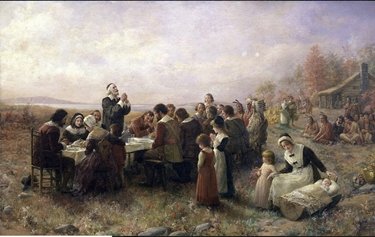
Mike Franc, at Human Events in 2005, identified the real reason for celebration at the first Thanksgiving.
Writing in his diary of the dire economic straits and self-destructive behavior that consumed his fellow Puritans shortly after their arrival, Governor William Bradford painted a picture of destitute settlers selling their clothes and bed coverings for food while others “became servants to the Indians,†cutting wood and fetching water in exchange for “a capful of corn.†The most desperate among them starved, with Bradford recounting how one settler, in gathering shellfish along the shore, “was so weak … he stuck fast in the mud and was found dead in the place.â€
The colony’s leaders identified the source of their problem as a particularly vile form of what Bradford called “communism.†Property in Plymouth Colony, he observed, was communally owned and cultivated. This system (“taking away of property and bringing [it] into a commonwealthâ€) bred “confusion and discontent†and “retarded much employment that would have been to [the settlers’] benefit and comfort.â€
Just how did the Pilgrims solve the problem of famine? In addition to receiving help from the local Indians in farming, they decided allow the private ownership of individual plots of land.
On the brink of extermination, the Colony’s leaders changed course and allotted a parcel of land to each settler, hoping the private ownership of farmland would encourage self-sufficiency and lead to the cultivation of more corn and other foodstuffs.
As Adam Smith would have predicted, this new system worked famously. “This had very good success,†Bradford reported, “for it made all hands very industrious.†In fact, “much more corn was planted than otherwise would have been†and productivity increased. “Women,†for example, “went willingly into the field, and took their little ones with them to set corn.â€
The famine that nearly wiped out the Pilgrims in 1623 gave way to a period of agricultural abundance that enabled the Massachusetts settlers to set down permanent roots in the New World, prosper, and play an indispensable role in the ultimate success of the American experiment.
A profoundly religious man, Bradford saw the hand of God in the Pilgrims’ economic recovery. Their success, he observed, “may well evince the vanity of that conceit…that the taking away of property… would make [men] happy and flourishing; as if they were wiser than God.†Bradford surmised, “God in his wisdom saw another course fitter for them.â€
The real story of Thanksgiving is the triumph of capitalism and individualism over collectivism and socialism, which is the summation of the story of America.
A tight helmet with grotesque face (masked visor), Germany or Italy, early 16th century and later. Height: 9.44″/24 cm. Typical modified helmet for the Gioco del Ponte. Provenance: Collection of the Royal Dynasty of Hanover, Marienburg, auctioned at Sotheby’s, October 2005