

02 Feb 2018
Whiffenpoofs (and the Senior Girls Imitation Group) Go Totally PC
Egalitarianism Run Amok, Political Correctness, The Whiffenpoofs, Un Autre Jolie Cadeau de la Revolution Francaise, Yale


Not a satire. This is from today’s Yale Daily News:
Breaking with more than a century of tradition, the Whiffenpoofs and Whim ’n Rhythm, Yale’s all-male and all-female senior a capella groups, announced on Thursday that this year both groups will consider accepting singers of all genders.
According to a joint announcement posted on Facebook, Whim ’n Rhythm will from this point on describe itself as, “SSAA,†— or Soprano I and II and Alto I and II — rather than all-female, while the Whiffenpoofs will use the label “TTBB,†or Tenor I and II, Baritone and Bass. The statement called these terms “more informative of the art [they] create†and “more inclusive†to members past, present and future, especially those who identify as transgender, gender nonbinary and gender nonconforming.
“Instead of talking about the membership of the group, [we want to] talk about the people who make that type of music,†said Kenyon Duncan ’19, the music director of the Whiffenpoofs. “We’re trying to make this as much about the music and ease gender boundaries.â€
The statement also announced a series of changes designed to close the “gap in opportunity†between the two organizations. The Whiffenpoofs, well-established in the world of a cappella, take a year off from school to tour the world, while the much newer Whim ’n Rhythm tours internationally only during the summer and performs locally throughout the year. Whim ’n Rhythm also brings in significantly less revenue than do the Whiffenpoofs — during fiscal year 2013, for example, Whim ’n Rhythm’s earnings amounted to less than a quarter of the Whiffenpoofs’.
With these changes, the announcement said, the two groups hope to “more explicitly link†together as two performing bodies representing the same Yale senior class.
Next year, both the Whiffenpoofs and Whim ’n Rhythm classes of 2019 will have the option to take a leave of absence or remain enrolled at Yale, with rehearsal, performance and tour schedules defined by each future class of singers. And the groups’ operations will become more cohesive in the future, through a joint website with shared booking information and closer integration of the two groups’ business teams. The statement also expressed a commitment to expanding the SATB — of Soprano, Alto, Tenor, Bass — repertoire so that Whim and the Whiffs can more often perform together on campus and for clients.
The joint decision to go all-gender as well as to implement the set of changes announced resulted from a prolonged conversation among all 28 members of the Whiffenpoofs and Whim ’n Rhythm classes of 2018 over the past six months about how to make senior a cappella at Yale more equitable.
02 Feb 2018
FBI Warns Republican Memo Could Undermine Faith In Massive, Unaccountable Government Secret Agencies
FBI, FISA Memo, Satire, The Onion

WASHINGTON—Stressing that such an action would be highly reckless, FBI Director Christopher Wray warned Thursday that releasing the “Nunes Memo†could potentially undermine faith in the massive, unaccountable government secret agencies of the United States. “Making this memo public will almost certainly impede our ability to conduct clandestine activities operating outside any legal or judicial system on an international scale,†said Wray, noting that it was essential that mutual trust exist between the American people and the vast, mysterious cabal given free rein to use any tactics necessary to conduct surveillance on U.S. citizens or subvert religious and political groups. “If we take away the people’s faith in this shadowy monolith exempt from any consequences, all that’s left is an extensive network of rogue, unelected intelligence officers carrying out extrajudicial missions for a variety of subjective, and occasionally personal, reasons.†At press time, Wray confirmed the massive, unaccountable government secret agencies were unaware of any wrongdoing for violating constitutional rights.
02 Feb 2018
Candlemas, Known Mostly in America Today as “Groundhog Day”
Candlemas, Groundhog Day, History, Traditions

Tintoretto, Presentation of Jesus at the Temple, 1550-1555, Gallerie dell Accademi, Venice
From Robert Chambers, The Book of Days, 1869:
From a very early, indeed unknown date in the Christian history, the 2nd of February has been held as the festival of the Purification of the Virgin, and it is still a holiday of the Church of England. From the coincidence of the time with that of the Februation or purification of the people in pagan Rome, some consider this as a Christian festival engrafted upon a heathen one, in order to take advantage of the established habits of the people; but the idea is at least open to a good deal of doubt. The popular name Candlemass is derived from the ceremony which the Church of Rome dictates to be observed on this day; namely, a blessing of candles by the clergy, and a distribution of them amongst the people, by whom they are afterwards carried lighted in solemn procession. The more important observances were of course given up in England at the Reformation; but it was still, about the close of the eighteenth century, customary in some places to light up churches with candles on this day.
At Rome, the Pope every year officiates at this festival in the beautiful chapel of the Quirinal. When he has blessed the candles, he distributes them with his own hand amongst those in the church, each of whom, going singly up to him, kneels to receive it. The cardinals go first; then follow the bishops, canons, priors, abbots, priests, &c., down to the sacristans and meanest officers of the church. According to Lady Morgan, who witnessed the ceremony in 1820:
‘When the last of these has gotten his candle, the poor conservatori, the representatives of the Roman senate and people, receive theirs. This ceremony over, the candles are lighted, the Pope is mounted in his chair and carried in procession, with hymns chanting, round the ante-chapel; the throne is stripped of its splendid hangings; the Pope and cardinals take off their gold and crimson dresses, put on their usual robes, and the usual mass of the morning is sung.’
Lady Morgan mentions that similar ceremonies take place in all the parish churches of Rome on this day.
It appears that in England, in Catholic times, a meaning was attached to the size of the candles, and the manner in which they burned during the procession; that, moreover, the reserved parts of the candles were deemed to possess a strong supernatural virtue:
‘This done, each man his candle lights,
Where chiefest seemeth he,
Whose taper greatest may be seen; And fortunate to be,
Whose candle burneth clear and bright: A wondrous force and might
Both in these candles lie, which if At any time they light,
They sure believe that neither storm Nor tempest cloth abide,
Nor thunder in the skies be heard, Nor any devil’s spide,
Nor fearful sprites that walk by night,
Nor hurts of frost or hail,’ &c.The festival, at whatever date it took its rise, has been designed to commemorate the churching or purification of Mary; and the candle-bearing is understood to refer to what Simeon said when he took the infant Jesus in his arms, and declared that he was a light to lighten the Gentiles. Thus literally to adopt and build upon metaphorical expressions, was a characteristic procedure of the middle ages. Apparently, in consequence of the celebration of Mary’s purification by candle-bearing, it became customary for women to carry candles with them, when, after recovery from child-birth, they went to be, as it was called, churched. A remarkable allusion to this custom occurs in English history. William the Conqueror, become, in his elder days, fat and unwieldy, was confined a considerable time by a sickness. ‘Methinks,’ said his enemy the King of France, ‘the King of England lies long in childbed.’ This being reported to William, he said, ‘When I am churched, there shall be a thousand lights in France !’ And he was as good as his word; for, as soon as he recovered, he made an inroad into the French territory, which he wasted wherever he went with fire and sword.
At the Reformation, the ceremonials of Candlemass day were not reduced all at once. Henry VIII proclaimed in 1539:
‘On Candlemass day it shall be declared, that the bearing of candles is done in memory of Christ, the spiritual light, whom Simeon did prophesy, as it is read in. the church that day.’
It is curious to find it noticed as a custom down to the time of Charles II, that when lights were brought in at nightfall, people would say—’ God send us the light of heaven!’ The amiable Herbert, who notices the custom, defends it as not superstitious. Some-what before this time, we find. Herrick alluding to the customs of Candlemass eve: it appears that the plants put up in houses at Christmas were now removed.
Down with the rosemary and bays,
Down with the mistletoe;
Instead of holly now upraise
The greener box for show.
The holly hitherto did sway,Let box now domineer,
Until the dancing Easter day
Or Easter’s eve appear.
The youthful box, which now hath grace
Your houses to renew,
Grown old, surrender must his place
Unto the crisped yew.
When yew is out, then birch comes in,And many flowers beside,
Both of a fresh and fragrant kin’,
To honour Whitsuntide.
Green rushes then, and sweetest bents,
With cooler oaken boughs,
Come in for comely ornaments,
To re-adorn the house.
Thus times do shift; each thing in turn does hold;
New things succeed, as former things grow old.’The same poet elsewhere recommends very particular care in the thorough removal of the Christmas garnishings on this eve:
‘That so the superstitious find
No one least branch left there behind;
For look, how many leaves there be
Neglected there, maids, trust to me,
So many goblins you shall see.’He also alludes to the reservation of part of the candles or torches, as calculated to have the effect of protecting from mischief:
‘Kindle the Christmas brand, and then
Till sunset let it burn,
Which quenched, then lay it up again, Till Christmas next return.
Part must be kept, wherewith to tend
The Christmas log next year;
And where ‘tis safely kept, the fiend Can do no mischief there.’Considering the importance attached to Candlemass day for so many ages, it is scarcely surprising that there is a universal superstition throughout Christendom, that good weather on this day indicates a long continuance of winter and a bad crop, and that its being foul is, on the contrary, a good omen. Sir Thomas Browne, in his Vulgar Errors, quotes a Latin distich expressive of this idea:
‘Si sol splendescat Maria purificante,
Major erit glacies post festum quam fait ante;which maybe considered as well translated in the popular Scottish rhyme:
If Candlemass day be dry and fair,
The half o’ winter’s to come and mair;
If Candlemass day be wet and foul,
The half o’ winter’s gave at Yule.’In Germany there are two proverbial expressions on this subject: 1. The shepherd would rather see the wolf enter his stable on Candlemass day than the sun; 2. The badger peeps out of his hole on Candlemass day, and when he finds snow, walks abroad; but if he sees the sun shining, he draws back into his hole. It is not improbable that these notions, like the festival of Candlemass itself, are derived from pagan times, and have existed since the very infancy of our race. So at least we may conjecture, from a curious passage in Martin’s Description of the Western Islands. On Candlemass day, according to this author, the Hebrideans observe the following curious custom:
The mistress and servants of each family take a sheaf of oats and dress it up in women’s apparel, put it in a large basket, and lay a wooden club by it, and this they call BrÃd’s Bed.; and then the mistress and servants cry three times, “BrÃd is come; BrÃd is welcome!†This they do just before going to bed, and when they rise in the morning they look among the ashes, expecting to see the impression of BrÃd’s club there; which, if they do, they reckon it a true presage of a good crop and prosperous year, and the contrary they take as an ill omen.
———————————————————————-
Groundhog Day is really a modern commercialized adaptation of the earlier weather traditions associated with the Christian feastday.
01 Feb 2018
Famous Waterhouse Painting Removed in Manchester
"Hylas and the Nymphs", Art, Feminist Issues, John William Waterhouse, Manchester City Art Gallery, Political Correctness

John William Waterhouse, Hylas and the Nymphs, 1896, Manchester City Art Gallery.
The Guardian reports that the Manchester City Art Gallery has removed a Pre-Raphaelite painting not as censorship, you understand, but rather “to prompt conversations.”
It is a painting that shows pubescent, naked nymphs tempting a handsome young man to his doom, but is it an erotic Victorian fantasy too far, and one which, in the current climate, is unsuitable and offensive to modern audiences?
Manchester Art Gallery has asked the question after removing John William Waterhouse’s Hylas and the Nymphs, one of the most recognisable of the pre-Raphaelite paintings, from its walls. Postcards of the painting will be removed from sale in the shop.
The painting was taken down on Friday and replaced with a notice explaining that a temporary space had been left “to prompt conversations about how we display and interpret artworks in Manchester’s public collectionâ€. Members of the public have stuck Post-it notes around the notice giving their reaction.
Clare Gannaway, the gallery’s curator of contemporary art, said the aim of the removal was to provoke debate, not to censor. “It wasn’t about denying the existence of particular artworks.â€
The work usually hangs in a room titled In Pursuit of Beauty, which contains late 19th century paintings showing lots of female flesh.
Gannaway said the title was a bad one, as it was male artists pursuing women’s bodies, and paintings that presented the female body as a passive decorative art form or a femme fatale.
“For me personally, there is a sense of embarrassment that we haven’t dealt with it sooner. Our attention has been elsewhere … we’ve collectively forgotten to look at this space and think about it properly. We want to do something about it now because we have forgotten about it for so long.â€
Gannaway said the debates around Time’s Up and #MeToo had fed into the decision.
The removal itself is an artistic act and will feature in a solo show by the artist Sonia Boyce which opens in March. People can tweet their opinion using #MAGSoniaBoyce. …
Gannaway said the removal was not about censorship.
“We think it probably will return, yes, but hopefully contextualised quite differently. It is not just about that one painting, it is the whole context of the gallery.â€
Look at you, oogling those nymphs! Aren’t you ashamed of yourself, you nasty cis-gendered masculine perpetuator of the patriarchy?
01 Feb 2018
Lost Crops of Amerindian North America
Agriculture, Botany, Cuisine, Indians, North America

Lost Indian crops of North America: a) goosefoot (Chenopodium berlandieri); b) sumpweed/mars helder (Iva annua); c) little barley (Hordeum pusillum); d) erect knotweed (Polygonum erectum); e) maygrass (Phalaris caroliniana).
We Europeans got potatoes, tomatoes, sweet corn, and tobacco from the Indians, but they apparently also cultivated a wide repertoire of crops which nobody adopted and which have been entirely forgotten.
Adventurers and archaeologists have spent centuries searching for lost cities in the Americas. But over the past decade, they’ve started finding something else: lost farms.
Over 2,000 years ago in North America, indigenous people domesticated plants that are now part of our everyday diets, such as squashes and sunflowers. But they also bred crops that have since returned to the wild. These include erect knotweed (not to be confused with its invasive cousin, Asian knotweed), goosefoot, little barley, marsh elder, and maygrass. We haven’t simply lost a few plant strains: an entire cuisine with its own kinds of flavors and baked goods has simply disappeared.
By studying lost crops, archaeologists learn about everyday life in the ancient Woodland culture of the Americas, including how people ate plants that we call weeds today. But these plants also give us a window on social networks. Scientists can track the spread of cultivated seeds from one tiny settlement to the next in the vast region that would one day be known as the United States. This reveals which groups were connected culturally and how they formed alliances through food and farming.
Natalie Mueller is an archaeobotanist at Cornell University who has spent years hunting for erect knotweed across the southern US and up into Ohio and Illinois. She calls her quest the “Survey for Lost Crops,†and admits cheerfully that its members consist of her and “whoever I can drag along.†She’s published papers about her work in Nature, but also she spins yarns about her hot, bug-infested summer expeditions for lost farms on her blog. There, photographs of the rare wild plants are interspersed with humorous musings on contemporary local food delicacies like pickle pops.
Indigenous to the Americas, erect knotweed grows in the moist flood zones near rivers. It’s a stalky plant with spoon-shaped leaves, and it produces achenes, or fruit with very hard shells to protect its rich, starchy seeds. Though rare today, the plant was common enough 2,000 years ago that paleo-Americans collected it from the shores of rivers and brought it with them to the uplands for cultivation. Archaeologists have found caches of knotweed seeds buried in caves, clearly stored for a later use that never came. And, in the remains of ancient fires, they’ve found burned erect knotweed fruits, popped like corn.
Mueller told Ars Technica that erect knotweed was likely domesticated on tiny farms on the western front of the Appalachians. There are clear differences between it and its feral cousins. After years of comparing the ancient seeds with wild types, Mueller has found two unmistakable signs of domestication: larger fruits and thinner fruit skins. We see a similar pattern in other domesticated plants like corn, whose wild version with tiny seeds is almost unrecognizable to people chomping on the juicy, large kernels of the domesticated plant.
Obviously, bigger seeds would make the erect knotweed a better food source, so farmers selected for that. And the thinner skin means the plants can germinate more quickly. Their wild cousins evolved to produce fruits tough enough to endure river floods and inhospitable conditions for over a year before sprouting. But farm life is cushy for plants, so these defenses weren’t necessary for their survival under human care.
Still, even the domesticated fruits of the erect knotweed have skins so tough that Mueller has not been able to crack them using the stone tools typical of the Woodland era. Working with a team at Cornell, she’s been trying to reverse engineer how they could have been eaten.
“The fruit coat is really hard, and it would have been necessary to break through it,†she mused. “It’s like buckwheat—the sprouts are nutritious. So maybe they ate the sprouted version.â€
As for whether early Americans ate popped knotweed like popcorn, she was less certain. “The only way to preserve it is to burn it, so [the remains we find] could have been accidents while cooking. It might have been for drying.†But yes, people from long ago might have munched on popweed.
Another possibility is that the seeds were soaked in lime before being turned into a hominy-style porridge. Ancient Americans used lime—the chemical, not the fruit—to soften the hulls of maize before cooking it, in a technique called nixtamalization. It’s very likely the Woodland peoples used this prehistoric form of culinary science on other plants, too. So people 2,000 years ago may have been eating a rich, knotweed mush.
Mueller is currently cultivating her own erect knotweed to test various forms of preparation, but she’s not quite ready to go into the kitchen yet. “I’m trying to be a good farmer and put my seeds back first,†she said. “In five years of looking, I’ve only found seven populations of this plant. I want to conserve the seeds as much I can.†She’s going to accumulate a sizable cache of seeds before wasting them on dinner.
31 Jan 2018
“The Old Order Changeth”
"Idylls of the King", Alfred Lord Tennyson, King Arthur
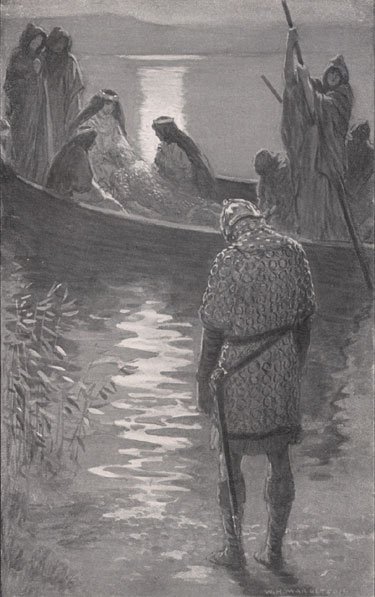
Then loudly cried the bold Sir Bedivere:
‘Ah! my Lord Arthur, whither shall I go?
Where shall I hide my forehead and my eyes?
For now I see the true old times are dead,
When every morning brought a noble chance,
And every chance brought out a noble knight.
Such times have been not since the light that led
The holy Elders with the gift of myrrh.
But now the whole Round Table is dissolved
Which was an image of the mighty world,
And I, the last, go forth companionless,
And the days darken round me, and the years,
Among new men, strange faces, other minds.’
And slowly answered Arthur from the barge:
‘The old order changeth, yielding place to new,
And God fulfils himself in many ways,
Lest one good custom should corrupt the world.
Comfort thyself: what comfort is in me?
–Alfred Lord Tennyson, Idylls of the King.
In Memoriam RMB.
30 Jan 2018
American Education Is For the Mediocre
Christopher Michael Langin, Education, Egalitarianism, High IQs

Christopher Michael Langin explains why conventional American education short changes the genuinely smart.
Owing to the shape of a bell curve, the education system is geared to the mean. Unfortunately, that kind of education is virtually calculated to bore and alienate gifted minds. But instead of making exceptions where it would do the most good, the educational bureaucracy often prefers not to be bothered.
In my case, for example, much of the schooling to which I was subjected was probably worse than nothing. It consisted not of real education, but of repetition and oppressive socialization (entirely superfluous given the dose of oppression I was getting away from school). Had I been left alone, preferably with access to a good library and a minimal amount of high-quality instruction, I would at least have been free to learn without useless distractions and gratuitous indoctrination. But alas, no such luck.
While my own background is rather exceptional, it is far from unique. Many young people are affected by one or more of the same general problems experienced by my brothers and me. A rising number of families have severe financial problems, forcing educational concerns to take a back seat to food, shelter, and clothing on the list of priorities. Even in well-off families, children can be starved of parental guidance due to stress, distraction, or irresponsibility. If a mind is truly a terrible thing to waste, then the waste is proportional to mental potential; one might therefore expect that the education system would be quick to help extremely bright youngsters who have it rough at home. But if so, one would be wrong a good part of the time.
Let’s try to break the problem down a bit. The education system is subject to a psychometric paradox: on one hand, it relies by necessity on the standardized testing of intellectual achievement and potential, including general intelligence or IQ, while on the other hand, it is committed to a warm and fuzzy but scientifically counterfactual form of egalitarianism which attributes all intellectual differences to environmental factors rather than biology, implying that the so-called “gifted†are just pampered brats who, unless their parents can afford private schooling, should atone for their undeserved good fortune by staying behind and enriching the classroom environments of less privileged students.
HT: Vox Day.

29 Jan 2018
The Gay Writer and His Father’s Gun
Corey Ford, Guns, Justin Quarry, Kassnar Feg Pjk-9hp 9mm

Kassnar Imports Feg Pjk-9hp 9mm pistol
Gay Writer Justin Quarry struggles to understand the meaning of 9mm Browning High Power clone left to him by his proletarian hunter father. An interesting variant on the deracinated-member-of-the-urban-community-of-fashion-meets-firearm genre.
When my father died in the winter of 2000, back when I was newly 19, the single thing he left me was a nine-millimeter pistol. The day after his funeral, my grandfather simply told me my father wanted me to have it, handing it to me in its ragged original packaging — spare bullets, along with the pistol, spilling from the Styrofoam encasement as I opened the discolored box.
This inheritance both surprised and confused me. For one thing, though I’d spent my early childhood with rifles and shotguns racked against the walls of our home and the rear window of my father’s Jeep, with countless taxidermied deer heads gazing down at me apathetically, I’d never known my father to own a handgun. For another, unlike all the other men in my family, I’d never spent a second in a tree stand, didn’t even recall playing with toy guns; rather than pretending to shoot deer or Iraqi soldiers, for instance, one Christmas I requested and received a custom-made deer costume for my Cabbage Patch doll, Casey.
The pistol also puzzled me because I hadn’t necessarily expected to inherit anything at all from my father. …
The pistol haunted me, even as it burrowed in my boyhood bedroom closet where I left it after my grandfather gave it to me, with my comic books and Magic: the Gathering cards, hundreds of miles away in the Mississippi Delta. It became an almost magical object to me because of its peculiarity in the context of my life, because of its singularity in what my father had bequeathed me. I struggled to decipher this talisman, the idea of it, as I simultaneously struggled to decipher myself.
The day after my father’s funeral, my grandfather simply told me my father wanted me to have his gun, handing it to me in its ragged original packaging.
In college, apart from my family, I discovered I had little identity without them, so entangled had I been throughout my childhood in my parents’ battles and crises. Even more, I was the first person in my family to go to college and one of very few of us to leave the flatlands of Arkansas. Once I went to Vanderbilt I was an alien, or a more apparent one, whenever I came home. However, being one of very few first-generation college students on campus, I was even more an alien at Vanderbilt. It was only when I began writing that I discovered how to create meaning for myself. …
The great thing about having a dead parent, I’ve heard, is that when you come out of the closet, you have one less person to disappoint. For me coming out didn’t just entail my sexuality but, moreover, my creativity as I declared myself a writer — the pressure all the higher as a first-generation college student, if only in my mind, to take a safer, more practical route However, as I sat so close to my father that day, with my hair dyed red and a Sarah McLachlan pendant on a choker around my neck, I imagined he might have seen — even before I did, even before I had an inkling I was an artist — that I’m gay.
Still, I wonder what story he might have imagined about me that would lead him to leave me the pistol.
I wonder, what else might he have seen about me that day, that at age 19 I wasn’t able, that even now I may not be able, to see about myself?
***
A decade later, I returned to Nashville to teach at my alma mater, and though I’d had luck in publishing shorter work, in reinventing myself through writing, I continued to toil over a novel-length manuscript I’d been trying to wrangle for years. Then one May I retreated to rural Minnesota where I could write in solitude for entire days and, in theory, with such intense focus, make major headway in crafting my book. However, that month, as I more and more slowly plodded on the page, I looked out the windows of my studio to the cold, gray spring, and even more slowly plodded until I at last gave in to the confusion of that world I struggled to order. Until I at last crumpled under its weight.
I felt not only that I had failed at writing but also that writing had failed me. I saw how isolated I was — not just in Minnesota but also in my life. I lived alone and devoted almost every available hour to writing, often rejecting invitations for the possibility that I might write at the given time, or the risk that going out might leave me unable to write the next morning. …
Two weeks later after I returned from my writing retreat, I visited my mother, with whom I’d skipped Mother’s Day to be in Minnesota. But I hadn’t only gone to Arkansas to see her and to make up for the missed holiday. I’d also gone to retrieve my father’s pistol. My pistol.
Before, every time I pondered finally taking the pistol into my possession, simply as a novelty, yet another mass shooting would occur somewhere in America, sparking yet another debate over the Second Amendment, making merely owning a gun feel like a political act, and in turn repelling me from it. But now I’d decided to use the gun as a means of taking myself as far outside my current experience, as far from my writing, as I could. I’d decided to get professionally trained on it. I wanted to try on the identity my father had perhaps imagined for me in his giving me the gun, and maybe even in his fathering me.
——————————————-
Roughly 60 years ago, the humorist Corey Ford used to publish a monthly feature in Field & Stream magazine called The Lower Forty, a chronicle of the adventures of a fictional informal club of small-town New England sportsmen formally titled “The Lower Forty Hunting, Shooting and Inside Straight Club.†The club’s leader and role model was Judge Parker (a fictional version of a friend of Ford’s named Parker Merrow).
Around 1960 or 1961, Parker Merrow received by telegram the news that his son, at the time serving as an Air Force officer in Japan, had fathered a baby boy. Judge Parker sat right down and wrote a “Letter to a Grandson,†which he shared with Corey Ford, who quoted it in full in one of the most moving and memorable of the Lower Forty stories.
“Letter to a Grandson” does a pretty good job of explaining to Justin Quarry what his Maytag-repairman father was trying to leave him.
TO MY GRANDSON:
This letter will be yours on your 16th birthday. If I am alive then, I will read it to you. If I have checked out before that date, please go off by yourself, alone, and read it aloud.
Three hours ago your father cabled me that you were in this world, that you and your mother were doing well, and that you will bear my father’s name.
So for three hours I have been celebrating your birth in an orderly and thorough manner. I have given your grandmother a couple of tranquilizer pills to calm her hysterics at the good news. I have notified all your father’s friends in town as he requested, so they can celebrate also. I have stopped at the bank and arranged a modest trust fund which should see you through college. I have had several drinks, and now I am writing a letter to you to open 16 years later.
I will waste neither your time nor mine in giving you advice. If by the time you are of age you do not know the meaning and practice of truth and loyalty and courage and honesty, and the deep satisfaction of doing hard work both physical and mental, then your great-grandfather did a hell of a poor job raising me, and I did a hell of a poor job raising your father.
I am leaving you a few things.
First I leave you your great-grandfather’s weapons. He taught me how to shoot a pistol with his .38 Colt Army. I have not fired it since the day he died. I will give it a real good cleaning, and put the neat’s-foot oil to the holster, and leave it with the same loads that he put in the cylinder himself the last time he dropped the hammer. Also you will receive his .30/30 carbine and his 12-gauge Greener. No buck ever went very far that caught one of my dad’s .30/30s behind the foreshoulder. No goose kept flying very long that he centered with a load of 4s..
Next I leave you my old Browning five-shot 12-bore. I have used that gun so much it has been reblued and rebuilt twice. Also my scope-sighted Model 70 Winchester .30/06. Also my house gun, a .357 Magnum Smith & Wesson snub nose. A man who is not ready and able to defend his home does not belong in our family.
Also I leave you my 81/2-foot, 4-ounce Leonard rod, which is as good as the day it was built, and they do not build them any more. I leave you my 9-foot, 61/2-ounce Orvis light salmon rod, which has killed some good fish in Canada and Alaska and Ireland. You may fish some of the same pools with it. I leave you my favorite 8-foot, 31/2-ounce fly rod which Walt Powell made for me, and which can lay a No. 12 Spentwing Coachman on the water slicker than a schoolmarm’s leg. All these rods and guns will be cleaned and cased and tagged with your name for presentation with this letter.
More important, I am leaving you some memories. I hope that through the years they will be your memories, as they have been mine, as they are now your father’s, as they were your great-grandfather’s once.
I leave you the cold gray dawn and the marshes and the wind and the slap of wavelets and whistle of wings and the recoil of your gun against your shoulder.
The creak of packstraps in the dark and the thud of moccasins on the steep trail and the deep breathing as you and your hunting partner pack out your deer.
The easy grating of your canoe over a gravel bar and the shaking out of your line in the last long dusk and the sudden staccato scream of your reel.
The flutter and thump of a turkey gobbler coming down from his roost in that first light when you can count the eyelets of your boots.
The taste of a cold mountain spring as you lie on your belly with your mouth spitting cotton.
The smells that men like to remember-pipe smoke and boot dubbing and Hoppe’s No. 9, and fly dope on a red bandanna handkerchief, and the smell of leather that is more like a taste, and the before-breakfast smell of coffee and bacon frying, and the smell of a cottonmouth, the smell of fear, and the fall smells of sweet-fern and rotting apples and burnt powder in the frosty air.
I leave you a windy spring night and the shrill of peepers like sleigh bells and the far-off baying of geese heading north in the empty sky.
Swimming stripped in a clear lake under an August moon and then standing on the shore with a cigarette while the night wind dries your body and the loons call.
An afternoon in October and a bird-dog puppy staunch on his first point with one foreleg drawn up and his brown eyes fixed and his whole skinny body shivering with the strange new excitement of grouse.
A winter evening with the sleet against the window and a log blazing and a highball and some friends you have hunted and fished with to share your memories with you.
All these and more I leave to you, my beloved grandson. Perhaps I will live long enough to be at your side when they become your memories too. But if I do not, I raise my glass to you across the years.



