Remember, remember!
The fifth of November,
Gunpowder, treason, and plot;
There is no reason
Why the Gunpowder treason
Should ever be forgot!
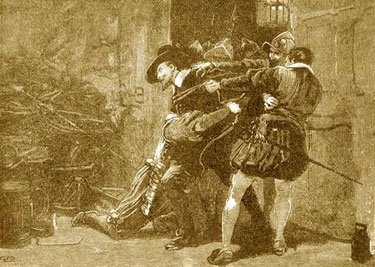
Early in the morning of November 5, Guy Fawkes crept, torch in hand, into the cellar beneath the House of Lords in the Palace of Westminster. In that cellar, he and his fellow conspirators had previously placed a cache of 1800 pounds ((36 barrels, or 800 kg) of gunpowder. Just as he was about to ignite the barrels, blowing himself and the House of Lords to Kingdom Come, the torch was snatched from his hand by a man named Peter Heywood.
Fawkes was arrested and taken before the privy council where he remained defiant. When asked by one of the Scottish lords what he had intended to do with so much gunpowder, Fawkes answered him, “To blow you Scotch beggars back to your own native mountains!”
So went the attempted Gunpowder Plot of 1605.
The intention of the plotters was to use the explosion, timed to coincide with the opening of Parliament, to kill King James I and eliminate much of the ruling Protestant aristocracy. They also intended to kidnap the royal children, then raise the standard of revolt in the Midlands with the object of restoring the freedom to practice Catholicism in England.
Vanderleun‘s boyhood had a good deal in common with mine, despite being set in California.
Sometime later my parents bought a house on the edge of Butte Canyon out on the fringes of Paradise. My father built a new bedroom for Tom and myself at the back of the house with its own entrance stairs that incorporated the trunk of a black walnut tree. There was a cherry tree in the backyard along with a brick barbecue. Beyond the backyard was an acre of wild oak, madrone, and manzanita. Behind that was an old dirt road that ran right at the edge of Butte Canyon. The canyon here was draped everywhere by frozen flows of black lava in all shapes and often precipitous drops. Nearby there were trails branching out and down into the canyon. On weekends and in the summer, our parent’s instructions to us were simple: “Home before dark.”
I was 9 and my brother 7 and we set off every summer and non-school morning with a couple of peanut butter and jelly sandwiches to explore this strange landscape of lava beds, High Sierra forests, and streams, and abandoned gold mines.
For there were abandoned gold mines everywhere in the sloping walls of Butte canyon. You found them by following old almost erased trails that slowly slumped downwards on the canyon walls. One particular site boasted a mine with three entrances branching off into the darkness under the canyon. Some mines were said to go back several miles but they were always too spooky and our flashlights too dim for us to venture very far inside.
Whenever we could we’d escape out our private entrance and ramble about the canyon under the watchful eyes of buzzards roosting atop dead pines waiting for a meal. It’s strange now to say we skipped along the edges of the paths oblivious to the potential for becoming buzzard food, but children are immortal in their own minds, are they not?
One day in (was it late autumn or before or after?) we were following a new path when we came upon a wide and long lava bed somewhere midway down the canyon. The lava was coal-black and had many lichen-covered stones protruding out of the crust. And in the midst of it all, there was one large lava spire that rose high above the bed below; a monolith that had felt the splash of the molten lava but had survived in a cooled lava shawl. The spire rose at least 20 feet above the canyon floor. At the top, the spire forked into several shards on all sides leaving the top open. And somehow in the top, there was enough earth for, strange in this High Sierra pine forest, for a stand of green bamboo to grow tall all around. It was like a giant lava planter with just a bit of a Chinese landscape at its top.
There was a hand-over-hand way of getting up into the bamboo at the top. We found it through the kind of determined trial and error a boy can have on a summer afternoon with nothing to do and the whole local wild world to explore. At the top, the bamboo thinned towards the center and we squeezed inside to be able to see the whole wide world of the canyon around us without being seen at all. It was a boy’s summer dream. It was impregnable. It was
“This fortress built by Nature for herself
Against infection and the hand of war,”.
And so we did what any two young boys would do. We improved our fort and hauled in supplies. With some pruning sheers that my mother convinced herself she must have mislaid, we carefully trimmed out the inside stands of bamboo until a comfortable space was made (invisible to outside eyes) for two brothers to relax in a comfortable manner. We hauled in some water in bottles and some “rations” consisting of apples, jelly sandwiches, and chocolate chip cookies. These “rations” did not last the afternoon when we would pour over our latest comic books bought at the Paradise drug store and soda fountain.
After sober consideration, Tom and I decided that grown-ups could not be allowed to know what we were up to and where our fortress was located. To heighten our fortress security measures we named the place: “X.” After that, we always referred to it as such confident that no eavesdropping adult would be able to break our code.
Bored with being the only unattacked fortress in California we would sally out from the bamboo and climb down onto the lava flow to pick through the gold rush garbage dump at the bottom of the flow.
The considerable garbage tip of gold rush detritus had been formed when the various gold mining operations in Paradise had been producing in the mid-1900s to well into the beginning of the 20th century. The rush for gold was over but there was still gold in them thar hills and many prospectors still worked the streams, rivers, and canyons. Up and down the streams and canyons of Paradise, there were still places that were showing enough color for man to get enough of a poke for his whiskey and fixings and other needful things in their ramshackle camps along the canyon’s edge. When such needful things were used up or the gold played out, the garbage was taken to the top of the lava flow and disposed of by just chucking it over and watching it tumble until it disappeared into the tangled madrone and manzanita at the rock-studded bottom.
But what was garbage to a gold miner was gold to a couple of young boys. We found old whiskey bottles and jars of uncertain provenance. We found rusted metal sheets and rods that we fashioned into a lean-to deep inside the bamboo walls of “X” so we could store our comic books and other treasures. We found many things and then…
then…
Then there was the day when we cut back a bunch of manzanita branches and pulled out a tightly dovetailed and nailed wooden box with the top stove in. Tom pulled back the shattered wood of the top to reveal a torn sheet of stiff brown paper. Widening the rip in the paper we looked in and saw about half a case of dynamite composed of broken sticks on the top and whole sticks of TNT on the bottom of the box. Read the rest of this entry »
#Ukraine: A Ukrainian paratrooper of the 95th Air Assault Brigade ambushed a Russian T-80BV tank at close range in the East. It was destroyed. pic.twitter.com/p9CzuhdYHa
The people who got it right, for whatever reason, may want to gloat. Those who got it wrong, for whatever reason, may feel defensive and retrench into a position that doesn’t accord with the facts. …
We have to put these fights aside and declare a pandemic amnesty. … [W]e need to learn from our mistakes and then let them go. We need to forgive the attacks, too. Because I thought schools should reopen and argued that kids as a group were not at high risk, I was called a “teacher killer” and a “génocidaire.” It wasn’t pleasant, but feelings were high. And I certainly don’t need to dissect and rehash that time for the rest of my days.
Moving on is crucial now, because the pandemic created many problems that we still need to solve.
I’m sorry somebody called you genocidal, Emily Oster. That must’ve been tough for you. You know what’s also tough? Getting your head kicked in by riot police because you had the temerity to protest against indefinite population-wide house arrest.
Or being fired from your university job and banned in perpetuity from the premises because you uploaded a video to social media complaining about the onerous and expensive testing requirements imposed upon unvaccinated staff. Or being confined to your house and threatened with fines because of personal medical decisions that had no chance of impacting the broader course of the pandemic in the first place. But somebody called this woman genocidal in French and she’s ready to move on, so it’s all good.
Emily Oster may have said a few reasonable things in the depths of her pandemic moderation, but she can take her proposal for pandemic amnesty and shove it all the way up her ass. I’m never going to forget what these villains did to me and my friends. It is just hard to put into words how infuriating it is, to read this breezy triviliasation of the absolute hell we’ve been through, penned by some comfortable and clueless Ivy League mommyconomist who is ready to mouth support for basically any pandemic policy that doesn’t directly affect her or her family and then plead that the horrible behaviour and policies supported by her entire social milieu are just down to ignorance about the virus. We knew everything we needed to know about SARS-2 already in February 2020. The pandemicists and their supporters crossed many bright red lines in their eradicationist zeal and ruined untold millions of lives. That doesn’t all just go away now.
A mountain climber in Japan fought off a hard-charging black bear and lived to tell the tale. The attack occurred while the unnamed man was traversing a precarious ridge near the summit of Mt. Futago. The entire ordeal was captured by a helmet-mounted GoPro camera, and the footage—which the climber posted to YouTube on October 1—has now been viewed more than 2 million times.
For too long Twitter free speech has been policed by authoritarian leftists. Now that Elon Musk has taken over we will hopefully be allowed to comment freely. The circled sulking woman, Vijaya Gadde (of banning Trump fame) was fired just after this photo was taken. 👍 pic.twitter.com/FNPBuNKZV0
It’s got to do with living location and population density. Some of us congregate in tightly packed cities, others of us spread out over the sparsely populated farmland. A high population density offers an option of hiding behind others, to those who need such a thing. To the substandard performers. The softies.
The blue-state fantasy is that wisdom should proliferate outward, from the tightly packed cities, invading the sparsely populated farmland. This isn’t evident to the casual observer, because there’s too much emphasis placed on what should be taught. The truth is that the liberals don’t care. They want to do the teaching, they want us rubes to do the learning. That’s their wish. It’s a wish that can never come to fruition, and that’s because of the way people are made. When the population density is high, and it becomes possible to play piss-poor because you didn’t practice enough, hiding behind others, pretending you know what you’re doing when you really don’t — that’s what people will do. You can’t do that out in the farmland. It’s not merely a matter of being happy alone, or being tough or big or strong. You have to know what you’re doing so you don’t need to hide behind anyone else. It’s a process of gestation. An organism that gestates in a tough environment, reaches maturity with a hardness that’s missing from things that grow up in kinder, more forgiving environments. Since this attribute of kindness to the growing organism and forgiveness of any missteps, is linked to pretending, there is a truth-fiction dichotomy linked to the hard-soft dichotomy.
They’re soft. They hide behind each other.
We’re hard. There are consequences involved in our mistakes, so if we don’t know what we’re doing, we go get help. And then we figure out what we’re doing before we do anymore.
We don’t pretend. We can’t. And we can’t compress the work we do into a slogan.
They don’t define…really, anything.
We have to define everything. If we don’t, someone gets hurt.
Big-city-center denizens who pretend to know what they’re doing when they really don’t, hiding behind others, can’t invade the prairie, orchard or farmland. They may want to, but they’re not suited. It’s not because they’re stupid and we’re smart, or because they quit too easily and we’re stubborn. It’s the hard-and-soft thing, period, full stop. It would be talcum penetrating diamond. The softer material is going to have to yield. It’s physics. How do you argue with physics?
That’s the inherent futility of liberalism, in America, in a nutshell. Soft people who don’t know what they’re doing, pretending to know everything, seeking to impose their way of doing things on others who know what they’re doing. Softness trying to invade hardness. Every time it doesn’t work, and it never will, they get more and more grumpy and upset. Then they try to use their anger as an ancillary tool, to do the invading they’ve already learned they can’t do. Now you understand American politics. This is why we’re being told, with some legitimacy, every two years that “This election is the most important one of our lifetime.” It’s the liberals trying, once again, to invade the hardness with their softness, just like Sisyphus in the afterlife struggling to push his boulder up the mountain, only to see it roll back down again. That’s their struggle, and ours. It lacks even the faintest prospect of success, but they lack the understanding to realize this, so around and around we go.
Their champion is a senile old man who doesn’t know where he is, who likes to eat ice cream.
I know what he means. I grew up in a working class coal town. Years later, as an adult, I was arguing Foreign Policy with an Amherst grad who’d grown up in cushy Ridgefield, CT. “You have to stand up to bullies!” I argued, “Bullies are always cowards, and crumble when faced with opposition. And, if you don’t stop them, they will just go on and on and do worse and worse. The world is just like your boyhood schoolyard. ” “There were no bullies at our school.” he replied.
I was nonplussed. I couldn’t imagine a childhood with no bullies. But it was obvious that, if such a thing actually existed, a childhood that sheltered would certainly lead to a warped and naive view of life.
Maybe he’s right. Maybe they never met any bullies because they were successfully hiding behind one another.
Tonight at eleven, a spooky story of political rage and right-wing violence has shattered the moral fabric of our completely healthy and stable country.
Husband of the Speaker of the House and third in line to the throne of Oligarch servantry, undefeated stock market picker, part-time drunk driver with unlisted male companions, and lover of Do-It-Yourself home improvement work was assaulted at Speaker’s Manor in the early hours Friday morning.
Run footage of crime tape with FBI agents on the scene.
Paul Pelosi was doing urgent home improvement work at 2 am in his underwear at Speaker’s Manor when an Ultra MAGA intruder smashed through the back patio window of the Speaker’s Manor with a hammer.
The intruder was apparently yelling, “Where’s Nancy?” in reference to Paul’s wife Nancy Pelosi who was out of town.
Paul Pelosi was able to distance himself from the intruder by saying he needed to use the bathroom. The intruder was attempting to tie him up with leather and chains Paul had purchased as part of his home improvement project, but let Mr. Pelosi leave anyway to relieve himself.
From the bathroom, Paul found his phone, where he, like all people living in mega-mansions keeps his main phone charger. From there he was able to phone the police. During the call with the 9-1-1 dispatcher, Mr. Pelosi spoke in codes.
When police arrived they found both men in their underwear holding hammers. At that moment the Ultra MAGA intruder grabbed Mr. Pelosi’s hammer and hit him over the head, cracking his skull. Police quickly subdued the assailant and took him into custody where he definitely won’t be committing suicide at any moment.
The Ultra MAGA assailant has been identified as a professional nudist, drug addict, homeless psychotic, and blogger who lives across the bay in Ultra MAGA country, Berkeley.
We’re looking at a live shot of the intruder’s home now, as you can see the Ultra MAGA paraphernalia with the standard rainbow flag with marijuana leaf in the yard and a Black Lives Matter sign in the house window. The suspect lives in that broken down white school bus in the driveway that says You are beautiful, a common living arrangement for Ultra MAGA violent far-right extremists.
We will have more facts about this story as they become available.
In 755, the Sogdian-Turkish general An Lushan rebelled against Emperor Xuanzong of the Tang dynasty after a dispute with a cousin of the emperor’s favorite concubine. Within a year, the general had captured the eastern capital of Luoyang and declared himself emperor; the next year, his forces seized and sacked the capital of Chang’an (present-day Xi’an), then the most populous city in the world. Although An—blind, crazed, and so obese that he was said to crush horses to death under his own weight—was assassinated in 757 by a eunuch conspiring with his son, the rebellion continued for several years until finally being put down by the imperial army in 763. As many as 36 million people were killed or displaced during the insurrection—three-quarters of the population. The Tang dynasty never fully recovered, and after suffering another uprising in the ninth century, China descended into civil war, ending what many consider its Golden Age.
This era of war and famine coincided with an immense flowering of calligraphy, painting, and poetry. In the eighth century, Chang’an had become a bustling, cosmopolitan city with countless canals, parks, teahouses, and monasteries and a diverse population that included Uighurs, Turks, Japanese, and Koreans. With the imperial examination system, which recruited bureaucrats on the basis of their knowledge of classical literature and philosophy, poetry was elevated to a stature that it has rarely, if ever, reclaimed: a class of scholar-officials governed the empire, and no one could rise in the ranks without the ability to compose an elegant quatrain or a witty couplet.
The Tang Dynasty, which lasted more than 270 years, produced China’s greatest poets: the Daoist drifter Li Bai, the Confucian poet-historian Du Fu, the painter-poet Wang Wei, the Buddhist hermit Han Shan, and many others. Their lives were marked by unceasing political turmoil. Refugees and fugitives, they spent their years wandering from place to place, falling in and out of imperial favor and all the while drinking, singing, and writing. Their poetry—for the most part regulated verse comprising linked couplets of between five and seven characters—is what we think of when we think of Classical Chinese poetry.
The astounding influence that Chinese poetry in translation has had on the English language throughout the 20th century—from the Modernist, Imagist revolution of Ezra Pound’s Cathay (1915) through its mid-century, counter-cultural incarnation by Gary Snyder, Kenneth Rexroth, and others—can be traced to this ragtag assortment of drunkards, hermits, and exiles. Very few collections, however, situate the Tang poets fully within their political and historical context, drawing out both the urgency and stakes of their verse. Many anthologies… simply follow the model of Three Hundred Tang Poems (1763) compiled by the Qing scholar Sun Zhu, which for many decades remained the standard text. In the Same Light (The Song Cave, 2022), translated by the Chinese-Singaporean-Irish poet Wong May, does something different. Collecting 200 poems by 38 poets, Wong May promises to find parallels between their time and the present and, in so doing, update them “for our century.” To do this, she excavates her own story and its resonance with those of the Tang poets.