ArtNet quotes a Daily Mail article describing the unhappy result of a virtual autopsy of the late 19-year-old boy Pharoah.
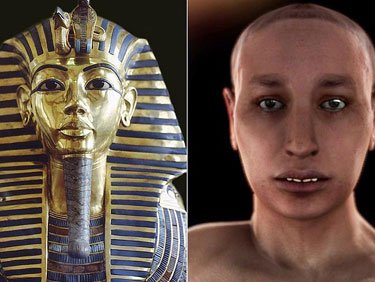
The golden burial mask of King Tutankhamun shows a young man with strong, idealized features: a strong jaw, full lips, high cheek bones, and a regal brow. Thanks to high-tech 3D imaging, reports the Daily Mail, the truth has finally been unwrapped, and it is far less pretty.
Tut underwent a “virtual autopsy,” with CT scans, genetic analysis, and over 2,000 digital scans used to generate a computer model of the pharaoh. Previous attempts to reconstruct Tut’s visage were fairly attractive, based on the theories that he had sustained facial injuries in a fatal chariot race crash or when he was murdered.
This new research not only indicates that Tut was born with the misshapen features and prominent overbite that he took to his grave at 19, but that he was physically unable to participate in chariot racing. (A fracture in Tut’s skull is now believed to have been sustained after his death.)
The boy king, the new science reveals, was sickly and crippled, with twisted, malformed hips. He suffered from epilepsy and malaria, and had to walk with a cane due to a club foot. It would have been impossible for him to stand in a fast moving chariot. So what was likely responsible for these deformities? Incest, which was not considered taboo in ancient Egypt. Genetic testing strongly indicates that King Tut’s parents were brother and sister, and Tut is known to have married his half-sister at the tender age of about 10.
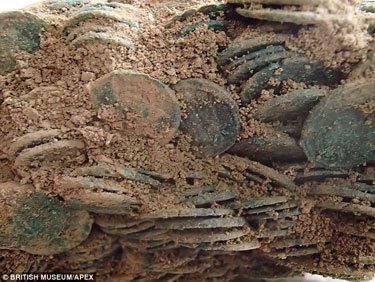
The Roman copper-alloy coins date back to between AD 260 and AD 348 and bear the images of Emperor Constantine, his family, co-Emperors and immediate predecessors and successors.
An amateur metal detectorist has unearthed one of the largest hoards of Roman coins ever found in Britain.
Laurence Egerton, 51, made the discovery as he explored land near Seaton, in East Devon – and he was so concerned someone would steal it, he camped out for three nights while archaeologists excavated the site.
Dubbed Seaton Down Hoard, the collection of 22,000 copper-alloy coins is thought to have been buried by a private individual or soldier for safe keeping, but was never recovered.
At the time the hoard was buried, it would have amounted to four gold coins, or solidi, which would have provided the ration of two soldiers for one year, or a worker’s pay for two years. …
‘The amount of money in this hoard would at some points have been the equivalent to a soldier’s total salary for two years; at other dates it would have bought the services of a skilled craftsmen for perhaps 80 days; it could buy maybe 1,000 or so pints of Gallic beer (or double quantities of Egyptian beer, which wasn’t so good) or enough grain to feed someone for two years or so.
‘If you try to turn any of those into modern figures, then, it’s clearly not the sort of fortune that would allow you to retire comfortably or buy a nice country estate; on the other hand, in a world where most people were living close to subsistence level and would have few if any savings, it’s pretty impressive that someone had amassed enough money to live on for a year or so.’
The Royal Albert Memorial Museum (RAMM) in Exeter, which already houses a large collection of local Romano-British objects, has launched a fundraising campaign to purchase the coins.
Mr Egerton originally made the discovery in November 2013, while operating under licence on private land near the previously excavated site of a Roman villa at Honeyditches in East Devon.
The coins were buried in a pit, and may have once been held in a bag, which did not survive.
The hoard was excavated by a team of archaeologists, and were cleaned so they could be identified by experts at the British Museum.
This headdress or crown was found on the head of a warrior buried with his sword and shield. It is made from two sheets of bronze held together with rivets. The bronze band which went around the head is decorated with La Tène-style patterns. The metal was worn directly on the head and not padded or strengthened with leather; when found impressions of human hair were left in the corrosion on the inner surface.
Also found in the grave were: an iron sword with bronze scabbard fittings and suspension rings for holding the sword on a belt; bronze parts from a wooden shield, and a bronze brooch decorated with applied coral studs.
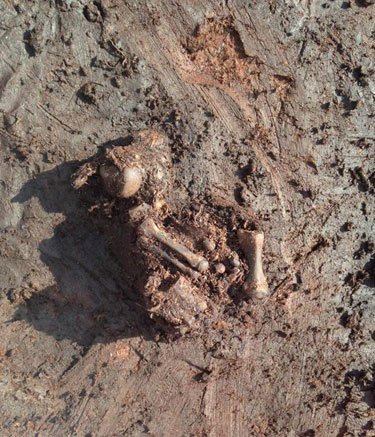
Utility workers discovered the lower leg bones of an adult in Rossan Bog. “The exact date of the remains is not known at this time but we will be conducting research in the coming months,†archaeologist Maeve Sikora of the National Museum of Ireland told The Irish Examiner. Two years ago, the remains of another adult, dubbed Moydrum Man, were found nearby. Those remains dated to between 700 and 400 B.C. “Every new find helps to bring us closer to understanding the lives and belief systems of our ancestors,†said Raghnall Ó Floinn, director of the National Museum of Ireland.
The Staffordshire Hoard is the largest hoard of Anglo-Saxon gold and silver metalwork yet found. Discovered in a field near the village of Hammerwich, near Lichfield, in Staffordshire, England, on 5 July 2009, it consists of over 3,500 items that are nearly all martial in character and contains no objects specific to female uses. The artefacts have tentatively been dated to the 7th or 8th centuries, placing the origin of the items in the time of the Anglo-Saxon kingdom of Mercia.
——————————-
My guess is that it is a handle for some sort of small personal tool or weapon. There is a pommel. The problems with my theory are that the grip shaft is very short and would have to have been made to be held between two fingers and the cup-shaped hilt is very delicate and fragile. Might it be the handle for one of those scrapers for erasing your mistake when you are scribing a manuscript?
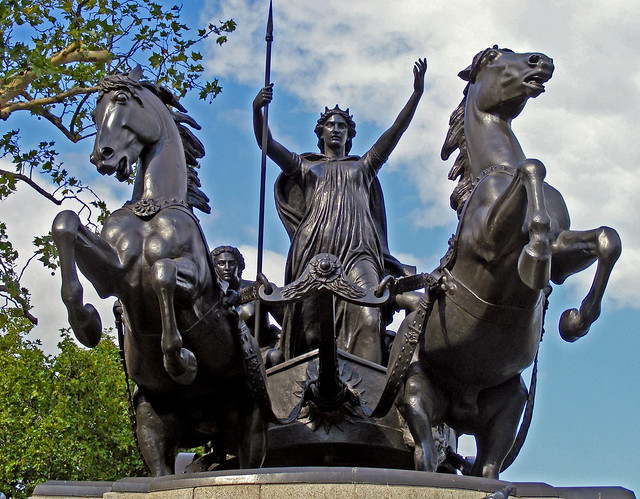
The hoard is believed to have been buried by Roman residents of Camulodunum circa A.D. 61, when the British Iceni tribe under their Queen Boadicea revolted against Roman rule and destroyed the city.
Gold and silver armlets, bracelets, rings and coins were found buried in the remains of a Roman house beneath Williams and Griffin in Colchester.
It is thought they were hidden by their wealthy owner in AD61, when Boudicca’s British tribes burnt down the town.
Colchester Archaeological Trust said it was a “remarkable Roman collection”.
The jewellery was found during renovation work at the shop, which is part of the Fenwick group and currently undergoing a £30m redevelopment.
Philip Crummy, the archaeological trust’s director, said it was discovered three days before the six-month dig was scheduled to end.
It was buried in a layer of red and black debris – the remains of burnt clay Roman walls – found under much of Colchester.
Three gold armlets, a silver chain necklace, two silver bracelets, a silver armlet, a small bag of coins and a small jewellery box containing two sets of gold earrings and four gold finger rings were unearthed by archaeologists.
The “quality” of the jewellery suggested its owner was a wealthy woman and had hidden the jewels to keep them safe from the enemy, Mr Crummy said.
“Boudicca and her army destroyed London and St Albans, though many of their inhabitants had time to escape. The townsfolk of Colchester were not so fortunate.
“They were not evacuated and endured a two-day siege before they were defeated.”
The jewellery has been taken to a laboratory for further examination and cleaning.
In July Mr Crummy’s team discovered human jaw and shin bones under the shop.
They are also believed to date from AD61 and were “likely to be the remains of people who died in buildings set on fire by the British as they overran the town”, Mr Crummy said.
The 1922 discovery of the tomb of the boy pharaoh Tutenkhamun dazzled the world with the precious artifacts and funeral goods found (which still regularly draw enormous numbers of visitors to exhibitions at museums around the world).
The deceased king was accompanied to the afterlife by two obviously personal favorite knives, both double-edged daggers in form, pretty close 3000-year-old equivalents of the Randall Model 2 Fighting Stiletto.
What is most interesting though is that King Tut’s personal daggers were made in the Bronze Age of other metals. One knife is made of gold, hardened with copper. The American custom knife-maker Buster Warenski (1942-2005) took it as a personal challenge and successfully completed in 1987 a replica. That project required five years of work and used 32 ounces of gold.
The second knife is made of iron, at a time in which the forging of primitive iron weapons was a new technology invented by the Hittites. Even in the future, when the Greeks would be besieging Troy, Achilles and the other heroes would still be armed with bronze swords and bronze-tipped spears. It’s good to be the king. Tutenkhamun possessed, and got to take with him into his tomb, the superb iron-bladed knife seen above. Modern analysis has determined that it was forged from meteoric iron, and though it lacked the complete rust-and-stain-resistance of the gold blade, it undoubtedly took a better edge and remained sharper longer. In 1300 B.C., iron would have been rarer and more expensive than gold. I think this knife may have been intentionally made with a ricasso, a flat, unsharpened area above the grip, which would allow the user to hold the blade farther forward for precision cutting.
Shieldmaidens are not a myth! A recent archaeological discovery has shattered the stereotype of exclusively male Viking warriors sailing out to war while their long-suffering wives wait at home with baby Vikings. (We knew it! We always knew it.) Plus, some other findings are challenging that whole “rape and pillage†thing, too.
Researchers at the University of Western Australia decided to revamp the way they studied Viking remains. Previously, researchers had misidentified skeletons as male simply because they were buried with their swords and shields. (Female remains were identified by their oval brooches, and not much else.) By studying osteological signs of gender within the bones themselves, researchers discovered that approximately half of the remains were actually female warriors, given a proper burial with their weapons.
[T]he study looked at 14 Viking burials from the era, definable by the Norse grave goods found with them and isotopes found in their bones that reveal their birthplace. The bones were sorted for telltale osteological signs of which gender they belonged to, rather than assuming that burial with a sword or knife denoted a male burial.
Overall, McLeod reports that six of the 14 burials were of women, seven were men, and one was indeterminable. Warlike grave goods may have misled earlier researchers about the gender of Viking invaders, the study suggests. At a mass burial site called Repton Woods, “(d)espite the remains of three swords being recovered from the site, all three burials that could be sexed osteologically were thought to be female, including one with a sword and shield,” says the study.
Various types of evidence have been used in the search for Norse migrants to eastern England in the latter ninth century. Most of the data gives the impression that Norse females were far outnumbered by males. But using burials that are most certainly Norse and that have also been sexed osteologically provides very different results for the ratio of male to female Norse migrants. Indeed, it suggests that female migration may have been as significant as male, and that Norse women were in England from the earliest stages of the migration, including during the campaigning period from 865.
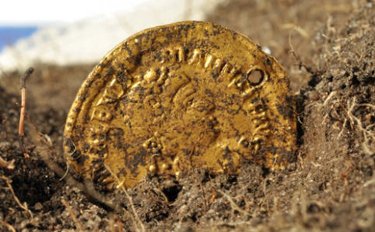
Most recently, a gold Roman solidus was discovered. The coin is thought to have been part of a looted hoard, dropped during the sack of the castle.
Although the sack of the fort and murder of its inhabitants occurred 1500 years ago, local memories cause residents of the fort’s vicinity still to shun the site. Archaeologist Helena Victor stated: “There are still memories 1,500 years later of these events, it’s a dangerous place. Parents tell their children that they can’t play there because it’s a dangerous place. They don’t remember the history but they remember it’s dangerous.”
Business Insider describes one of the North American finds strikingly resembling Solutrean tools from Western Europe, which suggest the possibility of some Paleolithic settlement of North America from Europe.
Most researchers believe the first Americans crossed the Bering Strait from Siberia about 15,000 years ago and quickly colonized North America. Artifacts from these ancient settlers, dubbed the Clovis culture after one of their iconic archaeological sites in Clovis, New Mexico, have been found from Canada to the edges of North America.
But in 1974, a small wooden scallop trawler was dredging the seafloor, about 230 feet (70 meters) below the sea surface and nearly 60 miles (100 kilometers) off the coastline in the Chesapeake Bay.
“They hit a snag, or a hang, as they like to say, which meant that something pretty heavy was in their net,” said Dennis Stanford, an archaeologist with the Smithsonian Institution in Washington, D.C., who has analyzed the find.
When they pulled up their net, they found the partial skull of a mastodon, a distant cousin of the woolly mammoth that began its slide into extinction about 12,000 years ago, Stanford said. The fishermen also noticed a flaked blade made of a volcanic rock called rhyolite.
The fisherman couldn’t lug the skull back to shore in their tiny wooden boat, so they sawed off the tusks and teeth, tossed the rest overboard and eventually handed portions to the crew as souvenirs. Capt. Thurston Shawn gave the remaining tusk portions, teeth and knife to a relative, who donated the remains to Gwynn’s Island Museum in Virginia. There they sat, unnoticed, for decades.
But while doing his doctoral dissertation, Darrin Lowery, a geologist at the University of Delaware, noticed the teeth and the tusk at the museum. …
By measuring the fraction of radioactive carbon isotopes (elements of carbon with different numbers of neutrons), the team found that the mastodon tusk was more than 22,000 years old.
There was no way to date the blade precisely, but the deft flint-knapping technique used to make it was similar to that found in Solutrean tools, which were made in Europe between 22,000 and 17,000 years ago.
Melting glaciers raised sea levels and submerged that area of the continental shelf about 14,000 years ago, so the knife must have been at least that old, Stanford added.
In addition, both pieces showed characteristic weathering that indicated they were exposed to the air for a while and then submerged in a saltwater marsh, before finally being buried in seawater.
That finding suggested that the two artifacts were possibly from the same environment — such as the marshes found between sand dunes that are often set back from the seashore. That would have been a perfect place for mastodons to find food, Stanford said.
“They like to chew on bushes and more rough shrubbery,” Stanford said.
To Stanford, Lowery and their colleagues, the discoveries suggest that people lived along the East Coast more than 14,000 years ago — potentially thousands of years before the Clovis culture emerged there. These first American colonizers may have even crossed the Atlantic Ocean from Europe, Stanford said.
More than five centuries after Christopher Columbus’s flagship, the Santa Maria, was wrecked in the Caribbean, archaeological investigators think they may have discovered the vessel’s long-lost remains – lying at the bottom of the sea off the north coast of Haiti. It’s likely to be one of the world’s most important underwater archaeological discoveries.
“All the geographical, underwater topography and archaeological evidence strongly suggests that this wreck is Columbus’ famous flagship, the Santa Maria,†said the leader of a recent reconnaissance expedition to the site, one of America’s top underwater archaeological investigators, Barry Clifford.
“The Haitian government has been extremely helpful – and we now need to continue working with them to carry out a detailed archaeological excavation of the wreck,†he said.
So far, Mr Clifford’s team has carried out purely non-invasive survey work at the site – measuring and photographing it.
Tentatively identifying the wreck as the Santa Maria has been made possible by quite separate discoveries made by other archaeologists in 2003 suggesting the probable location of Columbus’ fort relatively nearby. Armed with this new information about the location of the fort, Clifford was able to use data in Christopher Columbus’ diary to work out where the wreck should be.
[The] team found and photographed the wreck 10 years ago, but did not realize what it was until recently, the paper reported.
The Santa Maria ran into a reef off the coast of Haiti with Columbus aboard, forcing him to build a small settlement for his crew — the first European settlement in the Americas since the Vikings’ 11th century village in Newfoundland.
He named it La Navidad — Christmas — and then returned to Spain on the Nina, leaving behind 39 crew members unable to fit on the ship.
The third ship, the Pinta, was separated from the other two at the time.
One year later, Columbus returned with 17 ships and some 1,200 men, but the settlement had been burned and no one remained. (This Smithsonian article has more on La Navidad.)
The 2003 discovery of the possible ruins of La Navidad led Clifford to the current location off the coast, where he re-examined the wreck that had been found by his team. He says the size and location in relation to the ruined fort match what he’d expect from the Santa Maria.
“I am confident that a full excavation of the wreck will yield the first ever detailed marine archaeological evidence of Columbus’ discovery of America,” Clifford was quoted as saying.
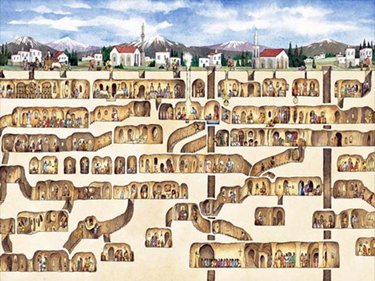
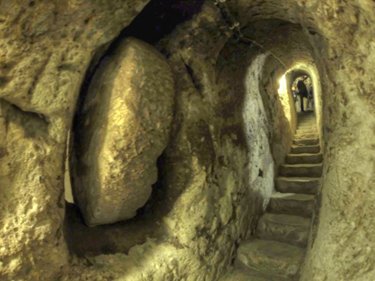
Welcome to Derinkuyu, an underground city that once housed up to 20,000 people. In the Cappadocia region, famous for its cave dwellings and underground villages, Derinkuyu stands out for sheer size and complexity. Locals began digging in the 500s BCE. The city consists of over 600 doors, each of which can be closed from the inside. Each floor could be closed off as well. And just to make attacking completely impossible, the entire city was deliberately built without any logic. Its maze-like layout makes navigating the city nightmarish for unfamiliar invaders.