Category Archive 'Archaeology'
27 Mar 2014
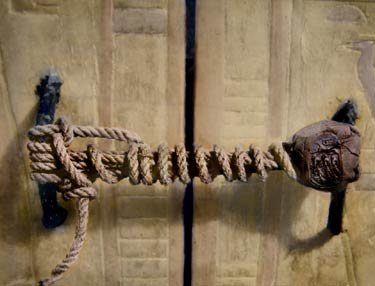
Knot tied in 1323 B.C., sealing the doors of Tutankhamun‘s tomb, discovered 1922.
Hat tip to Vanderleun.
12 Feb 2014


It seems that, either on land in Gaza or under the sea nearby, last summer, some ignorant and greedy barbarians came into possession of an unusually intact and highly artistically significant Hellenistic bronze statue of Apollo. Reports differ, but apparently the priceless statue was briefly being offered on Ebay for $500,000, probably only a fraction of its actual value. Its finder, we are told, chopped off a few fingers for testing, thinking that the statue might be gold. Police representing the Palestinian authority, Hamas, subsequently seized the statue, and it has disappeared.
We can only hope that the nearby civilized state of Israel will take steps to secure possession of this important art object on behalf of the rest of the nations of the West.
Businessweek, January 30th: The Apollo of Gaza: Hamas’s Ancient Bronze Statue
The Guardian, February 10th: ‘Priceless’ bronze statue of Greek god Apollo found in Gaza Strip — Hamas officials seize statue after it appears on eBay — Doubt cast on fisherman’s claim to have found item in sea
Businessweek, February 10th: New Details Emerge in Mystery of Bronze Apollo Held by Hamas
The Verge, February 11th: Ancient statue of Greek god Apollo discovered in Gaza strip
Hat tip to Karen L. Myers.
08 Feb 2014
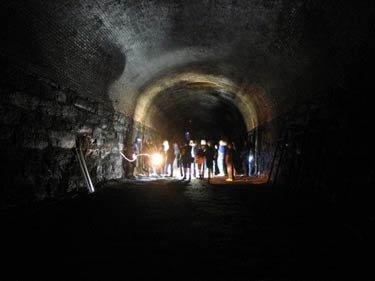
Cornelius Vanderbilt built NYC’s first subway in 1841 in order to bring steam locomotives carrying Long Island Railroad passengers from Brooklyn into Manhattan wile bypassing the traffic-filled Court Street and Atlantic Avenue intersection underground. As the Verge notes: “The Atlantic Avenue Tunnel holds the Guinness world record for “oldest subway tunnel,” predating the Tremont Street subway in Boston from 1897, the 312-foot Beach Pneumatic Transit tunnel in Manhattan from 1869, and the first subway in the London Underground, which was built in 1863.”
Walt Whitman memorialized the tunnel’s closure in 1861 (after Brooklyn banned steam locomotives within its city limits): “The old tunnel, that used to lie there under ground, a passage of Acheron-like solemnity and darkness, now all closed and filled up, and soon to be utterly forgotten, with all its reminiscences.”
Reputedly, the 1611-foot-long tunnel was reopened decades later for growing mushrooms, and used during Prohibition for boot-legging, but it had remained closed and forgotten for many, many years when Bob Diamond, a local amateur archaeologist, persuaded the Brooklyn Union Gas Company to open one of its manholes and allow him to explore.
Diamond broke through a concrete wall and constructed his own staircase giving access to the tunnel, and operated his own small-scale business for 30 years, taking people (through the original man-hole) on tours of the historic tunnel.
At the end of 2010, however, jealousy of somebody else making a dollar out of an asset over which they could claim control provoked the city authorities to shut down Diamond’s tours, closing off access to the historic tunnel permanently, on the basis of safety concerns. (No one had been injured in the course of 30 years of Diamond’s operations.)
There is a bit more at Atlas Obscura.
Hat tip to Fred Lapides.
21 Dec 2013

Dr. Yonatan Sahle, leader of a team who found stone tools older than expected, stands in front of an outcrop where artifacts were found.
Motherboard Vice:
Ancient stone-tipped javelins found in Ethiopia have scientists raising eyebrows thanks to an odd dating conundrum. The javelins were recently carbon-dated to around 280,000 years ago. Pretty old, right? There’s only one problem:​ The earliest fossils of modern Homo sapiens are from around 195,000 years ago. With an 80,000 year gap, you have to ask: Who made them?
The discovery could mean one of two things: that our species is much older than archaeologists once thought, or, more likely, that another species before us was intelligent enough to make and use these kind of projectile weapons
Read the whole thing.
Hat tip to Fred Lapides.
07 Dec 2013

Gazeta Krakowska has the story of the recent discovery of a medieval sword in southeastern Poland by a high school student.
(roughly translated by me)
During a Sunday walk with his dad and his Bernese dog along the banks of the Dunajec River, 17-year-old Piotr Warzała made a surprising discovery. He found in the river a very well preserved sword from the Middle Ages. The river was unusually shallow , and in a place where water once flowed, there was now a small beach. They went down to it during their walk.
Immediately, he caught sight of a round objerct projecting about 10 centimeters above the ground covered with mud. It proved to be the pommel of the handle of a sword 1.2 meters [3.9 feet] in length. The boy took the unusual discovery home and wrapped it in a sheet to bring to the city of Tarnow, to the local office of the National Service for the Protection of Monuments.
Peter’s rational and praiseworthy action made it possible to document and map the location where the sword was found as new archaelogical site, said Andrzej Cetera , Head of the Office for the Protection of Monuments.
The teenager’s behavior was exemplary and a proposal is being prepared requesting that the Ministry of Culture and National Heritage reward the boy with a diploma of commendation, and also with a financial reward, not exceeding 5% of the average salary, he said.
It is not only his opinion that finding this sword is worth a reward. There are in the collections of the department of archeology and museums about ten medieval swords, but this one is unique because of its unusually well-preserved handle and hilt, says Andrzej Szpunar from the District Museum.
On Friday, the sword was exhibited in Tarnow to researchers from Warsaw specializing in the period of the Hussite Wars, who were very impressed with our latest acquisition, reported Agnieszka Kukułka of the department of archeology .
After detailed documentation is completed, the sword will ​​probably next week be taken to Glogau, where it will undergo conservation by specialists, which may take up to six months. It is possible that it will seen again in the Tarnów museum in all its glory later this year.
It is impossible to tell how the sword came to be lost in Biskupice Radłowskie or to whom it belonged. Perhaps, it was the property of one of the knights who fought at the Battle of Grunwald.
“I am glad that in this small way I could contribute to the preservation of such traces of the past. Just knowing this is a great reward for me.” said Piotr WarzaÅ‚a, day student of the first class at the Szczepanik school in Tarnow.
04 Nov 2013

Tuthankamun’s mummy caught fire in his casket after embalming.
Scientists haven’t confirmed the reality of the mummy’s curse, but they have got new information of Tutankhamun’s death (of injuries inflicted by a high-speed chariot crash), and they have additionally concluded that a poor job of embalming caused the pharaoh’s mummy to catch fire via spontaneous combustion.
Daily Mail.
08 Oct 2013

Judean date palm seeds
Treehugger had a very cool item:
For thousands of years, Judean date palm trees were one of the most recognizable and welcome sights for people living in the Middle East — widely cultivated throughout the region for their sweet fruit, and for the cool shade they offered from the blazing desert sun.
From its founding some 3,000 years ago, to the dawn of the Common Era, the trees became a staple crop in the Kingdom of Judea, even garnering several shout-outs in the Old Testament. Judean palm trees would come to serve as one of the kingdom’s chief symbols of good fortune; King David named his daughter, Tamar, after the plant’s name in Hebrew.
By the time the Roman Empire sought to usurp control of the kingdom in 70 AD, broad forests of these trees flourished as a staple crop to the Judean economy — a fact that made them a prime resource for the invading army to destroy. Sadly, around the year 500 AD, the once plentiful palm had been completely wiped out, driven to extinction for the sake of conquest.
In the centuries that followed, first-hand knowledge of the tree slipped from memory to legend. Up until recently, that is.
During excavations at the site of Herod the Great’s palace in Israel in the early 1960’s, archeologists unearthed a small stockpile of seeds stowed in a clay jar dating back 2,000 years. For the next four decades, the ancient seeds were kept in a drawer at Tel Aviv’s Bar-Ilan University. But then, in 2005, botanical researcher Elaine Solowey decided to plant one and see what, if anything, would sprout.
“I assumed the food in the seed would be no good after all that time. How could it be?” said Solowey. She was soon proven wrong.
Amazingly, the multi-millennial seed did indeed sprout — producing a sapling no one had seen in centuries, becoming the oldest known tree seed to germinate.
Today, the living archeological treasure continues to grow and thrive; In 2011, it even produced its first flower — a heartening sign that the ancient survivor was eager to reproduce.
24 Sep 2013

Boo hoo! Human economic development is ravaging the precious Amazon rain forest. Except, wait a moment, clearing rain forest vegetation is making it clear that people had cleared the same land centuries ago, cities, systems of irrigation, an entire unknown civilization once existed covering huge areas that have since been buried by the jungle.
In the academic journal Antiquity: Pre-Columbian geometric earthworks in the upper Purús: a complex society in western Amazonia.
The combination of land cleared of its rainforest for grazing and satellite survey have revealed a sophisticated pre-Columbian monument-building society in the upper Amazon Basin on the east side of the Andes. This hitherto unknown people constructed earthworks of precise geometric plan connected by straight orthogonal roads. Introducing us to this new civilisation, the authors show that the ‘geoglyph culture’ stretches over a region more than 250km across, and exploits both the floodplains and the uplands. They also suggest that we have so far seen no more than a tenth of it.
03 Sep 2013
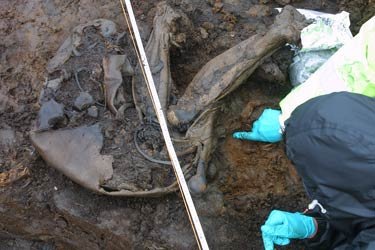
Live Science reports on the fairly recently (2011) found Cashel Man bog body.
A resident of central Ireland’s County Laois came across the well-preserved “Cashel Man” — named for the bog he was found in — while milling for peat moss, which is used for a variety of farm purposes, including animal-bedding and field conditioning.
Having realized that he had come across a human body, the resident notified archaeologists at the National Museum of Ireland, who later conducted a formal excavation of the site. A summary of the dig appeared in the latest edition of the Irish journal Ossory, Laois, and Leinster.
“All that was visible to start with was a pair of legs below the knees, and a torso,” Eamonn Kelly, an archaeologist at the National Museum and lead excavator of the project, wrote in the report. “The body appeared to be naked. Later, it was possible to work out that the torso had been damaged by the milling machine, which also removed the head, neck and left arm.”
The team calculated the age of the body using radiometric carbon dating, in which the constant decay rate of radioactive carbon-14 is used to estimate age based on remaining levels of carbon-14 in the dead tissues. Surprised to find the body was roughly 4,000 years old, the team dated the peat above and below the body to confirm the results, and came up with about the same age. Previously, the oldest bog body ever found in Ireland was 1,300 years old, according to the Irish Times.
The team conducted computed tomography (CT) scans of the body after the dig, and found that the young man’s arm and spine had been broken multiple times, seemingly from sharp blows before his death.
The researchers also found cuts along the man’s back that looked like ax wounds. They uncovered axes capable of producing such wounds within the vicinity of the site.
Given this evidence of brutality, the team concluded that the young man had been killed in a ritual sacrifice, a practice commonly known in later eras, but not well documented in the Early Bronze Age of 2000 B.C., about the time this bog body would’ve lived.
“All the indications are that the human remains from Cashel Bog tell of the fate of a young king who, through folly or misadventure, was deemed to have failed to appease the goddess on whose benevolence his people depended, and who paid the ultimate price,” Kelly wrote.
10 Jun 2013

Late Bronze Age sacrificial pit: three murdered people and the head of a cow
Scienceblogs:
From British Archaeology #131 (July/August): [There was] a Wessex Archaeology dig in 2004-05 at Cliffs End farm in Thanet, a piece of north-east Kent that was an island up until the 16th century when silting finished connecting it to mainland England. What we’re dealing with here is ritual murder, some pretty strange disposal of the dead and ancient Scandinavian migrants. …
[It went] on for 800 years, well into the Middle Iron Age about 200 cal BC. A three-century hiatus during the Early Iron Age, I speculate, may be covered by the part of the feature that hasn’t been excavated.
At least 24 people end[ed] up in sacrificial pits between 1000 and 800: males and females, ages 6 to 55. One large pit sees the following sequence (image above):
1. Redeposited human bones and two new-born lambs
2. Woman over 50, killed by sword blows to the back of the head
3. Another pair of lambs
4. Cow’s head, two children and a teenage girl
5. Cattle foot and bag containing dismembered man, 30-35
6. More redeposited bones from people who died before the pit was dug …
Iron Age practices in the sacrificial pit complex are less intense and intricate: over a period of three centuries, eight people get buried whole and seven disarticulated bone bundles are deposited. One young man is buried on top of half a horse. The bone bundles bear signs of scavenging by dogs.
Who were these people then? Could anybody at Cliffs End get roped in for sacrifice and be denied respectful burial at the whim of the local druid? …
Andrew Millard of Durham University analysed all suitable teeth from 25 individuals. Here’s the geographical breakdown of the sacrificial victims’ area of origin:
36% local
32% southern Norway or Sweden
20% western Mediterranean
12% indeterminate
The reason that you do more than one tooth from the same individual is that teeth form in sequence during gestation, childhood and adolescence. If you move or change your diet during that period, this shows up in the isotope ratios of whatever tooth your body is making at the time. This gave particularly interesting results in the case of an old woman whose disarticulated skull was redeposited in the Late Bronze Age charnel pit discussed above. She was born in Scandinavia, moved to northern Britain as a child, lived a long life and finally ended up as a prop in a religious ritual on Thanet.
More than half of the victims are foreigners. And though more than a third are locals, we don’t know if their parents were locals as DNA hasn’t been done yet. Who travels like this in the 1st millennium BC? Certainly not tourists. Traders do travel, but for a community dependent on long-distance bronze deliveries, it would not be a sustainable strategy to ambush and kill the traders – never mind that these were in all likelihood well organised and armed. My guess is that we’re dealing with slave raiding and slave trade. Goods travelled, and one valuable commodity was slaves. All valuable commodities were appropriate as sacrifices to the gods when that time came.
In the case of the well-travelled old woman, I imagine her being taken from her tribe in southern Norway by Scottish slave raiders, growing up in Scotland, and then being traded on maturity to a Kentish tribe with odd religious practices. She probably gives birth to more slaves there (perhaps a few of the recovered individuals with local isotope signatures) and lives most of her adult life at Cliffs End. Not as a member of the clan, but as property of a clan member. And then comes that final Beltane feast out by the barrows.
03 Apr 2013
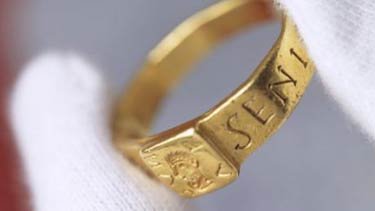
A Roman ring, found in a farmer’s field (presumably part of what was once the Roman town Calleva Atrebatum) near Silchester, Hampshire in 1785 in some unknown manner wound up preserved in the library of The Vyne, a stately 16th century home belonging (until 1958, damn Socialism!) to the Chute family.
The ring bears an image of Venus and a Latin inscription. That inscription apparently connects the ring to a Latin curse tablet found by Sir Mortimer Wheeler in an excavation of a temple complex associate with the god Nodens at Lydney Park in Gloucestershire.
The lead curse tablet read:
DEVO NODENTI SILVIANVS ANILVM PERDEDIT DEMEDIAM PARTEM DONAVIT NODENTI INTER QVIBVS NOMEN SENICIANI NOLLIS PETMITTAS SANITATEM DONEC PERFERA VSQVE TEMPLVM DENTIS
For the god Nodens. Silvianus has lost a ring and has donated one-half [its worth] to Nodens. Among those named Senicianus permit no good-health until it is returned to the temple of Nodens.
Sir Mortimer Wheeler in 1929 apparently consulted with J.R.R. Tolkien at Oxford about the natural hypothesis that the Silchester ring, with the inscription “SENI???”, might be the very same ring Silvianus had lost.
Tolkien took an interest in the matter, visited the Gloucestershire temple complex several times, and made a point of looking into the etymology of the name of the god Nodens.
It is believed today that it was this real world story of a lost, and very improbably rediscovered, gold ring, bearing an inscription, and weighted with a curse that may very well have been the inspiration of the One Ring featured in The Hobbit which appeared in 1937.
In any event, the Silchester ring is now being put on display by the combined efforts of the Tolkien Society and the National Trust in a newly-established “Ring Room” in The Vyne.
BBC story
The Register
National Trust page
18 Mar 2013

Sampson Strong, Cardinal Wolsey, 1610, Christ Church College, Oxford.
The Telegraph reports that the successful search for Richard III’s remains is prompting the city fathers of Leicester to promote a search for another lost burial, that of Cardinal Thomas Wolsey.
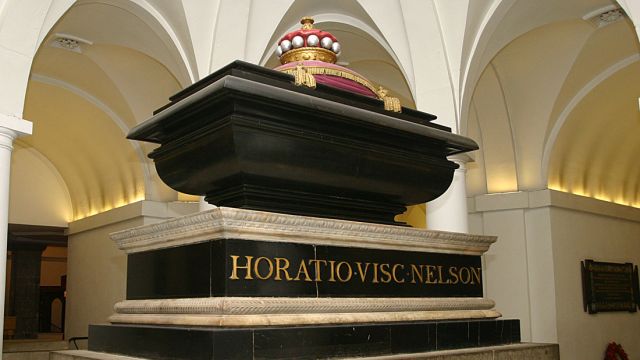
Wolsey, a great builder, had arranged for himself a magnificent black sarcophagus in the crypt of St. Paul’s Cathedral, but his failure to procure Henry VIII the annulment of his marriage to Catherine of Aragon led to Wolsey’s downfall, the confiscation of his properties, and finally to his arrest for treason. He was lucky enough to expire in Leicester of natural causes en route to London for his trial and inevitable execution. Wolsey was consequently buried in the same Leicester Abbey as Richard III, without a monument. The grand sarcophagus eventually went to a more worthy occupant: naval hero Lord Nelson.
City councillor Ross Willmott said: “The discovery of Richard III is wonderful news, yet there remains something of a mystery about what happened to Wolsey, who rivaled Henry VIII in wealth and power and was one of the most significant political figures of the era.
“Arguably, he is far more influential than Richard III. To discover his remains would help tell the story of another historic figure linked to the city.”
“There have been digs over the years to try to find him but they have not succeeded. I would like another go.
“It would bring more tourists to the city and further excite the interest in history and archeology that we are now seeing.”
The churchman, Henry VIII’s Lord Chancellor, died at the town’s abbey, the ruins of which can be seen from the city centre, while travelling to London after being accused of treason when he failed to secure the annulment of the king’s marriage to his first wife Catherine of Aragon.
He served as royal chaplain to Henry VII, who seized the throne after Richard was killed at the Battle of Bosworth in 1485.
It is likely he was buried with great ceremony at the abbey but historians think his tomb was destroyed later in Henry VIII’s reign, when abbeys were dissolved in the late 1530s after England’s split with the Catholic Church.
Attempt to locate Wolsey’s remains during digs in 1820 and again in the 1930s drew blanks.
However, Leicester Civic Society chairman Stuart Bailey said: “His bones may have been scattered and any remnants destroyed, but for years they said that about Richard III.
“I think it would be marvellous to have another look. It was a great fluke that Richard was found but we know Wolsey was buried in the Lady Chapel of the abbey church, which is not all that big.”
Your are browsing
the Archives of Never Yet Melted in the 'Archaeology' Category.
/div>

Feeds
|