Chinese construction firms can 3-D print 10 low-cost houses a day with machines that add layer after layer of quick-drying cement in a process called “contour crafting”.
A private company in east China recently used a giant printer set to print out ten full-sized houses within just one day.
The stand-alone one-story houses in the Shanghai Hi-Tech Industrial Park look just like ordinary buildings. They were created using an intelligent printing array in east China’s city of Suzhou.
The array consists of four printers that are 10 meters wide and 6.6 meters high and use multi-directional automated sprays. The sprays emit a combination of cement and construction waste that is used to print building walls layer-by-layer.
Ma Yihe, the inventor of the printers, said he and his team are especially proud of their core technology of quick-drying cement. Ma said he hopes his printers can be used to build skyscrapers in the future.
This technology allows for the printed material to dry rapidly. Ma has been cautious not to reveal the secrets of this technology.
Francis Frith, Photograph: Batalha, Portugal, mislabeled “Capela Imperfeita [Unfinished Chapel],” actually Main Portal of the Mosteiro de Santa Maria da Vitória [Monastery of St. Mary of Victory], photographed between 1850 and 1880, whole-plate albumen print from wet collodion glass negative, Victoria & Albert Museum.
My personal version of OCD makes me research and identify striking unknown Tumblr images which come to my attention.
The Monastery of Batalha (Portuguese: Mosteiro da Batalha), literally the Monastery of the Battle, is a Dominican convent in the civil parish of Batalha, in the district of Leiria, in central region of Portugal. Originally, and officially known, as the Monastery of Saint Mary of the Victory (Portuguese: Mosteiro de Santa Maria da Vitória), it was erected in commemoration of the 1385 Battle of Aljubarrota, and would serve as the burial church of the 15th-Century Aviz dynasty of Portuguese royals. It is one of the best and original examples of Late Gothic architecture in Portugal, intermingled with the Manueline style.
The convent was built to thank the Virgin Mary for the Portuguese victory over the Castilians in the battle of Aljubarrota in 1385, fulfilling a promise of King John I of Portugal. The battle put an end to the 1383-1385 crisis.
It took over a century to build, starting in 1386 and ending circa 1517, spanning the reign of seven kings. It took the efforts of fifteen architects (Mestre das Obras da Batalha), but for seven of them the title was no more than an honorary title bestowed on them. The construction required an enormous effort, using extraordinary resources of men and material. New techniques and artistic styles, hitherto unknown in Portugal, were deployed.
Work began in 1386 by the Portuguese architect Afonso Domingues who continued till 1402. He drew up the plan and many of the structures in the church and the cloister are his doing. His style was essentially Rayonnant Gothic, however there are influences from the English Perpendicular Period. There are similarities with the façade of York Minster and with the nave and transept of Canterbury Cathedral.
He was succeeded by Huguet from 1402 to 1438. This architect, who was probably from Catalonian descent, introduced the Flamboyant Gothic style. This is manifest in the main façade, the dome of the square chapter house, the Founder’s Chapel, the basic structure of the Imperfect Chapels and the north and east naves of the main cloister. He raised the height of the nave to 32.46 m. By altering the proportions he made the interior of the church even seem narrower. he also completed the transept but he died before he could finish the Imperfect Chapels. …
The portal shows in the archivolt a profusion of 78 statues, divided over six rows, of Old Testament Kings, angels, prophets and saints, each under a baldachin. The splays on both sides display (inferior copies of) statues of the apostles, with one standing on a chained devil. The tympanum shows us Christ enthroned, sitting under a baldachin and flanked by the Four Evangelists, each with his own attribute.
Designed by Stanford White in 1904, the Italian Renaissance Revival palazzo-style Gorham Building at 390 Fifth Avenue at West 36th Street in New York.
The vertical grandiosity of the Gorham building proved a tremendous hit, and it was copied again and again all over the United States in the course of the next couple of decades.
Shorpy’s yesterday posted this photo of the Columbus Savings & Trust, built 1905.
I’m personally familiar with this style because the tallest downtown building in my hometown of Shenandoah, Pennsylvania was the Stief Drugstore Building, at the northeast corner of Main & Centre, built in the 1920s as the Shenandoah Trust Building. They tore it down in the 1970s.
I know similar buildings used to stand in Pottsville and Reading, Pennsylvania. How many more examples can readers add?
43 Hillhouse Avenue, built for Henry Farnum by architect Russell Sturgis in 1871. Victorian features were removed in 1934. It has been the home of Yale’s presidents since 1937.
If the US Department of Defense ever finds itself falling short on its spending goals, if it ever can’t find enough $750 toilet seats and $450 claw hammers to buy, DOD procurement specialists can just call up the geniuses running Yale University and ask them to lend a hand with some building or renovation project.
Building the truly verdant green Kroon Hall, erected as a kind of Taj Mahal shrine to environmentalism that cleans its own water with aquatic plants, cost only $501 a square foot. In the recent renovation, including fixing plaster, installing a “state of the art” security system, changing over from steam-heat to hot water, and generally tidying up, the stately mansion on Hillhouse Avenue in New Haven, once called “the most beautiful street in America” by Charles Dickens, provided for the use of the university’s president, Yale managed to spend $810 a square foot, a total of $17,000,000!
If we assume that Yale tuition and room and board is running something like 60 grand per annum these days, that means Yale could have given 283 and 1/3 students, more than half the population of one of Yale’s 12 residential colleges, a free year of college for what all this cost. The mind boggles.
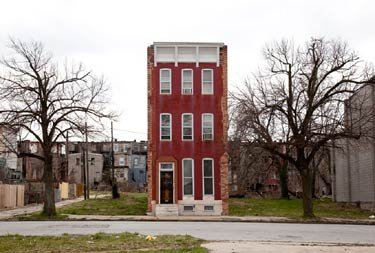
According to an article in the Baltimore Sun, there are roughly 16,000 vacant homes in Baltimore that the city plans to restore or destroy to replace with green spaces and housing redevelopment over the next 10 years. Many of the homes to be torn down are row homes, built in the late 1800s.
Photographer Ben Marcin lives in a Baltimore row house with his wife, Lynn. Several years ago, Marcin, a self-taught photographer who bought his first camera at 27, began noticing lone row houses in the blighted sections of the city. “For me it was a fascinating sight: a solitary structure, well over 100 years old, sometimes 40 feet tall and less than 20 feet wide,†he wrote via email. “An amputee shorn of its former neighbors, yet still retaining architectural details and other touches, proclaiming the heights of an earlier era.â€
August 1940. “Old house in Upper Mauch Chunk, Pennsylvania. In the background is East Mauch Chunk.” Photo by Jack Delano.
Mauch Chunk, renamed as Jim Thorpe in 1953 in an outrageous feat of Babbitry, is the county seat of Carbon County. Described as “the Switzerland of Pennsylvania,” the town lies at the eastern edge of the Anthracite Mining region. Four Molly Maguire terrorists were hanged there in 1876.
Upper Mauch Chunk is distinguished by its proximity to a mountain ridge where rock hounds can find carnotite, a radioactive mineral containing uranium. Guess how I know that.
I’ve always had a personal weakness for old, decayed houses, and for the gingerbread Victorian ornamentation found on small town Pennsylvania houses.
Pacific Standard gets the scoop from Sebastian Acker and Phil Thompson, who traveled to China to document the Copy Town phenomenon in a new book.
Hallstatt, Austria, is in China. So is the Eiffel Tower, the Taj Mahal, Christ the Redeemer, and a soon-to-be-completed Manhattan. There are others, too, and it’s all part of this weird (at least to us Westerners, or this one Westerner who is writing this) proliferation of what are being called “copy towns.†They’re villages and buildings and cities in China that are being constructed as replicas of non-Chinese places from around the world—and people are living in them. Hallstatt, China, has an artificial lake, and they imported doves to make it more Hallstatt-like. …
There are many different reasons as to why these towns exist. No one reason seems to be fully responsible, rather it is culmination of many different circumstances. One of the main reasons is China’s developing middle and upper classes; a significant portion of people have become very wealthy, very quickly, and these people want a way to showcase their wealth. They are allowed to do so in modern China, but under the Mao regime public shows of wealth would not have been possible. However, given China’s recent history, it does not have a societal model for prosperity. Under Mao, class divisions were squashed and declarations of wealth were not usually allowed, and so they have turned to the West for ways in which to display their new-found fortunes. This adoption of Western styles may be an attempt to pick up an already established ready-made social attitude.
Another reason for the towns could be the huge building bubble that is taking place in China. Vast numbers of new buildings are being built, many of which have never been filled. In order to attract residents to their developments, the construction companies may be creating copy towns so that they stand out amongst the myriad buildings opening every day. Ironically, it is their copied nature that makes them unique in the market.
But generally China has a long history of copying, especially within architecture and the arts. For centuries the emperors would replicate lands that they had conquered within their own palace gardens. These constructs would often include fauna and plants from the conquered regions. This ability to replicate and maintain the distant land demonstrated the emperor’s control over the original region.
Then there is also China’s desire to replicate the West and become a first-world country. A lot of Chinese people look up to the West as an ideal, so the construction of these towns could be seen as a way of accelerating their progress; a quick way of achieving through emulation.
Thamestown: “a new town in Songjiang District, about 30 kilometres (19 mi) from central Shanghai, China. It is named after the River Thames in England. The architecture is themed according to classic English market town styles. There are cobbled streets, Victorian terraces and corner shops.”(photo: triplefivechina.)
My wife Karen forwarded to me the other day Gizmodo’s story on a dry nook in the middle of a pond in Vöcklabruck, Austria, and it is certainly an eye-catching and amusing architectural gimmick.
The interesting coincidence is the location.
Vöcklabruck, in Upper Austria is my family’s ancestral home.
They were first recorded under the surname “Buchhaim,” which later became corrupted into Puchhaim and finally Pöchner. (Zienkiewicz came later.)
Seibmacher writes:
Über die Heimat der Pöchner ist nichts verlässliches bekannt. Während einige dieselben aus Schottland stammen lassen, wieder andere Steiermark als ihre Heimat nennen, kommen selbe zu Anfang des. 12. Jahrhunderts bereits in Salzburg vor, von wo sie sich nach Oberöstereich in die Gegend von Vöcklabruck wandten.
(translation:)
Concerning the homeland of the Pöchners there is no reliable information. According to some they originally emigrated from Scotland, but different sources call the Steiermark their homeland. From the beginning of the 12th Century onward they were in Salzburg, from whence they went to Upper Austria to the vicinity of Vöcklabruck.
The theory proposed by the former sources is that Buchhaim-Puchhaim-Pöchner surname comes actually from the Scottish Buchan, and that some Comyns related to the Norman Comyns who inherited via a Celtic maternal line the Scottish Earldom of Buchan moved to Austria.
This would be a plausible story if the emigration occurred in the years between 1306 and 1314 when the Comyns lost the struggle for power and the throne of Scotland to the Bruces, but the Pöchners are already in Austria two centuries earlier.
Below is the Pöchner coat of arms, which the heraldically-knowledgeable will perceive at once represents a simple reversal of the tinctures of the arms of Austria, i.e. of the Babbenburg Dukes of Austria, acquired by Leopold V (“Luitpold der Tugendhafte,” Leopold the Virtuous) in the course of the 1191 Siege of Acre.
Leopold’s arms consisted of “Gules, a fess Argent” because in the course of the fighting his tunic had become completely covered with blood except for a white band which had been covered by his belt.