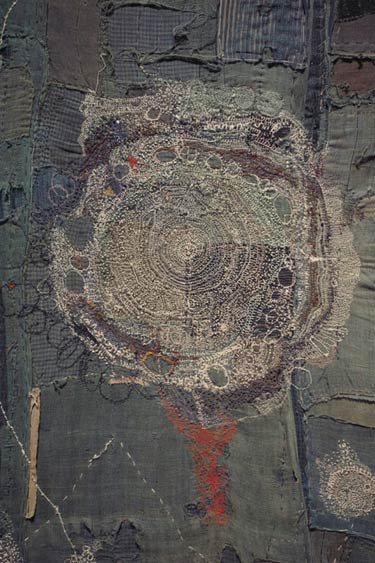
Seeing the above extraordinary image on Ka-Ching!, I was puzzled. Was this a strikingly interesting patch on a pair of blue jeans? some new kind of Amish quilt-making? Maybe I was looking at it wrong. Perhaps it was really some culture on a microscope slide. Or maybe it was some kind of geologic feature seen from Outer Space. No, it really did look like embroidery… What in hell was going on here?
So I looked and looked, and I found that this is a photograph of a piece of fibre art by the Japanese artist Junko Oki. She calls her work Woky Shoten, which name apparently refers to the “free movement of the line to make a simple repetition of workâ€, and relates to her grandfather’s memories.
She published a book in 2011 in which she describes her artistic vocation (quoted by Julie B. Boot):
(translation by Toshiaki Komuro)
Poesy
I have always dreamed of becoming a poet.
It is still my dearest wish.
Upon seeing one of my works one woman had tears in her eyes.
I had never come upon such a scene before.
What had made her cry?
“That is the power of poetry,†said a wise friend.
“You have become a poetâ€
When I have needles, threads, and other special materials in front of me, something stirs deep inside my unconscious mind in spite of myself,
and I am filled with strong emotion.
That is when I regain my true self.
When I was afraid to move forward,
I came upon a book of paintings by Antoni Tapies.
When I chant his name, I feel fully armored, even with a dagger in my belt.
In an instance I know clearly which way to go and I will my legs to move forward.
The joy of meeting and the sorrow of separation
have given me strength and courage.
Another day, another walk, I will resume my steps.
I will always be myself as a willow tree is true to its nature.
I will make today another good day.
July 2011
Junko Oki
————————————————
Poesy can apparently be ordered from the author via mmtukj@nifty.com.
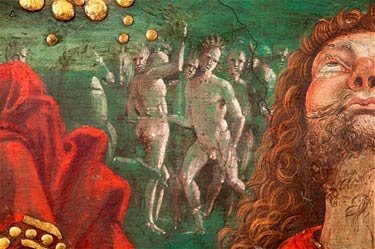
Bernardino di Betto, called Pintoricchio or Pinturicchio, Detail from The Resurrection, 1494, Musei Vaticani
Restoration of a painting of the Resurrection of Christ by Pinturicchio, commissioned by Pope Alexander VI to ornament his Papal apartments found that the painting’s background features “nude men, who are decorated with feathers and seem to be dancing.”
Antonio Paolucci, the director of the Vatican Museums, announced that these figures have been recognized as representations of Native Americans which were painted on the basis of their description by Christopher Columbus in 1494, in the direct aftermath of his first voyage of discovery to the New World.
The painting had been long neglected because of the unsavory character of Rodrigo Borgia (Alexander VI). Subsequent popes closed and abandoned his apartments, which were only re-opened for the first time after his death in 1503 in 1889 by Pope Leo XIII.
Carving of a head inv. 30001, Mammoth ivory/bone, c.26,000 years old, Provenance: Archaeological excavation 1936 Dolnà Věstonice.
Lent by: Moravian Museum, Anthropos Institute, Brno, Czech Republic
The above head of a woman, carved in Mammoth ivory, and found in Moravia in 1936 (or 1937) is thought to be 26,000 years old and represents the oldest portrait of a human being ever found.
It is one of a large number of items being featured at the British Museum’s current exhibition titled (Gawd help us!):”Ice Age art: arrival of the modern mind,” running 7 February – 26 May 2013.
Four women playfully strip in emulation of Jean-Baptiste Regnault‘s Les Trois Grâces, (1799) in the Louvre.
This photo turned up yesterday on the feed of one of my European correspondents on Facebook. I was curious, and when I looked into into its background, I found the picture first appeared a year ago, also on Facebook, from which it was promptly removed on grounds of allegedly violating FB’s “community standards.”
The original poster (possibly the photographer?), one Jim Harris, responded indignantly to FB’s censorship on HuffPo.
Gabriel de Cool had a heck of a name, and he seems to have been principally a painter of nudes. This muse is certainly not the Muse of History, Dance, or of Epic Poetry. This muse looks more like the muse of absinthe, hashish, Symbolist Poetry, and kinky sex. The image is obviously kitsch, but it is the very successful, totally corrupting, kind of kitsch that makes you want to look again, and enjoy doing it.
Thomas Couture, The Thorny Path, 1873, Philadelphia Museum of Art
“The Thorny Path is Couture‘s satire of decadent French society. A courtesan drives a carriage pulled not by animals but by four male captives who represent different ages and states of society. The naked old man leading the procession is flabby from indulgence; the troubadour following him, a symbol of young love, parodies the medieval ballads popular in nineteenth century France. The old soldier bends his head in self-reproach, and the young student writes as he walks, symbolizing the educated nobility’s ignorance of the realities of daily life. The thistles and thorny plants along the road suggest the painfulness of their journey. The decrepit figure seated at the rear of the carriage with a bottle of wine in her basket foreshadows the courtesan’s future. Finally, Couture signed his initials on the stone figure at center, which seems to be laughing at the entourage.”
I came across a spectacular Daily Mail feature on the interior photography of Massimo Listri.
I had not previously heard of the remarkable work of Listri, but I was thoroughly impressed at both the technical quality and the aesthetic sensibility of this extraordinary artist’s work.
Listri’s photography of historic and aristocratic interiors has attracted extravagant, and entirely justified, praise.
“Loosing oneself in Massimo Listri’s images, strong oneiric webs entwine themselves in one’s thoughts. Mainly they are dreams, dreams which in any case, contrary to what happens normally when we realise to be dreaming, are inexpungeable from our minds forevermore…” — Cesare Cunaccia
————————-
The central and frontal perspective of his photos involves the spectator in the silence of the rooms, in the magnificence of the constructions bringing to memory known spaces but ever visited in reality. Listri’s photographs, examples of technical perfection and formal rigor, testify his own personal aspiration to capture and to exalt the beauty, even where it doesn’t apparently seem to be present, and the desire to understand and to disclose the secrets of each human creation.
————————-
What makes his work unique is how he has made interiors look so absolutely vivid, as if they had a secret life of their own that only he knows how to portray. Listri has the extraordinary ability to capture all the small details that make the difference and reveal all the stories that remain hidden behind the surface. When asked about his distinctive approach, he reveals: ”It is purely a question of sensibility. The secret is in the light which highlights the details. That’s why I definitely prefer to use natural light when possible”. Listri’s photos transmit an almost deafening silence, as if time had stopped and humans had suddenly disappeared and the only thing reminiscent of them are the interiors they’ve left behind, the remains of their lives and their passions, their art and their culture. –Apostolos Mitsios
————————-
The Daily Mail feature seems to have been drawn from a tribute to Listri published in Yatzer last May.
————————-
Apparently, it is possible to purchase copies of Listri’s photographs which are published in very small editions (of 4 or 5) by Maison d’Art/Piero Corsini Inc. in Monaco.
Pierre-Auguste Renoir, Paysage Bords de Seine [Landscape Banks of the Seine], c.1879
The Washington Post apparently did a little investigating of its own, and found that the Flea-Market-find Renoir about to be auctioned tomorrow at Potomack Galleries in Alexandria belonged to a Baltimore Museum and had been stolen in 1951.
[A] Washington Post reporter entered the library at the Baltimore Museum of Art. In a box full of Saidie May’s letters and artwork receipts lay one major clue: records showing that she had lent the painting to the museum in 1937. The discovery startled museum officials, who had already said the flea-market Renoir never entered their institution.
But armed with the loan registration number, museum officials dug up in their collection records an even-more-astounding clue about the Renoir’s journey. An old museum loan registration document revealed that the tiny landscape, measuring 51 / 2 by 9 inches, was stolen Nov. 17, 1951, from the BMA — shortly after May’s death.
Now the painting’s highly anticipated auction by the Potomack Company has been canceled. The FBI is investigating, and museum officials are trying to learn more about the painting’s theft. They couldn’t explain why it does not appear on a worldwide registry of stolen and lost art.
Pierre-Auguste Renoir, Paysage Bords de Seine [Landscape Banks of the Seine], c.1879
The Boston Globe story explains that the frame featured a very broad hint, and it didn’t take a lot of research to authenticate the painting.
A woman who paid $7 for a box of trinkets at a West Virginia flea market two years ago apparently acquired an original painting by French impressionist Pierre-Auguste Renoir without knowing it.
The woman considered discarding the painting to salvage its frame, but instead made an appointment to have it evaluated in July by the Potomack Co. auction house in Alexandria, Va., said its fine arts director Anne Norton Craner.
When the woman pulled the painting out of a garbage bag she carried it in, Craner was nearly certain the painting was a Renoir with its distinct colors, light and brushwork. A plaque on the front labeled it ‘‘Renoir.’’
‘‘My gut said that it was right, but you have to then check,’’ Craner said.
French handwriting on the back of the canvass included a label and number. Craner turned to the catalog by French gallery Bernheim-Jeune that’s published all of Renoir’s work.
‘‘Low and behold, it was in volume one,’’ she said.
An image of the painting was published in black and white, and the gallery’s stock number matched the flea market find. So Craner made a digital image of the flea market painting, converted it to black and white for a closer look, and the brush strokes also matched, she said.
‘‘It’s not a painting you would fake,’’ Craner said. ‘‘If you’re going to fake something, you’d fake something easier.’’
Painting No. 24349 turns out to be Renoir’s painting ‘‘Paysage Bords de Seine,’’ which translates to Banks of the River Seine, Craner determined. It dates to about 1879 and measures 6 inches by 10 inches.
The painting is set for auction Sept. 29. It could fetch $75,000 or more, Craner said.