Category Archive 'Art'
14 Dec 2014
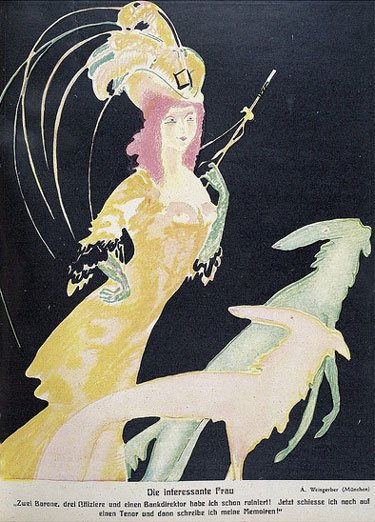
From Jugend 1910 in the Heidelburg University Collection: A. Weinberger, Munich, “An Interesting Woman”
I have ruined two barons, three officers, and a bank director! Now I conclude with a tenor and then I write my memoirs!
Hat tip to Beautiful Century via Karen L. Myers.
12 Dec 2014

Georg Jung, Ruckkehr des Odysseus [Odysseus’ Homecoming], 1947, private collection.
Hat tip to Madame Scherzo.
06 Dec 2014

Lesser Ury, Gentleman and Lady in a Cafe, 1910, private collection.
Via Madame Scherzo.
11 Nov 2014
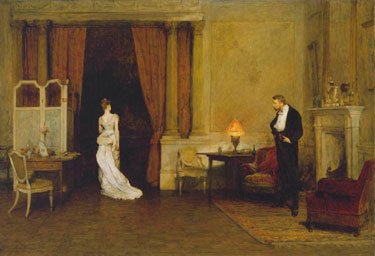
Sir William Quiller Orchardson, The First Cloud, 1887
lol bye< /em>
21 Oct 2014

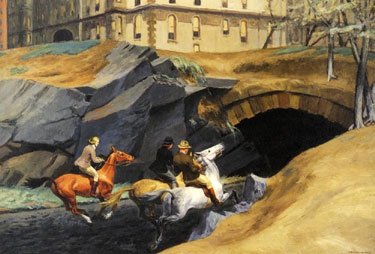
Edward Hopper, Bridle Path, 1939, formerly San Francisco Museum of Modern Art, now privately owned. Sold for $10,386,500 at a Sotheby’s auction in 2012 to allow the SFMOMA to purchase a different Hopper.
SFMOMA evidently preferred a more characteristic Hopper painting, presenting a gritty image of Mid-20th Century Everyman’s loneliness and alienation to this glimpse of Pre-WWII, American Upper-Crust ecstasy.
The New York Times in 1994 described the rise and decline of riding in Central Park.
The 1856 plan for Central Park by Frederick Law Olmsted and Calvert Vaux did not provide for horseback riding, although the planners did not expressly oppose it. William Alex, president of the Frederick Law Olmsted Association, said the bridle paths were among 17 suggested changes in the Central Park plan made by Robert J. Dillon, one of the original Central Park Commissioners, a Democratic politician and two-term Corporation Counsel.
Dillon’s proposals included waiting to lay out pathways until pedestrians established them by habit, and extending the Mall over the lake and up to Belvedere Castle with a large suspension bridge.
Olmsted & Vaux were able to fend off most meddling, but Dillon’s suggestion for bridle paths survived. By 1863 six miles of gravel- and sand-surfaced paths extended from 59th Street and Fifth Avenue to the west side of the park and around the reservoir. The rules of the park for 1873 specifically allowed horseback riding “with a free hand and a rapid rate of speed,” something not allowed anywhere else in the city.
The 1886 Appletons’ Dictionary of New York City said that renting a horse cost $3 for an afternoon. The Sun’s Guide to New York of 1892 noted that the stables’ business fell off markedly in the summer, when their patrons “go to the seashore or to the mountains.”
The soft surfaces of the bridle paths required intensive maintenance; the 1908 report notes that they were harrowed and leveled every evening and watered in the summer.
A 1929 editorial in The New York Times recalled the days when there were several hundred horses available from stables and riders frequently rode to the north end of the park, then up Seventh Avenue and along the Harlem River, and back down a bridle trail in Riverside Park.
In 1964, Hart’s Guide to New York City reported that there were only 50 horses for rent, out of Claremont Stables at 175 West 89th.
By the 1970’s the bridle paths were a shambles.
Claremont Riding Academy (where I used to rent horses to ride in early mornings in the Park) was located on West 89th Street. It closed forever in 2007. Wikipedia:
The location of the stable made for an unusual experience in the equestrian world: riding in heavy traffic. The stable was not in Central Park itself, but a block and a half away. Getting to the park required riding a horse on Manhattan streets, mixed in with the regular traffic, and crossing Central Park West.
The Academy was dependent on the structural condition of the bridle paths in nearby Central Park, as this was the primary designated area for horseback riding in Manhattan. At some point, the city allowed the bridle paths to be used by pedestrians, joggers, bicyclists and others, and discontinued structural maintenance of the paths. With the overuse of the paths in combination with the city’s discontinuance of maintenance, riders were no longer able to canter on the pathways, ending one of the pleasures of horseback riding which deterred new ridership. Due to declining patronage and increasing cost from renovations and taxes, Claremont closed forever at 5 p.m. April 29, 2007.
When I rented my first horse from Claremont, I was surprised to find that I’d been presented with a double bridle. (I was accustomed to riding only with a snaffle.) But, when the time came to ride through city traffic and the need to stop at a traffic light before crossing Central Park West arose, I was very happy indeed that I also had a curb bit at my disposal.
Some rather preposterous and pretentious interpretations of the painting, in French, (by a non-rider) are here.
John R. Shipp interprets the painting (in English). I’m afraid that I do not agree with his supposed connections myself. I think Hopper just chose to paint an image of three people riding at a gallop at a particular piece of Central Park architecture.
From Ratak Monodosico.
20 Oct 2014

Hand-decorated envelope and tie sent by Pablo Picasso to MoMA director Alfred H. Barr, Jr.. 1957
Via Ratak Monodosico.
11 Oct 2014
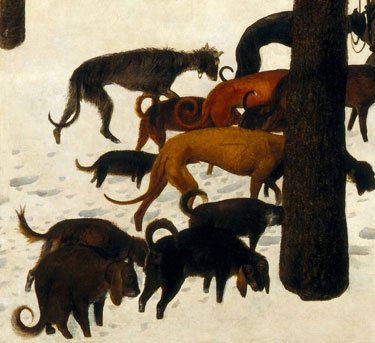
Deatai from Pieter Bruegel the Elder, Hunters in the Snow, 1565, Kunsthistorisches Museum, Vienna
Karen forwarded this, commenting: “Notice all the curly tails. But are the ears greyhound-like or pendant, like tazis?”
Her reference to curly tails, pertains to the policy of organized hunting packs to cull hounds with curly tails because, when they are bred from, the curvature of the tail tends to migrate forward, producing spinal problems in their offspring.
Tazis are the more northerly form of the Persian, or Oriental, Greyhound, known elsewhere as the saluki.
Bruegel’s hunters’ dogs, I think, consist of three types: I see three long-bodied, short-haired sighthounds (visible on the upper right): greyhounds. The only one whose head is visible has short, pointed ears. The upper left dog, with coarse coat, is a lurcher type (a cross between a sighthound and another kind of breed, either a pastoral guard dog or a terrier). So, too, might be the taller, heavier-built dark brown dog whose loins are concealed behind a tree. The shorter, flop-eared dogs would be scent hounds.
I like the way Image Diver produced this detail image.
30 Sep 2014

17th century Tantric painting from Rajastan: a meditation on “the endless dance of energy.”
Siglio Press book page
From Frank André Jamme’s Tantra Song: Tantric Painting from Rajasthan
Stephen Heyman, in the New York Times: 17th Century Modernism?
Hat tip to Virtual Artifacts.
30 Sep 2014

Via Ratak Monodosico.
27 Sep 2014

“Art enthusiasts admire Newstrom’s paintings and sculptures at the Schulberg Gallery in New York.”
The wags at CBC.Canada photoshopped a stock image and wrote up an amusing news story satirizing modern art.
27-year-old artist Lana Newstrom says she is the first artist in the world to create invisible “art.” In this documentary we traveled to her empty studio to learn more about Lana and her unusual artistic process.
“Art is about imagination and that is what my work demands of the people interacting with it. You have to imagine a painting or sculpture is in front of you,” says Newstrom.
Paul Rooney, Lana’s agent, believes she might be the greatest artist alive working today: “When she describes what you can’t see, you begin to realize why one of her invisible works can fetch upwards of a million dollars.” said Rooney.
Listen to learn more about Lana Newstrom and her invisible art.
6:53 audio
The story was just a little too good to be true, and I made a point of searching for the “Schulberg Gallery” and other confirmatory material before swallowing this one whole.
——————————————
They did fool a number of bloggers though.
Moonbattery: “Lana Newstrom’s Invisible Art”
Tea Party News Network: “The Sheer Stupidity of Useful Idiots on Full Display; Looks Like the ‘Intellectuals’ Aren’t So Smart”
Barstool Sports: “NYC Artist Selling ‘Invisible Art’ For Millions”
Even Richard Fernandez (who is a very smart guy) bit: “The Unseen”
Unfortunately, the spoof story was only too plausible in today’s cultural climate.
30 Aug 2014

Zygmund Andrychiewicz (1861–1943), Death of the Artist — the Last Friend.
Via du vide.
06 Aug 2014

Don Bergland, Ideology, Digital drawing
Jed Perl gets down to some serious chin-stroking in the New Republic about the contemporary Left’s preference for ideology over aesthetic considerations.
Back in 1950, in the preface to The Liberal Imagination, Lionel Trilling worried that liberalism’s “vision of a general enlargement and freedom and rational direction of human life . . . drifts toward a denial of the emotions and the imagination.†Liberalism, he argued, “in the very interest of affirming its confidence in the power of the mind . . . inclines to constrict and make mechanical its conception of the nature of the mind.†In the sixty-four years since Trilling published those words the process of constriction and mechanization has only become more pronounced. This process is reflected in the ever-growing obsession with polls, surveys, and sundry forms of bureaucratic analysis, which threaten to reduce all art’s unruly richness to a set of data points. Instead of viewing life’s unquantifiable artistic experiences as a check on quantification, the well-intended impulse among many liberal commentators is to try and quantify the unquantifiable. But the power of art, which is so personal and so particular, is finally unquantifiable—and therefore a source of embarrassment to the rationalizing mind. What is at stake is art’s freestanding power.
I suppose it is the casualness with which that freestanding power can now be dismissed that struck me in what was on the face of it a fairly off-the-cuff observation in a review that Alex Ross published in The New Yorker not too long ago. Ross is a winningly fluid writer, and he knows how to report on the musical performances that mean the most to him in such a way that his readers become as excited as he is; we share his avidity, his intentness, his keen pleasure. He is a friend of the arts, and he obviously cares passionately about the musical arts. This is why a passing remark in a piece about the Russian conductor Valery Gergiev has held my attention. In the midst of a discussion of Gergiev—who was conducting the opening night of Eugene Onegin at the Metropolitan Opera, and had voiced his strong support for Putin in spite of the Putin regime’s abhorrent support of homophobic legislation in Russia—Ross complained that Gergiev “dabbles in politics, yet insists that politics stops at the doors of art.†And then—and this is the remark that pulled me up short—Ross announced, referring to the idea that politics stops at the doors of art: “This is an old illusion.†There was something in the mingled broadness and offhandedness of Ross’s comment—the sense that this was not just an illusion but an old illusion—that set me to wondering and worrying.
Note that there is no place in contemporary culture for conservatives. We will be lucky, at best, as Auden put it, to be pardoned.
Time that is intolerant
Of the brave and the innocent,
And indifferent in a week
To a beautiful physique,
Worships language and forgives
Everyone by whom it lives;
Pardons cowardice, conceit,
Lays its honours at their feet.
Time that with this strange excuse
Pardoned Kipling and his views,
And will pardon Paul Claudel,
Pardons him for writing well.
/div>

Feeds
|




