Eddie Rickenbacker (who would just a few years later shoot down thirteen Fokker D.VIIs, four other German fighters, five highly defended observation balloons, and four two-seated reconnaissance planes) beats Barney Oldfield at the Sioux City Speedway, July 4, 1914. Rickenbacker is probably driving a Peugeot; Oldfield either a Fiat or a Stutz.
Commenter Pico knows the correct answers: “Rickenbacker won driving a Duesenberg, Oldfield a Stutz, which dropped out due to a cracked cylinder.”
Ferrari F340 Competizione, based on a true classic – the 1952 Ferrari 340 Mexico Berlineta. Only three of the original were built, by Vignale specially for the 1952 Carrera PanAmericana race, held in Mexico. With Gullwings, these were only $4,000,000.
The R7 shows how deep art deco influence ran. A pure prototype, the R7 stands as one of the most stunning bikes ever created. The opulent mudguards, the fluid sculpture of the body and the ornate steel and chrome all lend to an unparalleled design for motorcycles. Its telescopic front forks also happen to be the first ever on a two-wheeler. Every aspect of the bike contributed to its elegant design, including the enclosed gas tank, the smooth rocker covers and the uniquely shaped exhaust. The bike was stored away in the 1940s and brought back to life by BMW Classics in 2005. Thank the motorcycle gods the R7 survived, since nothing else on two wheels looks anything like it, nor ever will.
Built, just before the start of WWII, on the rear-engine Mercedes-Benz 170H chassis it was known as the Göttinger Ei (“an egg from Göttingen”) or the Schlörwagen. Its designer, Karl Schlör, a Krauss Maffei engineer, had proposed a bodyshell with extremely low drag coefficient as early as of 1936. The prototype dazzled the public at the Berlin autoshow of 1939. But, because of the outbreak of WWII, the Schlörwagen never actually went into production. Karl Schlör died in 1997.
Maserati 450S (built 1956-1958) were nine racing cars made by Maserati of Italy, and used in FIA’s endurance World Sportscar Championship racing.
[The automobile in the above photo must be] Chassis #4501 [which] had a 4.2-litre V8, based on the prototype raced at 1956 Mille Miglia and 1956 Swedish Grand Prix. A clutch failure after a very promising start in the Buenos Aires 1000 km by Stirling Moss and Juan Manuel Fangio prevented the car from commencing the season with a win. The car was redesigned to a coupe drawn by Frank Costin of England, constructed by Zagato, and raced once again by Stirling Moss at Le Mans where it failed to finish. Later, the car was restored by Medardo Fantuzzi of Maserati (new chassis #4512); later by Faralli & Mazzanti.
Road & Track simply marvels at the astounding overreach of proposed eco-tyranny.
In an effort to further reduce pollution in Great Britain, new regulations have been proposed that would effectively ban all classic cars from London’s city center. R&T understands that the mandate, which was first floated last February, would establish an Ultra Low Emissions Zone (ULEZ), disallowing all pre-2005-registered vehicles from entering a prime area of downtown London effective 2020. …
Britain, always fertile ground for irony, also seems to have forgotten that its auto industry hasn’t contributed anything truly noteworthy to the motoring zeitgeist in roughly half a century (with a few notable exceptions, such as the McLaren F1). Thus, the ULEZ would take every great English car ever made—the Jaguar E-Type, Aston Martin DB5, Rolls-Royce Silver Shadow, the Lotus Esprit Series 1, and even the original city car, Issigonis’s Mini—and promptly ban them all from entering the most visible area of the nation’s capital.
Take a moment to let that sink in.
Well-intentioned? Sure, but the proposed ULEZ is ignorant at best and outright draconian at worst.
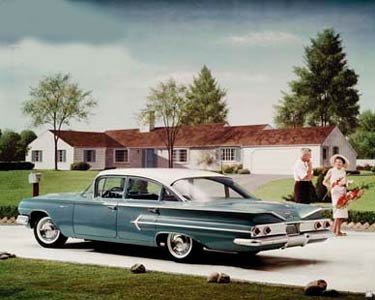
The 1960 Chevrolet Bel Air was a no frills model which cost a mere $2500.
My dad bought one of the above Chevrolets brand new in 1960. He eventually passed it along to me and it was still running in 1971 with 150,000 and I got something like $500 for it when I sold it upon returning to Yale.
In the pre-WWII period, you could go to Morris Garages (MG) in Oxford, England and have a custom automobile, your choice of engine, your choice of body run up for you.
Eric Peters explains how it came about that today’s automobiles cost more than working men’s houses did when I was a boy, and why buyers’ choices shrink every year. Our most recent BMW came lacking any sort of spare tire whatsoever. Someone in the federal bureaucracy decided that you could always just phone for roadside assistance when you got a flat and thought that eliminating the spare tire would reduce automobile’s rolling weight and save energy. “So let it be written, so let it be done.” Auto companies, like BMW, happily clicked their heels, fell into line, and stopped providing spare tires.
In this economy, can anyone seriously doubt that there is a market for simple, reliable – and inexpensive – transportation?
In any case, why not let the market operate? Why not allow (god, how I hate that term) Tata or Cherry (or whomever) to offer their basic, low-cost cars for sale here – and see whether people are interested?
You and I know why this will not be allowed, of course. Precisely because people would buy such cars – and that would impose pressure on the industry at large to simplify their offerings, too – and reduce the cost.
Can’t have that.
It is critical to keep people perpetually in debt. Why allow them to buy a new $6,000 car outright – or pay it off in two or three years (as was common once – and within living memory of any person older than 40) when you can effectively force them to buy a $30,000 car (the average price paid for a new vehicle as of last year) and sign them up for 5 or 6 years of payments? And force them to spend $1,000 annually to insure it, too?
That’s the truth of the thing.
It’s not about “safety†– or any other such altruistic palaver.broke picture
It is about power – control.
And, of course, money.
I’ve written about air bags before. Classic example, so worth repeating. They were first put on the market – in the early-mid 1970s by both GM and Chrysler – as optional equipment that people could buy. Or not.
Most people chose not to buy.
Not because they were cavalier risk junkies – as people such as myself are often characterized by the Air Bag Nazis. But simply because the cost of the air bags was prohibitive. They added as much to the bottom line price of a car (this is back in the ’70s) as air conditioning did – and AC was just about the most expensive option you could buy in those days.
So, they failed in the marketplace. Which is why the car companies worked with the government to see them made mandatory. Now you cannot say no to air bags. And to many other “features†you may not want in a car. These features are not necessarily bad. The question is – or ought to be: Can you afford them? Many people cannot. Hence the now-common six-year payment plan. Soon – count on it – to be expanded to seven years.
Then eight. …
The problem is most people are not outraged about this. They don’t seem to mind being told what they’ll buy – nor how much they’ll pay for it. They’d probably be annoyed if their next door neighbor marched over one day and told them they had to drive this type of car – and weren’t going to be allowed to drive that type of car. Their first reaction would be open-mouthed bewilderment. Their second reaction would be: Who the hell do you think you are? And then: Get the hell off my property – and mind your own business.
Right?
And yet, most people will accept the same damn thing when it’s done at once or twice remove, by “regulation†and in a city, far, far away.
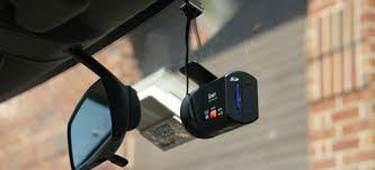
The LA Times reports on an unlikely alliance between statist tax grabbers and some libertarians(!) to arrange for Big Brother to accompany you every mile you drive.
As America’s road planners struggle to find the cash to mend a crumbling highway system, many are beginning to see a solution in a little black box that fits neatly by the dashboard of your car.
The devices, which track every mile a motorist drives and transmit that information to bureaucrats, are at the center of a controversial attempt in Washington and state planning offices to overhaul the outdated system for funding America’s major roads.
The usually dull arena of highway planning has suddenly spawned intense debate and colorful alliances. Libertarians have joined environmental groups in lobbying to allow government to use the little boxes to keep track of the miles you drive, and possibly where you drive them — then use the information to draw up a tax bill.
The tea party is aghast. The American Civil Liberties Union is deeply concerned, too, raising a variety of privacy issues.
And while Congress can’t agree on whether to proceed, several states are not waiting. They are exploring how, over the next decade, they can move to a system in which drivers pay per mile of road they roll over. Thousands of motorists have already taken the black boxes, some of which have GPS monitoring, for a test drive.
“This really is a must for our nation. It is not a matter of something we might choose to do,” said Hasan Ikhrata, executive director of the Southern California Assn. of Governments, which is planning for the state to start tracking miles driven by every California motorist by 2025. “There is going to be a change in how we pay these taxes. The technology is there to do it.”
The push comes as the country’s Highway Trust Fund, financed with taxes Americans pay at the gas pump, is broke. Americans don’t buy as much gas as they used to. Cars get many more miles to the gallon. The federal tax itself, 18.4 cents per gallon, hasn’t gone up in 20 years. Politicians are loath to raise the tax even one penny when gas prices are high.
“The gas tax is just not sustainable,” said Lee Munnich, a transportation policy expert at the University of Minnesota. His state recently put tracking devices on 500 cars to test out a pay-by-mile system. “This works out as the most logical alternative over the long term,” he said.
Wonks call it a mileage-based user fee. It is no surprise that the idea appeals to urban liberals, as the taxes could be rigged to change driving patterns in ways that could help reduce congestion and greenhouse gases, for example. California planners are looking to the system as they devise strategies to meet the goals laid out in the state’s ambitious global warming laws. But Rep. Bill Shuster (R-Pa.), chairman of the House Transportation Committee, has said he, too, sees it as the most viable long-term alternative. The free marketeers at the Reason Foundation are also fond of having drivers pay per mile.
“This is not just a tax going into a black hole,” said Adrian Moore, vice president of policy at Reason. “People are paying more directly into what they are getting.”
The movement is also bolstered by two former U.S. Transportation secretaries, who in a 2011 report urged Congress to move in the pay-per-mile direction.
The U.S. Senate approved a $90-million pilot project last year that would have involved about 10,000 cars. But the House leadership killed the proposal, acting on concerns of rural lawmakers representing constituents whose daily lives often involve logging lots of miles to get to work or into town.
Several states and cities are nonetheless moving ahead on their own. The most eager is Oregon, which is enlisting 5,000 drivers in the country’s biggest experiment. Those drivers will soon pay the mileage fees instead of gas taxes to the state. Nevada has already completed a pilot. New York City is looking into one. Illinois is trying it on a limited basis with trucks. And the I-95 Coalition, which includes 17 state transportation departments along the Eastern Seaboard (including Maryland, Pennsylvania, Virginia and Florida), is studying how they could go about implementing the change.
The concept is not a universal hit.
In Nevada, where about 50 volunteers’ cars were equipped with the devices not long ago, drivers were uneasy about the government being able to monitor their every move.
“Concerns about Big Brother and those sorts of things were a major problem,” said Alauddin Khan, who directs strategic and performance management at the Nevada Department of Transportation. “It was not something people wanted.”
As the trial got underway, the ACLU of Nevada warned on its website: “It would be fairly easy to turn these devices into full-fledged tracking devices…. There is no need to build an enormous, unwieldy technological infrastructure that will inevitably be expanded to keep records of individuals’ everyday comings and goings.”
1997 Jeep Cherokee (XJ)
220K Miles
4.0 L in-line 6
4WD
AUTOMATIC Transmission
Bright Red
Straight Stock
Crank Windows, no cruise, no tilt, no delay wiper, no nonsense
POWER MIRRORS! Woo Hoo!
$1750
Here’s the deal, kids:
This is a Jeep Cherokee. This is not a luxury SUV, or a maintenance-free disposable import. It has solid front axles, wind noise, and character.
It’s a Jeep. It rides like a Jeep. It drives like a Jeep. All of these are GOOD things.
It is not new, it is not pristine, it is used. This will be apparent in the pictures.
If you do not own a toolbox, have never changed your own oil, and are scared of firearms: THIS VEHICLE IS NOT FOR YOU.
If you have been posting on facebook all about how excited you are for pumpkin latte season: THIS VEHICLE IS NOT FOR YOU.
If you get offended easy and often, whine to your co-workers, and bitch a lot: THIS VEHICLE IS NOT FOR YOU.
If you feel you are owed anything in the world & have a bullshit job where you fail to produce: THIS VEHICLE IS NOT FOR YOU.
If you own a bieber album, white oakleys, affliction t-shirts, or those candy-assed stitched-pocket jeans: THIS VEHICLE IS NOT FOR YOU.
If you consider the 2nd Amendment an anachronistic relic and have never owned a firearm: THIS VEHICLE IS NOT FOR YOU.
If, however, you have BALLS OF STEEL and consider adverse weather an excuse to do stupid shit: THIS IS YOUR JEEP.
Do you laugh at danger, and tempt fate?
Have you ever uttered the words, “Hold my beer and watch this …”?
While bored at work do you pick targets at random and think, “I could hit that from here with the .22 …”?
Have any of your friends quit hanging out because you were too much fun?
Do you have the number of a friend with cash memorized for bail?
When you pass an abandoned flatbed farm truck along a fenceline do you consider taking on another project?
Is your ol’ lady really sick of the random piles of parts, greasy footprints, and empty beer bottles in the garage?
-could you not care less?
Do you have Jalopnik saved on your laptop AND smartphone?
Do you own a service manual for every vehicle you ever owned?
Do you still miss your first ride?
Can you carry on a two hour conversation discussing tools, scars, and hi-lift jacks?
Remember when tool companies had the balls to put half-naked beauty queens on their calendars?
Do you consider the Prius an abominable affront to the Gods of displacement, torque, and All Mighty Internal Combustion?
If you answered in the affirmative to the preceding: THIS IS YOUR JEEP.