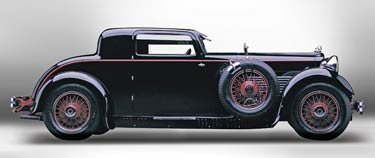
1929 Stutz Model M with coupe coachwork by Lancefield of London.
Old Car Reports’ Car of the Week is the A.K. Miller 1929 Stutz Model M Coupe.
The story of A.K. Miller is legendary, even outside of Stutz collecting. The Vermont collector was born in 1906 and developed a taste for fine cars — what would be considered Classic cars today — and began gathering them when they were used cars. Commensurate with his frugal ways, Miller stored his valuable collection in dirt-floor wood sheds and lean-to’s on the primitive East Orange, Vt., farm he shared with his wife, Imogene.
Although great Peerless, Cadillac and Rolls-Royce cars passed through Miller’s hands, it was Stutz he preferred. A 1917 Stutz was Miller’s first car, and he occasionally drove it until he died in 1993. The other cars in Miller’s 40-some-vehicle collection were often parked on makeshift “wood stump†jack stands and left to gather dust while surrounded by spare Stutz parts. Miller would sometimes trade these parts, but he drove a hard bargain to his financial benefit and the misfortune of his fellow trader. It was not until his wife died in 1996 that it became clear what exactly was hidden in the wilds of Vermont, and more than car collectors were interested.
The Millers had essentially lived as recluses on their simple homestead. They had no children, and they had almost no paper trail. Their collection had been known to only a few outsiders, and the handful of people allowed to visit rarely caught a glimpse of more than a car or two. Only visitors from foreign lands were typically offered more than a peek, supposedly because Miller could be assured they were not from the IRS. Indeed, Miller had lived so far off the grid he was able to avoid paying state and federal taxes. He and his wife were also hiding more than cars and income — they had buried or otherwise hid millions of dollars in gold bullion and silver ingots around their property.
After Imogene’s passing, the Millers’ fortune captured the attention of car and tax collectors, and an auction was held by Christie’s, after which the IRS was to receive its due. Police scouted the property leading up to the auction to stop the shovels and metal detectors of treasure hunters, and the curious eyes and hands of car enthusiasts. When the auction was held Sept 7-9, 1996, about 35 “barn find†Stutz motor cars crossed the block, most fetching far more than their pre-sale estimates in front of a standing-room-only crowd.
One of the stand-outs in that sale was a special 1929 Stutz Model M with coupe coachwork by Lancefield of London. Lancefield often bodied Rolls-Royce and Bentley chassis, but it also held an association with Stutz of Indianapolis, Ind. The aluminum-sheathed Lancefield coupe body sat low on the Stutz chassis, thanks in part to a worm gear drive setup, but was made to look lower with Lancefield’s tear drop step plates and trademark low roof, cycle-type front and rear fenders and dozens of louvers that ran the length of the apron that masked the frame sides. In deep black, the masterpiece was sinister.
“They only built five of these coupes,†said Richard Mitchell, the Lancefield-bodied Stutz coupe’s present owner. “Two were sold to the Woolworth Brothers and this is one of the two. Of the two cars, only this one was supercharged. There is no record of the others; this is the lone ranger.â€
Lambrecht Chevrolet in Pierce, Nebraska was owned and operated by Ray and Mildred Lambrecht for 50 years until they retired in 1996 at ages 78 and 75. Now 17 years later, they have finally decided to liquidate the dealership’s massive inventory of 500 vehicles, including a number of brand-new 1950s and 1960s Chevrolet cars and trucks.
Those London firemen must have stopped for a cup of tea before arriving to extinguish the fire.
They only made 764 Miuras between 1968 and 1972. This one was a P400SV, probably made after 1970.
British sports cars were notorious for a wilingness to rust, and for every kind of electrical problem. (Famous joke: “Why do the British drink warm beer? Because Lucas made the refrigerators.”) But members of the exclusive club rich enough to own an Italian exotic car could apparently get with it really exotic issues… like a propensity to catch fire at idle(!).
Lamborghini [Miura]’s use[d] Weber 40 IDL 3C1 carburetors which were designed exclusively for racing applications and weren’t suitable for road use. The problem occurred when the car sat idling (e.g. at a stoplight), the area above the throttles filled with fuel which often ignited when the car accelerated away from the stop.
—————————————-
Peter Orosz was allowed to examine and sit in one at a collectible car company, and he was moved to rhapsodize:
There is a menacing beauty to the Miura up close. The roofline is so low the car would be inadequate to cover the private parts of a man were he to approach it naked. The cute eyelashes of the ventilation ducts surrounding the headlights begin to look like alien claws. As you make your way into the snug cabin, the velocity trumpets of that great engine tower over your head, mere inches away. If not for the thin plate of glass between you and the six carburetors, a blip of the gas pedal would send loose strands of your hair down their throats, ready to combine with gasoline. And burn.
My girlfriend Natalie, described the driving position as “basically perfectâ€, quite a surprise when you consider the monkey-boy ergonomics of most Italian cars. The cabin is simple yet full of gorgeous detail, a combination of fine materials and charming reminders of low-volume handmade production.
But said perfection combines with much imperfection: The Miura has an annoying tendency to catch on fire at idle. The front end tends to lose traction at speed. And its spotty relationship with reliability is most likely a direct function of being an Italian car, built in a small factory almost half a century ago.
Still, being up close to one makes it more desirable to me than ever. No matter how many times I see a Miura—and I haven’t seen many, and this is the first one I’ve actually sat in—I am always in awe of its impeccable proportions, its wonderful punk history, and its sheer sense of speed and style. Inside, you dream of gently twisting motorways with no speed limits, and no traffic. Of mountain roads and plains and electric blue lakes. Of tunnels to amplify the shriek of that V12. Driving a Miura is one of life’s great petrolhead fantasies. But to enjoy it, you don’t even have to drive. Just climb inside, close your eyes, and dream your merry automotive dreams.
Ettore Bugatti made only six examples of his stupendously large and luxurious type 41 Royale. He originally intended to produce 25 examples for the use of European royalty and Indian maharajahs, but during the first Great Depression even royalty were a bit hard up.
Type 41s are among the rarest of collectible automobiles and there are none currently for sale but, if you actually still have money these days, you have a chance next month at a great Royale memento: a type 41 elephant radiator cap mascot is being sold by L’art et l’automobile auction on December 12th. Bidding starts at $75,000. Take it home and mount it on the bonnet of your Range Rover and you’ll really make an impression. Also, the perfect gift for the rabid Republican.
It was Ettore Bugatti’s most exclusive creation, the Type 41 Royale. From the onset, only 25 examples were ever planned and in the end, only six were ever produced. Using a huge 12.7-Liter, inline eight-cylinder engine rated at 300 hp, everything about the Royale was massive. Each car had a 169.3-inch wheelbase, 24-inch wheels, a weight of more than 7,000 lbs and a price tag that was just as colossal at around $25,000 U.S. dollars in 1929. On top of the base chassis price, each car had a custom-ordered body ranging in price from $5,000 to $18,000 in pre-depression 1929 dollars.
To finish off this grand automobile, the radiator mascot had to be something just as special and just as big. For the crowning touch, Ettore Bugatti turned to the work of his beloved younger brother Rembrandt, a noted and talented artist. The younger Bugatti brother made animals the subject of his art. He was a patron of the city zoo in Antwerp, Belgium, and used many of the animals there as the basis for his works. Sadly, during World War I, many of these exotic creatures had to be killed due to the inability to properly care for the animals in the zoo during the war. The story goes that Rembrandt was so distraught with these actions, he traveled to Paris and committed suicide in 1916.
Ettore Bugatti felt that one of his brother’s most exquisite works was the mighty elephant rising up on its rear legs with his trunk high in the air. This, he felt, would be the finishing touch for his most exclusive automobile, the Type 41 Royale.
Using an original bronze casting from Rembrandt, a very limited run of these mascots were produced. Each was cast in sterling silver by the Charkles Valsuani Foundry in Paris using the “Cire Perdue†(lost wax) method.
Theo published this photo of a seriously decayed Mercedes Benz 300SL. The picture seems to have come from a Latvian web-site‘s collection of photos of abandoned supercars.
Presumably sitting out there in the rain, somewhere in Europe, awaiting restoration is a serious contender for most desirable car of its 1954-1963 era.
Ones in good condition seem to be going in the $600,000-700,000 range.
Autoblog has one of those stories of government fiscal irresponsibility which will boggle your mind.
Have you ever bought a brand new cars only to forget where you put it? How about 300 of them? Probably not – unless you’re Miami-Dade County, which was recently reunited with 298 vehicles it bought brand new between 2006 and 2007.
The county “discovered” this fleet of no-mileage vehicles after reading about them in a Spanish-language newspaper there (see the source for more images). Most of the misplaced motorcade is made up of Toyota Prius hybrids whose warranties either expired with very few miles on the odo or will very soon.
Looking to save some face, the county has rushed at least 123 of the hybrids into service. The Toyota warranty covered the hybrid bits for eight years or 100,000 miles, but we’re not sure if that covers cars parked for five of those eight. We’re also not sure what that much time in Miami heat and humidity does to an unused hybrid powertrain, but it can’t be good.
Jack Baruth describes how it’s not only the modern population that has become demasculinized. The same thing has happened to great automotive brands, and with the arrival of the Urus, it has happened to Lamborghini, alas!
Sports cars and supercars — yes, we are finally getting to cars — used to be real ass-kickers themselves, you know. Think of a Miura blowing down the autostrada at 170mph when the average Italian car couldn’t break a hundred. Or an early short-wheelbase 911 trying actively to kill its driver on the Stelvio Pass. Or a ’69 big-block ‘Vette snarling down Mulholland. Men’s cars. Driven by the men who ruled the world, who had built the world. And created by those men, too. Ferrari himself, sacrificing drivers like pawns and burning the essence of his life to obtain victory. Ferry Porsche, who had to build and engineer a racecar to ransom the life of his own father. David Brown, earning a fortune and then throwing it away so he could put his own intials on the Aston Martin. Ferrucio Lamborghini, who famously started his company because Enzo showed him a lack of respect (or because he found out how much the markup on Ferrari parts was, depending on which story you believe.) These were real men, building appropriate conveyances for other men of means, courage, and accomplishment.
Those men are all as dead as Caesar now. Their famously fragile businesses, which often held together simply on the faith of their workers that “the old man†would find a way to pay them next week, have been plucked from uncertainty and nestled safely within the bosoms of monstrous corporations or the accidentally oil-rich.
And the cars those men made? They’ve been replaced by products, which are branded and marketed to “high net worth individualsâ€, our infamous one percent, existing within a safety net of corrupt banks, protective governments, and barriers to entry. The “heritage†those men manufactured on the fly has become a precious resource to be doled out by turtleneck-clad designers timidly riffing on the tracks cut by their betters long ago, like a club DJ spinning Parliament in scratches and squeaks because he never learned to play the bass himself.
Worse yet, the “products†themselves have ceased doing the man’s work of the company. Porsche used to live or die by 911 sales, the same way Lamborghini relied on selling the Countach to keep the doors open. No longer. Today, the Panamera and Cayenne drive the business. They trade on the image of the 911 to move the metal, but the 911 itself has become irrelevant. It’s a trophy wife on the arm of the Panamera. It’s there to make the Pano look good.
Sunday: Dead Ferraris all over the Chugoku Expressway in Shimonoseki, southwestern Japan.
8 Ferraris, a Lamborghini, three Mercedes Benz, and two Toyotas, a total of 14 vehicles bought the farm when one Ferrari driver trying to change lanes lost control, bounced off a barrier, and came spinning back into the middle of a luxury car caravan heading for an enthusiasts’ event in Hiroshima.
No one, besides the automobile insurance company executives seen leaping from high windows, was seriously injured in the accident, but a lot of very expensive metal was seriously bent.