The Next Web describes an ingenious solution adopted by a Chinese father to a widespread parental problem.
What would you do if your adult son was playing video games all day instead of looking for work? Well, one Chinese father resorted to desperate measures when he reportedly hired in-game hitmen to attack his son whenever he logged on to his favorite game, according to the People’s Daily.
After being killed repeatedly in an online game, 23-year-old Xiao Feng figured out that the high-level griefers had been put up to the task by his dad, who says he hoped the trick would cause his son to lose interest in the game. Xiao Feng maintains that he’s not going to settle for just any job and that he hasn’t found the right fit yet.
Dan Greenfield has another of his intelligent essays full of unpalatable truth.
[T]he West has been headed out of the territory of reason for some time now. Its truths have become ideological beliefs. Its goals have become the self-worship of its own symbols, size for the sake of size, and centralization for the sake of centralization. There is a mingled horror and longing for the savage and the barbaric, as civilization appears to have lost its meaning. The leadership cries “Onward to a united world” on the one hand, and “Back to the caves” on the other. That confused melange boils down to a cultural intelligence which has lost the awareness of its own contradictions. High tech environmentalism, soft wars and valueless money are all symptoms of that same intellectual degeneracy.
The rise of China is directly tied to our own irrationality. The People’s Republic of China has become rich and powerful by serving as the reservoir of our contradictions. We wanted cheap products, no pollution, high wages and generous benefits. All these things are not compatible, so we outsourced our manufacturing to China and pretended that we could have it all. But all we got were cheap products, and the country we outsourced them to got the jobs and the national prosperity. We wanted to spend money without worrying about where it came from. Again we turned to China. And like the grasshopper and the ant, we sang and played all summer, while the ants worked and prepared for the winter.
We used China to escape the limits of reality, but there is no escape. Only temporary vacations from consequences.
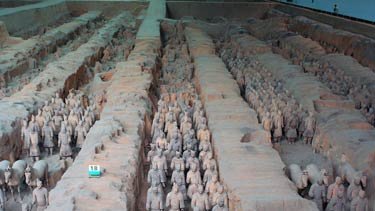
Shi Huang, China’s first emperor, is protected in the afterlife by an army of teracotta warriors.
Here’s an interesting item from Gizmodo, essentially translated from the Spanish-language paper El Pais:
(some typos corrected
After discovering a secret palace hidden in China’s first emperor massive burial complex, Chinese technicians are nervous. Not because Qin Shi Huang’s tomb is the most important archeological discovery since Tutankhamun, but because they believe his burial place is full of deadly traps that will kill any trespassers. Not to talk about deadly quantities of mercury. …
Talking to Spanish newspaper El Pais, the archeologists working at the excavation said that “it’s like having a present all wrapped at home, knowing that inside is what you always wanted, and not being able to open it.” But, at the same time, nobody wants to be the first to get inside because of the mausoleum’s dangerous traps—they’re detailed in the same texts that recount its abundant riches.
It’s not clear if the traps are really there, even while many texts describe them. …
[L]et’s assume that the Chinese … really installed booby traps that triggered deadly crossbows in the emperor’s tomb. Even if the old Chinese texts are correct, they might not still work after two thousand years. Perhaps the mechanisms are so rusty that the bolts won’t fire. Maybe the wood and the cords used the in the traps have long since been destroyed by bacteria.
Chinese historian Guo Zhikun argues the contrary. He is one of the main experts on Qinshihuang’s burial site, and says that it’s very possible that the traps are still active. He claims that the use of chrome in the figures may indicate that the traps received a similar protective treatment. He is sure that “the artisans who built the traps installed crossbows that will fire if any thief tries to get inside.”
Even if the traps don’t work, there is still the matter of the high, deadly concentration of mercury inside the tomb. On-site measurements indicate dangerous levels, which may come from another feature described in the scrolls: Imperial engineers created large rivers of quicksilver inside the tomb. So much that the level of mercury inside could be deadly for any unprotected adventurers.
The Chinese government hasn’t decided what to do with the hidden complex yet. The authorities will wait for some time because they believe that, with the current technology, you can’t get inside the tomb without destroying some of its contents.
If the Chinese archaeologists are indeed afraid of two-thousand-years-in-the-ground working crossbows and alleged “rivers of mercury,” I’ll be glad to enter the hidden palace first and take a look around for them. All they have to do is cover my expenses.
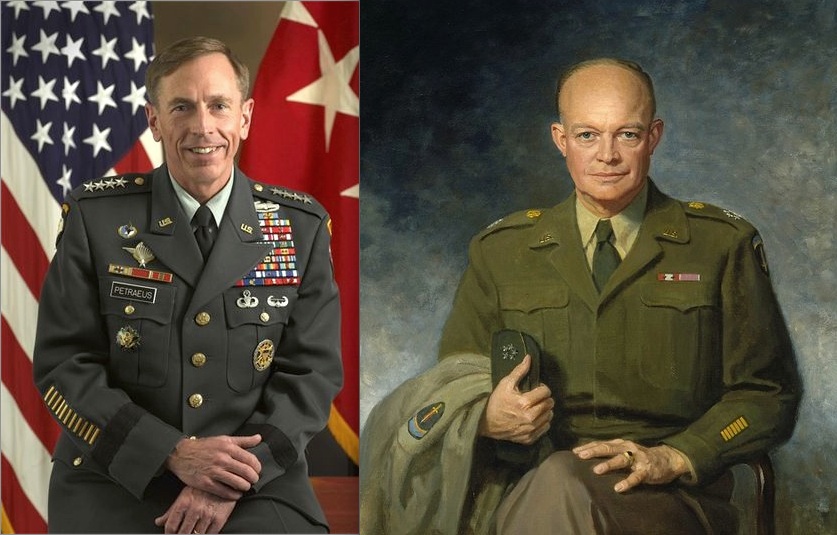
David Petraeus wore regularly a lot more awards than Dwight Eisenhower did many years ago.
Marines have long remarked humorously on the proliferation of awards, badges, and decorations worn by members of the US Army. General Petraeus’s resignation as CIA Director recently even provoked comment from left-wing commentators, like Andrew Sullivan, on the questionable taste of contemporary doggie custom.
The Marines, of course, are a lot better qualified to criticize in areas of this kind than are foreign poofter journalists who make professional careers of Dolchstoß-ing those who protect them from big bad sand monkeys who would do them harm.
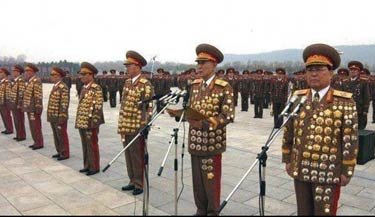
I was reminded of the criticism of General Petraeus’s uniform’s collection of shiny hardware by a photo of even more heavily be-medalled Chinese officers that has been floating around on Facebook. The original was sufficiently profuse with badges that it provoked some wag to use Photoshop to multiply them, and even to extend the medals to some Chinamen’s trousers. (see below)
The legitimate, original photo of Chinese officers.
Photoshopped parody. There are medals even on the sleeves and trousers.
Mark Kitto studied in China, lived in China for many years, married in China, built two businesses in China, but he has now decided to leave.
Death and taxes. You know how the saying goes. I’d like to add a third certainty: you’ll never become Chinese, no matter how hard you try, or want to, or think you ought to. I wanted to be Chinese, once. I don’t mean I wanted to wear a silk jacket and cotton slippers, or a Mao suit and cap and dye my hair black and proclaim that blowing your nose in a handkerchief is disgusting. I wanted China to be the place where I made a career and lived my life. For the past 16 years it has been precisely that. But now I will be leaving. …
Deng had promised the Chinese people material wealth they hadn’t known for centuries on the condition that they never again asked for political change. The Party said: “Trust us and everything will be all right.â€
Twenty years later, everything is not all right.
I must stress that this indictment has nothing to do with the trajectory of my own China career, which went from metal trading to building a multi-million dollar magazine publishing business that was seized by the government in 2004, followed by retreat to this mountain hideaway of Moganshan where my Chinese wife and I have built a small business centred on a coffee shop and three guesthouses, which in turn has given me enough anecdotes and gossip to fill half a page of Prospect every month for several years. That our current business could suffer the same fate as my magazines if the local government decides not to renew our short-term leases (for which we have to beg every three years) does, however, contribute to my decision not to remain in China.
During the course of my magazine business, my state-owned competitor (enemy is more accurate) told me in private that they studied every issue I produced so they could learn from me. They appreciated my contribution to Chinese media. They proceeded to do everything in their power to destroy me. In Moganshan our local government masters send messages of private thanks for my contribution to the resurrection of the village as a tourist destination, but also clearly state that I am an exception to their unwritten rule that foreigners (who originally built the village in the early 1900s) are not welcome back to live in it, and are only allowed to stay for weekends.
Fake electronic components from China have been discovered in thermal weapons sights delivered to the U.S. Army on mission computers for the Missile Defense Agency’s Terminal High Altitude Area Defense, or THAAD, missiles and on military aircraft, including several models of helicopters and the P-8A-Poseidon, according to federal investigators.
Suspected electronic parts were found in the Forward Looking InfraRed, or FLIR, Systems being used on the Navy’s SH-60-B. The counterfeit parts were delivered by Raytheon, which alerted the Navy.
The new evidence comes reports that the problem with faked Chinese electronic components being installed in U.S. military systems is far more widespread that originally thought. …
The Senate panel tracked some 1,800 cases of suspected counterfeit parts through the supply chain. It found that U.S. defense contractors had purchased many of the critical components from U.S. companies who in turn obtained them from Chinese firms but never subjected them to testing before handing them over to the U.S. military as part of their contract.
The Senate unit, whose investigators were denied access to Chinese firms by Chinese authorities, said that the evidence “consistently point(s) to China as the epicenter of the global trade in counterfeits.â€
To put the growing problem into perspective, Gen. Patrick O’Reilly, director of the U.S. Missile Defense Agency, said, “We do not want a $12 million missile defense interceptor’s reliability compromised by a $2 counterfeit part.
The world’s waterways are of themselves neutral and without a preference for the state that governs them. Different states bring their own order of governing the seas, and the US brings with it liberal economics. It is difficult to imagine serious discussions of international maritime law, or treaties that establish a law of the seas, had the Soviet Union emerged victorious in the Cold War.
America’s allies in the Pacific are currently being pressed more immediately by the Chinese than we are. They see, as Americans tend not to, that the US is in a long-term competition with China, and recognize, as we don’t, that the Chinese desire slowly to push US sea power out of the international waters close to them. The only force standing in the way of such a transition, which would destroy a complex web of alliances for the US in the Pacific, is our current sea power.
Alfred Thayer Mahan offers the intellectual arguments that address what the US stands to lose economically and militarily—and all that China will gain—if there is a profound shift of power in the Western Pacific. Commerce, he believes, plays to the natural advantage of an enterprising people who are largely free to act upon their judgment and enterprising spirit. But commercial advantage and our enterprising spirit relies equally on the ability to keep open the oceanic arteries through which commerce must be able to flow. This equation is set on its head when prosperity becomes an important instrument to justify single-party rule—as in China, where freedoms of commerce are restricted by the state’s pressing requirement, for example, to employ millions; by an understanding of commercial freedom that is wholly separate from political freedom; and by a parallel view of sea power that sees the interruption of commerce as a personal threat to those who rule the state.
Mahan saw correctly that American greatness depends on dominant sea power. He understood the close connection between domestic prosperity and maritime preeminence. The acceptance of his ideas at the beginning of the twentieth century helped immeasurably in encouraging both, the condition of which is the only one in the memory of Americans alive today.
Libertarian Justin Raimondo explains the recent fall of Chinese communist “princeling” Bo Xilai.
Bo went after the corrupt head of the local Communist party’s judicial branch, Wen Qiang, former deputy chief of the local police. Wen was found guilty of protecting the gangsters, taking bribes, and rape: he was duly executed. At the time, the Peoples’ Daily, the official voice of the Communist Party, praised these actions, but the central party leadership was not happy. Here was a charismatic and – worst of all – populist figure, who was gaining public support on the strength of political campaigns that, they say, resembled the dark days of the Cultural Revolution, when the country was enveloped in chaos.
Bo’s various campaigns, however, also resembled the efforts of a political party, such as one might see if China allowed multiparty democracy. Here was Bo offering up his own “Chongqing model†– in implicit opposition to the “Guangdong model†favored by the party’s Eastern elites, which emphasized exports over targeting the huge domestic market. Bo’s initiatives were bold, in stark contrast to the timid “reforms†preferred by “pragmatic†party leaders. In the days before his ouster, Bo declared China was ready to move toward a multiparty system: “We need to take the road to democratic rule.†A week later, he was ousted, his whereabouts unknown. …
Having been stripped of his post, it appears he will lose his seat on the Politburo, and the lesson here is clear for any other aspiring populist leader who dares challenge the Beijing bureaucrats: don’t do it. What Western observers should take away from all this is that the Chinese gerontocracy is as brittle as an over-baked fortune cookie, and living in fear of the populist giant that shows worrying signs of restlessness, especially in the still-impoverished countryside.
Ethan Gutmann, in the Weekly Standard, delivers a gruesome look at one of the world’s greatest atrocities occurring during the last two decades, China’s harvesting of organs from sometimes-still-living condemned prisoners.
In 1989, not long after Nijat Abdureyimu turned 20, he graduated from Xinjiang Police School and was assigned to a special police force, Regiment No. 1 of the Urumqi Public Security Bureau. As one of the first Uighurs in a Chinese unit that specialized in “social securityâ€â€”essentially squelching threats to the party—Nijat was employed as the good cop in Uighur interrogations, particularly the high-profile cases. I first met Nijat—thin, depressed, and watchful—in a crowded refugee camp on the outskirts of Rome.
Nijat explained to me that he was well aware that his Chinese colleagues kept him under constant surveillance. But Nijat presented the image they liked: the little brother with the guileless smile. By 1994 he had penetrated all of the government’s secret bastions: the detention center, its interrogation rooms, and the killing grounds. Along the way, he had witnessed his fair share of torture, executions, even a rape. So his curiosity was in the nature of professional interest when he questioned one of the Chinese cops who came back from an execution shaking his head. According to his colleague, it had been a normal procedure—the unwanted bodies kicked into a trench, the useful corpses hoisted into the harvesting vans, but then he heard something coming from a van, like a man screaming.
“Like someone was still alive?†Nijat remembers asking. “What kind of screams?â€
“Like from hell.â€
Nijat shrugged. The regiment had more than enough sloppiness to go around.
A few months later, three death row prisoners were being transported from detention to execution. Nijat had become friendly with one in particular, a very young man. As Nijat walked alongside, the young man turned to Nijat with eyes like saucers: “Why did you inject me?â€
Nijat hadn’t injected him; the medical director had. But the director and some legal officials were watching the exchange, so Nijat lied smoothly: “It’s so you won’t feel much pain when they shoot you.â€
The young man smiled faintly, and Nijat, sensing that he would never quite forget that look, waited until the execution was over to ask the medical director: “Why did you inject him?â€
“Nijat, if you can transfer to some other section, then go as soon as possible.â€
“What do you mean? Doctor, exactly what kind of medicine did you inject him with?â€
“Nijat, do you have any beliefs?â€
“Yes. Do you?â€
“It was an anticoagulant, Nijat. And maybe we are all going to hell.â€
Wired wonders aloud what the rulers of Red China can possibly be building in one of the world’s most remote locations.
It is probably not going to be a recreational theme park.
—————————
New photos have appeared in Google Maps showing unidentified titanic structures in the middle of the Chinese desert. The first one is an intricate network of what appears to be huge metallic stripes. Is this a military experiment?
They seem to be wide lines drawn with some white material. Or maybe the dust have been dug by machinery.
It’s located in Dunhuang, Jiuquan, Gansu, north of the Shule River, which crosses the Tibetan Plateau to the west into the Kumtag Desert. It covers an area approximately one mile long by more than 3,000 feet wide.
The tracks are perfectly executed, and they seem to be designed to be seen from orbit.
——————————————-
See comments: Reliapundit thinks he knows what it is.
Nov. 15: The Daily Mail has more pictures of more things.
The tidal bore on the Qiantang River in Eastern China is the largest in world, commonly reaching heights of 9 m. (30′) and traveling at speeds up to 40 kph (25 mph).
Tourists travel annually to stand on the dike at Haining and admire this striking demonstration of Nature’s power, but this year an off-shore storm (Typhoon Nanmadol) added a little extra oomph to the incoming tide and last Wednesday more than 20 people were injured.
Looking at the photos, I was surprised that the news reports don’t mention dozens of deaths.