Category Archive 'DNA'
08 Feb 2015


Cornell scientists spent 18 months collecting and identifying DNA samples collected on the trains and at 466 open stations in the New York City Transit System.
They found lots of bacteria, including those responsible for Anthrax and Tetanus.
Wall Street Journal:
Among the pathogenic and infectious bacteria, the Cornell researchers identified DNA related to strep infections at 66 stations and urinary tract infections at 192 stations. They found E. coli at 56 stations and other bacteria related to food poisoning at 215 stations.
A multidrug resistant bacterium called Stenotrophomonas maltophilia, associated with respiratory ailments and hospital infections, turned up at 409 stations. Another antibiotic resistant infectious microbe, called Acinetobacter baumannii, turned up at 220 stations.
New York Times:
..fragments of DNA associated with the bubonic plague were found at three stations in disparate parts of the city: on a garbage can at the 103rd Street station on the No. 6 line in Manhattan; a stairway railing at the 111th Street station of the A line in Queens; and another railing at the Winthrop Street station of the No. 2 and No. 5 lines in Brooklyn.
But you’re perfectly safe, the WSJ reports:
We think the rats are the likely carrier [of the plague bacteria], since we see plenty of rat and mouse DNA,†said Dr. Mason.
They also found a trace of anthrax DNA on a railing at one station and on a handhold in a subway car. “The results do not suggest that the plague or anthrax is prevalent, nor do they suggest that NYC residents are at risk,†the researchers reported.
The New York City Department of Health and Mental Hygiene “strongly†disputed that the bacteria were correctly identified. “The interpretation of the results are flawed, and the researchers failed to offer alternative, much more plausible explanations for their findings,†a department spokeswoman said in a written statement. “The NYC subway system is not a source of plague or anthrax disease, and the bacteria that cause these diseases do not occur naturally in this part of North America.â€
Data links here.
Hat tip to Glenn Reynolds.

29 Dec 2014

115 English colonists established a new colony on Roanoke Island, North Carolina on July 22, 1587. The first English child born in North America, Virginia Dare, was born on August 18th. Her grandfather, the colony’s governor, John White, left for England, later that year in search of aid and reinforcements for the new colony.
The arrival of the Spanish Armada and the consequent war with Spain delayed assistance and White’s return. He finally arrived back at Roanoke on August 18, 1590, his grand daughter’s third birthday. White found the colony deserted and the homes and fortifications dismantled. The only clue to the fate of the English colonists was the word “Croatoan” found carved in a tree.
World News Daily reports that recent archaeological investigations appear to have solved the mystery of what happened to the Lost Colony.
Archaeologists excavating an early 17th century Native American village near the Enoree River in Laurens County, North Carolina, have discovered seven contemporary Christian sepultures holding the skeletons of six males and one female of European origins. The bones have been proven through comparative DNA testing, to have belonged to members of the lost colony of Roanoke, established in 1585 on Roanoke Island, which disappeared mysteriously. …
The female skeleton has been identified thanks to DNA testing, as Virginia Dare, the first English child born in the Americas. The DNA of the skeleton which was found in October, was compared to that of modern day descendants of Governor John White, her grandfather. The test confirmed that the bones were indeed with more than 99.8% certainty, those of Ms. Dare. Four of the others corpses have also been identified through the same process by the scientists, including that of the girl’s father Ananias Dare, a tiler and bricklayer from London. The other identified skeletons are those of Arnold Archard and his son Thomas, as well as the young John Sampson. …
It is still unclear if the colonists were taken as prisoners or if they sought shelter with the Eno people, but Professor Monroe and his team believe that the colonists were most likely sold into slavery at some point in time and held captive by differing bands of the Eno tribe, who were known slave traders. They survived with the natives for many years, as Virginia Dare who was born in August 1587, was estimated to have been around twenty years old at the time of her death.
This astounding discovery seems to confirm the 17 th Century writings of William Strachey, a secretary of the Jamestown Colony. He wrote in his The historie of travaile into Virginia Britannia in 1612, that four English men, two boys and one girl had been sighted at the Eno settlement of Ritanoc, under the protection of a chief called Eyanoco. This mysterious settlement had however evaded discovery until now, as its location was not clearly mentioned by the author and no other mention of it or its chief have ever been recorded.
Strachey had reported that the captives were forced to beat copper for the natives. He explains that they had escaped an attack that had allegedly killed most of the other colonists. They would have fled up the Chaonoke river (the present-day Chowan River in Bertie County, North Carolina) only to be captured by Eno warriors.
Read the whole thing.
———————————————–
CORRECTION AND RETRACTION, later on 12/29:
This is only the second time in many years I fell for a fake story. (The first time was when I first came across Duffleblog and failed to recognize that the story was appearing on a satire site.
This Roanoke story looked good and had a very plausible ring to it. There was no obvious giveaway.
But, one commenter, Gray, called the story out, and he is perfectly correct. There is no Professor William J. Monroe at Johns Hopkins or anywhere else. This story is otherwise completely unreported. There is no Laurens County in North Carolina. And “World News Daily” is just a totally irresponsible Israeli tabloid that evidently thinks making up stories like this is fun.
Apologies to Free Republic and American Digest. I’m off to eat a large plate of crow.
04 Dec 2014

Edmund Blair Leighton, The End of the Song, 1802, private collection.
DNA testing of the bones of Richard III apparently demonstrates that what DNA testers refer to as a “non-paternal event” occurred at some crucial point in the blood-line of the British royal family.
Telegraph:
When the body of Richard III was discovered in a car park in Leicester in 2012 archaeologists knew it was a momentous find.
But little did they realise that it might expose the skeletons in the cupboard of the British aristocracy, and even call into question the bloodline of the Royal family.
In order to prove that the skeleton really was Richard III, scientists needed to take a DNA sample and match it to his descendants.
Genetic testing through his maternal DNA proved conclusively that the body was the King. However, when they checked the male line they discovered something odd. The DNA did not match showing that at some point in history an adulterous affair had broken the paternal chain.
Although it is impossible to say when the affair happened, if it occurred around the time of Edward III (1312- 1377) it could call into question whether kings like Henry VI, Henry VII and Henry VIII had royal blood, and therefore the right to rule.
Without his claim to royalty, Henry VII is unlikely to have been able to raise an army for the Battle of Bosworth Field, in which Richard III was killed, and the history of England could have been very different.
And it has implications for our own Royal Family who also share a direct bloodline to the Tudors.
Hat tip to Karen L. Myers.
11 Sep 2014

io9:
A genetic analysis shows that all of the Ashkenazi Jews alive today — of which there are more than 10 million — can trace their roots to a group of just 330 people who lived 600 to 800 years ago.
The new study, which now appears in the journal Nature Communications, involved the genetic analysis of 128 healthy Ashkenazi Jews. These complete genomes were in turn compared to each other, along with the DNA of 26 Flemish people from Belgium.
Writing in the LA Times, Karen Kaplan explains more:
“Ashkenaz” in Hebrew refers to Germany, and Ashkenazi Jews are those who originated in Eastern Europe. (Sephardic Jews, by contrast, are from the areas around the Mediterranean Sea, including Portugal, Spain, the Middle East and Northern Africa.) About 80% of modern Jews have Ashkenazi ancestry, according to the Hebrew University of Jerusalem. Albert Einstein was an Ashkenazi Jew, as were Gertrude Stein and Carl Sagan. Steven Spielberg and Scarlett Johansson are also Ashkenazi Jews, along with three current members of the U.S. Supreme Court (Ruth Bader Ginsburg, Stephen Breyer and Elena Kagan).
Despite their close ties with Europe, no more than half of their DNA comes from ancient Europeans, the researchers found. Only 46% to 50% of the DNA in the 128 samples originated with the group of people who were also the ancestors of the Flemish people in the study. Those ancient people split off from the ancestors of today’s Middle Easterners more than 20,000 years ago, with a founding group of about 3,500 to 3,900 people, according to the study.
The rest of the Ashkenazi genome comes from the Middle East, the researchers reported. This founding group “fused” with the European founding group to create a population of 250 to 420 individuals. These people lived 25 to 32 generations ago, and their descendants grew at a rate of 16% to 53% per generation, the researchers calculated.
————————————
Nature Communications:
Sequencing an Ashkenazi reference panel supports population-targeted personal genomics and illuminates Jewish and European origins
Abstract:
The Ashkenazi Jewish (AJ) population is a genetic isolate close to European and Middle Eastern groups, with genetic diversity patterns conducive to disease mapping. Here we report high-depth sequencing of 128 complete genomes of AJ controls. Compared with European samples, our AJ panel has 47% more novel variants per genome and is eightfold more effective at filtering benign variants out of AJ clinical genomes. Our panel improves imputation accuracy for AJ SNP arrays by 28%, and covers at least one haplotype in ≈67% of any AJ genome with long, identical-by-descent segments. Reconstruction of recent AJ history from such segments confirms a recent bottleneck of merely ≈350 individuals. Modelling of ancient histories for AJ and European populations using their joint allele frequency spectrum determines AJ to be an even admixture of European and likely Middle Eastern origins. We date the split between the two ancestral populations to ≈12–25 Kyr, suggesting a predominantly Near Eastern source for the repopulation of Europe after the Last Glacial Maximum.
Hat tip to Karen L. Myers.
07 Sep 2014

Aaron Kosminski
The Daily Mail reports that DNA analysis of semen left on the shawl of one of the Ripper’s victims has pinned down the identity of the most famous killer of the 19th century.
It is the greatest murder mystery of all time, a puzzle that has perplexed criminologists for more than a century and spawned books, films and myriad theories ranging from the plausible to the utterly bizarre.
But now, thanks to modern forensic science, The Mail on Sunday can exclusively reveal the true identity of Jack the Ripper, the serial killer responsible for at least five grisly murders in Whitechapel in East London during the autumn of 1888.
DNA evidence has now shown beyond reasonable doubt which one of six key suspects commonly cited in connection with the Ripper’s reign of terror was the actual killer – and we reveal his identity.
A shawl found by the body of Catherine Eddowes, one of the Ripper’s victims, has been analysed and found to contain DNA from her blood as well as DNA from the killer.
The landmark discovery was made after businessman Russell Edwards, 48, bought the shawl at auction and enlisted the help of Dr Jari Louhelainen, a world-renowned expert in analysing genetic evidence from historical crime scenes.
Using cutting-edge techniques, Dr Louhelainen was able to extract 126-year-old DNA from the material and compare it to DNA from descendants of Eddowes and the suspect, with both proving a perfect match.
The revelation puts an end to the fevered speculation over the Ripper’s identity which has lasted since his murderous rampage in the most impoverished and dangerous streets of London.
Read the whole thing.

16 Aug 2014

Flaked blade recovered from Chesapeake Bay.
Business Insider describes one of the North American finds strikingly resembling Solutrean tools from Western Europe, which suggest the possibility of some Paleolithic settlement of North America from Europe.
Most researchers believe the first Americans crossed the Bering Strait from Siberia about 15,000 years ago and quickly colonized North America. Artifacts from these ancient settlers, dubbed the Clovis culture after one of their iconic archaeological sites in Clovis, New Mexico, have been found from Canada to the edges of North America.
But in 1974, a small wooden scallop trawler was dredging the seafloor, about 230 feet (70 meters) below the sea surface and nearly 60 miles (100 kilometers) off the coastline in the Chesapeake Bay.
“They hit a snag, or a hang, as they like to say, which meant that something pretty heavy was in their net,” said Dennis Stanford, an archaeologist with the Smithsonian Institution in Washington, D.C., who has analyzed the find.
When they pulled up their net, they found the partial skull of a mastodon, a distant cousin of the woolly mammoth that began its slide into extinction about 12,000 years ago, Stanford said. The fishermen also noticed a flaked blade made of a volcanic rock called rhyolite.
The fisherman couldn’t lug the skull back to shore in their tiny wooden boat, so they sawed off the tusks and teeth, tossed the rest overboard and eventually handed portions to the crew as souvenirs. Capt. Thurston Shawn gave the remaining tusk portions, teeth and knife to a relative, who donated the remains to Gwynn’s Island Museum in Virginia. There they sat, unnoticed, for decades.
But while doing his doctoral dissertation, Darrin Lowery, a geologist at the University of Delaware, noticed the teeth and the tusk at the museum. …
By measuring the fraction of radioactive carbon isotopes (elements of carbon with different numbers of neutrons), the team found that the mastodon tusk was more than 22,000 years old.
There was no way to date the blade precisely, but the deft flint-knapping technique used to make it was similar to that found in Solutrean tools, which were made in Europe between 22,000 and 17,000 years ago.
Melting glaciers raised sea levels and submerged that area of the continental shelf about 14,000 years ago, so the knife must have been at least that old, Stanford added.
In addition, both pieces showed characteristic weathering that indicated they were exposed to the air for a while and then submerged in a saltwater marsh, before finally being buried in seawater.
That finding suggested that the two artifacts were possibly from the same environment — such as the marshes found between sand dunes that are often set back from the seashore. That would have been a perfect place for mastodons to find food, Stanford said.
“They like to chew on bushes and more rough shrubbery,” Stanford said.
To Stanford, Lowery and their colleagues, the discoveries suggest that people lived along the East Coast more than 14,000 years ago — potentially thousands of years before the Clovis culture emerged there. These first American colonizers may have even crossed the Atlantic Ocean from Europe, Stanford said.
Read the whole thing.
The problem with the theory of Solutrean settlement is that, so far, at least, DNA studies argue against the hypothesis.
31 Jul 2014
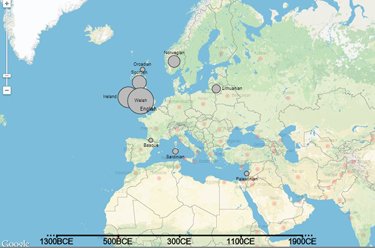
Interactive map of human genetic history
A global map detailing the genetic histories of 95 different populations across the world, showing likely genetic impacts of all sorts of events including the 13th century Mongol Invasion of Europe, has been revealed for the first time.
The interactive map, produced by researchers from Oxford University and UCL (University College London), details the histories of genetic mixing between each of the 95 populations across Europe, Africa, Asia and South America spanning the last four millennia.
The study, published this week in Science, simultaneously identifies, dates and characterises genetic mixing between populations. To do this, the researchers developed sophisticated statistical methods to analyse the DNA of 1490 individuals in 95 populations around the world. The work was chiefly funded by the Wellcome Trust and Royal Society.
Read more
The group with the longest time since admixture is detected are the Kalash from Pakistan, with an
ancient inferred event prior to 206BCE, involving mixing between a more European group, and a more
Central/South Asian group (there may also be a contribution from people carrying DNA shared with
modern-day East Asians, but we are less certain about this). Some Kalash believe they are descended
from the army of Alexander the Great, as do other groups in the region, some of whom show similar
early events–our date does not rule this out but the date range also allows for other possibilities. …
There are a number of populations that show admixture events that are not straightforward enough to
be categorized by our current analysis. For example, the French show an event involving Northern and
Southern European and North African populations dating to 1085 years ago plus or minus 300 years.
However, according to the automated quantitative criterion we developed for characterizing admixture
events, this event is characterized as “uncertainâ€.
From the Science Junkie via Ratak Monodosico.
03 Jul 2014

“7 Daughters of Eve” DNA researcher Brian Sykes and his Oxford team decided to look into Bigfoot-Yeti legends from many continents.
IFL Science:
In 2012, they put out a call to museums and individuals for cryptid hair samples. What usually happens is a person hears one howling, and “then they see a clump of hair caught in a bush, and say ‘Aha, that’s come from the Bigfoot,’†Sykes tells National Geographic. They received 57 samples.
After weeding out plant matter and glass fibers, they selected 36 for genetic analysis. Over half came from the US; the rest are from Russian and South Asia. The team methodically cleaned 2-4 centimeter shaft samples, and then amplified the ribosomal mitochondrial DNA 12S fragment — a snippet commonly used for species identification. Some failed to yield DNA sequences, and the team ended up with 30 recovered sequences, which they compared with GenBank data. They got a 100 percent match for each one.
Most samples attributed to hairy beast-men were identified as known species living in their normal geographical range: 10 were brown or black bears, four came from some canine, and the rest were raccoons, horses, cows, sheep, deer, a goat-like serow, and a porcupine. One Texan sample came back as human (very unlikely Neanderthal). The sample that supposedly came from the Sumatran orang pendek (Indonesian for “short personâ€) turned out to be Malaysian tapir.
But there’s more! Two Himalayan yeti samples — one from Ladakh, India, and the other from Bhutan — came from a mystery bear whose closest genetic affinity is to an ancient polar bear, based on DNA from the jawbone of a Paleolithic Ursus maritimus who lived 40,000 years ago. The golden-brown Ladakh sample was collected by a hunter four decades ago when he thought he shot an abnormally aggressive brown bear. The reddish-brown Bhutan sample came from what was known to be a migyhur (or yeti) nest in a bamboo forest 3,500 meters in the air. The researchers suspect these hairs came from unrecognized bear species, color variants of polar bears, or maybe a polar bear x brown bear hybrid (pizzlies!), though they can’t know for sure without genomic sequence data.
18 Jun 2014

Marc Chagall, I and the Village, Museum of Modern Art, New York.
In Tablet magazine, Cherie Woodworth reviews the fascinating debate on the origin of the Yiddish language.
That history revolves around two theories, that proposed by Max Weinrich:
If you want to know not just what Yiddish is but where it came from, how it managed to survive and even to flourish, you can do no better than the new edition of Max Weinreich’s History of the Yiddish Language—but be sure to read the footnotes. They extend for over 750 pages, are now published in English for the first time in the new Yale edition, and contain the most interesting, and controversial, part of what had seemed till now a fairly straightforward and unchallenged historical narrative.
Weinreich’s original text and notes were published in 1973, four years after his death. A partial translation into English—without the notes—was published by the University of Chicago Press in 1980. Yale’s new edition thus finally makes available for the first time the greater part of Weinreich’s work—the notes are longer than the text—thoroughly edited by Paul Glasser. The notes cite research in two dozen languages and took more than a decade to edit and check even after they were translated. These notes are not just the usual formal apparatus, reassuring to any scholarly reader: They are essential to understanding Weinreich’s many-stranded argument about the relationship between culture and language. They also provide a subtle counter-argument to his lifelong thesis. Weinreich was a careful, fair, and judicious scholar, and it was in the notes to his monumental work that he gave place to the vexing confusion of counter-evidence to his main, and beloved, story of Yiddish origins and, by implication, the origins of millions of East European Jews and their descendants in America. …
Weinreich’s basic story of the beginnings of Yiddish in the Rhine valley and its centrality in creating a European Jewish culture are repeated everywhere, and without question. But the pillars of Weinreich’s argument are too broad, their foundations in a millennial-old history too unstable, to be as unshakable as his subsequent readers have made them seem—a fact that Weinreich knew very well. He was too careful a scholar to buy into a simplistic view, as the publication of the notes now clearly reveals.
Weinreich’s first innovation in the History was to argue, against apparent common sense and abundant personal experience, that Yiddish was formed not through isolation but through constant interaction combined with a chosen separateness. The walled-off ghettos of 18th-century European cities, although they preserved Yiddish, were not the environment that gave it life. Weinreich’s innovation was to argue that “Jewish othernessâ€â€”and the language that goes with it—“cannot be the result of ‘exclusion’; it is not even the result of exile.â€
Where others had persistently told the story of confinement, prejudice, and persecution, Weinreich spoke of independence, self-government, selfassertion, and community building. It was undeniable that “without communal separateness there is no separate language,†and so the separateness of the Ashkenazi community was necessary for Yiddish to arise. But the modern explanation for that separateness, according to Weinreich, got the story exactly backward. Nineteenth-century Jewish activists, demanding rights of citizenship, created the story that the Jews had been locked in ghettos since the Middle Ages, “and thus excluded from society at large and its intellectual development; in this forced isolationâ€â€”an influential Jewish assimilationist argued—“both their mode of life in general and their language in particular became corrupted.†…
For Weinreich, based on both the linguistic and historical evidence, there could be no doubt that up until the 18th century “the Jews wanted to be by themselves. … Separate residence (strange as this may appear in the light of present Jewish and general conceptions of rights) was part of the privileges granted the Jews at their own request†so they could worship together; provide for their own slaughterhouse, bathhouse, cemetery, and social halls; study together; run their own rabbinic courts; supervise tax collection; and when necessary, protect themselves from attacks.
Archeology supports this part of Weinreich’s argument. Befuddled tour guides in Prague struggle to explain why, given the expectation of exclusion of Jews, the city’s famous Jewish quarter, Josefov, is so central to the old town. (One misguided explanation is that the Jews were given land near the river that was too marshy for the other city inhabitants, prone to flooding and disease-bearing miasmas.) But Prague’s Josefov is not an isolated case—it is typical. Weinreich’s point is that exclusion could also be exclusivity; restrictions also came with designated privileges. In Trier, Mainz, Aachen, Cologne, Worms, and more than 100 medieval towns in Central Europe, the Jewish district was both a central and a prime location, close to the economic heart of the city. The German Bishop Rüdiger, granting a charter of the city of Speyer in 1084 wrote, “I thought that I would increase the glory of our city a thousandfold if I were to include Jews.†…
Once he demonstrated that Yiddish is an independent language, Weinreich explained how it came to be, first as an altered language formed among medieval Jewish trading settlements in the French–German borderland along the Rhine valley. Weinreich deduced from traces left in early Yiddish that these first Jewish immigrants to the heart of Europe spoke a Romance language, having left Hebrew, Aramaic, and Greek behind when they left the eastern Mediterranean, although Hebrew and Aramaic were still languages of study. But early on (in the 10th or 11th century) these Jews from Rhineland France, presumably through contact with Jewish settlements in southern Germany, converted from old Judeo-French to western Yiddish, which was more purely German with some elements of Latin or early French. In subsequent centuries—when, exactly, is a source of considerable debate—this language moved east with Jewish emigrants, settlers, and refugees, either in the 12th century (after the Crusades and persecutions) or in the 14th or 15th. There it picked up a significant cargo of Slavic vocabulary and expressions and became the Yiddish more familiar today: eastern Yiddish.
With his 1,000-year history, Weinreich thus removed the East European Jews from both the poor shtetls (the cliché associated with Jewish immigrants to America of the 19th and early 20th century) and their tragic end. Distancing them from their Slavic neighbors, who had little cultural cachet in America, and bypassing the association with Germany, which had become toxic after 1945, he placed their roots instead in France, where Jews still like to go on vacation.
And the alternative argued by Paul Wexlar:
[H]ow to account, demographically, for the millions of Jews who appear on the records in Poland, Ukraine, Lithuania, Hungary, and elsewhere by the 19th century. Immigration following the medieval Crusades and expulsions from Western Europe, followed by 400 to 500 years of natural biological growth, are not enough to account for the size of the East European Jewish population. The numbers simply don’t add up. Two scholars from disparate fields of inquiry have recently tried anew to solve this puzzle, first noted at least a century ago: Paul Wexler from comparative linguistics and David Goldstein from genetics.
The title of Paul Wexler’s detailed study, The Ashkenazic Jews: A SlavoTurkic People in Search of a Jewish Identity, is not shy about his claim: Yiddish has Slavic grammar, syntax, morphemes, phonemes, and lexicon, with a smaller input from Turkic. Wexler made the case that Yiddish is a “relexificationâ€â€”a massive borrowing of Germanic words onto a basically Slavic structure, as opposed to Weinreich’s view that Slavic words were added to a Germanic structure. Wexler’s claim applies not only to the language: “The bulk of their [Ashkenazi Jewish] religious practices and folkways also prove to be of Slavic origin†and thus “the Ashkenazic [sic] Jews may be in the main ethnic Slavsâ€â€”Wexler added his own italics, in case readers should not get the point. Wexler’s preferred term for modern Judaism was “Judaized pagano-Christianity,†though he used the term rarely on the grounds that it was too cumbersome. …
Genetics might provide us with an exit to this uncomfortable, and vexingly arcane, linguistic argument. Recent studies of markers on the Y chromosome of Ashkenazi men hold out the possibility of determining, with apparent mathematical precision, how many Ashekenazi men share markers distinctive to the European, Middle Eastern, or other (for example, Central Asian Turkic) gene pool. The results are inconclusive, puzzling, and unexpected. David Goldstein, a molecular geneticist at Duke, undertook to trace Y markers among two Ashekenazi subgroups: the Cohanim (the class of priests narrowly defined) and the Levites (liturgical officiants from the tribe of Levi). He found that the Cohanim from both Ashkenazi and Sephardic populations shared an unusual marker on the Y chromosome that set them apart both from the surrounding non-Jewish populations—and from their own communities. He traced the marker to a mutation originating about 3,000 years ago and suggested in conclusion that this showed both groups had a real and unbroken genetic link with the original priestly Jews of Israel. (He received tremendous media coverage as a result.)
The Ashkenazi Levites, on the other hand, showed a puzzling genetic signature: they did not match particularly well with the Cohanim, nor with the broader population of Ashkenazi Jews. Comparing this group with the most common Y-chromosome micro-mutations in European and West Eurasian populations (i.e., Turkic and Caucasian tribes), Goldstein concluded that though he had at first been very skeptical of the “Khazar hypothesis†that Ashkenazi Jews came to Eastern Europe from the Eurasian steppe, rather than from Germany, he now found it “plausible, if not likely†and “worth investigating further.â€
In his latest work—more linguistic studies, as well as an etymological dictionary of Yiddish—Wexler argues that the core of what became the Ashkenazi Jews originated not in post-exilic Judea, later dispersed through the Mediterranean Roman Empire, but in Persia: the Azhkenazi(c) Jews were “an outgrowth of Jewish Iranians who brought Judaism to the Khazars, and subsequently migrated westwards with Turkic-origin Jews and non-Jewish Khazars.â€
Read the whole thing, and look forward to part two.
16 May 2014

One of the earliest examples of human remains ever found in the Americas, an Ice Age skeleton, 12,000 to 13,000 years old, of a sixteen-year-old girl was found in 2007 in Hoyo Negro, an underwater cave in Mexico’s Yucatan Peninsula. The cave also contained skeletal remains of saber-toothed tigers, gomphotheres, two species of giant ground sloth (including one previously unknown to Science), cougars, cave bears, coyotes, bats and other small animals. The girl’s skeletal remains were DNA-tested, and her Mitochondrial DNA identified as belonging to Haplogroup D1, one of five haplogroups typical of Native Americans.
National Geographic article & video
Current coverage was occasioned by the appearance of an article in Science.
Hat tip to Karen L. Myers.
19 Oct 2013

Geneticist Bryan Sykes may have identified the mysterious Abominable Snowman of the Himalayas.
BBC story with video.
Research by a British scientist has concluded that the legendary Himalayan yeti may in fact be a sub-species of brown bear.
DNA tests on hair samples carried out by Oxford University genetics professor Bryan Sykes found that they matched those from an ancient polar bear.
He subjected the hairs to the most advanced tests available.
He says the most likely explanation for the myth is that the animal is a hybrid of polar bears and brown bears.
Prof Sykes told the BBC that there may be a real biological animal behind the yeti myth.
“I think this bear, which nobody has seen alive,… may still be there and may have quite a lot of polar bear in it,” he said.
“It may be some sort of hybrid and if its behaviour is different from normal bears, which is what eyewitnesses report, then I think that may well be the source of the mystery and the source of the legend.”
Prof Sykes conducted the DNA tests on hairs from two unidentified animals, one from Ladakh – in northern India on the west of the Himalayas – and the other from Bhutan, 1,285km (800 miles) further east.
The results were then compared with the genomes of other animals that are stored on a database of all published DNA sequences.
Suspected yeti footprints in Nepal Suspected yeti footprints – such as these in Nepal – are regularly photographed
Prof Sykes found that he had a 100% match with a sample from an ancient polar bear jawbone found in Svalbard, Norway, that dates back to between 40,000 and 120,000 years ago – a time when the polar bear and closely related brown bear were separating as different species.
The species are closely related and are known to interbreed where their territories overlap.
The sample from Ladakh came from the mummified remains of a creature shot by a hunter around 40 years ago, while the second sample was in the form of a single hair, found in a bamboo forest by an expedition of filmmakers around 10 years ago.
Prof Sykes said that his results were “completely unexpected” and that more work needed to be done interpreting them.
Read the whole thing.
/div>

Feeds
|





