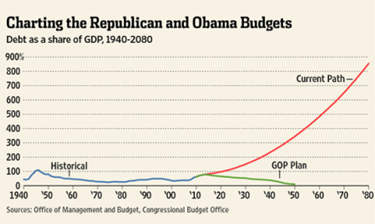
Janet Daily, in the British Telegraph, recognizes that America is having the kind of election that European countries are incapable of having: an election in which one party is proposing to face economic reality.
Whatever the outcome of the American presidential election, one thing is certain: the fighting of it will be the most significant political event of the decade. Last week’s Republican national convention sharpened what had been until then only a vague, inchoate theme: this campaign is going to consist of the debate that all Western democratic countries should be engaging in, but which only the United States has the nerve to undertake. The question that will demand an answer lies at the heart of the economic crisis from which the West seems unable to recover. It is so profoundly threatening to the governing consensus of Britain and Europe as to be virtually unutterable here, so we shall have to rely on the robustness of the US political class to make the running.
What is being challenged is nothing less than the most basic premise of the politics of the centre ground: that you can have free market economics and a democratic socialist welfare system at the same time. The magic formula in which the wealth produced by the market economy is redistributed by the state – from those who produce it to those whom the government believes deserve it – has gone bust. The crash of 2008 exposed a devastating truth that went much deeper than the discovery of a generation of delinquent bankers, or a transitory property bubble. It has become apparent to anyone with a grip on economic reality that free markets simply cannot produce enough wealth to support the sort of universal entitlement programmes which the populations of democratic countries have been led to expect. The fantasy may be sustained for a while by the relentless production of phoney money to fund benefits and job-creation projects, until the economy is turned into a meaningless internal recycling mechanism in the style of the old Soviet Union.
Or else democratically elected governments can be replaced by puppet austerity regimes which are free to ignore the protests of the populace when they are deprived of their promised entitlements. You can, in other words, decide to debauch the currency which underwrites the market economy, or you can dispense with democracy. Both of these possible solutions are currently being tried in the European Union, whose leaders are reduced to talking sinister gibberish in order to evade the obvious conclusion: the myth of a democratic socialist society funded by capitalism is finished. This is the defining political problem of the early 21st century.
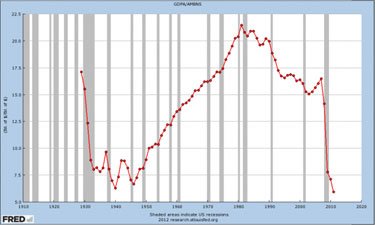
Money velocity has recently declined far below any point during the Great Depression of the 1930s.
Tyler Durden argues that the real state of the US economy, measured by velocity of money, is today far worse than it was during the Great Depression, and federal monetary easing is a disastrous policy certain to produce the same result very shortly in the United States that it did in Weimar Germany.
Velocity of money is the frequency with which a unit of money is spent on new goods and services. It is a far better indicator of economic activity than GDP, consumer prices, the stock market, or sales of men’s underwear (which Greenspan was fond of ogling). In a healthy economy, the same dollar is collected as payment and subsequently spent many times over. In a depression, the velocity of money goes catatonic. Velocity of money is calculated by simply dividing GDP by a given money supply. This VoM chart [above] using monetary base should end any discussion of what â€this†is and whether or not anybody should be using the word “recovery†with a straight face.
In just four short years, our “enlightened†policy-makers have slowed money velocity to depths never seen in the Great Depression. Hard to believe, but the guy who made a career out of Monday-morning quarterbacking the Great Depression has already proven himself a bigger idiot than all of his predecessors (and in less than half the time!!). During the Great Depression, monetary base was expanded in response to slowing economic activity, in other words it was reactive (here’s a graph) . They waited until the forest was ablaze before breaking out the hoses, and for that they’ve been rightly criticized. Our “proactive†Fed elected to hose down a forest that wasn’t actually on fire, with gasoline, and the results speak for themselves. With the IMF recently lowering its 2012 US GDP growth forecast to 2%, while the monetary base is expanding at about a 5% clip, know that velocity of money is grinding lower every time you breathe.
The Fed’s refusal to recognize the importance of velocity of money quickly goes from idiotic to insidious. Here’s a question: If I give you 50¢ and as a result of that transaction, you owe me $1.00, what interest rate have I charged you? Obviously, I’ve charged you 100% interest. ….
In 2011, every dollar of GDP growth created $2.08 in debt. In real life, that’s 108% interest plus the nominal rate, and our twisted leaders want you say, “Thank you sir, may I have another!â€
2011 wasn’t an anomaly either; it’s the new normal.
James Delingpole, at the Telegraph, is offering readers an economics red pill.
The red pill – for those who haven’t seen The Matrix – is the one which shows you the world as it really is rather than cosy, fantasy confection of the popular imagination. The red pill is not for the fainthearted because it involves confronting painful, ugly reality rather than living the dream.
Let me give you an example of what taking the red pill entails. It’s a report from last year by the Boston Consulting Group showing that the amount of household, corporate and government debt which needs to be eliminated stands at $21 trillion. The cost of dealing with this “debt overhang” will entail the loss (ie confiscation by the government) of one third of the wealth of the asset-owning classes. Some time in the next few months, weeks or years, we’re all going to be taking a 30 per cent hair cut.
Anselm Kiefer, Abendland (Twilight of the West), 1989
Mark Steyn gloomily predicts that the attempts of politicians to deliver material comfort, cradle-to-the-grave security, and substantial life intervals of leisure to the masses are not compatible with economic reality.
In the twilight of the West, America and Europe are still different but only to this extent: They’ve wound up taking separate paths to the same destination. Whether you get there via an artificial common currency for an invented pseudo-jurisdiction or through quantitative easing and the global decline of the dollar, whether you spend your final years in the care of Medicare or the National Health Service death panels, whether higher education is just another stage of cradle-to-grave welfare or you have a trillion dollars’ worth of personal college debt, in 2012 the advanced Western social-democratic citizen looks pretty similar, whether viewed from Greece or Germany, California or Quebec.
That’s to say, the unsustainable “bubble†is not student debt or subprime mortgages or anything else. The bubble is us, and the assumptions of entitlement. Too many citizens of advanced Western democracies live a life they have not earned, and are not willing to earn. …
Look around you. The late-20th-century Western lifestyle isn’t going to be around much longer. In a few years’ time, our children will look at old TV commercials showing retirees dancing, golfing, cruising away their sixties and seventies, and wonder what alternative universe that came from. In turn, their children will be amazed to discover that in the early 21st century the Western world thought it entirely normal that vast swathes of the citizenry should while away their youth enjoying what, a mere hundred years earlier, would have been the leisurely varsity of the younger son of a Mitteleuropean Grand Duke.
As usual, Mark Steyn’s rhetoric is well worth the read, but I do not entirely agree.
I think it’s true that the dynamic of egalitarian democracy by its nature faces the fundamental danger of an ongoing benefits auction for the masses’ political support which will always in the end wind up devouring too great a portion of the economy resulting in disaster.
But I think myself, on the other hand, that, if government regulation and economic meddling were minimized and the burden of taxation was modest, economic growth could create and sustain an economically-independent and leisured middle class, much larger than the vanished one which existed in Britain and America before 1914. It’s just not possible to lift all the boats all at once.
I do strongly agree with Mark Steyn that our current model of near-universal college education, consisting of four years of leisure and good times combined with plenty of left-wing indoctrination, represents a simply astounding waste of human energy and talent.
Between useless high school and useless college, millions upon millions of people today fritter away what are actually their most healthy, energetic, and potentially productive years imbibing modest quantities of learning, having a good time, and being flattered into believing that are members of an omniscient elite charged with the revolutionary overthrow of a wicked and stupid past. It would be infinitely better all the way around if 90+% of everyone simply went to work at 13, as my parents’ generation generally did.
The Times talks to one of Mitt Romney’s partners at Bain who has written a book explaining the vital role of inequality of result in providing the funding that makes innovation and economic growth possible.
[Edward] Conard, who retired a few years ago at 51, is not merely a member of the 1 percent. He’s a member of the 0.1 percent. His wealth is most likely in the hundreds of millions; he lives in an Upper East Side town house just off Fifth Avenue; and he is one of the largest donors to his old boss and friend, Mitt Romney.
Unlike his former colleagues, Conard wants to have an open conversation about wealth. He has spent the last four years writing a book that he hopes will forever change the way we view the superrich’s role in our society. Unintended Consequences: Why Everything You’ve Been Told About the Economy Is Wrong to be published in hardcover next month by Portfolio, aggressively argues that the enormous and growing income inequality in the United States is not a sign that the system is rigged. On the contrary, Conard writes, it is a sign that our economy is working. And if we had a little more of it, then everyone, particularly the 99 percent, would be better off. This could be the most hated book of the year.
Obama’s EPA riding over the bodies of energy producing companies
Why is the US economy a wreck? Why are we paying sky-high prices at the gasoline pump? We have an administration in Washington that is philosophically bent on treating the productive free market economy the same way a conquering Roman general or invading barbarian horde would treat a foreign territory. The democrat party left views the private sector economy as a victim it is entitled to conquer, rule over, and loot at will.
You couldn’t have a clearer demonstration of the total incomprehension on the part of the left of the role of freedom and the rule of law in making possible economic growth, innovation, and prosperity. When this country elected Barack Obama, it really in essence turned over control of the government to someone with the same economic perspective as Attila the Hun.
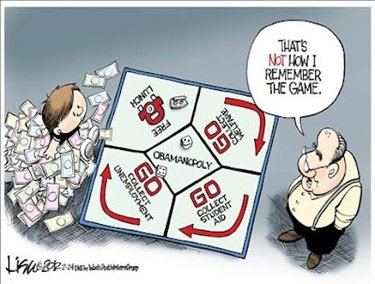
Ezra Klein offers the left’s intellectually bankrupt and futile response. Young Ezra has nothing to offer but emotionally manipulative appeals to sentimentality. The Obama budget must be supported, regardless of consequences or affordability because it spends lots of money on the poor. “The poor” are a species of Brahmanic sacred cattle whose interests trump reality.
It doesn’t matter if you bankrupt the country and strangle economic growth affecting everyone. If you fail to immolate the American economy on the altar of bleeding heart social consciousness, you are just mean!
Ezra is a member of the economic school that wants to raise taxes (and stifle economic activity) now. After all, as unidentified “experts” cited by the Associated Press announced today, no study accepted by the left proves that drilling (and thereby increasing petroleum supply) reduces gas prices.
If you are simply an irrational emotionalist, economics is whatever left-wing studies say it is, and the proper operation of any economy really consists of transfers of wealth from the more affluent to the less affluent members of society.
Andy Laperriere explains that the federal government’s cheap money/low interest policies have very real costs, including the long term reduction of economic growth.
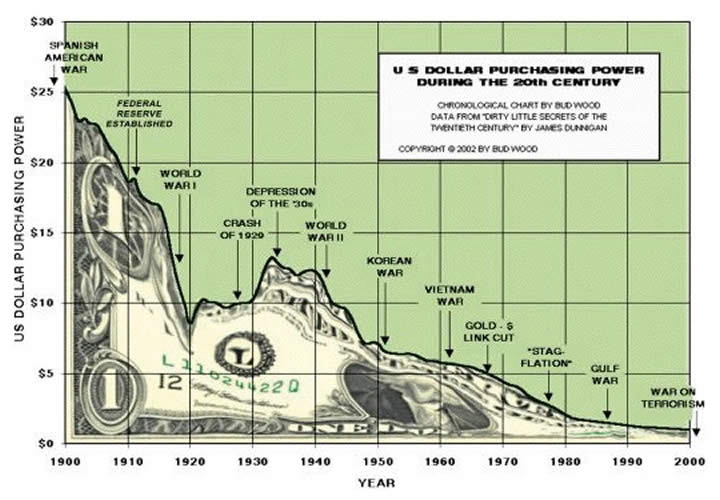
During the past three years, the Federal Reserve has tripled the size of its balance sheet—in effect printing $2 trillion—something it had never done in its nearly 100-year history. The Fed has lowered short-term interest rates to zero and signaled that it will keep them at that level for years. Inflation-adjusted short-term rates, or real rates, have been in the minus 2% range during the past couple of years for the first time since the 1970s.
The unfortunate fact is, as Milton Friedman famously observed, there is no free lunch. After the Fed’s loose monetary policy helped spur the boom-bust in housing, it’s remarkable how little attention has been devoted to exploring the costs of Fed policy.
A few critics of quantitative easing (QE) and the zero interest rate (ZIRP) have correctly pointed out that these policies weaken the dollar and thereby reduce the purchasing power of American paychecks. They increase the risk of future inflation, obscure the true cost of the unsustainable fiscal policy the federal government is running, and transfer wealth from savers to debtors.
But QE and ZIRP also reduce long-term economic growth by punishing savers, reducing saving and investment over the long run. They encourage the misallocation of resources that at a minimum is preventing the natural rebalancing of our economy and could sow the seeds of another painful boom-bust.
One intended effect of a loose monetary policy is a weaker dollar, which can help gross domestic product by boosting exports. But a weaker dollar also raises import prices (such as oil prices) for American consumers. For the average American family, this adverse impact has likely outweighed any positive impact from QE and ZIRP.
Conservatives (really more accurately referred to as “liberals”) argue that the free market produces superior allocations of resources because of its natural access to superior information on supply and demand provided by the voluntary input of enormously large numbers of individual human beings. The free market consequently inevitably operates on the basis of better information than any possible small group of political leaders or experts can ever hope to possess. Beyond mere utility, the free market additionally has morality on its side. Human beings are morally entitled to exchange what is their own, whether goods, services, or currency, as they desire and think best. The alternative to freedom is always coercive force, and freedom is intrinsically morally better than coercion.
Progressives reject the free market, noting that it fails to make the idle prosperous, the incompetent and the unlucky successful, and the improvident and intoxicated equal in security and material success to the responsible and provident.
Since the free market never actually seems able to deliver heaven on earth, progressives proposed that government should intervene to establish a safety net to assure that no one, no matter how unlucky or ill-behaved, should be left without the necessities of human existence.
Progressives demand that we should all surrender some significant portion of our economic liberty and deliver control over the free market to government specifically because they believe that the rule of credentialed experts will deliver superior results.
The Progressive experiment, which has gone on for many decades now, has survived this long because of the capacity of capitalist enterprise to deliver prosperity and economic growth despite being shackled by ever-increasing levels of regulation and despite the diversion of substantial percentages of economic output to entitlements.
Our expert rulers, in reality, merely exchanged an ever-increasing slice of the entire economy for more political support. Their calculations were fraudulent and completely risible, burying information unfavorable to their ends, achieving balanced budgets by phony bookkeeping, and invariably relying on wildly optimistic projections to cause their plans’ mathematics to add up.
In good times, progressive experts have always spent more, added new programs, and constructed new bureaucratic empires, piling the promises for the future up to the stars. When the budget didn’t really add up, they simply placed their trust in the ability of the capitalist system to deliver enough growth, soon enough, to save them, and simply kicked the can of fiscal responsibility down the road to be dealt with later.
Now, of course, in both Europe and America, the music has finally stopped, the game is over. There is no more road to kick the can down. America and Europe have hit the point where the costs of government are dramatically impairing the free market’s ability to deliver prosperity and growth. The capitalist goose has been shaken and squeezed and strangled, but there is no increase in egg production occurring.
It seems perfectly evident to me that, if what the progressives believe, that the rule of scientifically trained experts can improve upon the results of the free market, those experts would have, in the course of all their training and elite education, encountered Chapter 41 of the Book of Genesis in which Joseph successfully interprets Pharaoh’s dream to mean that seven fat years will be followed in turn by seven lean years, and counsels Pharaoh to set aside a portion of his government’s revenues to cover future shortfalls during the seven lean year recession.
The current international economic crisis demonstrates vividly that contemporary progressive economic planning is not only inferior to free market results, it is decidedly inferior to Bronze Age Middle Eastern economic administration.
Essentially what has happened is that progressive establishment elites, those who claim the right to rule over all the rest of us on the basis of their superior wisdom, training, and credentials, have flown the Entitlement State airplane right into the ground. They wrecked the economies of a large number of nations by creating a crisis through market interference and mismanagement. They have issued too many promises and threaten to bankrupt their nation’s economies far into the future.
The current recession proves, once and for all, that the wise men of progressivism were never very wise at all, and that their claim of a right to overrule liberty and the free market on the basis of superior wisdom and morality is not well-founded.
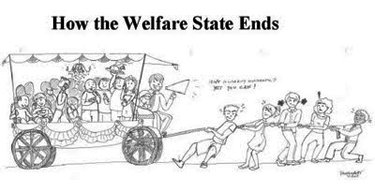
When you steer the cart off the road, you don’t get to take the wheel again and continue driving. It is time for a change of driver.
The feature humor item you’ll be seeing everywhere this holiday season is about a drastic shortage of butter in Norway occurring just as the Christmas season is at hand.
The journalists are telling us that the scarcity is the result of recent high Norwegian butter consumption resulting from a fashionable low-carb, high-fat diet on top of reduced production caused by a shortage of hay due to an unusually rainy summer growing season.
Profiteers are reported trying to charge as much as 350 euros ($465) for a 500-gram (1.1 lb. or 1 lb and 1.6 oz) packet of butter.
Ho, ho! Isn’t it funny?
None of the features on this news item I have found, however, notes that no butter shortage exists elsewhere in Europe or in the United States. But the AFP story offers a clue:
Last Friday, customs officers stopped a Russian at the Norwegian-Swedish border and seized 90 kilos (198 pounds) of butter stashed in his car.
The butter shortage obviously is not result, in a modern world, of a local dairy feed shortage, or of local supplies being exhausted by unusual demand. With rising demand and consumers willing to pay higher prices, the supply would be being met by enterprising Russians trying to make a kroner, if government were not standing in the way.
It is obvious that some kind of Norwegian limits on butter importation, doubtless in place to protect Norwegian dairy farmers, prevents legal access to supplies from abroad.
Norway’s holiday problem isn’t really about diet fads or rainy summers. It’s about government doing what government likes to do: delivering favors to special interests at the expense of society as a whole.
lynnux notes that government regulation establishes the rules by which banks operate and even creates their opportunities for profits, but these vital economic realities come into being in the first place through the agency of politicians, people like Barney Frank, whose expertise (such as it is), and interests and concerns have no connection to economic realities or markets.
Politicians seem such busy-beavers today, “doing things†“for†us. Why such whirling dervishes, generating laws in bulk? In its broadest outlines, law is mostly static. Politicians seek to appear to the public to be men of action “doing something.†This leads them to make too many economic and personal choices that they are not supposed to be making “for†us at all, picking winners and losers. It is now to the point where, famously, they no longer even read the laws they promulgate upon the body politic. Their process is finger in the wind (test the zeitgeist for what buzz evokes positives), then claim to be acting in name of the democratic will of the people—who, like banks to regulators, can later be blamed, should anything go wrong. As a republic, not a direct democracy, our representatives are supposed to be doing the right thing, in their best judgment. We rely on their decency, wisdom, and intelligence and vision for the long term. They have no way of knowing anything about their constituency anyway, because to pollsters, people only express self-interest, not the public interest. The public interest can only be assessed at a remove, which is the representative’s job. Pollsters get whatever they fish for. Responders also like to echo conventional wisdom. Implementing conventional wisdom is not politicians’ job. …
Politicians wrapped in soundbites simply may not be qualified to make all the rules they seek to impose on us in their show of “caring†for us. This, I think, is what Richard Posner is getting at when he speaks of The Crisis of Capitalist Democracy. We need systems engineers today who really do understand the system. Politicians are mostly not this, but marketing specialists. They dissolve always into futile calls for infinitely ethical global governmental forces (themselves) to abolish investment uncertainty in a complicated utopian merger with perfect empirical risk analysis, forgetting that the past is no divining rod of the future (nor of truth. …
The law is being asked to make business judgments law simply should not be making at all. Law is static. Markets are not. The market will adjust to any fixed rule, changing the “new normal.†Positive feedback loops (“positive†does not imply good) can ensue, at many unexpected levels. The media’s celebrity focus on political figure summiteering, however, follows an old trope, of suggesting to the public that our pseudo-gods and deities, through law, can command markets. These heroes then arrogantly begin to believe their press releases and to act accordingly.
Lawyers often go to law school precisely because they don’t like math or statistics. The type can quite easily ignore economic reality as they proceed to plug old forms and numbers into new contexts.
“The core problem underneath all of this, when you whittle it down, is that we simply are not getting enough growth in the developed world economies to pay our way out of all the debts that those economies have built up by making promises that are undeliverable to public sector workers.”




 to be published in hardcover next month by Portfolio, aggressively argues that the enormous and growing income inequality in the United States is not a sign that the system is rigged. On the contrary, Conard writes, it is a sign that our economy is working. And if we had a little more of it, then everyone, particularly the 99 percent, would be better off. This could be the most hated book of the year.