Category Archive 'History'
12 Sep 2015

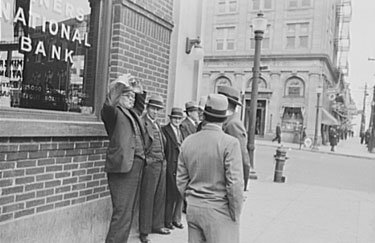
Shenandoah, Pennsylvania, corner of Main & Centre in front of Miners’ National Bank, circa 1940: coal miners on their days-off would customarily wear suits, neckties, and hats.
The Washington Posts’s Roberto A. Ferdman discusses with University of Nevada Fashion historian Dierdre Clemente the fashion triumph of “casual dress.”
There’s this fashion theorist who wrote in the 1930s about how in capitalist societies, clothing serves as this way to jump in and out of socioeconomic class. Now, he was writing at a time when people were still really trying to jump up, and could feign wealth. You could buy a nice-looking suit and make it seem like you were a lot more wealthy than you actually were then. But in the second half of the 20th century, what we’ve seen is people doing just the opposite. …
There’s something called collective selection. And what it is, is the idea that no longer is it the rich people telling the poor people how to dress, no longer is it that the poor people want to wear what the rich wear. Nowadays it’s a group decision. Because class is so wishy washy today, since everyone thinks that they’re middle class, the collective selection is what is acceptable in different scenarios — the office, the church, the classroom, etc. It’s decided by the group.
Read the whole thing.
11 Sep 2015

Captain Rescorla in action at Ia Drang, Republic of Vietnam, 15 November 1965.
photograph: Peter Arnett/AP.
Born in Hayle, Cornwall, May 27, 1939, to a working-class family, Rescorla joined the British Army in 1957, serving three years in Cyprus. Still eager for adventure, after army service, Rescorla enlisted in the Northern Rhodesia Police.
Ultimately finding few prospects for advancement in Britain or her few remaining colonies, Rescorla moved to the United States, and joined the US Army in 1963. After graduating from Officers’ Candidate School at Fort Benning, Georgia in 1964, he was assigned as a platoon leader to Bravo Company of the 2nd Battalion, 7th Cavalry, Third Brigade of the 1st Cavalry Division (Airmobile). Rescorla’s serious approach to training and his commitment to excellence led to his men to apply to him the nickname “Hard Corps.”
The 2nd Battalion of the 7th Cavalry was sent to Vietnam in 1965, where it soon engaged in the first major battle between American forces and the North Vietnamese Army at Ia Drang.
The photograph above was used on the cover of Colonel Harold Moore’s 1992 memoir We Were Soldiers Once… and Young, made into a film starring Mel Gibson in 2002. Rescorla was omitted from the cast of characters in the film, which nonetheless made prominent use of his actual exploits, including the capture of the French bugle and the elimination of a North Vietnamese machine gun using a grenade.
For his actions in Vietnam, Rescorla was awarded the Silver Star, the Bronze Star (twice), the Purple Heart, and the Vietnamese Cross of Gallantry. After Vietnam, he continued to serve in the Army Reserve, rising to the rank of Colonel by the time of his retirement in 1990.
Rick Rescorla became a US citizen in 1967. He subsequently earned bachelor’s, master’s, and law degrees from the University of Oklahoma, and proceeded to teach criminal law at the University of South Carolina from 1972-1976, before he moved to Chicago to become Director of Security for Continental Illinois Bank and Trust.
In 1985, Rescorla moved to New York to become Director of Security for Dean Witter, supervising a staff of 200 protecting 40 floors in the South Tower of the World Trade Center. (Morgan Stanley and Dean Witter merged in 1997.) Rescorla produced a report addressed to New York’s Port Authority identifying the vulnerability of the Tower’s central load-bearing columns to attacks from the complex’s insecure underground levels, used for parking and deliveries. It was ignored.
On February 26, 1993, Islamic terrorists detonated a car bomb in the underground garage located below the North Tower. Six people were killed, and over a thousand injured. Rescorla took personal charge of the evacuation, and got everyone out of the building. After a final sweep to make certain that no one was left behind, Rick Rescorla was the last to step outside.
—————————————-

Directing the evacuation on September 11th.
Security Guards Jorge Velasquez and Godwin Forde are on the right.
photograph: Eileen Mayer Hillock.
Rescorla was 62 years old, and suffering from prostate cancer on September 11, 2001. Nonetheless, he successfully evacuated all but 6 of Morgan Stanley’s 2800 employees. (Four of the six lost included Rescorla himself and three members of his own security staff, including both the two security guards who appear in the above photo and Vice President of Corporate Security Wesley Mercer, Rescorla’s deputy.) Rescorla travelled personally, bullhorn in hand, as low as the 10th floor and as high as the 78th floor, encouraging people to stay calm and make their way down the stairs in an orderly fashion. He is reported by many witnesses to have sung “God Bless America,” “Men of Harlech, ” and favorites from Gilbert & Sullivan operettas. “Today is a day to be proud to be an American,” he told evacuees.
A substantial portion of the South Tower’s workforce had already gotten out, thanks to Rescorla’s efforts, by the time the second plane, United Airlines Flight 175, struck the South Tower at 9:02:59 AM. Just under an hour later, as the stream of evacuees came to an end, Rescorla called his best friend Daniel Hill on his cell phone, and told him that he was going to make a final sweep. Then the South Tower collapsed.
Rescorla had observed a few months earlier to Hill, “Men like us shouldn’t go out like this.” (Referring to his cancer.) “We’re supposed to die in some desperate battle performing great deeds.” And he did.
—————————————-
His hometown of Hayle in Cornwall has erected a memorial.

—————————————-
2,996 was a project put together by blogger Dale Roe to honor each victim of the September 11, 2001 attacks. 3,061 blogs committed to posting tributes to each victim. Never Yet Melted’s tribute was to Rick Rescorla, and is republished annually.
19 Aug 2015

I don’t often agree with Conor Friedersdorf, but this time he nails it. I’m myself the grandson of turn-of-the-last-century Lithuanian immigrants. My ancestors arrived legally, because immigration was all but unregulated before 1905 and had no limits on anyone except East Asians before 1921.
I know a lot of people I went to school with in my hometown, of precisely the same background as myself, who have convinced themselves somehow that their ancestors arrived on the Mayflower, and who are now horrified to see the American landscape polluted by a new wave of exotic greenhorn immigrants speaking imperfect English.
Donald Trump’s immigration paper asserts, as “core principles,†that “there must be a wall across the southern border†because “a nation without borders is not a nation.†And it argues that “any immigration plan must improve jobs, wages, and security for all Americans,†because “a nation that does not serve its own citizens is not a nation.†Many have observed that America has never had a wall across its southern border, and that no immigration plan has ever improved wages and security for all Americans. By Trump’s logic, America has never been a nation.
One wonders what he calls the country that allowed his ancestors to immigrate here.
He is of German stock on his father’s side.
Prior to his grandfather’s arrival, plenty of immigration restrictionists believed, not without reason, that German immigration had irrevocably changed their communities.
As one example, consider what took place in Cincinnati, Ohio.
“In the 1840s and 1850s, Cincinnati society became increasingly unstable as German and Irish immigrants poured in,†The Cincinnati Inquirer reported in a historical retrospective. When an Italian emissary of the Pope visited in 1853, “German Catholics took to the streets armed with guns, pistols, clubs, canes and sling shots trying to run Cardinal Bedini out of town. The Germans, many of whom fled to the U.S. after the failed European revolutions of 1848, saw the priest as a symbol of repression.â€
Two years later, Germans clashed with a nativist mob alarmed by a rumor about electoral shenanigans. “German-Americans barricaded streets into Over-the-Rhine on the north edge of the Miami-Erie Canal,†the story notes. “Members of the Turners, a German physical fitness organization, aimed their cannon and ‘shot it over the head of the mob of nativists that came at them,’ says Don Heinrich Tolzmann, University of Cincinnati German-American studies director and curator of UC’s German-American Collection.†German immigrants, who started many German language settlements in the U.S., “had become such a force at the ballot box that they pushed for—and received—bilingual education in city schools and Sunday beer sales.â€
The Know-Nothing Party ultimately failed at mid-century to stop the immigration of both Irish and Germans. And because they failed, Frederich Christ Trump could immigrate to America in 1885.
Read the whole thing.
——————–
Building a wall across the entire Southern US border would be preposterously expensive as well as constituting a disgraceful expression of totalitarian statism. Hispanic immigrants are not perfect. They are typically socially and educationally inferior to Americans. Some of them are criminals and undesirable. But that’s the way it always was. You get a certain number of crooks and radicals along with a great mass of perfectly assimilable salt-of-the-earth hard working people. America has always needed affordable labor, and America has always needed a new influx of people willing to take the low-paying, unpleasant jobs which native-born Americans, who have typically moved up and out of the laboring class, cannot be found to do.
19 Aug 2015

These two graphs show the number of men (left) and women (right) who reproduced throughout human history.
Pacific Standard:
Once upon a time, 4,000 to 8,000 years after humanity invented agriculture, something very strange happened to human reproduction. Across the globe, for every 17 women who were reproducing, passing on genes that are still around today—only one man did the same.
“It wasn’t like there was a mass death of males. They were there, so what were they doing?” asks Melissa Wilson Sayres, a computational biologist at Arizona State University, and a member of a group of scientists who uncovered this moment in prehistory by analyzing modern genes.
Another member of the research team, a biological anthropologist, hypothesizes that somehow, only a few men accumulated lots of wealth and power, leaving nothing for others. These men could then pass their wealth on to their sons, perpetuating this pattern of elitist reproductive success. Then, as more thousands of years passed, the numbers of men reproducing, compared to women, rose again. “Maybe more and more people started being successful,” Wilson Sayres says. In more recent history, as a global average, about four or five women reproduced for every one man.
13 Aug 2015

A retired soldier sells matches on the street in Canterbury, Kent, 1928.
England in 1928.
12 Aug 2015
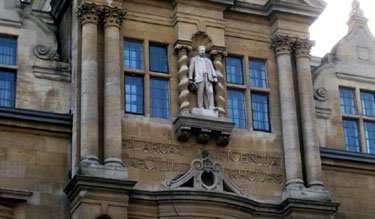
Statue of Cecil Rhodes at Oriel College, Oxford, where he was a student for one term in 1873. Rhodes left a portion of his estate to the college.
Last April, a statue of Imperialist hero Cecil Rhodes erected in 1934 was removed from the campus of the University of Cape Town. The statue had been previously desecrated with paint and excrement. When a crane lifted the statue away, celebrating students climbed up and danced on its plinth. Rhodes had to be removed, you see, because the 19th century figure was guilty of believing in African Inequality and was a renowned champion of British Colonialism.
Telegraph story
The insistence upon the removal of prominent historical figures guilty by the present standards of the extremist left of politically incorrect behavior and opinions is not merely restricted to Third World countries where revolutionary regimes have succeeded to power.
In Oxford, in the heart of England itself, the campus left is following the South African example and demanding the removal of a statue of Rhodes from a niche on the facade of his own college. Newsweek
The Left’s war on history, as you see below, at Yale, has been underway for decades.
What could possibly demonstrate the intellectual and moral fatuity of today’s academic establishment than this kind of abject surrender to the worst kinds of left-wing extremism in response to emotionalist blackmail?
If the study of History produces any kind of wisdom at all, the most basic component of that enlightened understanding would have to be the apprehension that it is impossible to pass judgement on the beliefs and actions of people living in the past by the standard of conventional opinions of the present.
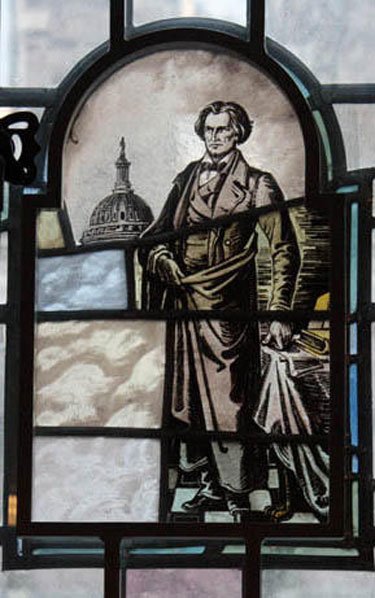
The stained glass picture of Vice President, Secretary of State, and political philosopher John C. Calhoun, Yale Class of 1804, ornamenting the Common Room of the Yale residential college named for the great man was deliberately broken by left-wing students during the 1970s. The window was restored, but portions of the window depicting a black slave in chains kneeling at Calhoun’s feet were removed officially in 1993, after a black student complained that he was personally offended.
09 Aug 2015
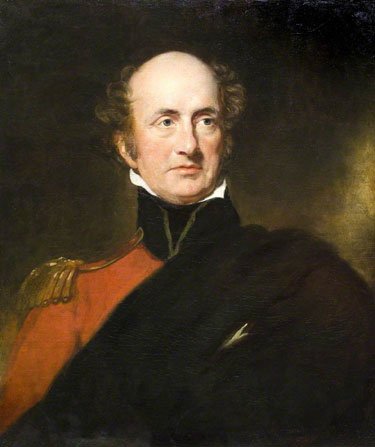
Sir John Malcolm 1769-1833, Governor of Bombay 1827-1830.
[Malcolm] was a grandson of the manse, his father being a small farmer of Eskdale. He was one of seventeen children and when his father fell suddenly into financial trouble it became necessary to settle as many sons as possible. The Directors of the East India Company were doubtful whether they could stretch things so far as to commission a boy of thirteen. ‘Why, my little man,’ asked one of them playfully, ‘what would you do if you met Hyder Ali?’ he being the father of Tippoo and the ogre of the moment. ‘I would draw ma sworrd and cut off his heid,’ replied the candidate, and was commissioned at once with acclamation.”
–Philip Woodruff, The Men Who Ruled India: The Founders, 1953.
27 Jul 2015

Armored skull from Visby Skeletal Collection in the Fornsalen Museum
Strange Remains:
The Visby skeletal collection at the Fornsalen Museum contains the remains of 1185 people who died at the Battle of Visby in 1361 and is the largest battlefield skeletal collection in Europe. Anthropologists from all over the world come to examine these battered bones to study medieval battlefield injuries. Here’s how these bodies ended up in a museum.
In July of 1361 the Danish king Valdemar IV decided to invade the island of Gotland, Sweden because it had a diverse population that included Danes, was populated with wealthy inhabitants, and was strategically located in the Baltic Sea. A legion of Swedish peasants tried to repel the Danish invasion near the city of Visby, but the inexperienced Gotlanders were no match for the Danish soldiers and many of them were slaughtered during the battle. The fallen Gotland soldiers were buried in three large mass graves, with their armor and weapons, near the city walls. After the Gotlanders surrendered, the island became a part of the Danish kingdom for a short period of time, until the Swedish crown reclaimed it in the early 15th century.
In 1905 Dr. Oscar Wennersten exhumed one of the graves and unearthed 300 bodies. Archaeologists Bengt Thordeman and Poul Nørlund recovered more bodies during additional excavations from two mass graves between 1912 and 1928, bringing the total bodies recovered to 1185.
/div>

Feeds
|