The Week found YouTube videos demonstrated what earlier versions of English actually sounded like.
Shakesperian English:
————————–
Middle English (not the best version of the Prologue):
————————–
Earlier Middle English (13th Century):
————————–
Old English (terrific performance of the opening of Beowulf):
They concluded with a pretty chick singing a semi-rock ballad in Breton to illustrate the sound of pre-Anglo-Saxon British, but I think that one is beside the point.
Robert Laird (a WASP Harvard guy) discusses the vexed relations between the two most influential American tribes.
I was raised to be prejudiced against the Jews. Not because they were inferior or evil or un-Christian, but because they were the only serious rivals of the real Chosen People, people of Anglo-Saxon and celtic descent. For my father it was that simple. If we were the New York Yankees, they were the Boston Red Sox, which meant that almost everything about them was wrong or at least unacceptable. Everything different was a line of demarcation. They were Democrats (many of them Communists). They were ostentatious in their wealth. They had bad taste in cars and houses and clothes. They were loud and obnoxious. They had bad manners and didn’t even know it. Everything similar was the field of competition. They were smart, they were devoted to education, they were fiercely competitive, they took care of their own, they had a way of enduring storm after storm after catastrophe and still rising almost unbelievably at the top of whatever hierarchy they were in. They were so much like us in every important way that they were completely intolerable because they sent food back in restaurants and made dirty jokes in mixed company. It was absolutely unacceptable to let them beat you in what mattered most: school. …
Always a romantic in the Sir Walter Scott mode, I thought Judaism itself was boring and creepily emasculating. Those yarmulkes and shawls. The dumb hats and curls of the orthodox. I thought Jewish accents and inflections were jarring, nasal, Hebrew a language of throat-clearing coughs that sounded gross compared to the music of English. Their synagogues looked like community centers, not holy places. Their young women wore ugly shoes and their older women wore too much makeup and nagged in public. They offended my esthetic senses, all of them. Although I did fall in love with Rebecca when I read Ivanhoe. If only I could meet one like her… which I did only much much later.
I attended a Lithuanian parochial elementary school, so I never actually had Jewish schoolmates before high school. In high school, I had a whopping two, count ’em, Jewish classmates. One of them was academically hopeless. The other was the best male student in our class, after me. He followed the stereotype accurately. He wanted to succeed. He worked furiously. And he always came in second. I did essentially no work in high school. I just pursued my own personal program of self education through extensive reading. I never did homework. I could always churn out the obligatory Latin exercises and math problems in school before the relevant classes.
Relations between Lithuanians and Jews in Shenandoah were very amicable. We bought our furniture and appliances from Jewish merchants who treated our parents like distant relatives. When my parents wanted a new range or a new sofa, they would go see Benny Schoor, who would make a big fuss over them, express enthusiasm over their selection and arrange to deliver it the next day. My parents never asked what Benny proposed to charge and they never paid in cash. A month or two after their purchase was delivered, a bill for some small sum from Benny would appear in the mail. My parents would make whatever monthly payment it was, and eventually the bills would stop coming. Everybody had perfect confidence in the honesty and reliability of everybody else.
I thought of Jewish kids, like Italians, as hopeless incompetent non-combatants, who needed to be looked after and protected by tough Lithuanians like myself from the predatory juvenile gangs of Poles, Irish, Slovaks, and Lithuanian scum who roamed our town’s streets looking for victims.
Where I grew up, pretty much everyone was some kind of Roman Catholic ethnic immigrant type with names like Kowalonek and Wodjehowski, so I got a real kick out of being at Yale and getting to meet people with English-language names, just like the people I’d read about in books.
WASPs struck me as a lot like Lithuanians who had simply been in the country longer and had more money, and who had consequently successfully cultivated better manners and tastes. Like Lithuanians, WASPs, I found, placed a high value on emotional restraint, revered tradition, cared strongly about morality and respectability, and typically possessed a love of order and a recognition of the necessity of making a practice of doing things correctly.
I think there is a general recognition, in the larger world, of a lot of similarities between the New England WASP tribe and the Jewish tribe. Both have traditionally been clannish, moralistic, hectoring and intolerant, intensely ambitious and keen on acquiring wealth and worldly success.
What seems odd to an outside spectator like myself has been the incredibly dramatic and downright astonishing retreat of the WASP from the center of the America Establishment, and his precipitous surrender of control and operation of the culture and institutions to others, most frequently to Jews. The American WASP was traditionally distinguished by his firm grip on common sense and his Yankee shrewdness and skepticism. All those admirable qualities have not been much in evidence in recent decades. Faced with the rise of a left-wing culture of accusation and complaint, the gentlemanly WASP has simply hung his head in shame over the alleged crimes of his ancestors and slunk quietly off the stage.
I think myself that the vanishing of the old-fashioned WASP from the culture and the establishment is really a pity. The old gentlemen who used to run things were more than adequately well-meaning, but they also had good sense. You couldn’t panic or stampede those people. If Eric Holder’s Justice Department had come along and demanded that Yale create a new Star Chamber system to adjudicate sexual harassment complaints or lose federal aid, old President Seymour, I suspect, would have felt bad at losing all that money, but would still have told Eric Holder that Yale would not comply. No one would ever expect the current president of Yale to resist the tide of fashion in any form.
The Telegraph reports that A new genetic map of Britain shows that there has been little movement between areas of Britain which were former tribal kingdoms in Anglo-Saxon England.
Britons are still living in the same ‘tribes’ that they did in the 7th Century, Oxford University has found after an astonishing study into our genetic make-up.
Archaeologists and geneticists were amazed to find that genetically similar individuals inhabit the same areas they did following the Anglo-Saxon invasion, following the fall of the Roman Empire.
In fact, a map showing tribes of Britain in 600AD is almost identical to a new chart showing genetic variability throughout the UK, suggesting that local communities have stayed put for the past 1415 years.
Many people in Britain claim to feel a strong sense of regional identity and scientists say they the new study proves that the link to birthplace is DNA deep.
The most striking genetic split can be seen between people living in Cornwall and Devon, where the division lies exactly along the county border. It means that people living on either side of the River Tamar, which separates the two counties, have different DNA.
The Philadelphia Daily News learns a secret about Bill Clinton’s presidential portrait from the artist Nelson Shanks.
The reality is he’s probably the most famous liar of all time. He and his administration did some very good things, of course, but I could never get this Monica thing completely out of my mind and it is subtly incorporated in the painting.
If you look at the left-hand side of it there’s a mantle in the Oval Office and I put a shadow coming into the painting and it does two things. It actually literally represents a shadow from a blue dress that I had on a mannequin, that I had there while I was painting it, but not when he was there. It is also a bit of a metaphor in that it represents a shadow on the office he held, or on him.
And so the Clintons hate the portrait. They want it removed from the National Portrait Gallery.
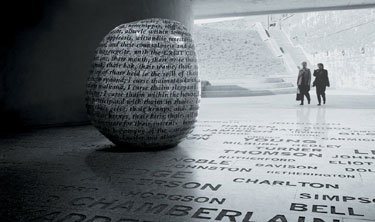
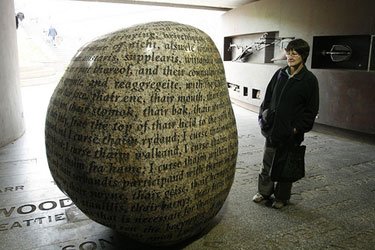
In 1525, the Archbishop of Glasgow Gavin Dunbar issued a very sternly worded curse to a large group of robbers and highwaymen who operated along the English-Scottish border,
“I curse their head and all the hairs of their head; I curse their face, their brain, their mouth, their nose, their tongue, their teeth, their forehead, their shoulders, their breast, their heart, their stomach, their back, their womb, their arms, their legs, their hands, their feet, and every part of their body, from the top of their head to the soles of their feet, before and behind, within and without. I curse them going and I curse them riding; I curse them standing and I curse them sitting; I curse them eating and I curse them drinking; I curse them rising, and I curse them lying; I curse them at home, I curse them away from home; I curse them within the house, I curse them outside of the house; I curse their wives, their children, and their servants who participate in their deeds; their crops, their cattle, their wool, their sheep, their horses, their swine, their geese, their hens, and all their livestock; their halls, their chambers, their kitchens, their stanchions, their barns, their cowsheds, their barnyards, their cabbage patches, their plows, their harrows, and the goods and houses that are necessary for their sustenance and welfare. May all the malevolent wishes and curses ever known, since the beginning of the world, to this hour, light on them. May the malediction of God, that fell upon Lucifer and all his fellows, that cast them from the high Heaven to the deep hell, light upon them.May the fire and the sword that stopped Adam from the gates of Paradise, stop them from the glory of Heaven, until they forebear, and make amends. May the evil that fell upon cursed Cain, when he slew his brother Abel, needlessly, fall on them for the needless slaughter that they commit daily.May the malediction that fell upon all the world, man and beast, and all that ever took life, when all were drowned by the flood of Noah, except Noah and his ark, fall upon them and drown them, man and beast, and make this realm free of them, for their wicked sins. May the thunder and lightning which rained down upon Sodom and Gomorrah and all the lands surrounding them, and burned them for their vile sins, rain down upon them and burn them for their open sins.May the evil and confusion that fell on the Gigantis for their opression and pride in building the Tower of Babylon, confound them and all their works, for their open callous disregard and oppression. May all the plagues that fell upon Pharaoh and his people of Egypt, their lands, crops and cattle, fall upon them, their equipment, their places, their lands, their crops and livestock.May the waters of the Tweed and other waters which they use, drown them, as the Red Sea drowned King Pharaoh and the people of Egypt, preserving God’s people of Israel.May the earth open, split and cleave, and swallow them straight to hell, as it swallowed cursed Dathan and Abiron, who disobeyed Moses and the command of God. May the wild fire that reduced Thore and his followers to two-hundred-fifty in number, and others from 14,000 to 7,000 at anys, usurping against Moses and Aaron, servants of God, suddenly burn and consume them daily, for opposing the commands of God and Holy Church. May the malediction that suddenly fell upon fair Absalom, riding through the wood against his father, King David, when the branches of a tree knocked him from his horse and hanged him by the hair, fall upon these untrue Scotsmen and hang them the same way, that all the world may see. May the malediction that fell upon Nebuchadnezzar’s lieutenant, Holofernes, making war and savagery upon true Christian men; the malediction that fell upon Judas, Pilate, Herod, and the Jews that crucified Our Lord; and all the plagues and troubles that fell on the city of Jerusalem therefore, and upon Simon Magus for his treachery, bloody Nero, Ditius Magcensius, Olibrius, Julianus Apostita and the rest of the cruel tyrants who slew and murdered Christ’s holy servants, fall upon them for their cruel tyranny and murder of Christian people. And may all the vengeance that ever was taken since the world began, for open sins, and all the plagues and pestilence that ever fell on man or beast, fall on them for their openly evil ways, senseless slaughter and shedding of innocent blood. I sever and part them from the church of God, and deliver them immediately to the devil of hell, as the Apostle Paul delivered Corinth. I bar the entrance of all places they come to, for divine service and ministration of the sacraments of holy church, except the sacrament of infant baptism, only; and I forbid all churchmen to hear their confession or to absolve them of their sins, until they are first humbled by this curse. I forbid all Christian men or women to have any company with them, eating, drinking, speaking, praying, lying, going, standing, or in any other deed-doing, under the pain of deadly sin. I discharge all bonds, acts, contracts, oaths, made to them by any persons, out of loyalty, kindness, or personal duty, so long as they sustain this cursing, by which no man will be bound to them, and this will be binding on all men.I take from them, and cast down all the good deeds that ever they did, or shall do, until they rise from this cursing. I declare them excluded from all matins, masses, evening prayers, funerals or other prayers, on book or bead; of all pigrimages and alms deeds done, or to be done in holy church or be Christian people, while this curse is in effect. And, finally, I condemn them perpetually to the deep pit of hell, there to remain with Lucifer and all his fellows, and their bodies to the gallows of Burrow moor, first to be hanged, then ripped and torn by dogs, swine, and other wild beasts, abominable to all the world.And their candle goes from your sight, as may their souls go from the face of God, and their good reputation from the world, until they forebear their open sins, aforesaid, and rise from this terrible cursing and make satisfaction and penance.
In 2001, as part of Carlisle’s millennium celebrations local artist Gordon Young carved 383 words of the curse into a 7.5 ton granite boulder. The floor of the display where it is kept features the names of the families the curse was directed towards. Since then, local livestock herds have been wiped out by foot-and-mouth disease, a devastating flood has struck the city, factories have closed, and the Carlisle United soccer team dropped a league.
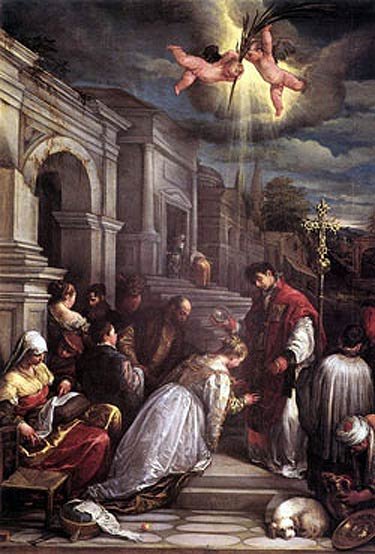
Jacopo Bassano, St Valentine Baptizing St Lucilla, 1575, oil on canvas, Museo Civico, Bassano del Grappa
The popular customs associated with Saint Valentine’s Day undoubtedly had their origin in a conventional belief generally received in England and France during the Middle Ages, that on 14 February, i.e., half way through the second month of the year, the birds began to pair. Thus in Chaucer’s Parliament of Foules we read:
For this was sent on Seynt Valentyne’s day
Whan every foul cometh ther to choose his mate.
For this reason the day was looked upon as specially consecrated to lovers and as a proper occasion for writing love letters and sending lovers’ tokens. Both the French and English literatures of the fourteenth and fifteenth centuries contain allusions to the practice. Perhaps the earliest to be found is in the 34th and 35th Ballades of the bilingual poet, John Gower, written in French; but Lydgate and Clauvowe supply other examples. Those who chose each other under these circumstances seem to have been called by each other their Valentines.
In the Paston Letters, Dame Elizabeth Brews writes thus about a match she hopes to make for her daughter (we modernize the spelling), addressing the favoured suitor:
And, cousin mine, upon Monday is Saint Valentine’s Day and every bird chooses himself a mate, and if it like you to come on Thursday night, and make provision that you may abide till then, I trust to God that ye shall speak to my husband and I shall pray that we may bring the matter to a conclusion.
——————————————–
From Robert Chambers, The Book of Days, 1869: Feast Day: St. Valentine, priest and martyr, circ. 270.
ST. VALENTINE’S DAY
Valentine’s Day is now almost everywhere a much degenerated festival, the only observance of any note consisting merely of the sending of jocular anonymous letters to parties whom one wishes to quiz, and this confined very much to the humbler classes. The approach of the day is now heralded by the appearance in the print-sellers’ shop windows of vast numbers of missives calculated for use on this occasion, each generally consisting of a single sheet of post paper, on the first page of which is seen some ridiculous coloured caricature of the male or female figure, with a few burlesque verses below. More rarely, the print is of a sentimental kind, such as a view of Hymen’s altar, with a pair undergoing initiation into wedded happiness before it, while Cupid flutters above, and hearts transfixed with his darts decorate the corners. Maid-servants and young fellows interchange such epistles with each other on the 14th of February, no doubt conceiving that the joke is amazingly good: and, generally, the newspapers do not fail to record that the London postmen delivered so many hundred thousand more letters on that day than they do in general. Such is nearly the whole extent of the observances now peculiar to St. Valentine’s Day.
At no remote period it was very different. Ridiculous letters were unknown: and, if letters of any kind were sent, they contained only a courteous profession of attachment from some young man to some young maiden, honeyed with a few compliments to her various perfections, and expressive of a hope that his love might meet with return. But the true proper ceremony of St. Valentine’s Day was the drawing of a kind of lottery, followed by ceremonies not much unlike what is generally called the game of forfeits. Misson, a learned traveller, of the early part of the last century, gives apparently a correct account of the principal ceremonial of the day.
‘On the eve of St. Valentine’s Day,’ he says, ‘the young folks in England and Scotland, by a very ancient custom, celebrate a little festival. An equal number of maids and bachelors get together: each writes their true or some feigned name upon separate billets, which they roll up, and draw by way of lots, the maids taking the men’s billets, and the men the maids’: so that each of the young men lights upon a girl that he calls his valentine, and each of the girls upon a young man whom she calls hers. By this means each has two valentines: but the man sticks faster to the valentine that has fallen to him than to the valentine to whom he is fallen. Fortune having thus divided the company into so many couples, the valentines give balls and treats to their mistresses, wear their billets several days upon their bosoms or sleeves, and this little sport often ends in love.’
St. Valentine’s Day is alluded to by Shakespeare and by Chaucer, and also by the poet Lydgate (who died in 1440).
The origin of these peculiar observances of St. Valentine’s Day is a subject of some obscurity. The saint himself, who was a priest of Rome, martyred in the third century, seems to have had nothing to do with the matter, beyond the accident of his day being used for the purpose. Mr. Douce, in his Illustrations of Shakespeare, says:
“It was the practice in ancient Rome, during a great part of the month of February, to celebrate the Lupercalia, which were feasts in honour of Pan and Juno. whence the latter deity was named Februata, Februalis, and Februlla. On this occasion, amidst a variety of ceremonies, the names of young women were put into a box, from which they were drawn by the men as chance directed. The pastors of the early Christian church, who, by every possible means, endeavoured to eradicate the vestiges of pagan superstitions, and chiefly by some commutations of their forms, substituted, in the present instance, the names of particular saints instead of those of the women: and as the festival of the Lupercalia had commenced about the middle of February, they appear to have chosen St. Valentine’s Day for celebrating the new feast, because it occurred nearly at the same time.”
February 14th, prior to 1969, was the feast day of two, or possibly three, saints and martyrs named Valentine, all reputedly of the Third Century.
The first Valentine, legend holds, was a physician and priest in Rome, arrested for giving aid to martyrs in prison, who while there converted his jailer by restoring sight to the jailer’s daughter. He was executed by being beaten with clubs, and afterwards beheaded, February 14, 270. He is traditionally the patron of affianced couples, bee keepers, lovers, travellers, young people, and greeting card manufacturers, and his special assistance may be sought in conection with epilepsy, fainting, and plague.
A second St. Valentine, reportedly bishop of Interamna (modern Terni) was also allegedly martyred under Claudius II, and also allegedly buried along the Flaminian Way.
A third St. Valentine is said to have also been martyred in Roman times, along with companions, in Africa.
Because of a lack of historical evidence, the Roman Catholic Church dropped the February 14th feast of St. Valentine from its calendar in 1969.
Sent to Ludovico Sforza in 1482. He was hired. i09.com:
1. I have a sort of extremely light and strong bridges, adapted to be most easily carried, and with them you may pursue, and at any time flee from the enemy; and others, secure and indestructible by fire and battle, easy and convenient to lift and place. Also methods of burning and destroying those of the enemy.
2. I know how, when a place is besieged, to take the water out of the trenches, and make endless variety of bridges, and covered ways and ladders, and other machines pertaining to such expeditions.
3. If, by reason of the height of the banks, or the strength of the place and its position, it is impossible, when besieging a place, to avail oneself of the plan of bombardment, I have methods for destroying every rock or other fortress, even if it were founded on a rock, etc.
4. Again, I have kinds of mortars; most convenient and easy to carry; and with these I can fling small stones almost resembling a storm; and with the smoke of these cause great terror to the enemy, to his great detriment and confusion.
5. And if the fight should be at sea I have kinds of many machines most efficient for offense and defense; and vessels which will resist the attack of the largest guns and powder and fumes.
6. I have means by secret and tortuous mines and ways, made without noise, to reach a designated spot, even if it were needed to pass under a trench or a river.
7. I will make covered chariots, safe and unattackable, which, entering among the enemy with their artillery, there is no body of men so great but they would break them. And behind these, infantry could follow quite unhurt and without any hindrance.
8. In case of need I will make big guns, mortars, and light ordnance of fine and useful forms, out of the common type.
9. Where the operation of bombardment might fail, I would contrive catapults, mangonels, trabocchi, and other machines of marvellous efficacy and not in common use. And in short, according to the variety of cases, I can contrive various and endless means of offense and defense.
10. In times of peace I believe I can give perfect satisfaction and to the equal of any other in architecture and the composition of buildings public and private; and in guiding water from one place to another.
11. I can carry out sculpture in marble, bronze, or clay, and also I can do in painting whatever may be done, as well as any other, be he who he may.
Again, the bronze horse may be taken in hand, which is to be to the immortal glory and eternal honor of the prince your father of happy memory, and of the illustrious house of Sforza.
And if any of the above-named things seem to anyone to be impossible or not feasible, I am most ready to make the experiment in your park, or in whatever place may please your Excellency – to whom I comment myself with the utmost humility, etc.
Tintoretto, Presentation of Jesus at the Temple, 1550-1555, Gallerie dell Accademi, Venice
From Robert Chambers, The Book of Days, 1869:
From a very early, indeed unknown date in the Christian history, the 2nd of February has been held as the festival of the Purification of the Virgin, and it is still a holiday of the Church of England. From the coincidence of the time with that of the Februation or purification of the people in pagan Rome, some consider this as a Christian festival engrafted upon a heathen one, in order to take advantage of the established habits of the people; but the idea is at least open to a good deal of doubt. The popular name Candlemass is derived from the ceremony which the Church of Rome dictates to be observed on this day; namely, a blessing of candles by the clergy, and a distribution of them amongst the people, by whom they are afterwards carried lighted in solemn procession. The more important observances were of course given up in England at the Reformation; but it was still, about the close of the eighteenth century, customary in some places to light up churches with candles on this day.
At Rome, the Pope every year officiates at this festival in the beautiful chapel of the Quirinal. When he has blessed the candles, he distributes them with his own hand amongst those in the church, each of whom, going singly up to him, kneels to receive it. The cardinals go first; then follow the bishops, canons, priors, abbots, priests, &c., down to the sacristans and meanest officers of the church. According to Lady Morgan, who witnessed the ceremony in 1820:
‘When the last of these has gotten his candle, the poor conservatori, the representatives of the Roman senate and people, receive theirs. This ceremony over, the candles are lighted, the Pope is mounted in his chair and carried in procession, with hymns chanting, round the ante-chapel; the throne is stripped of its splendid hangings; the Pope and cardinals take off their gold and crimson dresses, put on their usual robes, and the usual mass of the morning is sung.’
Lady Morgan mentions that similar ceremonies take place in all the parish churches of Rome on this day.
It appears that in England, in Catholic times, a meaning was attached to the size of the candles, and the manner in which they burned during the procession; that, moreover, the reserved parts of the candles were deemed to possess a strong supernatural virtue:
‘This done, each man his candle lights,
Where chiefest seemeth he,
Whose taper greatest may be seen; And fortunate to be,
Whose candle burneth clear and bright: A wondrous force and might
Both in these candles lie, which if At any time they light,
They sure believe that neither storm Nor tempest cloth abide,
Nor thunder in the skies be heard, Nor any devil’s spide,
Nor fearful sprites that walk by night,
Nor hurts of frost or hail,’ &c.
The festival, at whatever date it took its rise, has been designed to commemorate the churching or purification of Mary; and the candle-bearing is understood to refer to what Simeon said when he took the infant Jesus in his arms, and declared that he was a light to lighten the Gentiles. Thus literally to adopt and build upon metaphorical expressions, was a characteristic procedure of the middle ages. Apparently, in consequence of the celebration of Mary’s purification by candle-bearing, it became customary for women to carry candles with them, when, after recovery from child-birth, they went to be, as it was called, churched. A remarkable allusion to this custom occurs in English history. William the Conqueror, become, in his elder days, fat and unwieldy, was confined a considerable time by a sickness. ‘Methinks,’ said his enemy the King of France, ‘the King of England lies long in childbed.’ This being reported to William, he said, ‘When I am churched, there shall be a thousand lights in France !’ And he was as good as his word; for, as soon as he recovered, he made an inroad into the French territory, which he wasted wherever he went with fire and sword.
At the Reformation, the ceremonials of Candlemass day were not reduced all at once. Henry VIII proclaimed in 1539:
‘On Candlemass day it shall be declared, that the bearing of candles is done in memory of Christ, the spiritual light, whom Simeon did prophesy, as it is read in. the church that day.’
It is curious to find it noticed as a custom down to the time of Charles II, that when lights were brought in at nightfall, people would say—’ God send us the light of heaven!’ The amiable Herbert, who notices the custom, defends it as not superstitious. Some-what before this time, we find. Herrick alluding to the customs of Candlemass eve: it appears that the plants put up in houses at Christmas were now removed.
Down with the rosemary and bays,
Down with the mistletoe;
Instead of holly now upraise
The greener box for show.
The holly hitherto did sway,
Let box now domineer,
Until the dancing Easter day
Or Easter’s eve appear.
The youthful box, which now hath grace
Your houses to renew,
Grown old, surrender must his place
Unto the crisped yew.
When yew is out, then birch comes in,
And many flowers beside,
Both of a fresh and fragrant kin’,
To honour Whitsuntide.
Green rushes then, and sweetest bents,
With cooler oaken boughs,
Come in for comely ornaments,
To re-adorn the house.
Thus times do shift; each thing in turn does hold;
New things succeed, as former things grow old.’
The same poet elsewhere recommends very particular care in the thorough removal of the Christmas garnishings on this eve:
‘That so the superstitious find
No one least branch left there behind;
For look, how many leaves there be
Neglected there, maids, trust to me,
So many goblins you shall see.’
He also alludes to the reservation of part of the candles or torches, as calculated to have the effect of protecting from mischief:
‘Kindle the Christmas brand, and then
Till sunset let it burn,
Which quenched, then lay it up again, Till Christmas next return.
Part must be kept, wherewith to tend
The Christmas log next year;
And where ‘tis safely kept, the fiend Can do no mischief there.’
Considering the importance attached to Candlemass day for so many ages, it is scarcely surprising that there is a universal superstition throughout Christendom, that good weather on this day indicates a long continuance of winter and a bad crop, and that its being foul is, on the contrary, a good omen. Sir Thomas Browne, in his Vulgar Errors, quotes a Latin distich expressive of this idea:
‘Si sol splendescat Maria purificante,
Major erit glacies post festum quam fait ante;
which maybe considered as well translated in the popular Scottish rhyme:
If Candlemass day be dry and fair,
The half o’ winter’s to come and mair;
If Candlemass day be wet and foul,
The half o’ winter’s gave at Yule.’
In Germany there are two proverbial expressions on this subject: 1. The shepherd would rather see the wolf enter his stable on Candlemass day than the sun; 2. The badger peeps out of his hole on Candlemass day, and when he finds snow, walks abroad; but if he sees the sun shining, he draws back into his hole. It is not improbable that these notions, like the festival of Candlemass itself, are derived from pagan times, and have existed since the very infancy of our race. So at least we may conjecture, from a curious passage in Martin’s Description of the Western Islands. On Candlemass day, according to this author, the Hebrideans observe the following curious custom:
The mistress and servants of each family take a sheaf of oats and dress it up in women’s apparel, put it in a large basket, and lay a wooden club by it, and this they call BrÃd’s Bed.; and then the mistress and servants cry three times, “BrÃd is come; BrÃd is welcome!†This they do just before going to bed, and when they rise in the morning they look among the ashes, expecting to see the impression of BrÃd’s club there; which, if they do, they reckon it a true presage of a good crop and prosperous year, and the contrary they take as an ill omen.