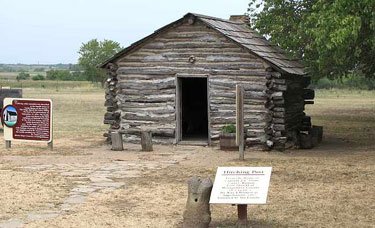
Laura Ingalls Wilder’s Little House on the Prairie reconstructed at the original location, 12 miles southwest of Independence, Kansas.
Megan McArdle reflects on the amazing way in which contemporary Americans enjoy an unprecedented kind of material abundance and have forgotten completely that there was ever a time when people got by with so much less.
Last week, in her State of the Union response, Joni Ernst mentioned going to school with bread bags on her feet to protect her shoes. These sorts of remembrances of poor but honest childhoods used to be a staple among politicians — that’s why you’ve heard so much about Abe Lincoln’s beginnings in a log cabin. But the bread bags triggered a lot of hilarity on Twitter, which in turn triggered this powerful meditation from Peggy Noonan on how rich we have become. So rich that we have forgotten things that are well within living memory:
I liked what Ernst said because it was real. And it reminded me of the old days.
There are a lot of Americans, and most of them seem to be on social media, who do not know some essentials about their country, but this is the way it was in America once, only 40 and 50 years ago:
America had less then. Americans had less. …
…
I am a few years younger than Noonan, but I grew up in a very different world — one where a number of my grammar school classmates were living in public housing or on food stamps, but everyone had more than one pair of shoes. In rural areas, like the one where Joni Ernst grew up, this lingered longer. But all along, Americans got richer and things got cheaper — especially when global markets opened up. Payless will sell you a pair of child’s shoes for $15, which is two hours of work even at minimum wage.
Perhaps that sounds like a lot to you — two whole hours! But I’ve been researching historical American living standards for a project I’m working on, and if you’re familiar with what Americans used to spend on things, this sounds like a very good deal.
Consider the “Little House on the Prairie” books, which I’d bet almost every woman in my readership, and many of the men, recalls from their childhoods. I loved those books when I was a kid, which seemed to describe an enchanted world — horses! sleighs! a fire merrily crackling in the fireplace, and children frolicking in the snow all winter, then running barefoot across the prairies! Then I reread them as an adult, as a prelude to my research, and what really strikes you is how incredibly poor these people were. The Ingalls family were in many ways bourgeoisie: educated by the standards of the day, active in community leadership, landowners. And they had nothing.
There’s a scene in one of the books where Laura is excited to get her own tin cup for Christmas, because she previously had to share with her sister. Think about that. No, go into your kitchen and look at your dishes. Then imagine if you had three kids, four plates and three cups, because buying another cup was simply beyond your household budget — because a single cup for your kid to drink out of represented not a few hours of work, but a substantial fraction of your annual earnings, the kind of money you really had to think hard before spending.
All correct-thinking members of today’s community of fashion know that human energy use and economic activity is altering the climate and producing extreme weather. Of course, until recent years when the earth’s human population has enormously increased along with accompanying energy consumption and industrial activity, we all know that extreme weather never really happened.
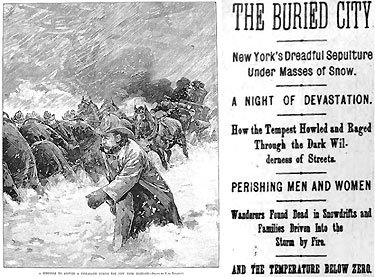
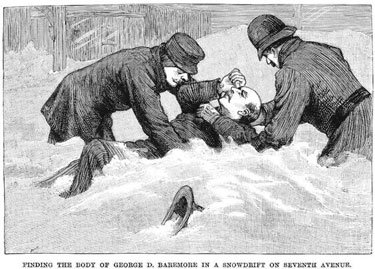
Gawker, nonetheless, today took the occasion of “extreme weather” visiting the Northeast to remember the Great Blizzard of ’88, which was obviously merely a case of perfectly ordinary weather. 200 people, however, died.
Trains full of people were trapped without food. Public transportation stopped, and hundreds of people went home to Brooklyn by crossing the East River over the ice.
Men of fashion were obliged to take shelter in Bowery flophouses, sleeping beside the tramps. The flophouse operators took advantage by raising their rates from ten cents to fifty cents.
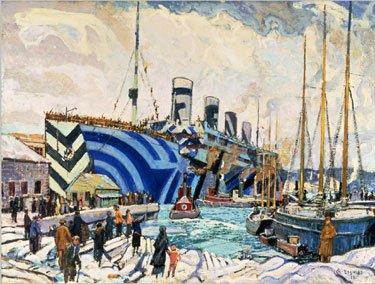
Modern art, wartime strategy and perceptual psychology converged during World War I giving rise to dazzle camouflage. The only color visual records of dazzle camouflage from the period are paint-scheme drawings made by the Admiralty and modernist marine paintings. The picture by Group of 7 artist Arthur Lismer of HMS Olympic in dazzle is not a fauvist hallucination, but a true record of the ship’s appearance just after the Armistice. The modernist painter Edward Wadsworth (British, 1889-1949) supervised the application of dazzle camouflage at the Liverpool naval shipbuilding yards during World War I. He painted the image above and others, and also made wood block prints depicting ships in dazzle. After the war, he also painted abstract compositions based on dazzle patterns.
Arthur Lismer, Olympic With Returned Soldiers, Halifax, 1918, Canadian War Museum
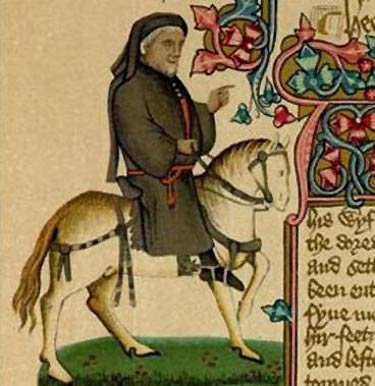
Strohm centres on a single year, 1386, at the end of which Chaucer “suddenly found himself without a patron, without a faction, without a dwelling, without a job … without a city.”
Exiled from London and his literary circle, Strohm’s Chaucer lost an audience, in an age before the printing press, when poetry in manuscript was read aloud in performance. The book’s compelling thesis is that Chaucer’s loss generated the invention of a “portable audience” within The Canterbury Tales: the pilgrims themselves. …
One of Chaucer’s overarching themes is the volatility of fortune, whose reversals – if we are wise – teach us “to maken virtu of necessitee”. Strohm’s Chaucer is essentially a small player in a world of venal power politics, “a politician of limited gifts, and not much of a factionalist either”. A loyalist of Richard II, he’d risen by espousing the long-term losing party. Esquire to the king, Chaucer had made an advantageous marriage. But he and his higher-ranking wife, Philippa de Roet, sister to John of Gaunt’s mistress, Katherine Swynford, lived apart and his association with the loathed Gaunt jeopardised him.
Deployed by his political masters to the post of controller of wool custom, Chaucer had the unenviable job of monitoring the activities of “some of the richest and best connected and least scrupulous crooks on the face of his planet”. Strohm’s portrait of the collector of the lucrative wool custom, corrupt magnate Nicholas Brembre, is formidable. When the royalist faction secured Chaucer’s election to the 1386 Parliament, and Brembre’s wheel came thundering down, so did Chaucer’s. His grace and favour apartment was forfeit. Strohm assesses Chaucer’s withdrawal from public life as “a matter of constrained choice”. Chaucer became “a wanderer in Kent, with no fixed job and insufficient income”. …
Losing “that thick and involving texture of London life” meant forfeit not only of discomfort but of stimulation and conviviality. The listening audience Chaucer now lacked he invented as a fellowship of pilgrims: “Chaucer’s varied cast of rogues, pitchmen, scammers … divines, social snobs, humble toilers [is] a miracle of imaginative inclusion.” …
From the misfortune of 1386, Chaucer moved towards a sense of authorial identity, preparing his literary legacy for generations to come. The pilgrims mediated “between Chaucer and the extended public he has begun to imagine”. The poet’s humiliated exile, Strohm compellingly suggests, is part of the deep story of how The Canterbury Tales came into being.
In 1596, German lawyer Paul Hentzner (1558-1623) at age 38, became tutor to a young Silesian nobleman, with whom he set out in 1597, on a 3 years’ tour through Switzerland, France, England, & Italy. After his return to Germany in 1600, he published, at Nuremberg in 1612, a description of this journey, written in Latin, as Itinerarium Germaniae, Galliae, Angliae, Italiae, cum Indice Locorum, Rerum atque Verborum.
Hentzner wrote the following account of his 1598 encounter with Queen Elizabeth I, reprinted at It’s About Time.
We arrived next at the royal palace of Greenwich…
“It was here Elizabeth, the present Queen, was born, and her she generally resides, particularly in summer, for the delightfulness of its situation.
“We were admitted, by an order Mr. Rogers had procured from the Lord Chamberlain, into the presence chamber, hung with rich tapestry, and the floor, after the English fashion, strewed with hay, & through which the Queen commonly passes on her way to chapel.
“At the door stood a gentleman dressed in velvet, with a gold chain, whose office was to introduce to the Queen any person of distinction that came to wait on her; it was Sunday, when there is usually the greatest attendance of nobility. In the same hall were the Archbishop of Canterbury, the Bishop of London, a great number of Councillors of State, officers of the Crown, and gentlemen, who waited the Queen’s coming out; which she did from her own apartment when it was time to go to prayers, attended in the following manner:
“First went gentlemen, barons, earls, Knights of the Garter, all richly dressed and bareheaded; next came the Chancellor, bearing the seals in a red silk purse, between two, one of whom carried the Royal sceptre, the other the sword of state, in a red scabbard, studded with golden Fleurs de Lis, the point upwards:
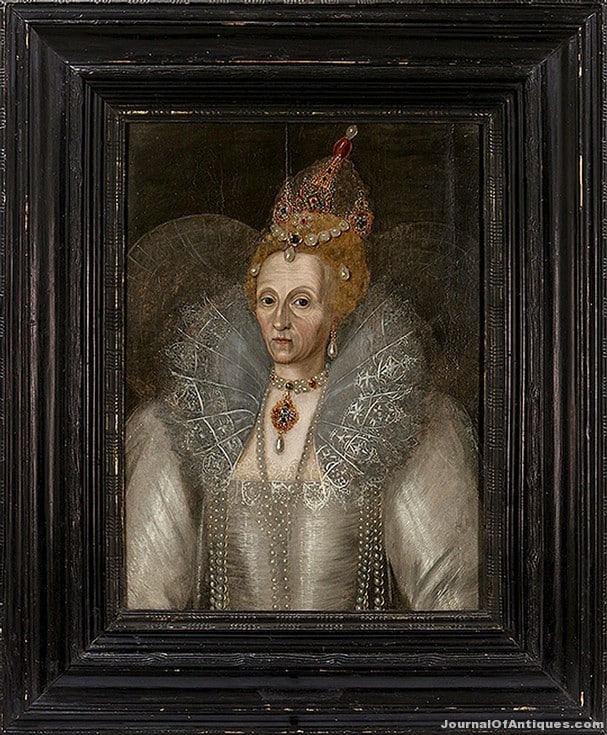
“Next came the Queen, in the sixty-fifth year of her age, as we were told, very majestic; her face oblong, fair, but wrinkled; her eyes small, yet black and pleasant; her nose a little hooked; her lips narrow, and her teeth black (a defect the English seem subject to, from their too great use of sugar); she had in her ears two pearls, with very rich drops; she wore false hair, and that red; upon her head she had a small crown, reported to be made of some of the gold of the celebrated Lunebourg table; her bosom was uncovered, as all the English ladies have it till they marry; and she had on a necklace of exceeding fine jewels; her hands were small, her fingers long, and her stature neither tall nor low; her air was stately, her manner of speaking mild and obliging.
“That day she was dressed in white silk, bordered with pearls of the size of beans, and over it a mantle of black silk, shot with silver threads; her train was very long, the end of it borne by a marchioness; instead of a chain, she had an oblong collar of gold and jewels.
“As she went along in all this state and magnificence, she spoke very graciously, first to one, then to another, whether foreign Ministers, or those who attended for different reasons, in English, French, and Italian; for, besides being well skilled in Greek, Latin, and the languages I have mentioned, she is mistress of Spanish, Scotch, and Dutch. Whoever speaks to her, it is kneeling; now and then she raises some with her hand.
“While we were there, W. Slawata, a Bohemian baron, had letters to present to her; and she, after pulling off her glove, gave him her right hand to kiss, sparkling with rings and jewels, a mark of particular favour.
“Wherever she turned her face, as she was going along, everybody fell down on their knees. The ladies of the court followed next to her, very handsome and well-shaped, and for the most part dressed in white.
“She was guarded on each side by the gentlemen pensioners, fifty in number, with gilt battle-axes. In the ante-chapel, next the hall where we were, petitions were presented to her, and she received them most graciously, which occasioned the acclamation of ‘Long Live Queen Elizabeth!’
“She answered it with “I thank you, my good people.” In the chapel was excellent music; as soon as it and the service were over, which scarce exceeded half an hour, the Queen returned in the same state and order, and prepared to go to dinner. But while she was still at prayers, we saw her table set out with the following solemnity:
“A gentleman entered the room bearing a rod, and along with him another who had a table-cloth which, after they had both kneeled three times with the utmost veneration, he spread upon the table, and, after kneeling again, they both retired. Then came two others, one with the rod again, the other with a salt-cellar, a plate, and bread; when they had kneeled as the others had done, and placed what was brought upon the table, they too retired with the same ceremonies performed by the first.
“At last came an unmarried lady (we were told she was a countess), and along with her a married one, bearing a tasting-knife; the former was dressed in white silk, who, when she had prostrated herself three times in the most graceful manner, approached the table and rubbed the plates with bread and salt with as much awe as if the Queen had been present.
“When they had waited there a little while, the yeomen of the guards entered, bareheaded, clothed in scarlet, with a golden rose upon their backs, bringing in at each turn a course of twenty-four dishes, served in plate, most of it gilt; these dishes were received by a gentleman in the same order they were brought, and placed upon the table, while the lady taster gave to each of the guard a mouthful to eat of the particular dish he had brought, for fear of any poison.
“During the time that this guard, which consists of the tallest and stoutest men that can be found in all England, being carefully selected for this service, were bringing dinner, twelve trumpets and two kettledrums made the hall ring for half an hour together.
“At the end of all this ceremonial, a number of unmarried ladies appeared, who, with particular solemnity, lifted the meat off the table, and conveyed it into the Queen’s inner and more private chamber, where, after she had chosen for herself, the rest goes to the ladies of the Court.
“The Queen dines and sups alone with very few attendants, and it is very seldom that anybody, foreigner or native, is admitted at that time, and then only at the intercession of somebody in power.”
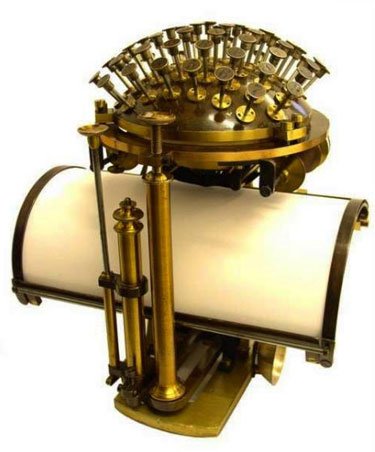
In 1881, when he had serious problems with his sight, Friedrich Nietzsche wanted to buy a typewriter to enable him to continue his writing, and from letters to his sister it is known that he personally was in contact with “the inventor of the typewriter, Mr Malling-Hansen from Copenhagen”. He mentioned to his sister that he had received letters and also a typewritten postcard as an example. Nietzsche received his writing ball in 1882 directly from the inventor in Copenhagen, Denmark, Rasmus Malling-Hansen. It was the newest model, the portable tall one with a color ribbon, serial number 125, and several typescripts are known to have been written by him on this writing ball (approximately 60). It is known that Nietzsche was also familiar with the newest model from E. Remington and Sons (model 2), but he wanted to buy a portable typewriter, so he chose to buy the Malling-Hansen writing ball, as this model was lightweight and easy to carry. Unfortunately, Nietzsche wasn’t totally satisfied with his purchase and never really mastered the use of the instrument. A number of theories have been advanced to explain why Nietzsche did not make more use of it. For example, Rüdiger Safranski indicates it was “defective”. New research indicates Nietzsche was not aware that his trouble in using the machine had been caused by damage to it during transportation to Genoa in Italy, where he lived at the time, and when he turned to a mechanic who had no typewriter repair skills, the man managed to damage the writing ball even more. Nietzsche claimed that his thoughts were influenced by his use of a typewriter (“Our writing instruments contribute to our thoughts”, 1882).
Haynes King, Jealousy and Flirtation, 1874, Victoria & Albert Museum.
Every once in a blue moon, Quora has an amusing and informative answer to a question.
Asked for a small act which might prevent WWII, Jon Davis responds:
I’d give a flower to a very particular young lady at a very particular moment in time.
This would have to be a very particular young lady, of course. Given the consequences of the choice, it had better also be a very particular flower. But either way, I would give a flower to a lady.
This young woman would a be very important girl in history, because at the time I would meet her, she should rightly be meeting someone else. If I were to succeed in gaining her attention, the attention of one girl history only remembers as a footnote, and even that for only a few short minutes, history would never have been the same.
As I said, this girl must be special, so special that there is no other girl like her in the world. She must be the Duke of Cleveland’s daughter. The time would have to be around 1837.
Kuriositas looks at Young Faces of the American Civil War. Apparently, some people collect Civil War photographs and devote considerable research into trying to identify the individual soldier who is the subject of the photograph.
Somehow we expect their faces to be different, not so staggeringly modern looking. Place them in contemporary clothing and all of these young men would not look out of place in a mall or a high school yearbook. Yet these extraordinary ambrotype and tintype photographs were taken during the American Civil War (1861-1865). Almost 150 years separates their lives from our own yet their youthful faces retain a powerful resonance and an immediacy which brings that dreadful conflict in to our imagination.
Who were these young men? What sort of lives did they live during and (one hopes) after the Civil War? The names of many of the young men pictured here are unknown, their fates a mystery. Yet despite the century and a half gap between their careful posing for the camera, some can still be identified. Astonishingly, names can still be discovered, as well as insight in to their character and personality.
Above is William T. Beidler, photographed with an already-archaic flintlock musket. Young Beidler, along with two of his brothers, served in Mosby’s 43rd Virginia Cavalry Battalion. He was born 9 December 1845 and enlisted from Fauquier County 10 February 1864. He served as a 4th Sergeant (not a Captain) in Captain William H. Chapman’s Company C.
He is recorded as having participated in actions: 12 March 1865 at the “Hague” near Kinsale, Westmoreland County, 21 March 1865 at Hamilton, and 4 May 1865 at Charles Town. West Virginia.
After the war, he worked in the wholesale drygoods business in Baltimore, where he died 7 August 1897 (aet. 53).
As a general statement, it may be asserted that neither the last evening of the old year nor the first day of the new one is much, observed in England as an occasion of festivity. In some parts of the country, indeed, and more especially in the northern counties, various social merry-makings take place; but for the most part, the great annual holiday-time is already past. Christmas Eve, Christmas-day, and St. Stephen’s or Boxing Day have absorbed almost entirely the tendencies and opportunities of the community at large in the direction of joviality and relaxation. Business and the ordinary routine of daily life have again been resumed; or, to apply to English habits the words of an old Scottish rhyme still current, but evidently belonging to the old times, anterior to the Reformation, when Christmas was the great popular festival:
Yule’s come and Yule ‘s gane,
And we hae feasted weel;
Sae Jock maun to his flail again,
And Jenny to her wheel.’
Whilst thus the inhabitants of South Britain are settling down again quietly to work after the festivities of the Christmas season, their fellow-subjects in the northern division of the island are only commencing their annual saturnalia, which, till recently, bore, in the license and boisterous merriment which used to prevail, a most unmistakable resemblance to its ancient pagan namesake. The epithet of the Daft [mad] Days, applied to the season of the New Year in Scotland, indicates very expressively the uproarious joviality which characterized the period in question. This exuberance of joyousness—which, it must be admitted, sometimes led to great excesses—has now much declined, but New-year’s Eve and New-year’s Day constitute still the great national holiday in Scotland. Under the 1st of January, we have already detailed the various revelries by which the New Year used to be ushered in, in Scotland. It now becomes our province to notice those ceremonies and customs which are appropriate to the last day of the year, or, as it is styled in Scotland, Hogmanay.
But two additional conjectures seem much more plausible, and the reader may select for himself what he considers the most probable. One of these is, that the term under notice is derived from Hoggu-nott, Hogenat, or Hogg-night, the ancient Scandinavian name for the night preceding the feast of Yule, and so called in reference to the animals slaughtered on the occasion for sacrificial and festal purpose word hogg signifying to kill. The other derivation of Hogmanay is from ‘Au gui menez’ (‘To the mistletoe go’), or ”Au gui ľan neuf’ ‘ (‘To the mistletoe this New Year ‘), an allusion to the ancient Druidical ceremony of gathering that plant. In the patois of Touraine, in France, the word used is Aguilanneu; in Lower Normandy, and in Guernsey, poor persons and children used to solicit a contribution under the title of Hoguinanno or 0guinano; whilst in Spain the term, Aguinaldo, is employed to denote the presents made at the season of Christmas.
In country places in Scotland, and also in the more retired and primitive towns, it is still customary on the morning of the last day of the year, or Hogmanay, for the children of the poorer class of people to get themselves swaddled in a great sheet, doubled up in front, so as to form a vast pocket, and then to go along the streets in little bands, calling at the doors of the wealthier classes for an expected dole of oaten-bread. Each child gets one quadrant section of oat-cake (some-times, in the case of particular favourites, improved by an addition of cheese), and this is called their hogmanay. In expectation of the large demands thus made upon them, the housewives busy themselves for several days beforehand in preparing a suitable quantity of cakes. The children on coming to the door cry, ‘Hogmanay!’ which is in itself a sufficient announcement of their demands; but there are other exclamations which either are or might be used for the same purpose. One of these is:
‘Hogmanay, Trollolay,
Give us of your white bread, and none of your gray.’
And another favourite rhyme is:
Get up, goodwife, and shake your feathers,
And dinna think that we are beggars;
For we are bairns come out to play,
Get up and gie’s our hogmanay!’
The following is of a moralising character, though a good deal of a truism:
Get up, goodwife, and binna sweir,
And deal your bread to them that ‘s here;
For the time will come when ye’ll be dead,
And then ye’ll neither need ale nor bread.’
The most favourite of all, however, is more to the point than any of the foregoing :
My feet’s cauld, my shoon’s thin;
Gie’s my cakes, and let me rin!’
It is no unpleasing scene, during the forenoon, to see the children going laden home, each with his large apron bellying out before him, stuffed full of cakes, and perhaps scarcely able to waddle under the load. Such a mass of oaten alms is no inconsiderable addition to the comfort of the poor man’s household, and enables him to enjoy the New-year season as much as his richer neighbours.
In the primitive parish of Deerness, in Orkney, it was customary, in the beginning of the present century, for old and young of the common class of people to assemble in a great band upon the evening of the last day of the year, and commence a round of visits throughout the district. At every house they knocked at the door, and on being admitted, commenced singing, to a tune of its own, a song appropriate to the occasion. The following is what may be termed a restored version of this chant, the imagination having been called on to make up in several of the lines what was deficient in memory. The ‘Queen Mary’ alluded to is evidently the Virgin:
‘This night it is grid New’r E’en’s night,
We’re a’ here Queen Mary’s men;
And we ‘re come here to crave our right,
And that’s before our Lady.
The very first thing which we do crave,
We ‘re a’ here Queen Mary’s men;
A bonny white candle we must have,
And that’s before our Lady.
Goodwife, gae to your butter-ark,
And weigh us here ten mark.
Ten mark, ten pund,
Look that ye grip weel to the grund.
Goodwife, gae to your geelin vat,
And fetch us here a skeet o’ that.
Gang to your awmrie, gin ye please,
And bring frae there a yow-milk cheese.
And syne bring here a sharping-stane,
We’ll sharp our whittles ilka ane.
Ye’ll cut the cheese, and eke the round,
But aye take care ye cutna your thoom.
Gae fill the three-pint cog o’ ale,
The maut maun be aboon the meal.
We houp your ale is stark and stout,
For men to drink the auld year out.
Ye ken the weather’s snow and sleet,
Stir up the fire to warm our feet.
Our shoon’s made o’ mare’s skin,
Come open the door, and let’s in.’
The inner-door being opened, a tremendous rush was made ben the house. The inmates furnished a long table with all sorts of homely fare, and a hearty feast took place, followed by copious libations of ale, charged with all sorts of good-wishes. The party would then proceed to the next house, where a similar scene would be enacted. How they contrived to take so many suppers in one evening, heaven knows ! No slight could be more keenly felt by a Deerness farmer than to have his house passed over unvisited by the New-year singers.
The doings of the guisers or guizards (that is, masquers or mummers) form a conspicuous feature in the New-year proceedings throughout Scotland. The favourite night for this exhibition is Hogmanay, though the evenings of Christmas, New-year’s Day, and Handsel Monday, enjoy like-wise a privilege in this respect. Such of the boys as can lay any claim to the possession of a voice have, for weeks before, been poring over the collection of ‘excellent new songs,’ which lies like a bunch of rags in the window-sill; and being now able to screech up ‘Barbara Allan,’ or the ‘Wee cot-house and the wee kail-yardie,’ they determine upon enacting the part of guisers. For this purpose they don old shirts belonging to their fathers, and mount mitre-shaped casques of brown paper, possibly borrowed from the Abbot of Unreason; attached to this is a sheet of the same paper, which, falling down in front, covers and conceals the whole face, except where holes are made to let through the point of the nose, and afford sight to the eyes and breath to the mouth. Each vocal guiser is, like a knight of old, attended by a sort of humble squire, who assumes the habiliments of a girl, ‘with an old-woman’s cap and a broomstick, and is styled ‘Bessie: Bessie is equal in no respect, except that she shares fairly in the proceeds of the enterprise. She goes before her principal, opens all the doors at which he pleases to exert his singing powers; and busies herself, during the time of the song, in sweeping the floor with her broomstick, or in playing any other antics that she thinks may amuse the indwellers. The common reward of this entertainment is a halfpenny, but many churlish persons fall upon the unfortunate guisers, and beat them out of the house. Let such persons, however, keep a good watch upon their cabbage-gardens next Halloween!
The more important doings of the guisers are of a theatrical character. There is one rude and grotesque drama which they are accustomed to perform on each of the four above-mentioned nights; and which, in various fragments or versions, exists in every part of Lowland Scotland. The performers, who are never less than three, but sometimes as many as six, having dressed themselves, proceed in a band from house to house, generally contenting themselves with the kitchen for an arena; whither, in mansions presided over by the spirit of good-humour, the whole family will resort to witness the spectacle. Sir Walter Scott, who delighted to keep up old customs, and could condescend to simple things without losing genuine dignity, invariably had a set of guisers to perform this play before his family both at Ashestiel and Abbotsford. The drama in question bears a close resemblance, with sundry modifications, to that performed by the mummers in various parts of England, and of which we have already given a specimen.
Such are the leading features of the Hogmanay festivities in Scotland. A similar custom to that above detailed of children going about from house to house, singing the Hagmena chorus, and obtaining a dole of bread or cakes, prevails in Yorkshire and the north of England; but, as we have already mentioned, the last day of the year is not in the latter country, for the most part, invested with much peculiar distinction. One or two closing ceremonies, common to both countries—the requiem, as they may be termed, of the dying year—will be more appropriately noticed in the concluding article of this work.
BURNING OF THE CLAVIE
A singular custom, almost unparalleled in any other part of Scotland, takes place on New-year’s Eve (old style) at the village of Burghead, on the southern shore of the Moray Firth, about nine miles from the town of Elgin. It has been observed there from time immemorial, and both its origin, and that of the peculiar appellation by which it is distinguished, form still matter of conjecture and dispute for antiquaries. The following extract from the Banffshire Journal presents a very interesting and comprehensive view of all that can be stated regarding this remarkable ceremonial:
‘Any Hogmanay afternoon, a small group of sea-men and coopers, dressed in blue overfrocks, and followed by numbers of noisy youngsters, may be seen rapidly wending their way to the south-western extremity of the village, where it is customary to build the Clavie. One of the men bears on his shoulders a stout Archangel tar-barrel, kindly presented for the occasion by one of the merchants, who has very considerately left a quantity of the resinous fluid in the bottom. Another carries a common herring-cask, while the remainder are laden with other raw materials, and the tools necessary for the construction of the Clavie. Arrived at the spot, three cheers being given for the success of the undertaking, operations are commenced forthwith. In the first place, the tar-barrel is sawn into two unequal parts; the smaller forms the groundwork of the Clavie, the other is broken up for fuel.
A common fir prop, some four feet in length, called the “spoke,” being then procured, a hole is bored through the tub-like machine, that, as we have already said, is to form the basis of the unique structure, and a long nail, made for the purpose, and furnished gratuitously by the village black-smith, unites the two. Curiously enough, no hammer is allowed to drive this nail, which is “sent home” by a smooth stone. The herring-cask is next demolished, and the staves are soon under-going a diminution at both extremities, in order to fit them for their proper position. They are nailed, at intervals of about two inches all round, to the lower edge of the Clavie-barrel, while the other ends are firmly fastened to the spoke, an aperture being left sufficiently large to admit the head of a man. Amid tremendous cheering, the finished Clavie is now set up against the wall, which is mounted by two stout young men, who proceed to the business of filling and lighting.
A few pieces of the split-up tar-barrel are placed in a pyramidal form in the inside of the Clavie, enclosing a small space for the reception of a burning peat, when everything is ready. The tar, which had been previously removed to another vessel, is now poured over the wood; and the same inflammable substance is freely used, while the barrel is being closely packed with timber and other combustible materials, that rise twelve or thirteen inches above the rim.
‘By this time the shades of evening have begun to descend, and soon the subdued murmur of the crowd breaks forth into one loud, prolonged cheer, as the youth who was despatched for the fiery peat (for custom says no sulphurous lucifer, no patent congreve dare approach ‘within the sacred precincts of the Clavie) arrives with his glowing charge. The master-builder relieving him of his precious trust, places it within the opening already noticed, where, revived by a hot blast from his powerful lungs, it ignites the surrounding wood and tar, which quickly bursts into a flame. During the short time the fire is allowed to gather strength, cheers are given in rapid succession for “The Queen,” “The Laird,” “The Provost,” “The Town,” “The Harbour,” and “The Railway,” and then Clavie-bearer number one, popping his head between the staves, is away with his flaming burden. Formerly, the Clavie was carried in triumph round every vessel in the harbour, and a handful of grain thrown into each, in order to insure success for the coming year; but as this part of the ceremony came to be tedious, it was dropped, and the procession confined to the boundaries of the town.
As fast as his heavy load will permit him, the bearer hurries along the well-known route, followed by the shouting Burgheadians, the boiling tar meanwhile trickling down in dark sluggish streams all over his back. Nor is the danger of scalding the only one he who essays to carry the Clavie has to confront, since the least stumble is sufficient to destroy his equilibrium. Indeed, this untoward event, at one time looked on as a dire calamity, foretelling disaster to the place, and certain death to the bearer in the course of next year, not unfrequently occurs. Having reached the junction of two streets, the carrier of the Clavie is relieved; and while the change is being effected, firebrands plucked from the barrel are thrown among the crowd, who eagerly scramble for the tarry treasure, the possession of which was of old deemed a sure safeguard against all unlucky contingencies.
Again the multitude bound along; again they halt for a moment as another individual takes his place as bearer—a post for the honour of which there is sometimes no little striving. The circuit of the town being at length completed, the Clavie is borne along the principal street to a small hill near the northern extremity of the promontory called the “Doorie,” on the summit of which a freestone pillar, very much resembling an ancient altar, has been built for its reception, the spoke fitting into a socket in the centre. Being now firmly seated on its throne, fresh fuel is heaped on the Clavie, while, to make the fire burn the brighter, a barrel with the ends knocked out is placed on the top. Cheer after cheer rises from the crowd below, as the efforts made to increase the blaze are crowned with success.
‘Though formerly allowed to remain on the Doorie the whole night, the Clavie is now removed when it has burned about half an hour. Then comes the most exciting scene of all. The barrel is lifted from the socket, and thrown down on the western slope of the hill, which appears to be all in one mass of flame—a state of matters that does not, however, prevent a rush to the spot in search of embers. Two stout men, instantly seizing the fallen Clavie, attempt to demolish it by dashing it to the ground: which is no sooner accomplished than a final charge is made among the blazing fragments, that are snatched up in total, in spite of all the powers of combustion, in an incredibly short space of time. Up to the present moment, the origin of this peculiar custom is involved in the deepest obscurity. Some would have us to believe that we owe its introduction to the Romans; and that the name Clavie is derived from the Latin word clavus, a nail—witches being frequently put to death in a barrel stuck full of iron spikes; or from clavis, a key—the rite being instituted when Agricola discovered that Ptoroton, i.e., Burghead, afforded the grand military key to the north of Scotland.
As well might these wild speculators have remarked that Doorie, which may be spelled Durie, sprang from durus, cruel, on account of the bloody ceremony celebrated on its summit. Another opinion has been boldly advanced by one party, to the effect that the Clavie is Scandinavian in origin, being introduced by the Norwegian Vikings, during the short time they held the promontory in the beginning of the eleventh century, though the theorist advances nothing to prove his assumption, save a quotation from Scott’s Marmion; while, to crown all, we have to listen to a story that bears on its face its own condemnation, invented to confirm the belief that a certain witch, yclept, a Kitty Clavers,” bequeathed her name to the singular rite.
Unfortunately, all external evidence being lost, we are compelled to rely entirely on the internal, which we have little hesitation, however, in saying points in an unmistakable manner down through the long vistas of our national history to where the mists of obscurity hang around the Druid worship of our forefathers. It is well known that the elements of fire were often present in Druidical orgies and customs (as witness their cran-tara); while it is universally admitted that the bonfires of May-day and Mid-summer eve, still kept up in different parts of the country, are vestiges of these rites. And why should not the Clavie be so too, seeing that it bears throughout the stamp of a like parentage? The carrying home of the embers, as a protection from the ills of life, as well as other parts of the ceremony, finds a counterpart in the customs of the Druids; and though the time of observance be somewhat different, yet may not the same causes (now unknown ones) that have so greatly modified the Clavie have likewise operated in altering the date, which, after all, occurs at the most solemn part of the Druidical year?’
To St. Stephen, the Proto-martyr, as he is generally styled, the honour has been accorded by the church of being placed in her calendar immediately after Christmas-day, in recognition of his having been the first to seal with his blood the testimony of fidelity to his Lord and Master. The year in which he was stoned to death, as recorded in the Acts of the Apostles, is supposed to have been 33 A.D. The festival commemorative of him has been retained in the Anglican calendar.
A curious superstition was formerly prevalent regarding St. Stephen’s Day—that horses should then, after being first well galloped, be copiously let blood, to insure them against disease in the course of the following year. In Barnaby Googe’s translation of Naogeorgus, the following lines occur relative to this popular notion:
Then followeth Saint Stephen’s Day, whereon doth every man
His horses jaunt and course abrode, as swiftly as he can,
Until they doe extremely sweate, and then they let them blood,
For this being done upon this day, they say doth do them good,
And keepes them from all maladies and sicknesse through the yeare,
As if that Steven any time tooke charge of horses heare.’
The origin of this practice is difficult to be accounted for, but it appears to be very ancient, and Douce supposes that it was introduced into this country by the Danes. In one of the manuscripts of that interesting chronicler, John Aubrey, who lived in the latter half of the seventeenth century, occurs the following record: On St. Stephen’s Day, the farrier came constantly and blouded all our cart-horses.’ Very possibly convenience and expediency combined on the occasion with superstition, for in Tusser Redivivus, a work published in the middle of the last century, we find this statement: ‘About Christmas is a very proper time to bleed horses in, for then they are commonly at house, then spring comes on, the sun being now coming back from the winter-solstice, and there are three or four days of rest, and if it be upon St. Stephen’s Day it is not the worse, seeing there are with it three days of rest, or at least two.’
In the parish of Drayton Beauchamp, Bucks, there existed long an ancient custom, called Stephening, from the day on which it took place. On St. Stephen’s Day, all the inhabitants used to pay a visit to the rectory, and practically assert their right to partake of as much bread and cheese and ale as they chose at the rector’s expense. On one of these occasions, according to local tradition, the then rector, being a penurious old bachelor, determined to put a stop, if possible, to this rather expensive and unceremonious visit from his parishioners. Accordingly, when St. Stephen’s Day arrived, he ordered his housekeeper not to open the window-shutters, or unlock the doors of the house, and to remain perfectly silent and motionless whenever any person was heard approaching. At the usual time the parishioners began to cluster about the house. They knocked first at one door, then at the other, then tried to open them, and on finding them fastened, they called aloud for admittance. No voice replied. No movement was heard within. ‘Surely the rector and his house-keeper must both be dead!’ exclaimed several voices at once, and a general awe pervaded the whole group. Eyes were then applied to the key-holes, and to every crevice in the window-shutters, when the rector was seen beckoning his old terrified housekeeper to sit still and silent. A simultaneous shout convinced him that his design was understood. Still he consoled himself with the hope that his larder and his cellar were secure, as the house could not be entered. But his hope was speedily dissipated. Ladders were reared against the roof, tiles were hastily thrown off, half-a-dozen sturdy young men entered, rushed down the stairs, and threw open both the outer-doors. In a trice, a hundred or more unwelcome visitors rushed into the house, and began unceremoniously to help themselves to such fare as the larder and cellar afforded; for no special stores having been provided for the occasion, there was not half enough bread and cheese for such a multitude. To the rector and his housekeeper, that festival was converted into the most rigid fast-day they had ever observed.
After this signal triumph, the parishioners of Drayton regularly exercised their ‘privilege of Stephening’ till the incumbency of the Rev. Basil Wood, who was presented to the living in 1808. Finding that the custom gave rise to much rioting and drunkenness, he discontinued it, and distributed instead an annual sum of money in proportion to the number of claimants. But as the population of the parish greatly increased, and as he did not consider himself bound to continue the practice, he was induced, about the year 1827, to withhold his annual payments; and so the custom became finally abolished. For some years, however, after its discontinuance, the people used to go to the rectory for the accustomed bounty, but were always refused.
In the year 1834, the commissioners appointed to inquire concerning charities, made an investigation into this custom, and several of the inhabitants of Drayton gave evidence on the occasion, but nothing was elicited to shew its origin or duration, nor was any legal proof advanced skewing that the rector was bound to comply with such a demand. Many of the present inhabitants of the parish remember the custom, and some of them have heard their parents say, that it had been observed:
‘As long as the sun had shone,
And the waters had run.’
In London and other places, St. Stephen’s Day, or the 26th of December, is familiarly known as Boxing-day, from its being the occasion on which those annual guerdons known as Christmas-boxes are solicited and collected. For a notice of them, the reader is referred to the ensuing article.
CHRISTMAS-BOXES
The institution of Christmas-boxes is evidently akin to that of New-year’s gifts, and, like it, has descended to us from the times of the ancient Romans, who, at the season of the Saturnalia, practiced universally the custom of giving and receiving presents. The fathers of the church denounced, on the ground of its pagan origin, the observance of such a usage by the Christians; but their anathemas had little practical effect, and in process of time, the custom of Christmas-boxes and New-year’s gifts, like others adopted from the heathen, attained the position of a universally recognised institution. The church herself has even got the credit of originating the practice of Christmas-boxes, as will appear from the following curious extract from The Athenian Oracle of John Dunton; a sort of primitive Notes and Queries, as it is styled by a contributor to the periodical of that name.
Q. From whence comes the custom of gathering of Christmas-box money? And how long since?
A. It is as ancient as the word mass, which the Romish priests invented from the Latin word mitto, to send, by putting the people in mind to send gifts, offerings, oblations; to have masses said for everything almost, that no ship goes out to the Indies, but the priests have a box in that ship, under the protection of some saint. And for masses, as they cant, to be said for them to that saint, &c., the poor people must put in something into the priest’s box, which is not to be opened till the ship return. Thus the mass at that time was Christ’s-mass, and the box Christ’s-mass-box, or money gathered against that time, that masses might be made by the priests to the saints, to forgive the people the debaucheries of that time; and from this, servants had liberty to get box-money, because they might be enabled to pay the priest for masses—because, No penny, no paternoster—for though the rich pay ten times more than they can expect, yet a priest will not say a mass or anything to the poor for nothing; so charitable they generally are.’
The charity thus ironically ascribed by Dunton to the Roman Catholic clergy, can scarcely, so far as the above extract is concerned, be warrantably claimed by the whimsical author himself. His statement regarding the origin of the custom under notice may be regarded as an ingenious conjecture, but cannot be deemed a satisfactory explanation of the question. As we have already seen, a much greater antiquity and diversity of origin must be asserted.
This custom of Christmas-boxes, or the bestowing of certain expected gratuities at the Christmas season, was formerly, and even yet to a certain extent continues to be, a great nuisance. The journeymen and apprentices of trades-people were wont to levy regular contributions from their masters’ customers, who, in addition, were mulcted by the trades-people in the form of augmented charges in the bills, to recompense the latter for gratuities expected from them by the customers’ servants. This most objectionable usage is now greatly diminished, but certainly cannot yet be said to be extinct. Christmas-boxes are still regularly expected by the postman, the lamplighter, the dustman, and generally by all those functionaries who render services to the public at large, without receiving payment therefore from any particular individual. There is also a very general custom at the Christmas season, of masters presenting their clerks, apprentices, and other employees, with little gifts, either in money or kind.
St. Stephen’s Day, or the 26th of December, being the customary day for the claimants of Christmas-boxes going their rounds, it has received popularly the designation of Boxing-day. In the evening, the new Christmas pantomime for the season is generally produced for the first time; and as the pockets of the working-classes, from the causes which we have above stated, have commonly received an extra supply of funds, the theatres are almost universally crowded to the ceiling on Boxing-night; whilst the ‘gods,’ or upper gallery, exercise even more than their usual authority. Those interested in theatrical matters await with consider-able eagerness the arrival, on the following morning, of the daily papers, which have on this occasion a large space devoted to a chronicle of the pantomimes and spectacles produced at the various London theatres on the previous evening.
In conclusion, we must not be too hard on the system of Christmas-boxes or handsets, as they are termed in Scotland, where, however, they are scarcely ever claimed till after the commencement of the New Year. That many abuses did and still do cling to them, we readily admit; but there is also intermingled with them a spirit of kindliness and benevolence, which it would be very undesirable to extirpate. It seems almost instinctive for the generous side of human nature to bestow some reward for civility and attention, and an additional incentive to such liberality is not infrequently furnished by the belief that its recipient is but inadequately remunerated otherwise for the duties which he performs. Thousands, too, of the commonalty look eagerly forward to the forth-coming guerdon on Boxing-day, as a means of procuring some little unwonted treat or relaxation, either in the way of sight-seeing, or some other mode of enjoyment. Who would desire to abridge the happiness of so many?