The British Embassy in Washington commemorated the recent 200th Anniversary of the Burning of Washington by tweeting a photo of a cake in the form of the White House with the witty message:
Commemorating the 200th anniversary of burning the White House. Only sparklers this time!
Some Americans were appropriately amused, like Joanna Tompkins who awarded a: hat tip for the sheer ballsiness of this post!
But there are sufficient numbers of the pious and easily-offended out there that, before very long, the Brits were issuing an apology. At least, they did not remove the original tweet, though.
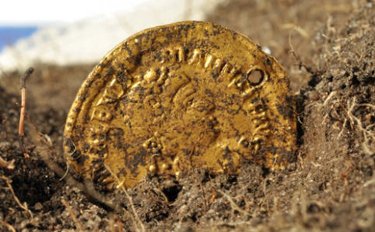
Most recently, a gold Roman solidus was discovered. The coin is thought to have been part of a looted hoard, dropped during the sack of the castle.
Although the sack of the fort and murder of its inhabitants occurred 1500 years ago, local memories cause residents of the fort’s vicinity still to shun the site. Archaeologist Helena Victor stated: “There are still memories 1,500 years later of these events, it’s a dangerous place. Parents tell their children that they can’t play there because it’s a dangerous place. They don’t remember the history but they remember it’s dangerous.”
Unknown artist, King Richard III, late 16th century, National Portrait Gallery.
Chemical analysis of the bones and teeth of the skeleton found beneath the Leicester parking lot seems to confirm its identity as the remains of Richard III, the last Plantagenet king of England.
According to a study performed by the British Geological Survey and researchers at the University of Leicester, the king changed location and diet early in his childhood, and then, when he was crowned king 26 months before his death at the Battle of Bosworth, started eating a richer diet associated with his change in status. …
The team analysed the isotopes found in three locations of King Richard III’s skeleton: his teeth, his femur, and his rib. Each showed elements related to geographical location, pollution, and diet: strontium, nitrogen, oxygen, carbon, and lead. As teeth and bones continue to change and develop throughout life, the team was able to map specific elements to locations and time frames.
According to his teeth, Richard III had moved away from Fotheringhay Castle in Northampshire by the time he was seven, to an area of higher rainfall, older rocks and a different diet to what was available in his birthplace.
According to his femur — which shows an average of the last 15 years before death — Richard moved back to England’s east sometime in his adolescence or young adulthood, and his diet changed to match that of the high aristocracy.
It is his rib that shows his later life. Typically, the ribs renew themselves quickly, so it only represents the last two to five years of life. It was in this period that Richard III’s diet changed the most — although the differences between femur and rib could indicate a relocation, Richard III did not move away from England’s east.
The elements found in his rib suggests an increase in his diet of freshwater fish and birds — such as swan, crane, heron, and egret — which were popular choices for royal banquets. It also suggests that he was drinking more wine. Both these changes reinforce that food and drink — and, in particular, types of food and drink — were very important indicators of social status in England in the Middle Ages.
Daniel McCarthy, over at the American Conservative, argues that if you want liberalism and democracy, you are going to need an Empire capable of “by upholding a relatively un-Hobbesian global security environment.”
In the 19th century, the United States enjoyed the advantages of an international security environment propitious to liberalism and democracy without having to incur the costs of empire necessary to sustain those conditions. America could be liberal without having to be imperial—although the Indians, Mexicans, and Filipinos might well disagree. Beginning with World War II, however, if America wished to remain liberal and democratic, it would have to become imperial in many of the ways Britain had been—including playing a leading role in Europe and on the oceans. Indeed, America would have to do much of what the British Empire had done in the previous century on an even larger scale.
The efflorescence of liberal democracy in the latter half of the 20th century—the growth of international trade and support for democracy and human rights to the point where the total package appeared to be the “End of Historyâ€â€”was not a spontaneous, natural development. It was driven by U.S. prestige and power. Germany is now deeply committed to political liberalism, and Japan may in some respects be more consumerist than the U.S. itself. But these states were, of course, remade by the U.S. after World War II.
This is not to say there aren’t genuinely local traditions of liberalism or democracy to be found among America’s allies, nor that American arms can simply transform any other kind of regime into a liberal and democratic one: the apparent success of nation-building in Japan and Germany owed as much to the threat that the Soviet Union posed to those states as to anything America did. The Germans and Japanese had the most urgent incentive imaginable to make their newly liberal and democratic constitutions work—because aligning with the U.S. was the only insurance they could buy against being annexed by the Soviet empire instead.
There is a crucial difference between the Napoleonic, land-empire mentality that wants to revolutionize other states—a mentality taken to extremes by the Soviets and exhibited with considerable fervor by many neoconservatives and liberal hawks today—and the example set by Britain in the 19th century, which was a liberal but not revolutionary world power and encouraged liberalization mostly though indirect means: via trade, culture, and above all, by upholding a relatively un-Hobbesian global security environment.
Liberal anti-imperialists today, whether libertarian or progressive, make the same mistakes Britain’s pacifists and America’s interwar noninterventionists once did: they imagine that the overall ideological complexion of the world, as determined by the state most capable of projecting power, need not affect their values and habits at home. They believe that liberalism is possible without empire.
Edward Luttwak, in a very learned essay on “The Cycles—or Stages—of Chinese History,” published by the Hoover Institution, describes the Chinese version of “Balance of Power” theory.
The innermost circle of the Tianxia is formed by the rest of the Politburo and top Beijing officialdom, while its outermost circle comprises the Solomon Islands along with the twenty or so other utterly benighted “outer barbarian†countries that still do not recognize Beijing, preferring Taipei. In between, all other Chinese from officials and tycoons to ordinary subjects and overseas Chinese fit in their own circles, further and further from the imperial coreas do foreign states both large and small, both near and far, both already respectful (too few) and those still arrogantly vainglorious. It is the long-range task of China’s external policy to bring each and every state into a proper relationship with the emperor—that is, a tributary relationship, in which they deliver goods and services if only as tokens of fealty, in exchange for security and prosperity, but even more for the privilege of proximity to the globally benevolent emperor1. All this is of course nothing more than an exceptionally elaborate rendition of universal ambitions that are merely grander for the greater—the Byzantine ranking of foreign potentates by their proximity to the emperor was only slightly less elaborate.
Nor is there anything peculiarly Chinese about the desire to bring other states into a tributary relationship—often better than a full incorporation, which may be unwanted for any number of reasons, and obviously superior to an alliance however close and secure but between equals, whereby there must be reciprocity, a quid for every quo, usually costly or irksome in some way. Hence from time immemorial, stronger clans, tribes, potentates, and entire nations have done their best to impose tributary relations on weaker clans, tribes, potentates and nations, obtaining goods and services for their forbearance and perhaps protection, or at least tokens of respectful subordination. Chinese emperors wanted no more than that, and unlike most recipients, not infrequently gave gifts more valuable than the tribute they received (as did many Byzantine emperors, by the way).
What is peculiar to China’s political culture, and of very great contemporary relevance is the centrality within it of a very specific doctrine on how to bring powerful foreigners—indeed foreigners initially more powerful than the empire—into a tributary relationship.
Be sure to read on in order to find out how it would be applied to us.
Germany implements the Schlieffen Plan, violating Belgian Neutrality, in an attempt to outflank the French Army and gain a quick victory by knocking France out of the war.
In response to the invasion of neutral Belgium, Britain declares war on Germany.
“The lamps are going out all over Europe, we shall not see them lit again in our life-time.” remarks British Foreign Secretary Sir Edward Grey.
A global map detailing the genetic histories of 95 different populations across the world, showing likely genetic impacts of all sorts of events including the 13th century Mongol Invasion of Europe, has been revealed for the first time.
The interactive map, produced by researchers from Oxford University and UCL (University College London), details the histories of genetic mixing between each of the 95 populations across Europe, Africa, Asia and South America spanning the last four millennia.
The study, published this week in Science, simultaneously identifies, dates and characterises genetic mixing between populations. To do this, the researchers developed sophisticated statistical methods to analyse the DNA of 1490 individuals in 95 populations around the world. The work was chiefly funded by the Wellcome Trust and Royal Society.
The group with the longest time since admixture is detected are the Kalash from Pakistan, with an
ancient inferred event prior to 206BCE, involving mixing between a more European group, and a more
Central/South Asian group (there may also be a contribution from people carrying DNA shared with
modern-day East Asians, but we are less certain about this). Some Kalash believe they are descended
from the army of Alexander the Great, as do other groups in the region, some of whom show similar
early events–our date does not rule this out but the date range also allows for other possibilities. …
There are a number of populations that show admixture events that are not straightforward enough to
be categorized by our current analysis. For example, the French show an event involving Northern and
Southern European and North African populations dating to 1085 years ago plus or minus 300 years.
However, according to the automated quantitative criterion we developed for characterizing admixture
events, this event is characterized as “uncertainâ€.
Eugene Volokh (who arrived in America in 1975) warns against letting in those dirty immigrants who may change America and the way things are in this country at the present time.
[F]or all the good that immigration can do (and I’m an immigrant to the U.S., who is very glad that America let me in, and who generally supports immigration), unregulated immigration can dramatically change the nature of the target society. It makes a lot of sense for those who live there to think hard about how those changes can be managed, and in some situations to restrict the flow of immigrants — who, after all, will soon be entitled to affect their new countrymen’s rights and lives, through the vote if not through force. …
Letting in immigrants means letting in your future rulers. It may be selfish to worry about that, but it’s foolish not to. … [E]ven for America, the influx of millions of new citizens — both the potentially legalized current illegal immigrants and the many others who are likely to come in the wake of the legalization — can affect the society and the political system in considerable ways. It seems to me eminently sensible to be concerned about the illegal immigrants who may well change (in some measure) your country even if your ancestors were themselves illegal immigrants who changed the country as it once was.
Via Clarice Feldman.
————————
But America has always been a country determined to occupy a new continent and build a new country, and America has always had a shortage of affordable labor. That’s why they imported criminals and slaves to Colonial America, and that’s why –until the 1920s– we had essentially unlimited immigration.
After hundreds of years and the influx of countless unrelated groups of people, the United States, I would argue, has a tradition of pluralism and assimilation of immigrants central to its own identity. America previously allowed in all sorts of groups with conspicuously undesirable characteristics, all of whom definitely changed the culture of the country in significant ways.
Native-born Americans in generations gone by endured the Scots Irish lawlessness and propensity toward violence, German-speaking religious extremists’ refusal to assimilate or to use modern technologies, Irish drunkenness and talent for political corruption, the popery and beer garden culture of Bavarian Germans, Italian criminal conspiracies, Jewish enthusiasm for radical politics and bad art, and the general barbarism and illiteracy of representatives of essentially every variety of rural European peasantry. Previous waves of immigration brought crime and violence, political corruption, poverty and illiteracy, and enormous cultural change to America, but immigrants typically rapidly prospered and assimilated, climbing out of poverty while, in the meantime, doing all the disagreeable, dangerous, and low-paying jobs native-born Americans wouldn’t do. Their children filled the ranks of the American Armed Forces and won America’s wars.
As a grandson of turn-of-the-last-century immigrants, I strongly disagree with Mr. Volokh. I think that, as Americans and as the descendants of immigrants, we have an obligation to affirm and defend our national tradition of welcoming and assimilating other immigrants succeeding our own ancestors in turn. The “I’m aboard, Captain, pull the ladder up!” position is simply disgraceful for an American.
Michael Robbins, at Slate, reviews Nick Spencer’s Atheists: The Origin of the Species, which seems to constitute a well-deserved attack on the “New Atheists,” i.e., the smug, self-congratulatory secular materialists of the Richard Dawkins-ilk.
Nietzsche realized that the Enlightenment project to reconstruct morality from rational principles simply retained the character of Christian ethics without providing the foundational authority of the latter. Dispensing with his fantasy of the Ãœbermensch, we are left with his dark diagnosis. To paraphrase the Scottish philosopher Alasdair MacIntyre, our moral vocabulary has lost the contexts from which its significance derived, and no amount of Dawkins-style hand-waving about altruistic genes will make the problem go away. (Indeed, the ridiculous belief that our genes determine everything about human behavior and culture is a symptom of this very problem.)
The point is not that a coherent morality requires theism, but that the moral language taken for granted by liberal modernity is a fragmented ruin: It rejects metaphysics but exists only because of prior metaphysical commitments. A coherent atheism would understand this, because it would be aware of its own history. Instead, trendy atheism of the Dawkins variety has learned as little from its forebears as from Thomas Aquinas, preferring to advance a bland version of secular humanism. Spencer quotes John Gray, a not-New atheist: “Humanism is not an alternative to religious belief, but rather a degenerate and unwitting version of it.†How refreshing would be a popular atheism that did not shy from this insight and its consequences.
It is, I suppose, perversely amusing, and confirming of Chesterton’s prediction that, post Religion, people will not believe in nothing, but will believe in anything, that the typical contemporary enlightened elite position involves both the contemptuous rejection of traditional religion and the uncritical acceptance of an even-more-simplistic catechism composed of sentimental humanitarianism constituting a sort of attenuated Christianity, sexually-emancipated but even more enthusiastic about ressentiment.
Stuart Kelly, in the Guardian, commemorates the 200th anniversary of the publication of the first of Sir Walter Scott’s historical novels, which were immensely popular for at least a century and a half, and which turned most of the reading public of Europe and America into reactionary romantics.
Waverley is not a precursor to the great Victorian novels (or even the mediocre Victorian novels by the likes of Bulwer-Lytton and Harrison Ainsworth) but a development from the form’s 18th-century radical roots. In the same year as he published Waverley anonymously, as Walter Scott he had produced an edition of the works of Swift. The opening pages of Waverley have a kind of sly self-consciousness that echoes Sterne’s Tristram Shandy more than Trollope’s Orley Farm. The reader doesn’t jump into the story, but jumps into a story about the story as the narrator ponders other titles and subtitles the book could have had. He parodies gothic, sentimental and fashionable tales (though the book will eventually encompass all these genres). Chapter 24 begins with the provocative question “Shall this be a long or a short chapter? This is a question in which you, gentle reader, have no vote, however much you may be interested in the consequences.”
The eponymous Waverley is an English soldier who ends up supporting Charles Edward Stuart’s Jacobite Rebellion of 1745 through a mixture of quixotic romanticism and personal petulance. Scott, anonymously reviewing one of his later books in The Quarterly Review called his protagonist “a very amiable and very insipid sort of young man” – in private he referred to him as a “sneaking piece of imbecility”. But then Scott’s habit of self-deprecation, charming though it can be, can obscure the psychological acuity and emotional realism of his work. Waverley, for example, falls in love when he plays at falling in love.
In his lifetime, Scott was compared to Shakespeare by the critics – not a judgment made too often these days. Nevertheless, it’s an important comparison. German critics (and Scott began his career translating Goethe) had praised Shakespeare for his immense scope, and Scott has something similar: Waverley has space for a royal usurper and the village idiot, the local laird and the middle-class soldier, the fanatic and the pragmatist, the outlaw and the establishment. Virginia Woolf would later claim he was “perhaps the last novelist to practice the great, the Shakespearean art, of making people reveal themselves in speech”.
Jane Austen said that Scott had “no business writing novels – especially good ones”. Francis Jeffrey, the most influential critic of the day, captures both the thrill and the frustration of reading Scott when he reviewed Waverley in The Edinburgh Review:
“It is wonderful what genius and adherence to nature will do in spite of all disadvantages. Here is a thing obviously very hastily, and, in many places, very unskilfully written — composed, one half of it, in a dialect unintelligible to four-fifths of the reading population of the country – relating to a period too recent to be romantic, and too far gone by to be familiar — and published, moreover, in a quarter of the island where materials and talents for novel-writing have been supposed to be equally wanting; and yet, by the mere force and truth and vivacity of its colouring, already casting the whole tribe of ordinary novels into the shade, and taking its place rather with the most popular of our modern poems, than with the rubbish of provincial romances. The secret of this success, we take it, is merely that the author is a person of genius”.
When I was young, you could find beautifully bound sets of the Waverly novels mouldering away in every used book barn at derisory prices. Today, you can download them in eBook form for free.
The Colt M1892 Revolver chambered in .38 Long Colt was found inadequate to stop a hopped-up, charging Muslim terrorist during the Phillipine Insurrection.
Russ Chastain observes that we seem to have a US Army that can’t learn from history, and is therefore obliged to repeat it.
Dear U.S. Army: We told you so.
When 38 bullets (actually .357 caliber, which is pretty much 9mm) failed to stop its enemies, the U.S. Army went in search of a bigger, better cartridge. The result was John Browning’s M1911 semi-automatic pistol and the 45 ACP (Automatic Colt Pistol) cartridge for which it was designed.
As you can guess from the M1911 designation, the 45 ACP was adopted into military service 103 years ago.
In 1985, the U.S. Army took a huge step backwards when it summarily dumped the 45 ACP in favor of the underpowered 9mm Luger cartridge (a.k.a. 9mm Parabellum). Irony: The 9mm is not quite as powerful as the cartridge which the 45 ACP replaced about 75 years earlier.
Now, things have apparently come full circle. Citing combat experience in Iraq and Afghanistan, authorities are once again recognizing the advantage of using a more powerful cartridge.
True to form, the government won’t look back at what once worked well and embrace it. Instead they plan to spend billions of our dollars creating and adopting something they’re calling a Modular Handgun System (MHS). And they’re not just tossing out the 9mm ammo and firearms. They’re ditching whole heaps of gear, holsters included, and starting over.
They haven’t yet settled on a caliber, and are looking just about anything better than a nine. This would include a faster same-caliber round (357 Sig) as well as larger-caliber cartridges like the 40 S&W, 10mm Auto, and 45 ACP.
Devotees of the diminutive 9mm Luger cartridge are going to have a hard time swallowing the fact that their Precious has been found to be a bit, er, weak. …
Anybody think they’ll end up with some jazzed-up version of a 1911? Hmmmm…