King John Sobieski and the military forces of Poland-Lithuania put a stop to Islamic aggression against Europe and Western Civilization for over three centuries.
How many people realize that the 9/11 attacks were deliberately timed to represent an Islamic response to the Relief of the Siege of Vienna?
The search in Leicester for the remains of Richard III, the last Plantagenet monarch of England slain August 22, 1485 at Bosworth Field, may have achieved success.
The Telegraph reports the finding of remains that may very possibly be those of Richard.
Over 500 years since he was killed in battle, archaeologists believe they have finally found the skeleton of King Richard III, buried deep beneath a council car park.
Experts said a fully intact skeleton matched much about what they knew about the medieval king, and are hoping that DNA tests will put their beliefs beyond doubt.
The remains were found three weeks into an archaeological dig by a team from Leicester University, which recently pinpointed the site of the ancient Grey Friars church, where Richard was believed to be buried after being killed in the Battle of Bosworth in August 1485, and which was razed to the ground in 1538 during the Dissolution of the Monasteries ordered by Henry VIII.
To their astonishment, an excavation unearthed a result which experts said were “beyond out wildest dreamsâ€.
Five key aspects underlined their belief that appears to have ended a decade-long search for his remains.
The skeleton was an adult male, who appeared fit and strong. He had suffered significant trauma to the head where a blade had cut away part of the back of his skull; an injury consistent with battle.
A barbed arrow head was found lodged between vertebrae in his upper back, and spinal abnormalities pointed to the fact that he had severe scoliosis, a form of spinal curvature. This would have made his right shoulder appear visibly higher than his left, which is consistent with contemporary accounts of Richard’s appearance.
Richard’s two year reign was the subject of one of William Shakespeare’s most famous plays, which portrayed him as an evil, ugly hunchback, and which helped cement the public perception of him.
The remains were found in the Choir area of the church, again consistent with historical record of where he was buried.
Captain Rescorla in action at Ia Drang, Republic of Vietnam, 15 November 1965. photograph: Peter Arnett/AP.
Born in Hayle, Cornwall, May 27, 1939, to a working-class family, Rescorla joined the British Army in 1957, serving three years in Cyprus. Still eager for adventure, after army service, Rescorla enlisted in the Northern Rhodesia Police.
Ultimately finding few prospects for advancement in Britain or her few remaining colonies, Rescorla moved to the United States, and joined the US Army in 1963. After graduating from Officers’ Candidate School at Fort Benning, Georgia in 1964, he was assigned as a platoon leader to Bravo Company of the 2nd Battalion, 7th Cavalry, Third Brigade of the 1st Cavalry Division (Airmobile). Rescorla’s serious approach to training and his commitment to excellence led to his men to apply to him the nickname “Hard Corps.”
The 2nd Battalion of the 7th Cavalry was sent to Vietnam in 1965, where it soon engaged in the first major battle between American forces and the North Vietnamese Army at Ia Drang.
The photograph above was used on the cover of Colonel Harold Moore’s 1992 memoir We Were Soldiers Once… and Young, made into a film starring Mel Gibson in 2002. Rescorla was omitted from the cast of characters in the film, which nonetheless made prominent use of his actual exploits, including the capture of the French bugle and the elimination of a North Vietnamese machine gun using a grenade.
For his actions in Vietnam, Rescorla was awarded the Silver Star, the Bronze Star (twice), the Purple Heart, and the Vietnamese Cross of Gallantry. After Vietnam, he continued to serve in the Army Reserve, rising to the rank of Colonel by the time of his retirement in 1990.
Rick Rescorla became a US citizen in 1967. He subsequently earned bachelor’s, master’s, and law degrees from the University of Oklahoma, and proceeded to teach criminal law at the University of South Carolina from 1972-1976, before he moved to Chicago to become Director of Security for Continental Illinois Bank and Trust.
In 1985, Rescorla moved to New York to become Director of Security for Dean Witter, supervising a staff of 200 protecting 40 floors in the South Tower of the World Trade Center. (Morgan Stanley and Dean Witter merged in 1997.) Rescorla produced a report addressed to New York’s Port Authority identifying the vulnerability of the Tower’s central load-bearing columns to attacks from the complex’s insecure underground levels, used for parking and deliveries. It was ignored.
On February 26, 1993, Islamic terrorists detonated a car bomb in the underground garage located below the North Tower. Six people were killed, and over a thousand injured. Rescorla took personal charge of the evacuation, and got everyone out of the building. After a final sweep to make certain that no one was left behind, Rick Rescorla was the last to step outside.
—————————————-
Directing the evacuation on September 11th.
Security Guards Jorge Velasquez and Godwin Forde are on the right. photograph: Eileen Mayer Hillock.
Rescorla was 62 years old, and suffering from prostate cancer on September 11, 2001. Nonetheless, he successfully evacuated all but 6 of Morgan Stanley’s 2800 employees. (Four of the six lost included Rescorla himself and three members of his own security staff, including both the two security guards who appear in the above photo and Vice President of Corporate Security Wesley Mercer, Rescorla’s deputy.) Rescorla travelled personally, bullhorn in hand, as low as the 10th floor and as high as the 78th floor, encouraging people to stay calm and make their way down the stairs in an orderly fashion. He is reported by many witnesses to have sung “God Bless America,” “Men of Harlech, ” and favorites from Gilbert & Sullivan operettas. “Today is a day to be proud to be an American,” he told evacuees.
A substantial portion of the South Tower’s workforce had already gotten out, thanks to Rescorla’s efforts, by the time the second plane, United Airlines Flight 175, struck the South Tower at 9:02:59 AM. Just under an hour later, as the stream of evacuees came to an end, Rescorla called his best friend Daniel Hill on his cell phone, and told him that he was going to make a final sweep. Then the South Tower collapsed.
Rescorla had observed a few months earlier to Hill, “Men like us shouldn’t go out like this.” (Referring to his cancer.) “We’re supposed to die in some desperate battle performing great deeds.” And he did.
—————————————-
His hometown of Hayle in Cornwall has erected a memorial.
—————————————-
2,996 was a project put together by blogger Dale Roe to honor each victim of the September 11, 2001 attacks. 3,061 blogs committed to posting tributes to each victim. Never Yet Melted’s tribute was to Rick Rescorla, and is republished annually.
A moving and nostalgic video which adds a musical background to 19th century hand-colored sketches of palaces and manor-houses in the former Grand Duchy of Lithuania (today’s Lithuania and Belarus) by the artist Napoleon Orda. Orda’s drawings record the romantic architecture of an aristocratic world swept out of existence by Revolutionary violence and totalitarianism.
The “Eastern Borderlands” is a translation of the Polish word kresy.
More interesting than any mere ordinary presidential campaign is Geoff Micks‘s theoretical question:
In a mass knife fight to the death between every American President, who would win and why?
Micks gives each president a lousy mass-produced, tactical-styled Gerber LRH. I think it would be more considerate to give them something a little better. My choice is the Randall Number 1 — All Purpose Fighting Knife. Each president can select his preferred blade length from 5 to 8″.
I don’t think Micks is far off on his analysis of the odds.
I think, though, that George Washington may have a better chance than Micks supposes. Washington was a large, powerful, and physically graceful man, and he was notoriously aggressive by temperament. After all, as a young lieutenant, George Washington essentially singlehandedly started the French and Indian War.
Teddy Roosevelt was game, and I think he would have made a spirited effort, hurrying into the fight, but let’s face it, Teddy was a four-eyed rich boy who went to Harvard. He was fine at shooting lions and bears, but it’s not certain that TR ever actually killed anybody.
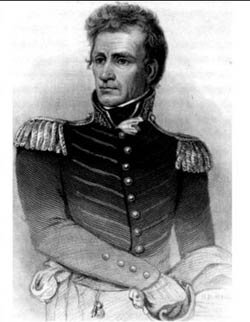
The obvious truth is, in the history of the American presidency, only one stone cold killer has ever occupied the Oval Office. The number of duels fought by Andrew “By God” Jackson varies in different accounts. Some authorities claim he fought 13 times. There is no doubt at all, though, that Andrew Jackson, after first taking a bullet, shot Charles Dickinson dead in 1806, observing afterwards that “If he had shot me through the brain, I would still have killed him.”
Andrew Jackson survived the first assassination attempt on an American president, and actually subdued and arrested his own assailant. Some accounts say that Jackson produced a pair of pistols out of his pockets. Others claim that Jackson beat the would-be assassin into unconsciousness with his cane.
On his death bed, Jackson reportedly remarked: “I have only two regrets: I didn’t shoot Henry Clay and I didn’t hang John C. Calhoun.”
It seems to me that with respect to readiness to fight, competence, and iron resolution, not even Washington could hope to compete with Old Hickory.
Unknown artist, Richard III, mid-16th century, Society of Antiquaries, London
A search is on in Leicester for the remains of Richard III, slain in battle at Bosworth Field, and then buried at Greyfriars Church. The location of the burial, and even the exact location of the Franciscan Friary, have been lost to five centuries of development.
Philippa Langley, from the Richard III Society which has been involved with the project, said: “We know he was buried here but the church disappeared after the dissolution of the monasteries as did his grave so today we begin the search for Richard.
“We know his body was led into Leicester and put on display for three days by Henry Tudor before he was buried.
“I hope we do find him because I want to give him a proper resting place and also to explode a lot of myths around Richard III.”
Richard Buckley, co-director of the Archaeology Service at the university, said: “It is quite a long shot but it’s a very exciting project. We don’t know the whereabouts of any of the friary buildings at the moment. We don’t know precisely where the body would have been buried but we suspect it would be in the choir or near the alter.”
If bones are found they will be assessed for trauma to the skeleton, as the monarch was killed in battle, then be subject to DNA analysis.
King Richard III, the last Plantagenet, ruled England from 1483 until he was defeated at the Battle of Bosworth in 1485.
Richard may never be found as there is also a tradition that the late king’s remains were thrown into the River Soar at the time of the Dissolution of the Monasteries.
On 22 August 1485, Richard met the outnumbered forces of Henry Tudor at the Battle of Bosworth Field. He was astride his white courser. The size of Richard’s army has been estimated at 8,000, Henry’s at 5,000, but exact numbers cannot be known. During the battle Richard was abandoned by Baron Stanley (made Earl of Derby in October), Sir William Stanley, and Henry Percy, 4th Earl of Northumberland. Despite his apparent affiliation with Richard, Baron Stanley’s wife, Lady Margaret Beaufort, was Henry Tudor’s mother. The switching of sides by the Stanleys severely depleted the strength of Richard’s army and had a material effect on the outcome of the battle. Also the death of John Howard, Duke of Norfolk, his close companion, appears to have had a demoralising effect on Richard and his men. Perhaps in realisation of the implications of this, Richard then appears to have led an impromptu cavalry charge deep into the enemy ranks in an attempt to end the battle quickly by striking at Henry Tudor himself. Accounts note that Richard fought bravely and ably during this manoeuvre, unhorsing Sir John Cheney, a well-known jousting champion, killing Henry’s standard bearer Sir William Brandon and coming within a sword’s length of Henry himself before being finally surrounded by Sir William Stanley’s men and killed. Tradition holds that his final words were “treason, treason, treason!”, when he found Lord Stanley had turned against him. The Welsh accounts state that Sir Wyllyam Gardynyr killed King Richard III with a poleaxe. The blows were so violent that the king’s helmet was driven into his skull. The account reads, “Richard’s horse was trapped in the marsh where he was slain by one of Rhys Thomas’ men, a commoner named Wyllyam Gardynyr.” Another account has Rhys ap Thomas himself slaying the king.
Polydore Vergil, Henry Tudor’s official historian, would later record that “King Richard, alone, was killed fighting manfully in the thickest press of his enemies”. Richard’s naked body was then exposed, possibly in the collegiate foundation of the Annunciation of Our Lady, and hanged by Henry Tudor, now King Henry VII, before being buried at Greyfriars Church, Leicester. In 1495 Henry VII paid £50 for a marble and alabaster monument. According to one tradition, during the Dissolution of the Monasteries his body was thrown into the nearby River Soar, although other evidence suggests that a memorial stone was visible in 1612, in a garden built on the site of Greyfriars.[18] The exact location is now lost due to over 500 years of subsequent development. On 24 August 2012, the University of Leicester and Leicester City Council, in association with the Richard III Society, have joined forces to begin a search for the mortal remains of King Richard III. Led by University of Leicester Archaeological Services (ULAS), experts will be seeking to locate the Greyfriars site and discover whether the remains of Richard III may still be found. There is currently a memorial plaque on the site of the Cathedral where he may have once been buried, as well as a stone plaque on the bridge where his remains were allegedly thrown into the Soar.
This young tech blogger dude sits down in a coffee shop in Portland to catch up on his email and do a little blogging on his Macbook Air, when an incredibly ancient geezer comes along and starts up a conversation about Apple computers.
The old guy doesn’t approve of Apple’s iPad approach: all consuming, no programming, no creating, no doing anything which hasn’t ever been done before. The young guy asks the old geezer what he ever did that hadn’t been done before, and the old guy replies: “I invented the first computer.”
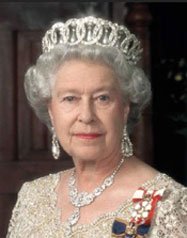
Queen Elizabeth II of Great Britain — Genghis Khan, ruler of the Mongol Empire
The official count says the United States came in first with 46 Gold Medals, followed by China with 38, and Great Britain in third position with 29.
But Reuters argues that, if we look at all this another way, taking all the medals won by countries of which Queen Elizabeth II is head of state, the total is really a bit different.
Thanks to her role as head of state for 16 countries, Queen Elizabeth is the world leader whose athletes have won more gold medals at London 2012 than any other and in her diamond jubilee year too. That’s 48 golds for Elizabeth to Obama’s 46.
Alongside Britain’s 29 golds, only six of the queen’s other countries were needed to top the medal count with seven from Australia, five from New Zealand, four from Usain Bolt and his fellow Jamaicans and one each from Bahamas, Canada and Grenada.
But what’s a piddling 48 Gold Medals?
Pingflux suggests counting historically and looking at the results by Empire. The British Empire does decently, achieving a tie for second place (55 Gold Medals each) with the Roman Empire. But the real winner may be a bit of a surprise.
The real winner of the 2012 Olympics proves to be Genghis Khan’s Mongol Empire with a whopping 102 Gold Medals, 285 total.
This striking photo of a Pittsburgh street at night in 1900 kind of reminded me of the gritty Pennsylvania coal town where I grew up. We didn’t have steel mills though, only coal mines.
Rachel Cooke goes for a walk in the course of interviewing Robert Macfarlane, author of a new book (being released in October in the USA, but already in print in the UK) on Britain’s ancient tracks, holloways, drove roads, and sea paths.
Examine a large-scale map of the Essex coastline between the river Crouch and the river Thames, and you’ll see a footpath which departs the land at a place called Wakering Stairs and heads east, straight into – or so it appears – the North Sea. A few hundred yards on, it veers north, heading out across Maplin Sands until, three miles later, it turns back in the direction whence it came, finally making landfall at Fisherman’s Head, on the edge of Foulness Island.
Can this carefully traced line be for real? Certainly. You are not hallucinating. This is the Broomway, a path that is said to date from Roman times, and when Robert Macfarlane agrees to go walking with me, it’s his first idea. Am I excited about this? Yes, and no. I’m thrilled at the idea of heading out with Macfarlane; I feel like a marathon runner who’s been invited to train with Paula Radcliffe. But then I read his book, The Old Ways, and anxiety rolls in, like Essex mist. The Broomway, which can only be crossed when the tide is out, is the deadliest path in Britain; Edwardian newspapers, relishing its rapacious reputation – 66 of its dead lie in Foulness churchyard – rechristened it “the Doomway”. As he notes, even the Ordnance Survey map registers the “gothic” atmosphere of the path: “WARNING,” it reads. “Public rights of way across Maplin Sands can be dangerous. Seek local advice.” I admire Macfarlane hugely; I would love to watch him “walking on silver water” in the “mirror-world” that is the Broomway. On the other hand, I would probably prefer not to drown in the service of trying to tell you what a good writer he is.
——————————
Wikipedia: The Broomway provided the main access to Foulness for centuries. It is an ancient track, which starts at Wakering Stairs, and runs for 6 miles (9.7 km) along the Maplin Sands, some 440 yards (400 m) from the present shoreline. The seaward side of the track is defined by bunches of twigs and sticks, shaped like upside-down besom brooms or fire-brooms, which are buried in the sands. Six headways run from the track to the shore, giving access to local farms. The track was extremely dangerous in misty weather, as the incoming tide floods across the sands at high speed, and the water forms whirlpools because of flows from the River Crouch and River Roach. Under such conditions, the direction of the shore cannot be determined, and the parish registers record the burials of many people who were drowned.
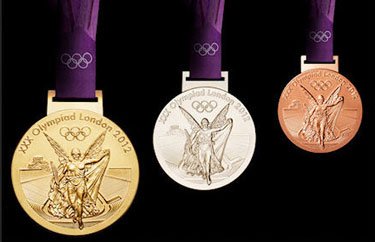
Inflation is almost as old as the modern Olympic Games (revived in 1896). Boing Boing informs us that the Olympic Gold Medals we are watching being awarded are only gold-plated, and that Olympic Gold Medals have not really been made of gold since a century ago.
The amount of gold in an Olympic gold medal has fallen to 1.34 percent, thanks to gold prices that recently peaked at $1,895 an ounce. At current prices, a pure 400g medal would cost about $25,000 to make, with a total bill of about $50m for the games.
“The last time the Olympic Games handed out solid gold medals was a hundred years ago at the 1912 Summer Games in Stockholm, Sweden,” writes gold brokers Dillon Gage. “Gold medals were in fact only gold for eight years. …
The 2012 gold is 92.5 percent silver, 1.34 percent gold, and 6.16 copper, with IOC rules specifying that it must contain 550 grams of high-quality silver and 6 grams of gold. The resulting medallion is worth about $500. For the silver medal, the gold is replaced with more copper, for a $260 bill of materials.
The bronze medal is 97 percent copper, 2.5 percent zinc and 0.5 percent tin. Valued at about $3, you might be able to trade one for a bag of chips in Olympic park if you skip the fish.