Category Archive 'History'
23 Apr 2010


Hans von Aachen, St. George Slaying the Dragon, c. 1600, Private Collection, London
From Robert Chambers, The Book of Days, 1869:
Butler, the historian of the Romish calendar, repudiates George of Cappadocia, and will have it that the famous saint was born of noble Christian parents, that he entered the army, and rose to a high grade in its ranks, until the persecution of his co-religionists by Diocletian compelled him to throw up his commission, and upbraid the emperor for his cruelty, by which bold conduct he lost his head and won his saintship. Whatever the real character of St. George might have been, he was held in great honour in England from a very early period. While in the calendars of the Greek and Latin churches he shared the twenty-third of April with other saints, a Saxon Martyrology declares the day dedicated to him alone; and after the Conquest his festival was celebrated after the approved fashion of Englishmen.
In 1344, this feast was made memorable by the creation of the noble Order of St. George, or the Blue Garter, the institution being inaugurated by a grand joust, in which forty of England’s best and bravest knights held the lists against the foreign chivalry attracted by the proclamation of the challenge through France, Burgundy, Hainault, Brabant, Flanders, and Germany. In the first year of the reign of Henry V, a council held at London decreed, at the instance of the king himself, that henceforth the feast of St. George should be observed by a double service; and for many years the festival was kept with great splendour at Windsor and other towns. Shakspeare, in Henry VI, makes the Regent Bedford say, on receiving the news of disasters in France:
Bonfires in France I am forthwith to make
To keep our great St. George’s feast withal!’
Edward VI promulgated certain statutes severing the connection between the ‘noble order’ and the saint; but on his death, Mary at once abrogated them as ‘impertinent, and tending to novelty.’ The festival continued to be observed until 1567, when, the ceremonies being thought incompatible with the reformed religion, Elizabeth ordered its discontinuance. James I, however, kept the 23rd of April to some extent, and the revival of the feast in all its glories was only prevented by the Civil War. So late as 1614, it was the custom for fashionable gentlemen to wear blue coats on St. George’s day, probably in imitation of the blue mantle worn by the Knights of the Garter.
In olden times, the standard of St. George was borne before our English kings in battle, and his name was the rallying cry of English warriors. According to Shakspeare, Henry V led the attack on Harfleur to the battle-cry of ‘God for Harry! England! and St. George!’ and ‘God and St. George’ was Talbot’s slogan on the fatal field of Patay. Edward of Wales exhorts his peace-loving parents to
‘Cheer these noble lords,
And hearten those that fight in your defence;
Unsheath your sword, good father, cry St. George!’
The fiery Richard invokes the same saint, and his rival can think of no better name to excite the ardour of his adherents:
‘Advance our standards, set upon our foes,
Our ancient word of courage, fair St. George,
Inspire us with the spleen of fiery dragons.’
England was not the only nation that fought under the banner of St. George, nor was the Order of the Garter the only chivalric institution in his honour. Sicily, Arragon, Valencia, Genoa, Malta, Barcelona, looked up to him as their guardian saint; and as to knightly orders bearing his name, a Venetian Order of St. George was created in 1200, a Spanish in 1317, an Austrian in 1470, a Genoese in 1472, and a Roman in 1492, to say nothing of the more modern ones of Bavaria (1729), Russia (1767), and Hanover (1839).
—————————-
St. George, being a soldier saint, was also a favorite of the Lithuanians, and the Lithuanian parish in Shenandoah, Pennsylvania where I grew up was named for him. Our church’s cornerstone was laid in 1891, and construction was completed in 1894. In 1901, the frame church was clad in brick and twin towers erected. In 1907, a poor immigrant coal mining community spent nearly $100,000 covering the church in granite and decorating its interior in the Gothic manner of Pugin.
The diocese of Allentown in its wisdom demolished St. George Church during the winter of 2009-2010.
Quomodo sedet sola civitas…

Main Altar, St. George Church, Christmas 1979
12 Apr 2010
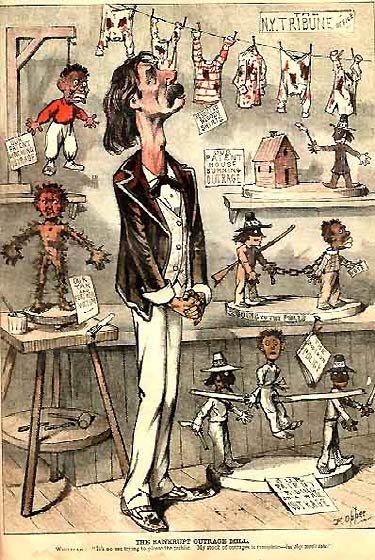
1880 Frederick Burr Opper Cartoon from Puck, titled: The Bankrupt Outrage Mill (showing bloody shirts, lynchings, and other forms of racial violence)
Virginia Governor Bob McDonnell’s break with political correctness and resumption of the practice avoided by two democrat party predecessors of declaring April to be “Confederate History Month” provoked the American left to open fire with all the batteries of the establishment media and the progressive blogosphere.
The contemporary left enthusiastically identifies with the 19th century radical abolitionist movement (which had so much to do with starting the Civil War) and is determined to ruthlessly suppress any expression of enthusiasm or affection for the Lost Cause.
The theoretical defense of the Southern political perspective and the rights of the states, remembrance of Confederate military victories, admiration for Confederate leaders, and any defense of the Southern Antebellum way of life are all treated as the gravest of thought crimes.
From the point of view of the Left, the politics of Slavery is all. Just as Harry Reid declared opposition to the Health Care Bill to be equivalent to opposing Civil Rights, the liberal commentariat characteristically treats any form of positive perspective on the Confederate Cause as tantamount to racism and an active defense of the Peculiar Institution.
Jon Meacham, in the New York Times, lays down the liberal law, insisting on the absolute centrality of Slavery to any interpretation of Civil War history.
If the slaves are erased from the picture [of the Civil War], then what took place between Sumter and Appomattox is not about the fate of human chattel, or a battle between good and evil. It is, instead, more of an ancestral skirmish in the Reagan revolution, a contest between big and small government.
We cannot allow the story of the emancipation of a people and the expiation of America’s original sin to become fodder for conservative politicians playing to their right-wing base. That, to say the very least, is a jump backward we do not need.
In other words, if the issues of states rights, popular sovereignty, and Constitutional limitations on federal power going back one hundred and fifty years are allowed to be raised, discussed, and argued, there is no telling what might come of it. Who knows? Some more complex interpretation beyond a simple drama featuring wicked slave owners and oppressed darkies might interfere with universal acceptance of the American left’s self-justifying narrative of radical leadership first overthrowing Slavery, then marching on to deliver first Civil Rights, then National Health Care.
It is vital to enforce a politically correct, crudely simplified version of history, so that history can be used as a credential by those who claim to be enforcing History’s will and decrees on the rest of us.
Invoking racial politics and inflaming sectional animosity at the expense of the South is a very old political game, as the 1880 cartoon above testifies. Americans were already tired of the practice in the 19th century. In the immediate aftermath of the Civil War, the radical Benjamin Butler, then a Congressman, exhibited on the floor of the House of Representative a blood-stained shirt belonging to an Ohio carpetbagger who had been whipped by night riders in Mississippi. This kind of divisive and manipulative politics of accusation came to be referred to derisively as “waving the bloody shirt.”
Bob McDonnell is just the most recent victim of the left’s habit of waving the bloody shirt in order to bully and intimidate its opponents.
Like myself, John R. Guardino had no relatives in the United States at the time of the Civil War. He discusses at some length, quoting Senator James Webb along the way, why the attacks on Governor McDonnell are so dishonest.
And, just for the record, I’d like to note that Virginia obviously did not secede to defend Slavery. Virginia seceded in order to avoid supplying troops to be used to conquer and invade her fellow states. Virginia went to war only to defend herself and other fraternal states from invasion.
12 Apr 2010

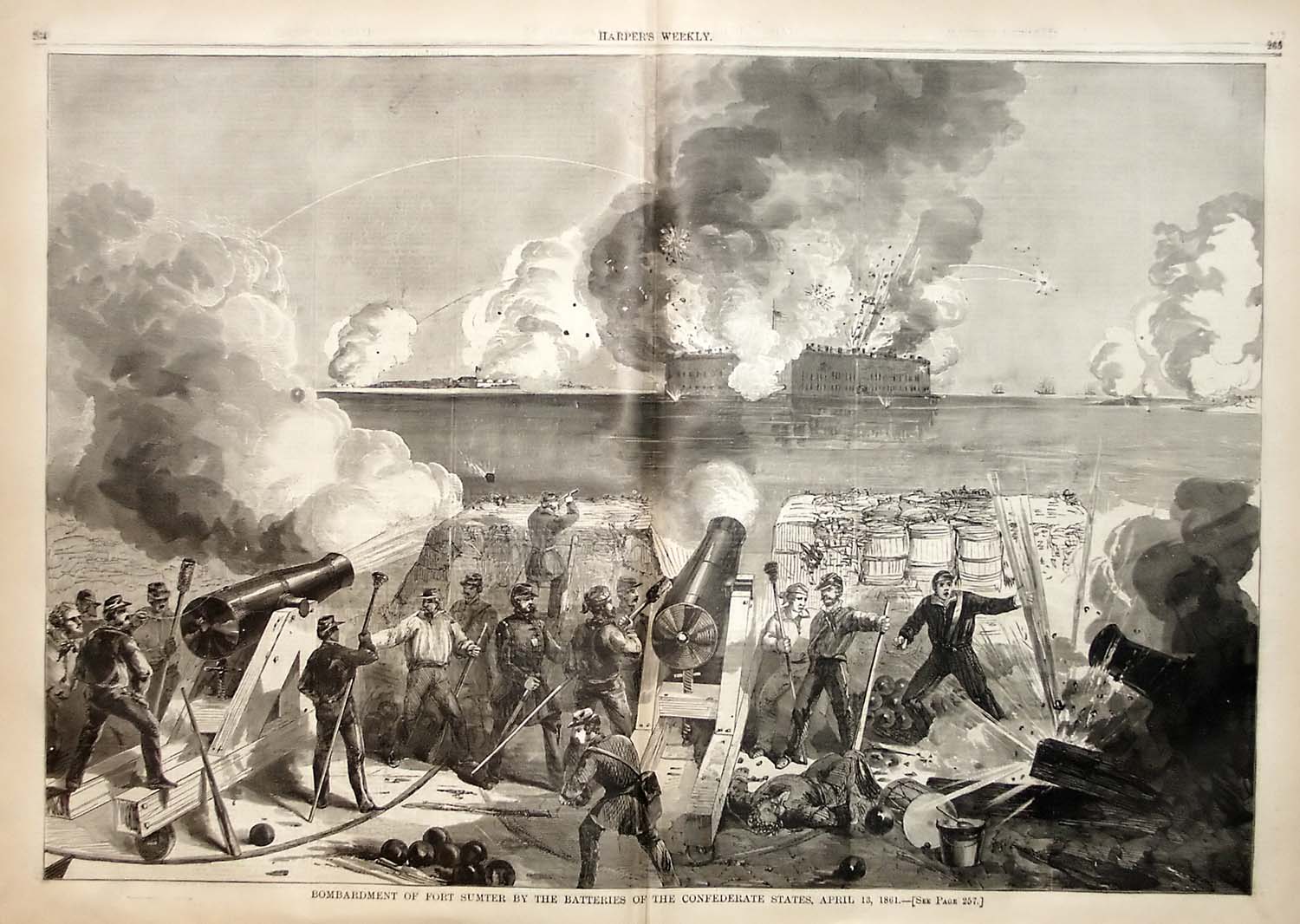
The Provisional Forces of the Confederate States, under the command of Brigadier General P.G.T. Beauregard, opened fire on Fort Sumter at 4:30 A.M. April 12, 1861.
Before the attack on Fort Sumter, President Lincoln had been in the uncomfortable position of seeking support in order to make war on fellow Americans. Opening fire on Fort Sumter was a disastrously bad idea. Offensive action initiated by the Confederacy placed the federal government in the position of the innocent victim wrongfully attacked and provided a compelling justification for President Lincoln’s call for 75,000 troops to defend the government.
It would have been far more difficult to obtain support to initiate a war of conquest of fraternal states. The majority of Northerners deplored secession, but initially favored allowing “the erring sisters to go in peace.”
Ironically, the South Carolina firebrands who insisted on asserting that state’s sovereignty over the forts in Charleston harbor inadvertently supplied the moral leverage to their own great adversary that allowed him to begin the process of defeating them.
President Lincoln’s call for troops resulted in the secessions of Virginia, North Carolina, Tennessee, and Arkansas, all of which chose to leave the Union rather than supply troops to be used to invade and occupy their fellow states.
04 Apr 2010

There won’t be a lot of blogging getting done today. We’ve been unpacking for a couple of days, and then arose at 4:30 A.M. this morning to drive up to the Dawn Easter Service at the Old Chapel (also here). Karen was part of the ensemble of singers performing Sacred Harp.
The Old Chapel is an unheated, unelectrified stone structure containing its original furnishings, and is the oldest Episcopalian church built west of the Blue Ridge. The slave gallery is, of course, a feature of ecclesiastical architecture unique to the South. Services began well before dawn and each person in attendance held a small wax taper with a circle of paper to guard the hand from hot wax drippings in the otherwise completely unilluminated old building.
After church, we went back to our old house on top of the Blue Ridge to pick up and transport another load, drove back to the farm, unloaded, changed clothing, and collapsed.
Two Sacred Harp shape note hymns can be heard performed on this 4:32 video
The singers at the Old Chapel this morning performed Green Fields, the second hymn on the video.
Curiously enough, we owe our access to Virginia hunting society to Sacred Harp signing. Karen met the Field Secretary of the Blue Ridge Hunt at a local Sacred Harp rehearsal and one thing led to another.
30 Mar 2010
W. James Antle III reminds us that a complex, poorly understood national health care bill was already passed only to be repealed, decades ago.
Unlike President Obama’s recent health care handiwork, the 1988 law was a genuinely bipartisan achievement passed by lopsided margins. It was signed into law by a Republican president, Ronald Reagan. It offered all kinds of new benefits, including expanded coverage of hospital stays, at-home care, and prescription drugs (the act was in some respects of a forerunner of Medicare Part D).
The Medicare Catastrophic Coverage Act was nevertheless repealed a year later. No change in partisan control of Washington was necessary—the repeal was passed by a Democratic Congress and signed into law by another Republican president, George H.W. Bush. The repeal turned out to be most popular with the elderly voters who had demanded the new benefits in the first place.
Why? In addition to creating new benefits, the reform also imposed staggering new costs. Those costs fell most heavily on the senior citizens who were supposed to be the program’s biggest constituency. But, congressional Democrats were astonished to learn, many of these seniors were happy with their existing coverage and resented having to pay a new tax to fund this expansion of government—costs which kicked in before many of the benefits.
Sound familiar? The similarities don’t end there. Members of Congress also had to hear from angry mobs opposed to the legislation, otherwise known as their constituents. The most memorable such incident occurred on Aug. 17, 1989, when House Ways and Means Chairman Dan Rostenkowski (D-Ill.) held a meeting in his district to sell seniors on the benefits of the catastrophic coverage act.
Instead of being won over by their powerful congressman, the angry seniors waved protest signs and ran him out of the room. As Rostenkowski fled, they shouted “coward,†“recall,†and “impeach.†One elderly woman wearing heart-shaped glasses even threw herself on the hood of Rostenkowski’s car to keep him from leaving.
Rostenkowski got out of the car and tried to escape on foot. The crowd chased him for about a block before his driver came to whisk him away. Imagine what would be said if the Tea Party movement did something like that. Instead the protest was organized by one Jan Schakowsky, then director of the Illinois State Council of Senior Citizens, now a Democratic congresswoman and chief deputy whip for House Speaker Nancy Pelosi.
The protest made the national news and graced the front pages of newspapers. It also had its desired affect—the catastrophic coverage act was repealed within three months.
The 1988 legislative debacle did not resemble this year’s bill with respect to partisanship or initial public support. Democrats had no problem getting Republican votes, and the public was behind it.
However, 1988 does resemble 2010 with respect to the same kind of irresponsible drafting of a dreadfully large and complex bill that was voted into law without serious consideration of its costs and effects. It backfired then, and a lot of people would predict that the new health care bill will prove in practice similarly distressing to many of its intended beneficiaries.
29 Mar 2010

Ronald Wilson Reagan, February 6, 1911 – June 5, 2004
General Electric is airing a very nice and truly well-deserved tribute to the greatest president of the last century.
0:32 video
I remember the scene as Ronald Reagan’s funeral cortege wound its way up the narrow road to his resting place at the Reagan Library in Simi Valley, California. One local woman was filmed by the news cameras holding up a sign which spoke for all of us. It read “WELL DONE.”
26 Mar 2010

43 Previous Presidents
Michael J. Boskin, a professor of Economics at Stanford, identifies what Barack Obama has managed to accomplish in under two years. He certainly has racked up one very startling statistic.
Mr. Obama’s $3.6 trillion budget blueprint, by his own admission, redefines the role of government in our economy and society. The budget more than doubles the national debt held by the public, adding more to the debt than all previous presidents — from George Washington to George W. Bush — combined. It reduces defense spending to a level not sustained since the dangerous days before World War II, while increasing nondefense spending (relative to GDP) to the highest level in U.S. history. And it would raise taxes to historically high levels (again, relative to GDP). And all of this before addressing the impending explosion in Social Security and Medicare costs.

17 Mar 2010

From Robert Chambers, The Book of Days, 1869:
LEGENDARY HISTORY OF ST. PATRICK
The principal enemies that St. Patrick found to the introduction of Christianity into Ireland, were the Druidical priests of the more ancient faith, who, as might naturally be supposed, were exceedingly adverse to any innovation. These Druids, being great magicians, would have been formidable antagonists to any one of less miraculous and saintly powers than Patrick. Their obstinate antagonism was so great, that, in spite of his benevolent disposition, he was compelled to curse their fertile lands, so that they became dreary bogs: to curse their rivers, so that they produced no fish: to curse their very kettles, so that with no amount of fire and patience could they ever be made to boil; and, as a last resort, to curse the Druids themselves, so that the earth opened and swallowed them up.
A popular legend relates that the saint and his followers found themselves, one cold morning, on a mountain, without a fire to cook their break-fast, or warm their frozen limbs. Unheeding their complaints, Patrick desired them to collect a pile of ice and snow-balls: which having been done, he breathed upon it, and it instantaneously became a pleasant fire—a fire that long after served to point a poet’s conceit in these lines:
‘Saint Patrick, as in legends told,
The morning being very cold,
In order to assuage the weather,
Collected bits of ice together;
Then gently breathed upon the pyre,
When every fragment blazed on fire.
Oh! if the saint had been so kind,
As to have left the gift behind
To such a lovelorn wretch as me,
Who daily struggles to be free:
I’d be content—content with part,
I’d only ask to thaw the heart,
The frozen heart, of Polly Roe.’
The greatest of St. Patrick’s miracles was that of driving the venomous reptiles out of Ireland, and rendering the Irish soil, for ever after, so obnoxious to the serpent race, that they instantaneously die on touching it. Colgan seriously relates that St. Patrick accomplished this feat by beating a drum, which he struck with such fervour that he knocked a hole in it, thereby endangering the success of the miracle. But an angel appearing mended the drum: and the patched instrument was long exhibited as a holy relic.
In 1831, Mr. James Cleland, an Irish gentleman, being curious to ascertain whether the climate or soil of Ireland was naturally destructive to the serpent tribe, purchased half-a-dozen of the common harmless English snake (matrix torqueta), in Covent Garden market in London. Bringing them to Ireland, he turned them out in his garden at Rathgael, in the county of Down: and in a week afterwards, one of them was killed at Milecross, about three miles distant. The persons into whose hands this strange monster fell, had not the slightest suspicion that it was a snake, but, considering it a curious kind of eel, they took it to Dr. J. L. Drummond, a celebrated Irish naturalist, who at once pronounced the animal to be a reptile and not a fish. The idea of a ‘rale living sarpint’ having been killed within a short distance of the very burial-place of St. Patrick, caused an extraordinary sensation of alarm among the country people. The most absurd rumours were freely circulated, and credited. One far-seeing clergyman preached a sermon, in which he cited this unfortunate snake as a token of the immediate commencement of the millennium: while another saw in it a type of the approach of the cholera morbus. Old prophecies were raked up, and all parties and sects, for once, united in believing that the snake fore-shadowed. ‘the beginning of the end,’ though they very widely differed as to what that end was to be. Some more practically minded persons, however, subscribed a considerable sum of money, which they offered in rewards for the destruction of any other snakes that might be found in the district. And three more of the snakes were not long afterwards killed, within a few miles of the garden where they were liberated. The remaining two snakes were never very clearly accounted for; but no doubt they also fell victims to the reward. The writer, who resided in that part of the country at the time, well remembers the wild rumours, among the more illiterate classes, on the appearance of those snakes: and the bitter feelings of angry indignation expressed by educated persons against the—very fortunately then unknown—person, who had dared to bring them to Ireland.
A more natural story than the extirpation of the serpents, has afforded material for the pencil of the painter, as well as the pen of the poet. When baptizing an Irish chieftain, the venerable saint leaned heavily on his crozier, the steel-spiked point of which he had unwittingly placed on the great toe of the converted heathen. The pious chief, in his ignorance of Christian rites, believing this to be an essential part of the ceremony, bore the pain without flinching or murmur; though the blood flowed so freely from the wound, that the Irish named the place St. fhuil (stream of blood), now pronounced Struill, the name of a well-known place near Downpatrick. And here we are reminded of a very remarkable fact in connection with geographical appellations, that the footsteps of St. Patrick can be traced, almost from his cradle to his grave, by the names of places called after him.
Thus, assuming his Scottish origin, he was born at Kilpatrick (the cell or church of Patrick), in Dumbartonshire. He resided for some time at Dalpatrick (the district or division of Patrick), in Lanarkshire; and visited Crag-phadrig (the rock of Patrick), near Inverness. He founded two churches, Kirkpatrick at Irongray, in Kireudbright; and Kirkpatrick at Fleming, in Dumfries: and ultimately sailed from Portpatrick, leaving behind him such an odour of sanctity, that among the most distinguished families of the Scottish aristocracy, Patrick has been a favourite name down to the present day.
Arriving in England, he preached in Patterdale (Patrick’s dale), in Westmoreland: and founded the church of Kirkpatrick, in Durham. Visiting Wales, he walked over Sarn-badrig (Patrick’s causeway), which, now covered by the sea, forms a dangerous shoal in Carnarvon Bay: and departing for the Continent, sailed from Llan-badrig (the church of Patrick), in the island of Anglesea. Undertaking his mission to convert the Irish, he first landed at Innis-patrick (the island of Patrick), and next at Holmpatrick, on the opposite shore of the mainland, in the county of Dublin. Sailing northwards, he touched at the Isle of Man, sometimes since, also, called. Innis-patrick, where he founded another church of Kirkpatrick, near the town of Peel. Again landing on the coast of Ireland, in the county of Down, he converted and baptized the chieftain Dichu, on his own threshing-floor. The name of the parish of Saul, derived from Sabbal-patrick (the barn of Patrick), perpetuates the event. He then proceeded to Temple-patrick, in Antrim, and from thence to a lofty mountain in Mayo, ever since called Croagh-patrick.
He founded an abbey in East Meath, called Domnach-Padraig (the house of Patrick), and built a church in Dublin on the spot where St. Patrick’s Cathedral now stands. In an island of Lough Deng, in the county of Donegal, there is St. Patrick’s Purgatory: in Leinster, St. Patrick’s Wood; at Cashel, St. Patrick’s Rock; the St. Patrick’s Wells, at which the holy man is said to have quenched his thirst, may be counted by dozens. He is commonly stated to have died at Saul on the 17th of March 493, in the one hundred and twenty-first year of his age.
Poteen, a favourite beverage in Ireland, is also said to have derived its name from St. Patrick: he, according to legend, being the first who instructed the Irish in the art of distillation. This, however, is, to say the least, doubtful: the most authentic historians representing the saint as a very strict promoter of temperance, if not exactly a teetotaller. We read that in 445 he commanded his disciples to abstain from drink in the day-time, until the bell rang for vespers in the evening. One Colman, though busily engaged in the severe labours of the field, exhausted with heat, fatigue, and intolerable thirst, obeyed so literally the injunction of his revered preceptor, that he refrained from indulging himself with one drop of water during a long sultry harvest day. But human endurance has its limits: when the vesper bell at last rang for evensong, Colman dropped down dead—a martyr to thirst. Irishmen can well appreciate such a martyrdom; and the name of Colman, to this day, is frequently cited, with the added epithet of Shadhack—the Thirsty.
‘In Burgo Duno, tumulo tumulantur in uno,
Brigida, Patricius, atque Columba pins.’
Which may be thus rendered:
‘In the hill of Down, buried in one tomb,
Were Bridget and Patricius, with Columba the pious.’
One of the strangest recollections of a strange childhood is the writer having been taken, by a servant, unknown to his parents, to see a silver case, containing, as was said, the jaw-bone of St. Patrick. The writer was very young at the time, but remembers seeing one much younger, a baby, on the same occasion, and has an indistinct idea that the jaw-bone was considered to have had a very salutary effect on the baby’s safe introduction into the world. This jaw-bone, and the silver shrine enclosing it, has been, for many years, in the possession of a family in humble life near Belfast. In the memory of persons living, it contained five teeth, but now retains only one—three having been given to members of the family, when emigrating to America; and the fourth was deposited under the altar of the Roman Catholic Chapel of Derriaghy, when rebuilt some years ago.
The curiously embossed case has a very antique appearance, and is said to be of an immense age: but it is, though certainly old, not so very old as reported, for it carries the Hallmark ‘plainly impressed upon it.’ This remarkable relic has long been used for a kind of extra-judicial trial, similar to the Saxon corsnet, a test of guilt or innocence of very great antiquity; accused or suspected persons freeing themselves from the suspicion of crime, by placing the right hand on the reliquary, and declaring their innocence, in a certain form of words, supposed to be an asseveration of the greatest solemnity, and liable to instantaneous, supernatural, and frightful punishment, if falsely spoken, even by suppressio veri, or suygestio falsi. It was also supposed to assist women in labour, relieve epileptic fits, counteract the diabolical machinations of witches and fairies, and avert the baleful influence of the evil eye. We have been informed, however, that of late years it has rarely been applied to such uses, though it is still considered a most welcome visitor to a household, where an immediate addition to the family is expected.
The shamrock, or small white clover (trifolium repens of botanists), is almost universally worn in the hat over all Ireland, on St. Patrick’s day. The popular notion is, that when St. Patrick was preaching the doctrine of the Trinity to the pagan Irish, he used this plant, bearing three leaves upon one stem, as a symbol or illustration of the great mystery. To suppose, as some absurdly hold, that he used it as an argument, would be derogatory to the saint’s high reputation for orthodoxy and good sense: but it is certainly a curious coincidence, if nothing more, that the trefoil in Arabic is called skamrakh, and was held sacred in Iran as emblematical of the Persian Triads. Pliny, too, in his Natural History, says that serpents are never seen upon trefoil, and it prevails against the stings of snakes and scorpions. This, considering St. Patrick’s connexion with snakes, is really remarkable, and we may reasonably imagine that, previous to his arrival, the Irish had ascribed mystical virtues to the trefoil or shamrock, and on hearing of the Trinity for the first time, they fancied some peculiar fitness in their already sacred plant to shadow forth the newly revealed and mysterious doctrine. And we may conclude, in the words of the poet, long may the shamrock,
‘The plant that blooms for ever,
With the rose combined,
And the thistle twined,
Defy the strength of foes to sever.
Firm be the triple league they form,
Despite all change of weather:
In sunshine, darkness, calm, or storm,
Still may they fondly grow together.’
W. P.
The serpent every Monday morning calls out in Irish, ‘It is a long Monday, Patrick.’
That St Patrick chained the serpent in Lough Dilveen, and that the serpent calls out to him every Monday morning, is firmly believed by the lower orders who live in the neighbourhood of the Lough.
17 Mar 2010

Ron Grossman recently tested the historical knowledge of younger colleagues in the Chicago Tribune’s newsroom with sometimes disastrous results.
I took a quick survey in the newsroom the other day, something between a Rorschach test and a pop quiz, asking younger colleagues to identify an iconic photograph of World War II.
While some instantly recognized the image, others couldn’t quite place it.
“I know I ought to know it,” one co-worker said. “It was in the movie, ‘Flags of Our Fathers.’ ” Some, seeing uniforms, realized it must be a war photo. Maybe Vietnam? One got the era right but the battlefield wrong. She guessed it was D-Day, not, as it was, the raising of the American flag on Iwo Jima.
14 Feb 2010

Jacopo Bassano, St Valentine Baptizing St Lucilla, 1575, oil on canvas, Museo Civico, Bassano del Grappa
The popular customs associated with Saint Valentine’s Day undoubtedly had their origin in a conventional belief generally received in England and France during the Middle Ages, that on 14 February, i.e., half way through the second month of the year, the birds began to pair. Thus in Chaucer’s Parliament of Foules we read:
For this was sent on Seynt Valentyne’s day
Whan every foul cometh ther to choose his mate.
For this reason the day was looked upon as specially consecrated to lovers and as a proper occasion for writing love letters and sending lovers’ tokens. Both the French and English literatures of the fourteenth and fifteenth centuries contain allusions to the practice. Perhaps the earliest to be found is in the 34th and 35th Ballades of the bilingual poet, John Gower, written in French; but Lydgate and Clauvowe supply other examples. Those who chose each other under these circumstances seem to have been called by each other their Valentines.
In the Paston Letters, Dame Elizabeth Brews writes thus about a match she hopes to make for her daughter (we modernize the spelling), addressing the favoured suitor:
And, cousin mine, upon Monday is Saint Valentine’s Day and every bird chooses himself a mate, and if it like you to come on Thursday night, and make provision that you may abide till then, I trust to God that ye shall speak to my husband and I shall pray that we may bring the matter to a conclusion.
——————————————–
From Robert Chambers, The Book of Days, 1869: Feast Day: St. Valentine, priest and martyr, circ. 270.
ST. VALENTINE’S DAY
Valentine’s Day is now almost everywhere a much degenerated festival, the only observance of any note consisting merely of the sending of jocular anonymous letters to parties whom one wishes to quiz, and this confined very much to the humbler classes. The approach of the day is now heralded by the appearance in the print-sellers’ shop windows of vast numbers of missives calculated for use on this occasion, each generally consisting of a single sheet of post paper, on the first page of which is seen some ridiculous coloured caricature of the male or female figure, with a few burlesque verses below. More rarely, the print is of a sentimental kind, such as a view of Hymen’s altar, with a pair undergoing initiation into wedded happiness before it, while Cupid flutters above, and hearts transfixed with his darts decorate the corners. Maid-servants and young fellows interchange such epistles with each other on the 14th of February, no doubt conceiving that the joke is amazingly good: and, generally, the newspapers do not fail to record that the London postmen delivered so many hundred thousand more letters on that day than they do in general. Such is nearly the whole extent of the observances now peculiar to St. Valentine’s Day.
At no remote period it was very different. Ridiculous letters were unknown: and, if letters of any kind were sent, they contained only a courteous profession of attachment from some young man to some young maiden, honeyed with a few compliments to her various perfections, and expressive of a hope that his love might meet with return. But the true proper ceremony of St. Valentine’s Day was the drawing of a kind of lottery, followed by ceremonies not much unlike what is generally called the game of forfeits. Misson, a learned traveller, of the early part of the last century, gives apparently a correct account of the principal ceremonial of the day.
‘On the eve of St. Valentine’s Day,’ he says, ‘the young folks in England and Scotland, by a very ancient custom, celebrate a little festival. An equal number of maids and bachelors get together: each writes their true or some feigned name upon separate billets, which they roll up, and draw by way of lots, the maids taking the men’s billets, and the men the maids’: so that each of the young men lights upon a girl that he calls his valentine, and each of the girls upon a young man whom she calls hers. By this means each has two valentines: but the man sticks faster to the valentine that has fallen to him than to the valentine to whom he is fallen. Fortune having thus divided the company into so many couples, the valentines give balls and treats to their mistresses, wear their billets several days upon their bosoms or sleeves, and this little sport often ends in love.’
St. Valentine’s Day is alluded to by Shakespeare and by Chaucer, and also by the poet Lydgate (who died in 1440).
The origin of these peculiar observances of St. Valentine’s Day is a subject of some obscurity. The saint himself, who was a priest of Rome, martyred in the third century, seems to have had nothing to do with the matter, beyond the accident of his day being used for the purpose. Mr. Douce, in his Illustrations of Shakespeare, says:
‘It was the practice in ancient Rome, during a great part of the month of February, to celebrate the Lupercalia, which were feasts in honour of Pan and Juno. whence the latter deity was named Februata, Februalis, and Februlla. On this occasion, amidst a variety of ceremonies, the names of young women were put into a box, from which they were drawn by the men as chance directed. The pastors of the early Christian church, who, by every possible means, endeavoured to eradicate the vestiges of pagan superstitions, and chiefly by some commutations of their forms, substituted, in the present instance, the names of particular saints instead of those of the women: and as the festival of the Lupercalia had commenced about the middle of February, they appear to have chosen St. Valentine’s Day for celebrating the new feast, because it occurred nearly at the same time.”
—————————————————-
February 14th, prior to 1969, was the feast day of two, or possibly three, saints and martyrs named Valentine, all reputedly of the Third Century.
The first Valentine, legend holds, was a physician and priest in Rome, arrested for giving aid to martyrs in prison, who while there converted his jailer by restoring sight to the jailer’s daughter. He was executed by being beaten with clubs, and afterwards beheaded, February 14, 270. He is traditionally the patron of affianced couples, bee keepers, lovers, travellers, young people, and greeting card manufacturers, and his special assistance may be sought in conection with epilepsy, fainting, and plague.
A second St. Valentine, reportedly bishop of Interamna (modern Terni) was also allegedly martyred under Claudius II, and also allegedly buried along the Flaminian Way.
A third St. Valentine is said to have also been martyred in Roman times, along with companions, in Africa.
Because of a lack of historical evidence, the Roman Catholic Church dropped the February 14th feast of St. Valentine from its calendar in 1969.
08 Feb 2010

In City Journal, Myron Magnet has a nice profile of founding father John Jay.
Few could fathom why 55-year-old John Jay turned down President Adams’s nomination to rejoin the Supreme Court when his two terms as New York’s governor ended. What would lead him, in the hale prime of life, to retire instead to the plain yellow house he’d just built on a hilltop at the remote northern edge of Westchester County, two days’ ride from Manhattan, where visitors were few and the mail and newspapers came but once a week? After 27 years at the forge of the new nation’s founding, why would so lavishly talented a man give up his vital role on the world stage for the quiet life of a gentleman farmer?
But just that option—the chance for every man to sit quietly under his vine and his fig tree, with none to make him afraid—is what he had labored more than a quarter-century to bring about, and he felt he had achieved it.
Read the whole thing.
I’m well acquainted with Jay’s house in Katonah, New York. We commuted past it every day during one period. Karen one day put her 911T into a grassy bank after failing to negotiate a sharp curve that must once have bordered Mr. Jay’s property.
The interior of the house still demonstrated the characteristic ingenuity of mind of its former owner. Jay had designed and arranged the construction of campaign furniture-style book cases, whose individual shelves could be separated and moved independently, or stacked in more than one arrangement. The shelves were handsome and they must have been very practical for a man of learning obliged to make so many long journeys on business of state.
02 Feb 2010

Detail, Giovanni Bellini, Presentation of Jesus at the Temple, (c. 1470), Fondazione Querini Stampalia, Venice
From Robert Chambers, The Book of Days, 1869:
From a very early, indeed unknown date in the Christian history, the 2nd of February has been held as the festival of the Purification of the Virgin, and it is still a holiday of the Church of England. From the coincidence of the time with that of the Februation or purification of the people in pagan Rome, some consider this as a Christian festival engrafted upon a heathen one, in order to take advantage of the established habits of the people; but the idea is at least open to a good deal of doubt. The popular name Candlemass is derived from the ceremony which the Church of Rome dictates to be observed on this day; namely, a blessing of candles by the clergy, and a distribution of them amongst the people, by whom they are afterwards carried lighted in solemn procession. The more important observances were of course given up in England at the Reformation; but it was still, about the close of the eighteenth century, customary in some places to light up churches with candles on this day.
At Rome, the Pope every year officiates at this festival in the beautiful chapel of the Quirinal. When he has blessed the candles, he distributes them with his own hand amongst those in the church, each of whom, going singly up to him, kneels to receive it. The cardinals go first; then follow the bishops, canons, priors, abbots, priests, &c., down to the sacristans and meanest officers of the church. According to Lady Morgan, who witnessed the ceremony in 1820:
‘When the last of these has gotten his candle, the poor conservatori, the representatives of the Roman senate and people, receive theirs. This ceremony over, the candles are lighted, the Pope is mounted in his chair and carried in procession, with hymns chanting, round the ante-chapel; the throne is stripped of its splendid hangings; the Pope and cardinals take off their gold and crimson dresses, put on their usual robes, and the usual mass of the morning is sung.’
Lady Morgan mentions that similar ceremonies take place in all the parish churches of Rome on this day.
It appears that in England, in Catholic times, a meaning was attached to the size of the candles, and the manner in which they burned during the procession; that, moreover, the reserved parts of the candles were deemed to possess a strong supernatural virtue:
‘This done, each man his candle lights,
Where chiefest seemeth he,
Whose taper greatest may be seen; And fortunate to be,
Whose candle burneth clear and bright: A wondrous force and might
Both in these candles lie, which if At any time they light,
They sure believe that neither storm Nor tempest cloth abide,
Nor thunder in the skies be heard, Nor any devil’s spide,
Nor fearful sprites that walk by night,
Nor hurts of frost or hail,’ &c.
The festival, at whatever date it took its rise, has been designed to commemorate the churching or purification of Mary; and the candle-bearing is understood to refer to what Simeon said when he took the infant Jesus in his arms, and declared that he was a light to lighten the Gentiles. Thus literally to adopt and build upon metaphorical expressions, was a characteristic procedure of the middle ages. Apparently, in consequence of the celebration of Mary’s purification by candle-bearing, it became customary for women to carry candles with them, when, after recovery from child-birth, they went to be, as it was called, churched. A remarkable allusion to this custom occurs in English history. William the Conqueror, become, in his elder days, fat and unwieldy, was confined a considerable time by a sickness. ‘Methinks,’ said his enemy the King of France, ‘the King of England lies long in childbed.’ This being reported to William, he said, ‘When I am churched, there shall be a thousand lights in France !’ And he was as good as his word; for, as soon as he recovered, he made an inroad into the French territory, which he wasted wherever he went with fire and sword.
At the Reformation, the ceremonials of Candlemass day were not reduced all at once. Henry VIII proclaimed in 1539:
‘On Candlemass day it shall be declared, that the bearing of candles is done in memory of Christ, the spiritual light, whom Simeon did prophesy, as it is read in. the church that day.’
It is curious to find it noticed as a custom down to the time of Charles II, that when lights were brought in at nightfall, people would say—’ God send us the light of heaven!’ The amiable Herbert, who notices the custom, defends it as not superstitious. Some-what before this time, we find. Herrick alluding to the customs of Candlemass eve: it appears that the plants put up in houses at Christmas were now removed.
Down with the rosemary and bays,
Down with the mistletoe;
Instead of holly now upraise The greener box for show.
The holly hitherto did sway,
Let box now domineer,
Until the dancing Easter day Or Easter’s eve appear.
The youthful box, which now hath grace
Your houses to renew,
Grown old, surrender must his place Unto the crisped yew.
When yew is out, then birch comes in,
And many flowers beside,
Both of a fresh and fragrant kin’, To honour Whitsuntide.
Greeu rushes then, and sweetest bents,
With cooler oaken boughs,
Come in for comely ornaments, To re-adorn the house.
Thus times do shift; each thing in turn does hold;
New things succeed, as former things grow old.’
The same poet elsewhere recommends very particular care in the thorough removal of the Christmas garnishings on this eve:
‘That so the superstitious find
No one least branch left there behind;
For look, how many leaves there be
Neglected there, maids, trust to me,
So many goblins you shall see.’
He also alludes to the reservation of part of the candles or torches, as calculated to have the effect of protecting from mischief:
‘Kindle the Christmas brand, and then
Till sunset let it burn,
Which quenched, then lay it up again, Till Christmas next return.
Part must be kept, wherewith to tend
The Christmas log next year;
And where ‘tis safely kept, the fiend Can do no mischief there.’
Considering the importance attached to Candlemass day for so many ages, it is scarcely surprising that there is a universal superstition throughout Christendom, that good weather on this day indicates a long continuance of winter and a bad crop, and that its being foul is, on the contrary, a good omen. Sir Thomas Browne, in his Vulgar Errors, quotes a Latin distich expressive of this idea:
‘Si sol splendescat Maria purificante,
Major erit glacies post festum quam fait ante;
which maybe considered as well translated in the popular Scottish rhyme:
If Candlemass day be dry and fair,
The half o’ winter’s to come and mair;
If Candlemass day be wet and foul,
The half o’ winter’s gave at Yule.’
In Germany there are two proverbial expressions on this subject: 1. The shepherd would rather see the wolf enter his stable on Candlemass day than the sun; 2. The badger peeps out of his hole on Candlemass day, and when he finds snow, walks abroad; but if he sees the sun shining, he draws back into his hole. It is not improbable that these notions, like the festival of Candlemass itself, are derived from pagan times, and have existed since the very infancy of our race. So at least we may conjecture, from a curious passage in Martin’s Description of the Western Islands. On Candlemass day, according to this author, the Hebrideans observe the following curious custom:
The mistress and servants of each family take a sheaf of oats and dress it up in women’s apparel, put it in a large basket, and lay a wooden club by it, and this they call BrÃd’s Bed.; and then the mistress and servants cry three times, “BrÃd is come; BrÃd is welcome!†This they do just before going to bed, and when they rise in the morning they look among the ashes, expecting to see the impression of Brad’s club there; which, if they do, they reckon it a true presage of a good crop and prosperous year, and the contrary they take as an ill omen.
———————————————————————-
Groundhog Day is obviously a modern, vulgar and commercialized adaptation of the earlier weather traditions associated with the Christian feastday.
———————————————————————-
Patrick Burns misinforms his readers, stating that the religious tradition revolved around the purification of the child, demonstrating that using the resources of Internet effectively requires starting out with a minimum of information already in hand.
Of course, the Christian Church is celebrating the Purification of the Virgin Mary who, despite –theologically speaking — having no personal need for purification, nonetheless piously observed the ritual of Judaism (Luke 2:22-40) purifying the mother who has given birth 40 days earlier as prescribed in Leviticus 12.
/div>

Feeds
|