Hunting is strictly banned in post-Imperial India, but the progressive administration of that country makes the occasional exception, in the case of man-eaters.
Outside magazine reports that, in Uttar Pradesh, hunting has been authorized for a man-eating tiger.
Officials in Uttar Pradesh, India, have issued a shoot-to-kill order for a tigress that has killed 10 people since early December. The four-year-old Royal Bengal tiger has attacked villagers of all ages, prowling an 80-mile area in the Binjor District.
The situation has placed the livelihoods of local villagers at stake, as people are afraid to work in the fields harvesting sugarcane, mustard, and wheat. “We will starve if this situation persists,” Sahuwala village resident Mithilesh told CNN.
Tigers that have turned man-eater rarely go back to hunting wildlife, and it’s clear this tigress is no exception. “She’s gotten used to killing people,†wildlife conservationist Nazim Khan told CNN. “This is easy prey for her. She’s going to kill again.”
Both conservationists and hunters are tracking the tigress, riding atop elephants through impenetrable jungle and terrain. Though conservationists would rather see the tigress tranquilized and transported to a zoo, hunters and most villagers are in support of seeking vengeance via rifle.
Only 11 percent of tigers’ natural habitat remains, according to the Wildlife Trust of India, and there are only 1,706 tigers left in the wild.
Maine Antique Digest runs a monthly Letter from London column which describes some of the more interesting items appearing in recent sales.
At Sotheby’s “Art of Imperial India” sale, London, October 9th last, was sold a captured and re-hilted British sword decorated with the bubri symbol of Tipu Sahib, “the Tiger of Mysore,” one of the most formidable enemies of British rule in India, slain finally defending his own fortress at the Siege of Seringapatam in 1799.
Tipu is quoted as saying: “Better to die like a soldier than live a miserable life dependent on the infidels… I would rather live two days as a tiger, than two hundred years as a sheep.”
Interestingly, this sword was not taken at Seringapatnam, as it comes from the estate of Sir Charles Malet, Bart., who had left India a year before the siege. It was probably a trophy of the Third Anglo-Mysore War.
The sword sold for $157,695 (98,500 GBP). Lot 249.
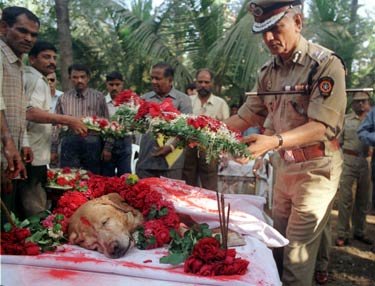
The dog was named Zanjeer [meaning “metal chain” in Persian].
He saved thousands of lives following a series of attacks in Bombay in March 1993 by detecting 3,329 kg. of RDX explosive, 600 detonators, 249 hand grenades, and 6406 rounds of live ammunition.
He was buried with honors.
—————————
Zanjeer (1992-2000) was a Golden Labrador who worked as a bomb detecting dog for the Bombay Police. He died of cancer in 2000 at age 8, and was buried with full honors by the Bombay Police.
The above photograph began going viral last March around the time of the twentieth anniversary of the Bombay attacks.
A 19th century Indo-Persian Steel Bow sold last year at Christie’s for £30,000 ($48,840).
Apparently, steel bows began replacing composite bows in Central Asia in the 16th century. Steel bows were superior with respect to having no need to be unstrung when not in use.
This take-down example is a remarkable piece of craftsmanship, made entirely of Damascus steel and completely inlaid on the front with 24 karat gold koftgari decoration.
Alex Mayyasi tells us all about the IIT Entrance Exam.
The admissions test for the Indian Institutes of Technology, known as the Joint Entrance Examination or JEE, may be the most competitive test in the world. In 2012, half a million Indian high school students sat for the JEE. Over six grueling hours of chemistry, physics, and math questions, the students competed for one of ten thousand spots at India’s most prestigious engineering universities.
When the students finish the exam, it is the end of a two plus year process. Nearly every student has spent four hours a day studying advanced science topics not taught at school, often waking up earlier than four in the morning to attend coaching classes before school starts.
The prize is a spot at a university that students describe without hyperbole as a “ticket to another life.†The Indian Institutes of Technology (IITs) are a system of technical universities in India comparable in prestige and rigor to the Massachusetts Institute of Technology or the California Institute of Technology. Alumni include Sun Microsystems co-founder Vinod Khosla, co-founder of software giant Infosys Narayana Murthy, and former Vodafone CEO Arun Sarin. Popular paths after graduation include pursuing MBAs or graduate degrees at India’s and the West’s best universities or entertaining offers from McKinsey’s and Morgan Stanley’s on-campus recruiters.
Government subsidies make it possible for any admitted student to attend IIT. The Joint Entrance Exam is also the sole admissions criteria – extracurriculars, personal essays, your family name, and, until recently, even high school grades are all irrelevant. The top scorers receive admission, while the rest do not.
This means that the test can vault students from the lowest socioeconomic background into the global elite in a single afternoon. Entire families wait outside the test center, as involved in the studying and test process as the children they pin their hopes on. In extreme cases, parents have sold their land to pay tutors to coach their children for the JEE.
Only two percent of students will be rewarded for their hard work. In 2012, Harvard accepted 5.9% of applicants. Top engineering schools MIT and Stanford had acceptance rates of 8.9% and 6.63%. The acceptance rate at the IITs, as represented by the pass rate in the JEE, was 2%. Every year, when the results are announced and the media swarms the accepted students, 490,000 students receive disappointing news.
You sit in a room with hundreds of test takers and look around and smile because, personally, you enjoy these kinds of tests, and besides, you have a private contest going with yourself. You mean to try to be finished with the test before anybody else, so that you can stand up, hand in the answer sheet, and theatrically leave, with dozens of eyes looking on at you with hatred.
The actual story referred to in the title of Lieut.-Colonel Frank Sheffield’s How I Killed the Tiger (1902) amounts to only 36-pages (including numerous, highly evocative, illustrations), but even the second edition is not easy to find and will cost you something in the neighborhood of $100.
But we happily live in the age of marvels, in which even such esoteric treasures are already scanned in and sitting there available in electronic form at the touch of a fingertip.
Col. Sheffield’s yarn is quite a story.
I would not myself want to take on a fully grown Bengal Tiger with an unreliable percussion fowling piece, even if I had a couple of General John Jacob’s explosive bullets in my pocket. But, if I had been so foolhardy as to do so and wound up once knocked down and mauled by a tiger, I’d like to hope that –like Col. Shefield–, faced with another charge, I’d still have “some kick in me” and stand there, Bowie knife in hand, “determined to make a hard fight for it.”
Former Yale English professor William Deresiewicz, in the American Scholar, gives a travel anecdotal spin to the usual liberal statist claptrap.
We were living in a middle-class suburb of a small city: lots of single-family houses with neat gardens, all of them surrounded by walls. Here are some of the things you would see on the other side, the public side: overflowing dumpsters; unpaved streets lined with garbage; smoldering trash fires; little rows of shanties tucked into corners of the neighborhood for the local servant class, the kind of miserable hovels that stretch for miles in places like Mumbai; and a small, polluted lake that no one in their right mind would have swum in. We never drank from the tap, of course; even certain kinds of produce were said to be unsafe. The phone was temperamental, too, and so was the television cable. One thing we were thankful for, however: we could breathe without feeling like we were damaging our health, something that could not be said in any of the larger cities we visited and the reason we were living where we were.
Being rich in a poor country, I discovered that year, is like being rich and poor at the same time. We could eat in any restaurant we cared to, could have had a fleet of servants at our disposal had we so chosen, but we couldn’t buy our own electric grid, or water system, or air.
I’ve thought of all this during the debate we’ve been having this election season about the extent to which business owners are responsible for their success. On the one hand, Democrats like Elizabeth Warren and Barack Obama, trying to remind entrepreneurs that they didn’t build the highway system themselves, or put their employees through school. On the other, people who continue to insist that they pulled themselves up by their own bootstraps. Well, let them go to India and see what it’s like to live in a place where you can’t take public services for granted. We’ll see how far their bootstraps get them there.
Too many Americans, goes the common complaint, want other people to pay for them. Yet the same is true in generational terms. We have been able to live well, and do well, because we inherited a rich, well-functioning country, but for a long time now—I’m thinking of the tax revolt that began in 1978—we have refused to do our share to keep it going. Essentially, the bootstrap crowd is living off the civic-minded willingness to sacrifice of those who came before.
Left-wingers like Deresiewicz look at the world through pink, political lenses, seeing everything around them as the creation of the coercive administrative state. They also consistently award the State credit for the achievements of Society, Culture, and the Individual.
It has somehow escaped Mr. Deresiewicz’s attention that both America and India only have electricity in the first place because Thomas Edison lived in an economically free country where he could profit from invention.
America doesn’t have more reliable electric service than India because of Government. Our power grid works more reliably than India’s because we possess cultural traditions promoting individual responsibility and India is only slowly overcoming very different cultural traditions of dependence, exploitation, collectivism, and corruption. Our power system is the creation of private companies operating in a competitive market system governed by the rule of law.
The reliability of our power system is assured by self interest and the profit motive. In India, the delivery of power is a consequence of political decree as is any economic return to its providers. In America, if you fail to deliver services, even in a natural monopoly context, competitors are available to step in, you are replaced and go out of business. In India, politicians simply decide which satrapy will exploit what and whom. Performance, like profit, is secondary and beside the point.
People like Mr. Deresiewicz are, in reality, agitating for us to become more like India rather than vice versa. Their goal is to take decision-making power out of the hands of consumers generally, and give it instead to politicians. Instead of the free enterprise feedback system of profit and loss based on performance and competition, they want a system in which politicians, as in India, are simply allowed to select winners and losers.
If William Deresiewicz had his way, we would very shortly become a lot more like India.
Atherton and Palo Alto receive regular visits from mountain lions who travel down the dry arroyos from the nearby mountains, and similar haute bourgeois suburbs of Bombay have leopards from a nearby wildlife refuge dropping by.
The website of Royal Palms Estate says that the township is your ‘world in a village’. Located in Mumbai’s Goregaon suburb, this ‘village’ is a 240-acre settlement that has five-star hotels, recreation clubs, lakes, swimming pools, a golf course, bungalows, villas, row houses and marble statues, apart from a little hill as part of its natural landscape. It even has the Sanjay Gandhi National Park as its neighbour.
It is a world apart, in many ways. Literally so, at some points. The past ten days have seen large grilled fences, at least 15 feet high, come up around the backyard of row house No 3. A large tree nearby has its trunk entwined in a creeper of barbed wire. And it’s not just this compound. Row houses No 4 and 5 are fortified too.
What warrants such self-encagement? An unwelcome guest, it turns out.
East or west, there is a good deal of inadvertent comedy in the inability of deracinated Homo affluentus urbanicus to cope effectively with his own oblivious proximity to Nature in its most potent and primordial forms.
In Palo Alto, the locals protest and build shrines with flowers and candles to the memory of invading pumas who get shot by the police when found lurking in tree branches near suburban elementary schools.
Michael Yon (mercifully) takes a break from his recent role of crusading journalist telling truth to power and exposing the errors and inadequacies of the US military’s Afghanistan chain of command to share some information on one of India’s most exotic sects (and one of its American converts descended from a famous author).
The fundamentals of Aghor—perhaps the most extreme religion in the world—are fantastically simple, though nonetheless repugnant to most. Repugnance, or rather the quest to overcome it, is in fact a central tenet of this belief system. Aghor is an extreme sect of Hinduism. Its adherents principally worship Shiva, the Hindu god of destruction. Aghoris live by a simple creed: 1. The gods are perfect. 2. The gods create everything: Every thought, every action, every bird and diamond, every birth and every death. 3. Since the gods are perfect, and everything is made by the gods, everything—everything—is perfect.
Since everything is perfect, being repulsed by anything or forbidding any behavior as taboo is tantamount to rejecting the gods. While this accounts for the willingness of more moderate Aghoris to work with lepers and other so-called untouchables, it also explains why some ardent Aghoris aim to overcome some of the more gruesome targets of revulsion. In my travels I’ve met Aghoris who would just as soon pluck an eyeball from a rotten human corpse and pop it into their mouths as eat chicken. He or she might carry a rotting dead dog over their shoulder for a week, or have sex with a dead cow (holy to other Hindus) or with a rotting human corpse. One Aghori in northern India ate part of the rotting penis of a bloated, vivisected corpse on the banks of the Ganges, engaging in this “sacred ritual†in full view of onlooking police.
Mossad-mouthpiece DEBKAfile reports that the assault on the US dollar as reserve currency by America’s most prominent foreign adversaries (including our trading partner China) is about to get underway.
India is the first buyer of Iranian oil to agree to pay for its purchases in gold instead of the US dollar, debkafile’s intelligence and Iranian sources report exclusively. Those sources expect China to follow suit. India and China take about one million barrels per day, or 40 percent of Iran’s total exports of 2.5 million bpd. Both are superpowers in terms of gold assets.
By trading in gold, New Delhi and Beijing enable Tehran to bypass the upcoming freeze on its central bank’s assets and the oil embargo which the European Union’s foreign ministers agreed to impose Monday, Jan. 23. The EU currently buys around 20 percent of Iran’s oil exports.
The vast sums involved in these transactions are expected, furthermore, to boost the price of gold and depress the value of the dollar on world markets.