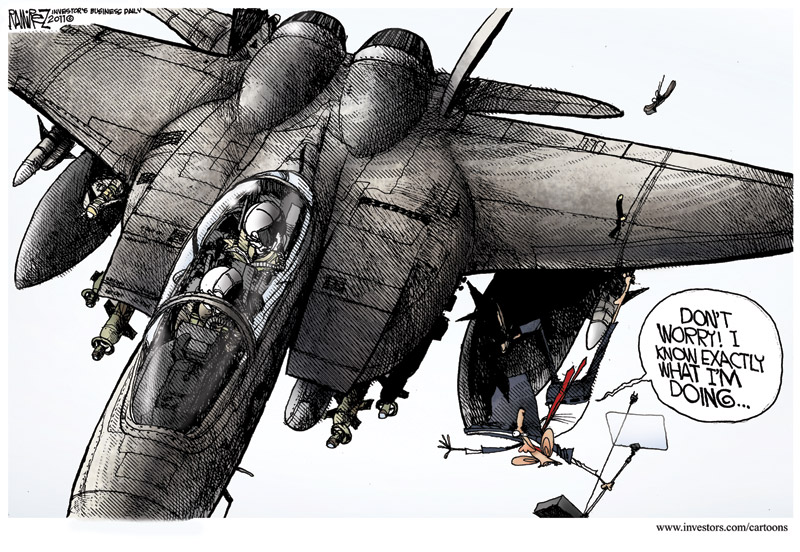
Michael Oren, yesterday in the Wall Street Journal, makes the same point.
America and its allies, empowered by the United Nations and the Arab League, are interceding militarily in Libya. But would that action have been delayed or even precluded if Libyan leader Moammar Gadhafi had access to nuclear weapons? No doubt Gadhafi is asking himself that same question.
Barack the Unready’s intervention against the un-nuclear-developing Qaddafi contrasts so strongly with the immunity from external threats of regime change enjoyed by the nuclear-developing or equipped even more loathsome tyrannies in Teheran and Pyongyang that the president has undoubtedly sent a very loud and very clear message to dictators everywhere: Get yourselves some nukes and you’re safe from us! Without nukes, we might just intervene.
“We Took A Series of Swift Steps:” Oh, you mean after you dithered around with the same basic facts for three weeks.
You mean after all that delay, you finally made a decision, and then the military acted swiftly.
“I Refused to Let That Happen:” Ah, okay, just as long as I know who the hero is here.
By the way, he’s super-proud that he waited until the last possible moment to save Benghazi (but none of the towns and cities along the decimated way to Benghazi). Apparently those other towns he let be demolished as he dithered didn’t count.
Only the dramatic, last-second decision to spare Benghazi specifically should matter.
Hilarious: He says that he’s all about getting other countries to bear the burdens. He says, to that end, that he’s transferred command to NATO.
Um, so, if I’m getting this right, our pilots and seamen are still fighting this war, they’re just being bossed around by a foreign general, right?
And that general isn’t actually in the fight, right?
Seems to me that all Obama is doing is distancing himself from any possible failure while keeping our troops in harm’s way.
———————————–
AndyLevy summed up Obama’s rhetorical style: If the straw men ever unionize, Obama’s gonna be in trouble.
Mark Steyn identifies some of the key problems with postmodern kinetic interventions in pursuit of undefined objectives in situations in which no one is on our side.
[I]t’s easy to mock the smartest, most articulate man ever to occupy the Oval Office. Instead, in a nonpartisan spirit, let us consider why it is that the United States no longer wins wars. OK, it doesn’t exactly lose (most of) them, but nor does it have much to show for a now-60-year old pattern of inconclusive outcomes. American forces have been fighting and dying in Afghanistan for a decade: Doesn’t that seem like a long time for a noncolonial power to be spending hacking its way through the worthless terrain of a Third World dump? If the object is to kill terrorists, might there not be some slicker way of doing it? And, if the object is something else entirely, mightn’t it be nice to know what it is?
I use the word “noncolonial” intentionally. I am by temperament and upbringing an old-school imperialist: There are arguments to be made for being on the other side of the world for decades on end if you’re claiming it as sovereign territory and rebuilding it in your image, as the British did in India, Belize, Mauritius, the Solomon Islands, you name it. Likewise, there are arguments to be made for saying, sorry, we’re a constitutional republic, we don’t do empire. But there’s not a lot to be said for forswearing imperialism and even modest cultural assertiveness, and still spending 10 years getting shot up in Afghanistan helping to create, bankroll and protect a so-called justice system that puts a man on death row for converting to Christianity.
Libya, in that sense, is a classic post-nationalist, post-modern military intervention: As in Kosovo, we’re do-gooders in a land with no good guys. But, unlike Kosovo, not only is there no strategic national interest in what we’re doing, the intended result is likely to be explicitly at odds with U.S. interests. A quarter-century back, Gadhafi was blowing American airliners out of the sky and murdering British policewomen: That was the time to drop a bomb on him. But we didn’t. Everyone from the Government of Scotland (releasing the “terminally ill” Lockerbie bomber, now miraculously restored to health) to Mariah Carey and Beyonce (with their million-dollar-a-gig Gadhafi party nights) did deals with the Colonel.
Now suddenly he’s got to go – in favor of “freedom-loving” “democrats” from Benghazi. That would be in eastern Libya – which, according to West Point’s Counter Terrorism Center, has sent per capita the highest number of foreign jihadists to Iraq. Perhaps now that so many Libyan jihadists are in Iraq, the Libyans left in Libya are all Swedes in waiting. But perhaps not. If we lack, as we do in Afghanistan, the cultural confidence to wean those we liberate from their less-attractive pathologies, we might at least think twice before actively facilitating them.
Officially, only the French are committed to regime change. So suppose Gadhafi survives. If you were in his shoes, mightn’t you be a little peeved? Enough to pull off a new Lockerbie? A more successful assassination attempt on the Saudi king? A little bit of Euro-bombing?
Alternatively, suppose Gadhafi winds up hanging from a lamppost in his favorite party dress. If you’re a Third World dictator, what lessons would you draw? Gadhafi was the thug who came in from the cold, the one who (in the wake of Saddam’s fall) renounced his nuclear program and was supposedly rehabilitated in the chancelleries of the West. He was “a strong partner in the war on terrorism,” according to U.S. diplomats. And what did Washington do? They overthrew him anyway.
The blood-soaked butcher next door in Sudan is the first head of state to be charged by the International Criminal Court with genocide, but nobody’s planning on toppling him. Iran’s going nuclear with impunity, but Obama sends fraternal greetings to the “Supreme Leader” of the “Islamic Republic.” North Korea is more or less openly trading as the one-stop bargain-basement for all your nuke needs, and we’re standing idly by. But the one cooperative dictator’s getting million-dollar-a-pop cruise missiles lobbed in his tent all night long. If you were the average Third World loon, which role model makes most sense? Colonel Cooperative in Tripoli? Or Ayatollah Death-to-the-Great-Satan in Tehran? America is teaching the lesson that the best way to avoid the attentions of whimsical “liberal interventionists” is to get yourself an easily affordable nuclear program from Pyongyang, or anywhere else, as soon as possible.
I don’t really have a problem with knocking off Qaddafi (who has actually contrived the murder of hundreds of Americans in the past). His elimination is long past due. But Obama is not even certain that he thinks Qaddafi needs to surrender power, and we have no basis for supposing that we are spending all those expensive cruise missiles on replacing him with a less barbarous and less dangerous alternative.
The Australian Daily Telegraph reports that the uprising in Libya has produced a weapons windfall for the North African al-Qaeda branch, al-Qaeda in the Islamic Maghreb (AQIM).
Al-Qaeda’s offshoot in North Africa has snatched surface-to-air missiles from an arsenal in Libya during the civil strife there, Chad’s President says.
Idriss Deby Itno did not say how many surface-to-air missiles were stolen, but told the African weekly Jeune Afrique that he was “100 per cent sure” of his assertion.
“The Islamists of al-Qaeda took advantage of the pillaging of arsenals in the rebel zone to acquire arms, including surface-to-air missiles, which were then smuggled into their sanctuaries in Tenere,” a desert region of the Sahara that stretches from northeast Niger to western Chad, Deby said in the interview.
“This is very serious. AQIM is becoming a genuine army, the best equipped in the region,” he said.
His claim was echoed by officials in other countries in the region who said that they were worried that al-Qaeda in the Islamic Maghreb (AQIM) might have acquired “heavy weapons”, thanks to the insurrection. …
“We have the same information,” about heavy weapons, including SAM 7 missiles, a military source from Niger said.
Charles Krauthammer rants over the disarray of the NATO coalition and the irresolution of its leadership.
As of this writing, Britain wanted the operation to be led by NATO. France adamantly disagreed, citing Arab sensibilities. Germany wanted no part of anything, going so far as to pull four of its ships from NATO command in the Mediterranean. France and Germany walked out of a NATO meeting on Monday, while Norway had planes in Crete ready to go but refused to let them fly until it had some idea who the hell is running the operation. And Turkey, whose prime minister four months ago proudly accepted the Qaddafi International Prize for Human Rights, has been particularly resistant to the Libya operation from the beginning.
And as for the United States, who knows what American policy is. Administration officials insist we are not trying to bring down Qaddafi, even as the president insists that he must go. Although on Tuesday Obama did add “unless he changes his approach.†Approach, mind you.
In any case, for Obama, military objectives take a back seat to diplomatic appearances. The president is obsessed with pretending that we are not running the operation — a dismaying expression of Obama’s view that his country is so tainted by its various sins that it lacks the moral legitimacy to . . . what? Save Third World people from massacre?
Obama seems equally obsessed with handing off the lead role. Hand off to whom? NATO? Quarreling amid Turkish resistance (see above), NATO still can’t agree on taking over command of the airstrike campaign, which is what has kept the Libyan rebels alive.
This confusion is purely the result of Obama’s decision to get America into the war and then immediately relinquish American command. Never modest about himself, Obama is supremely modest about his country. America should be merely “one of the partners among many,†he said Monday. No primus inter pares for him. Even the Clinton administration spoke of America as the indispensable nation. And it remains so. Yet at a time when the world is hungry for America to lead — no one has anything near our capabilities, experience, and resources — America is led by a man determined that it should not.
A man who dithers over parchment. Who starts a war from which he wants out right away. Good God. If you go to take Vienna, take Vienna. If you’re not prepared to do so, better then to stay home and do nothing.
Hat tip to Richard Fernandez who reflects on history, while contemplating the unhappy spectacle of escalating regime violence in response to protests in Syria:
Deraa, the site of one of the many protests, was where the fledgling Royal Air Force won its first ground-air battle in 1918 in support of Colonel T. E. Lawrence’s Arab Revolt. He was cutting the lifeline of the Ottoman empire. Viewed from the 21st century, the battle seems almost quaint: biplanes dropping a few pounds of bombs from low altitude and landing to rendezvous with riders in flowing robes on steaming horses. But those riders, all encased in cotton, creaky leather and sweat, had the virtue of knowing which end was up. Today we are even luckier to be led, not simply by the competent and daring, but by leaders who are truly awesome.
PJM explains that we are supporting, among others, Abdul-Hakim al-Hasadi who fought American troops in Afghanistan and recruited Libyans to fight American troops in Iraq.
Shortly after unrest broke out in eastern Libya in mid-February, reports emerged that an “Islamic Emirate†had been declared in the eastern Libyan town of Darnah and that, furthermore, the alleged head of that Emirate, Abdul-Hakim al-Hasadi, was a former detainee at the American prison camp in Guantánamo. The reports, which originated from Libyan government sources, were largely ignored or dismissed in the Western media.
Now, however, al-Hasadi has admitted in an interview with the Italian newspaper Il Sole 24 Ore that he fought against American forces in Afghanistan. (Hat-tip: Thomas Joscelyn at the Weekly Standard.) Al-Hasadi says that he is the person responsible for the defense of Darnah — not the town’s “Emir.†In a previous interview with Canada’s Globe and Mail, he claimed to have a force of about 1,000 men and to have commanded rebel units in battles around the town of Bin Jawad.
“I have never been at Guantánamo,†al-Hasadi explained to Il Sole 24 Ore. “I was captured in 2002 in Peshawar in Pakistan, while I was returning from Afghanistan where I fought against the foreign invasion. I was turned over to the Americans, detained for a few months in Islamabad, then turned over to Libya and released from prison in 2008.†…
In his more recent remarks to Il Sole 24 Ore, al-Hasadi admits not only to fighting against U.S. troops in Afghanistan, but also to recruiting Libyans to fight against American forces in Iraq. As noted in my earlier PJM report here, captured al-Qaeda personnel records show that al-Hasadi’s hometown of Darnah sent more foreign fighters to fight with al-Qaeda in Iraq than any other foreign city or town and “far and away the largest per capita number of fighters.†Al-Hasadi told Il Sole 24 Ore that he personally recruited “around 25†Libyans to fight in Iraq. “Some have come back and today are on the front at Ajdabiya,†al-Hasadi explained, “They are patriots and good Muslims, not terrorists.†“The members of al-Qaeda are also good Muslims and are fighting against the invader,†al-Hasadi added.
Reportorial jaws were heard dropping out as far as the Blue Ridge, when Barack Obama hinted yesterday that regime change in Libya might not be essential.
President Obama indicated on Tuesday that Muammar Qadhafi may still have an opportunity to “change his approach†and put in place “significant reforms†in the Libyan government.
Asked by NBC’s Savannah Guthrie what the U.S. commitment is in Libya if Qadhafi remains in power but continues to pose a threat to his people, Obama appeared to leave the door open for political reforms.
“You are absolutely right that as long as Qadhafi remains in power, and unless he changes his approach and there are significant reforms in the Libyan government that allow the Libyan people to express themselves, there are still going be potential threats against Libyan people—unless he is going to step down,†Obama said.
—————————
James Poulos contends that this kind of erratic policy shifting has become a recognizable pattern of the Obama presidency.
Obama’s puzzling leadership style has driven more than a few critics to plunge into labyrinthine investigations of his personality in the hopes of finding some explanatory key tucked away at its center.
Nonetheless, this is a fool’s errand. What matters is not whether the president is, for instance, a passive-aggressive guy, but whether he is a passive-aggressive president. The soap opera surrounding our Libyan engagement, and Obama’s halting and irregular efforts at managing it, have me convinced that the answer is yes.
A pattern has emerged. With the Wisconsin union drama, with the long, tormented passage and reversal of Obamacare, even with the Skip Gates scandal, the president has oscillated, one way or the other and sometimes both, between a mild-mannered non-interventionism and a terse, testy, yet attenuated variety of interventionism. So it is again with Libya. Neither the passivity nor the aggressiveness is without its bemused critics, right and left. And neither has proven very effective. Put together, they seem to deliver the worst of both worlds. His errors unforced, his support unreliable, his strategy inscrutable, Obama as president has time and again left allies and opponents in an uncanny perpetual lurch.
I think myself that, as was speculated by some on the basis of Obama’s autobiography and his 2008 campaign, that Barack Obama operates in most circumstances with the most extreme caution, voting “Present” 130 times in the Illinois State Senate, defining himself with broad strokes of gorgeous rhetoric, and intentionally allowing his audience to project their wishes and fantasies onto him without committing himself to very much.
Barack Obama proved to be personally deeply invested in socializing health care, but beyond that single issue he has merely played the part of a conventional democrat, faithfully delivering the goods to important constituencies from SEIU to Goldman Sachs. Outside of trading political favors for support, and extending the welfare state one more big step, Barack Obama has proven timid, indecisive, and prone to reverse positions.
He has not withdrawn from Afghanistan, he has not closed the holding facility at Guantanamo, and he has reversed course on civil trials for terrorists. Serious issues, particularly risky choices in the realm of foreign policy (where former law lecturers, foundation board members, and state senators may feel just a bit out of their depth) seem to induce paralysis and vacillation.
Watching Obama’s behavior with respect to the civilian insurrection against the Libya dictatorship, I find myself reminded of John Randolph of Roanoke’s description of his cousin Edmund Randolph: “Like the chameleon on the aspen, always trembling, always changing.”
Robert Krikorian, at NR’s The Corner, warned that weak presidents can provoke US adversaries (even with strong female staffers to take up the slack) and provoked squeals of girlish outrage from Jamison Foser.
One of the reasons Khrushchev gambled on missiles in Cuba is that he perceived JFK as a weak man when they met in Vienna. Conversely, one of the reasons Khomeini released the hostages just as Reagan was taking the oath of office was his “Ronnie Ray-guns†reputation (something the air traffic controllers ignored — which itself became another lesson for our enemies). Do you think Putin and A-jad and Chavez and the ChiComs are more afraid of Obama now? It was obvious to most of us that Hillary has more, uh, stones than Obama, but to have it confirmed so publicly for less-attentive foreign goons means they’re that much more likely to try to push us and see how The One responds.
Before you send me any burning bras, the problem is not with women leaders — the enemies of the Virgin Queen and the Iron Lady can attest to that. The problem is not even with the president having strong female subordinates. Rather, Obama’s pusillanimity has been hugely magnified by the contrast with the women directing his foreign policy and the fact that they nagged him to attack Libya until he gave in. Maybe it’s unfair and there shouldn’t be any difference from having a male secretary of state do the same thing, but there is.
So we have the worst situation of all. Instead of a strong leader resisting calls for an unjustified military action — or even a strong leader resolutely supporting the military action — we have a timorous and irresolute leader reluctantly caving in to the demands of his staff. We are in for a heap of trouble.
But even Robert Dreyfuss, at the Nation, (who denounces them for it) agrees that the resolve to act in the Libyan crisis was supplied by several women in the Administration, not by Barack Obama.
We’d like to think that women in power would somehow be less pro-war, but in the Obama administration at least it appears that the bellicosity is worst among Hillary Clinton, Susan Rice and Samantha Power. All three are liberal interventionists, and all three seem to believe that when the United States exercises military force it has some profound, moral, life-saving character to it. Far from it. Unless President Obama’s better instincts manage to reign in his warrior women—and happily, there’s a chance of that—the United States could find itself engaged in open war in Libya, and soon. The troika pushed Obama into accepting the demands of neoconservatives, such as Joe Lieberman, John McCain and The Weekly Standard’s Bill Kristol, along with various other liberal interventionists outside the administration, such as John Kerry. The rode roughshod over the realists in the administration
Jezebel’s Irin Carmon categories the discussion under “Emasculation,” and headlines her link collection “The Many Ways To Say “Hillary Stole Obama’s Balls.”
A rebel fighter looks on as missiles strike vehicles belonging to Colonel Qaddafi’s forces (Reuters photo)
Western aid to the Libyan insurgency, in the form of French fighter jets and US cruise missiles, arrived in the nick of time, preventing Muamar Qaddafi’s armed forces from capturing the rebellion capital of Benghazi and dealing a possibly fatal blow to the revolt against his authority.
The Guardian’s correspondent Richard Pendlebury reports that a Qaddafi-loyalist armored column was destroyed just as it closed in on Benghazi.
Benghazi just about hung on. …
Gaddafi’s armoured forces failed in their attempt to blitzkrieg a way, using tanks and heavy artillery, into the centre of this rebel stronghold.
It was the dictator’s last chance, because Nato airpower then took a terrible toll. …
The evidence of this mauling could be seen yesterday all along the main highway leading into the city from the south.
Outside the university, where Gaddafi forces had raised his green flag on Saturday morning, several vehicles were burned out, probably hit during ground fighting.
For the first mile after that the wrecks I saw were also probably the result of desperate rebel attempts to stem Gaddafi’s armoured thrust.
A knocked-out Gaddafi tank straddled the central reservation, the result, it seemed, of a hit by a rocket propelled grenade.
A few hundred yards away a wrecked armoured car was still smoking; across the road a tank transporter had been destroyed by an explosion which also felled a large tree.
But a little further out of Benghazi I came across the first, indisputable evidence of Nato airstrikes and their effectiveness. In a field a few yards from the road lay the decapitated and upturned turret of a main battle tank. It was some distance from the crushed and burned-out carcass, from which huge pieces of armour plate had also been torn off and scattered as if feathers, by a massive explosion.
Smoke on the horizon drew us onwards. And suddenly, there it was: The breathtaking and dreadful spectacle of an armoured column which had in the last hours been hit suddenly and with utter devastation from the air.
An armoured personnel carrier was still burning on its heavy transporter, one of several lying destroyed in the fields beside the road. There were maybe two dozen vehicles in all.
The most arresting sight was a line of huge and relatively modern self-propelled guns. Their large calibre cannon were easily within shelling range of central Benghazi. But missile strikes had ripped the tanks to pieces, their turrets and guns lying twisted and grotesque.
Smashed: A tank belonging to forces loyal to Libyan leader Muammar Gaddafi burns after an air strike by coalition forces
Cooking pots, opened ration packs and blankets, scattered about the wreckage, suggested that their crews had been bivouacked here for the night when targeted.
Many of them had been killed, a rebel fighter told me.