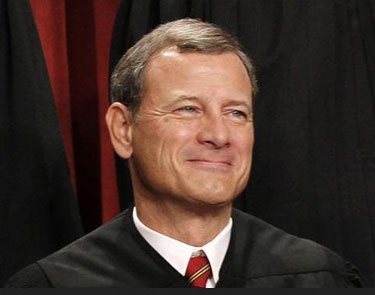
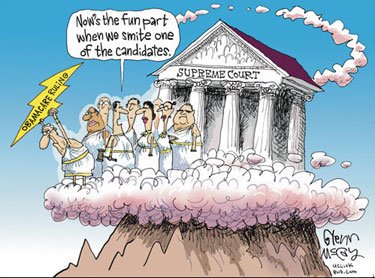
Paul Rahe makes a very interesting argument that John Roberts only appeared to cave. That, in reality, the Chief Justice was playing a diabolically clever long game strategy which involved permanently gutting Congressional illegitimate exploitation of the Commerce Clause while only apparently surrendering on Obamacare. Roberts, he contends, vastly enhanced the authority and immunity to liberal attacks of the Court, while dealing a deadly blow to the regulatory administrative state, and yet, hidden in the Tax Powers interpretation, astute commentators are able to identify aspects of the opinion boding very, very ill for Obamacare.
Most conservatives … suspect that John Roberts did not have the stomach to confront the President and his party. See, for example, Joel Pollak’s post Did Roberts Give in to Obama’s Bullying? Moreover, there is evidence that the opinion authored by Justice Scalia was originally a majority opinion. Roberts was forced to back off. His was an act of judicial cowardice. …
Or was it merely a recognition of the weakness of the judicial branch? … Roberts is very much concerned with sustaining the legitimacy and influence of the Court, and Obama and the Democrats have made it clear that they would regard a decision overturning Obamacare as a declaration of war.
There is, I am confident, more to it than this. In his opinion, the Chief Justice affirmed the principle asserted by Justices Kennedy, Alito, Scalia, and Thomas. He made it clear that the commerce clause does not give Congress authority over economic activity that we do not engage in. He also made it clear that the necessary and proper clause cannot be applied to achieve this end. In short, he joined these four Justices in setting a clear limit to the commerce clause, and he paved the way for future challenges to extensions of the regulatory state.
At the same time, he dodged the political firestorm, and nearly all of the liberals who have commented on the matter – a slow-thinking lot, in my opinion – have applauded what they take to be cowardice on his part as “judiciousness.†Glenn Reynolds at Instapundit was among the first to recognize that Roberts might be playing an elaborate game. … Reynolds pointed to one crucial fact: [Emphasis added] Senate rules do not allow a filibuster when the bill under consideration has to do with imposing or repealing a tax. If the Republicans take the Senate and the Presidency, they can now repeal the individual mandate. They will not need sixty votes. …
[Another crucial detail] The version of Obamacare that became law originated in the Senate. The Constitution stipulates that all tax bills must originate in the House. [It is possible to] file another suit arguing that the mandate is unconstitutional because the Senate cannot originate tax bills.
Chief Justice Roberts hurrying off to write his decision.
Looks like. David Bernstein, at Volokh, shares evidence that Chief Justice Roberts switched his vote and the majority on the Court changed.
Scalia’s dissent, at least on first quick perusal, reads like it was originally written as a majority opinion … (in particular, he consistently refers to Justice Ginsburg’s opinion as “The Dissentâ€). Back in May, there were rumors floating around relevant legal circles that a key vote was taking place, and that Roberts was feeling tremendous pressure from unidentified circles to vote to uphold the mandate. Did Roberts originally vote to invalidate the mandate on commerce clause grounds, and to invalidate the Medicaid expansion, and then decide later to accept the tax argument and essentially rewrite the Medicaid expansion (which, as I noted, citing Jonathan Cohn, was the sleeper issue in this case) to preserve it? If so, was he responding to the heat from President Obama and others, preemptively threatening to delegitimize the Court if it invalidated the ACA?
Chief Justice Roberts voted with the liberals to uphold the bill.
The Supreme Court astonished many Americans including this blogger by upholding Obamacare essentially in its entirety by ruling that the individual mandate is a tax.
Barack Obama can be seen in this video arguing that the individual mandate is not a tax (increase). (H/T Patterico)
What does all this mean?
Well, I guess our liberal friends are going to change their minds about the illegitimacy of the Supreme Court, and Chief Justice Roberts is going to receive massive quantities of strange, new respect.
If the Court is willing to read the taxing power so sweepingly, in future Congress won’t need to go looking to the Commerce Clause. In essence, the Roberts Court has decided to dramatically expand Congressional power far more than it would have done if it had followed Wickard and upheld the law under the Commerce Clause.
We are left wondering, if the Obamacare individual mandate is a legitimate exercise of an enumerated Congressional power, what could Congress try to compel individual Americans to buy or do that would be beyond its legitimate authority?
———————
Over on Twitter,
Drew M observes: Just a reminder: Democrats NEVER get screwed by their Court nominees. ‪
Megan McArdle has returned to blogging just in time to deliver a post anticipating the Supreme Court’s decision on Obamacare.
Personally, I suspect that progressives will stop attacking the court pretty soon. I have been much amused watching people try to simultaneously defend the fruits of Franklin Delano Roosevelt’s outrageous court-bullying, while also indignantly claiming that it would be abusive, infamous, fundamentally illegitimate and also, downright mean, for conservative justices to even think about overturning long-standing precedent. Suddenly, the internet is full of Latter Day Originalists who think that the constitution was handed down by God on stone tablets—in January 1936.
Since the argument that justices aren’t allowed to overturn laws passed by the legislature, or that they aren’t allowed to overturn long-standing precedent, or that 5-4 decisions aren’t legitimate, would undercut a vast body of laws liberals love—from Miranda to Roe to Boumediene—I tend to think they’ll give up on this line fairly quickly. Especially since going on the attack means spending even more valuable pre-election airspace saying “Hey, voters! Remember that health care law that we passed even though you hated it? The one you still don’t like? Well, I just wanted to remind you that it was also unconstitutional, according to the Supreme Court!â€
On the other hand, I consistently underestimate both the hypocrisy, and the political stupidity, of politicians and political activists.
As the fatal hour when the Supreme Court announces the fate of Obamacare’s individual mandate draws near, the New York Times reports that a lot of Washington liberals today are looking embarrassed and trying to come up with new excuses for their past overconfidence.
With the Supreme Court likely to render judgment on President Obama’s health care law this week, the White House and Congress find themselves in a position that many advocates of the legislation once considered almost unimaginable.
In passing the law two years ago, Democrats entertained little doubt that it was constitutional. The White House held a conference call to tell reporters that any legal challenge, as one Obama aide put it, “will eventually fail and shouldn’t be given too much credence in the press.â€
Congress held no hearing on the plan’s constitutionality until nearly a year after it was signed into law. Representative Nancy Pelosi, then the House speaker, scoffed when a reporter asked what part of the Constitution empowered Congress to force Americans to buy health insurance. “Are you serious?†she asked with disdain. “Are you serious?â€
Opponents of the health plan were indeed serious, and so was the Supreme Court, which devoted more time to hearing the case than to any other in decades. A White House that had assumed any challenge would fail now fears that a centerpiece of Mr. Obama’s presidency may be partly or completely overturned on a theory that it gave little credence. The miscalculation left the administration on the defensive as its legal strategy evolved over the last two years.
“It led to some people taking it too lightly,†said a Congressional lawyer who like others involved in drafting the law declined to be identified before the ruling. “It shouldn’t strike anybody as a close call,†the lawyer added, but “given where we are now, do I wish we had focused even more on this? I guess I would say yes.â€
Watch Nancy Pelosi confidently predict Obamacare being upheld 6-3 and then assuring reporters that she knows the Constitution and the bill is “ironclad” and laugh.
Kevin Drum, in Mother Jones, contends that we diabolical conservatives first strong-armed the Republican Party into accepting our view of the unconstitutionality of the Obamacare individual mandate, then we successfully used the right-wing media to brainwash the mainstream media into accepting our arguments as legitimate, and all this, you see, gives cover to our partisan judges to make a partisan ruling.
Two years ago, when President Obama signed the Affordable Care Act into law, the idea that its individual mandate provision was unconstitutional was laughable. There was no case law, no precedent, and frankly, no serious argument that the federal government’s Commerce Clause power didn’t give it the authority to mandate purchase of health insurance if it wanted to. That’s why Democrats didn’t bother looking for a clever alternative—many of which were available—in order to avoid including an explicit mandate in the law. They didn’t think they needed to. Of course it was constitutional. Even Randy Barnett, the law professor who popularized the activity/inactivity distinction that opponents latched onto as their best bet against the mandate, initially didn’t really think it was anything but a long shot.
So how did that conventional wisdom change so dramatically in only two years? …
Orin Kerr says that, in the two years since he gave the individual mandate only a one-percent chance of being overturned, three key things have happened. First, congressional Republicans made the argument against the mandate a Republican position. Then it became a standard conservative-media position. “That legitimized the argument in a way we haven’t really seen before,” Kerr said. “We haven’t seen the media pick up a legal argument and make the argument mainstream by virtue of media coverage.” Finally, he says, “there were two conservative district judges who agreed with the argument, largely echoing the Republican position and the media coverage. And, once you had all that, it really became a ballgame.”
This is, needless to say, a powerfully depressing analysis. For all practical purposes, Kerr is agreeing that conservative judges don’t even bother pretending to be neutral anymore. They listen to Fox News, and if something becomes a consvative talking point then they’re on board. And that goes all the way up to the Supreme Court.
Kevin Drum’s perspective amounts to assuming that extreme New Deal jurisprudence, like the 1942 Wickard v. Filburn (a decision which ruled that the Constitution’s grant of power to regulate Interstate Commerce gave Congress the power to tell an Ohio farmer named Roscoe Filburn that he was not allowed to grow wheat on his farm to feed his own chickens. Farmer Filburn using his own wheat, and not buying wheat on the market, was deemed to impact Interstate Commerce and therefore to provide a legal basis for Congressional authority.) was good law and destined to endure forever unchallenged by the reasoning of later courts.
Kevin Drum studiously ignores the fact that the Constitution-in-exile of the New Deal era has been gradually coming back. The Supreme Court resumed, in a modest way, re-adopting the perspective that Constitutional authority to regulate Interstate Commerce actually required the legislative object to involve commerce crossing state lines. In U.S. v. Lopez (1995), the Court struck down a Gun-Free School Zone law because the regulated activity concerned actually had nothing to do with Interstate Commerce.
A number of other once-thought-to-be-extinct Constitutional provisions, like the Second Amendment, have come roaring back to life in recent years.
To believe, as people like Kevin Drum and Nancy Pelosi notoriously did, that it was completely unnecessary to look for an actual constitutionally enumerated power to permit Congress to tell Americans to buy health insurance policies is to reject the fundamental American idea of limited government.
What has actually occurred, over decades, is a national debate over whether a long string of unprincipled, legal realist rulings simply setting the Constitution and the entire earlier history of constitutional law aside were correct. In law review articles, public debate, and in national elections leading to judicial appointments and ultimately to rulings, the left has been losing and the conservative position has been winning.
In the end, there should be no surprise to anyone who takes the Constitution seriously when the Obamacare individual mandate is struck down. That was the intent of the framers, and those of us who contend that that is what the Constitution says inevitably have the better arguments.
David Steinberg, at PJM, in my view, does not really pull off the Colonel Kurtz allusion which led me to his editorial, but he does identify the crucial philosophical point: it is impossible to create new (supposititious) rights without violating (real) natural rights. The Constitution was written to protect natural rights by men who believed that they were self evident.
[Y]ou cannot invent a right. The government attempted to do this, and found they could not do so without also violating a right.
Why? Because a “right†to a good or service necessitates a violation of the rights of the provider of that good or service or of whomever is chosen to be stuck with the bill, and further, as the citizen receiving the proposed new “right†is also subject to the violation in different time and circumstance, any new “right†is by definition a decrease in liberty for everyone, and might I add “duh.â€
Elsewhere in the field of reality lies a perfect analogy for the Left’s century of affronts to Natural Law:
In all cases in which work is produced by the agency of heat, a quantity of heat is consumed which is proportional to the work done; and conversely, by the expenditure of an equal quantity of work an equal quantity of heat is produced.
This sentence, the First Law of Thermodynamics, represents the end of all inquiries into the creation of a perpetual motion generator. The First Law cannot tell you what form a proposed perpetual motion generator will take; it is, however, unfailingly predictive of the experiment’s conclusion in failure. Of course, that didn’t halt centuries of “mathematical leftists†from attempting to design and construct perpetual motion machines. The builders predating the First Law pursued knowledge in the best tradition of humanity; the builders following the Law belonged to one of three categories: they either refused to accept the Law; were ignorant of its discovery; or were charlatans who knew a great number of suckers resided in the other two categories.
“A right to health care†offers equivalent parallels to the First Law of Thermodynamics and its three categories of opposition: the deniers, the ignorants, and the common schmucks.
Unfortunately for the suddenly uncomfortable, the bigger problem for the left-leaning does not halt beyond Obamacare: can you name many Leftist proposals that do not either violate Natural Law or disdainfully tread on its boundaries? Any? How much of Leftist thought is, and should have been, dead on arrival? How many landmark bills, slogans, teachings, entire executive branch departments?
For the intellectually honest Leftist, today the pupils must widen, lest you mislead yourself and waste another day or life. The Constitution forbids Leftism.
Ben Smith quotes an unnamed conservative lawyer who offers a simultaneously cynical and whimsical explanation of exactly why Obamacare is toast.
You have built an imaginary mansion, with thousands of rooms, on the foundation of Wickard v. Filburn — the 1942 ruling that broadened the understanding of how the Commerce Clause could be used to regulate economic activity.
We aren’t being asked to radically revise the Commerce Clause and throw out seven decades of law, and we won’t. But we know the founders never intended the Commerce Clause to allow the Federal Government to regulate everything on the planet. So we are going to accept Randy Barnett’s basically spurious exception to that basically spurious idea, and throw out the Affordable Care Act on the grounds that the Commerce Clause regulates “activity†(which we don’t really believe), but not “inactivity†(because, why not draw the line somewhere?).
This is to say: You have built a fantasy mansion on the Commerce Clause. You can hardly blame us if, in one wing of this mansion, down a dusty corridor, we build a fantasy room called “inactivity,†lock the door, and don’t let you in.
Barack Obama made history of a kind in the course of his 2010 State of the Union address, when he openly criticized the Supreme Court for deciding in Citizens United that federal restrictions on political speech by corporations and unions was unconstitutional.
President Obama’s highly partisan statements actually provoked Justice Alito to murmur “Not true.”
———————
In a further triumph of jurisprudential diplomacy, Barack Obama yesterday “warned” the Surpreme Court not to overturn Obamacare.
President Obama, employing his strongest language to date on the Supreme Court review of the federal health care overhaul, cautioned the court Monday against overturning the law — while repeatedly saying he’s “confident” it will be upheld.
The president spoke at length about the case at a joint press conference with the leaders of Mexico and Canada. The president, adopting what he described as the language of conservatives who fret about judicial activism, questioned how an “unelected group of people” could overturn a law approved by Congress.
“I’m confident that the Supreme Court will not take what would be an unprecedented, extraordinary step of overturning a law that was passed by a strong majority of a democratically elected Congress,” Obama said.
The Supreme Court’s sharp questioning of the constitutionality of Obamacare, and the obvious weakness of the Administration’s defense of that approach to health care reform, shocked and astounded liberal commentators. John Podhoretz notes that nothing came up in the Court’s questions that had not been argued previously by opponents of Obamacare, but previously the left just was not listening.
The panicked reception in the mainstream media of the three-day Supreme Court health-care marathon is a delightful reminder of the nearly impenetrable parochialism of American liberals.
They’re so convinced of their own correctness — and so determined to believe conservatives are either a) corrupt, b) stupid or c) deluded — that they find themselves repeatedly astonished to discover conservatives are in fact capable of a) advancing and defending their own powerful arguments, b) effectively countering weak liberal arguments and c) exposing the soft underbelly of liberal self-satisfaction as they do so.
That’s what happened this week. There appears to be no question in the mind of anyone who read the transcripts or listened to the oral arguments that the conservative lawyers and justices made mincemeat out of the Obama administration’s advocates and the liberal members of the court.
This came as a startling shock to the liberals who write about the court.