Jose Calzada called a suicide hotline from his home in Roy, Utah, at about 4:00 a.m. on Tuesday morning, but by 11 a.m. he was shot dead by a SWAT team.
After Calzada called the suicide hotline, the SWAT team arrived and negotiated with him for hours (video below).
“At some point those negotiations failed and unfortunately the SWAT team was involved in a shooting, and the subject is now deceased,†Officer Matt Gwynn, public information officer for the Roy Police Department, told Standard.net.
“There were people in the home at the time the [suicide] call was placed,” Officer Gwynn told ABC4 News. “They left the home shortly thereafter.”
There was no hostage situation, but news reports say that something happened in the home’s garage that caused SWAT officers to shoot Calzada.
“It seem like there was one shot, and then a pause, and then four or five shots after that, that were very rapid,†said neighbor Ron Smith. “The pause after the first shot was really brief. After that I went inside and shut the door.â€
The Weber County attorney’s office is investigating the shooting. The officers who fired their guns at Calzada have all been placed on administrative leave during the investigation.
The Roy Police Department’s advice to suicidal people struck an ironic and chilling tone.
“We encourage those having suicidal thoughts or tendencies to contact a physician or expert that can talk them through it,” stated officer Gwynn. “In this particular case he attempted to do that, it’s unfortunate and sad that it failed.â€
In numerous press reports, Police Spokesman Gwynn is simply quoted verbatim. Although he is obviously being evasive why the police thought it was necessary to fire on Mr. Calzada, the press incompetently fails to insist on that obvious question being answered.
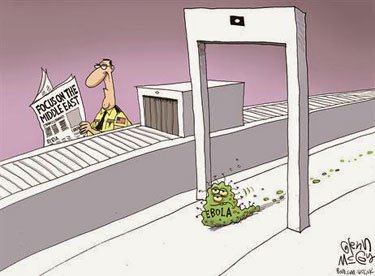
Michael Walsh identifies ten things Americans can learn from the Obama Administration’s handling of the Ebola crisis.
1) If a retread party hack like Klain is the best Obama can do, then the Democrat talent pool is incredibly shallow. Naturally, though, Obama wouldn’t think of going outside it.
2) The President considers Ebola a political/messaging problem, not a medical problem. Klain is an an insider process guy, not an expert in the field.
3) The fact that we need a “Czar†to cut across federal agency red-tape and make things happen expeditiously is an indictment of the federal agencies themselves, although no Democrat would ever dare to suggest such a thing. The choice signals that, as Ronald Reagan said, government itself is the problem, not the solution.
4) The reason they won’t dare is that the federal agencies — unelected hives of beetling bureaucrats, scurrying beneath the media surface — are the sources of their power. You don’t alienate or fire your most ardent union voters and financial supporters.
5) This is a government devoted to process, not results. Its most deeply held belief — a by-product of its quasi-Marxist belief in the “labor theory of value†— is that putting in hours and hitting “metrics†is the job itself, not whatever it ostensibly happens to be about; hey, even if you die, they get paid. In this sense, bureaucrats are similar to to the education majors who teach our children in the public schools, with no particular expertise in anything but theory. And the results speak for themselves.
6) With theory ascendant over common sense, the government’s adamant refusal so far to ban travel to and from West Africa and its affected nations proves conclusively that Leftists are perfectly willing to have you die for their ideological beliefs.
7) The longer this goes on, the more the panic will spread — look what happened at the Pentagon earlier today, or on this cruise ship. If you haven’t started to panic yet, then read this.
8) Regarding the open borders and open airports, a larger issue: why is the Left so adamantly opposed to the people’s right to defend themselves? There is nothing “racist†about closing the country to travelers from certain countries in west Africa — heck, the Africans have already done it themselves.
9) In twice electing Barack Obama president Americans made a choice: professional politicians over men of integrity. Symbolism over substance (hello, Nobel Peace Prize). Potential over accomplishment. Guilt over responsibility.
10) If the naked malevolence of the Leftist project for America isn’t visible to you now, then you’re beyond help.
But hey, not to worry — Kevin Spacey played Ron Klain in a movie. So it’s all good.
Mark Steyn notes that when government gets too big, it completely loses its sense of priorities, devoting unlimited energy to enforcing petty regulations while totally failing to perform its legitimate functions in cases when it really matters.
Thomas Eric Duncan has the distinction of being America’s Patient Zero – the first but not the last person to develop Ebola symptoms in the United States.
Is he a US citizen? No, he’s Liberian.
Is he a resident of the United States? No, he landed at Washington’s Dulles Airport on September 20th, in order to visit his sister and having quit his job in Monrovia a few weeks earlier.
So he’s a single unemployed man with relatives in the US and no compelling reason to return to his native land. That alone is supposed to be cause for immigration scrutiny.
In addition, visitors from Liberia have the fifth highest “visa overstay rate” in the United States. That’s to say, they understand very clearly that all that matters is getting in. Once you’re in, they’ll never get you out.
And, of course, Liberia is one of the hottest spots of Ebola’s West African “hot zone”. It’s been all over the front pages, except apparently in The US Customs & Border Protection Staff Newsletter, where it rated a solitary “News In Brief” item at the foot of page 37.
Just to give you an example of how hard-assed the boneheads of America’s immigration bureaucracy can be when they want to:
The legendary Gord Sinclair, longtime news director of CJAD in Montreal, had a ski place near Jay in northern Vermont, and he invited his engineer on the show to come down and visit him. “What’s the purpose of your visit?” asked the agent at the small rural border post.
“Oh, just a relaxing weekend at my boss’ place,” said Gord’s colleague affably, and then chortled, “although I don’t know if it’ll be that relaxing. He’ll probably have me out in the yard chopping wood all day.”
So the immigration agent refused him entry on the grounds that he would be working illegally in the United States.
They all had a good laugh about that back on the air on Monday, but it took forever to straighten out. A single man with contacts in the United States: He says he’s coming for the weekend, but we all know any Montrealer would willingly trade a job at Quebec’s Number One anglo radio station for casual yard work in Vermont, right?
And yet the unemployed guy from an Ebola hot zone gets in.
Every day CBP agents pull stuff like that weekend-in-Vermont thing, screwing over perfectly obviously law-abiding persons – tourists, businessmen, legal residents and, indeed, citizens.
But the Ebola guy gets in.
What is the priority of America’s deranged border regime right now? As I wrote two months ago:
This weekend [Campbell Webster] was returning to New Hampshire from a competition in Canada, which is how a newspaper story comes to open with a sentence never before written in the history of the English language:
‘BAGPIPERS have expressed their fear over a new law which led to two US teenagers having their pipes seized by border control staff at the weekend.’
They can chisel that on the tombstone of the republic. On the northern border, bagpipers are “expressing their fear”, while on the southern border gangbangers have no fear and stroll through the express check-in.
As do Ebola-bearing Liberians at Dulles. US border security devotes more time and resources to Campbell Webster of Concord bringing in a bagpipe than to Thomas Duncan of Monrovia bringing in Ebola.
Well, isn’t this embarassing. The female Secret Service officer who first encountered the intruder was overpowered by him. Because…reality. Physical reality. And the White House is a gun free zone? Political correctness has its limits.
FTA Gonzalez then proceeded to run through the entrance hall to the cross hall of the White House, past the staircase that leads up to the first family’s residence.
He was confronted by a female Secret Service agent, who he overpowered, and made it all the way to the East Room, Rep. Jason Chaffetz, R-Utah, told CBS News, citing whistleblowers.
We’ve lost control of the Texas border? Compared to what – the White House border?
No wonder Obama has no confidence in fences or guards. And since you ask, I deplore the criminal characterization of White House intruder Omar Gonzalez; surely he should be described as an “undocumented resident”.
Old-fashioned (now illegal) plastic gas can with built-in vent.
Jeffrey Tucker discusses in loving detail one prominent example of the countless ways in which government regulation has impacted the lives of just about every American.
[Y]esterday, [I ran out of gas and] had to get a can of gas from the local car shop. I started to pour it in. But, hmmm, this is strange. The nozzle doesn’t quite go in. I tilted it up and tried to jam it in.
I waited. Then I noticed gas pouring all down the side of the car. So I pulled it out and experimented by pouring it on the ground. There was some weird contraption on the outside and it wasn’t clear how it worked.
I poured more and more on the ground. Some got on my shoe. Some got on my hands. Some got on my suit.
Gas was everywhere really — everywhere but in the tank. It was a gassy mess. If someone had lit a match, I would have been a goner.
Finally I turned out the crazy nozzle thing a few times. It began to drip in a slightly coherent direction so I jammed it in. I ended up putting about one cup of gas in, started my car and made it to the gas station.
I’m pretty sure gas cans used to work. Yes. It was a can. It had a spout. It had a vent hole on the other side. You stuck in the spout and tipped. You never saw the gas.
Then government “fixed†the gas can. Why? Because of the environmental hazards that come with spilled gas. You read that right. In other words, the very opposite resulted. Now you cannot buy a decent can anywhere. You can look forever and not find a new one.
Instead you have to go to garage sales. But actually people hoard old cans. There is a burgeoning market in kits to fix the can.
The whole trend began in (wait for it) California. Regulations began in 2000, with the idea of preventing spillage. The notion spread and was picked up by the EPA, which is always looking for new and innovative ways to spread as much human misery as possible.
An ominous regulatory announcement from the EPA came in 2007: “Starting with containers manufactured in 2009… it is expected that the new cans will be built with a simple and inexpensive permeation barrier and new spouts that close automatically.â€
The government never said “no vents.†It abolished them de facto with new standards that every state had to adopt by 2009. So for the last five years, you have not been able to buy gas cans that work properly. They are not permitted to have a separate vent. The top has to close automatically. There are other silly things now, too, but the biggest problem is that they do not do well what cans are supposed to do. …
Never heard of this rule? You will know about it if you go to the local store. Most people buy one or two of these items in the course of a lifetime, so you might otherwise have not encountered this outrage.
Yet let enough time go by. A whole generation will come to expect these things to work badly. Then some wise young entrepreneur will have the bright idea, “Hey, let’s put a hole on the other side so this can work properly.†But he will never be able to bring it into production. The government won’t allow it because it is protecting us! ….
There is no possible rationale for these kinds of regulations. It can’t be about emissions really, since the new cans are more likely to result in spills. It’s as if some bureaucrat were sitting around thinking of ways to make life worse for everyone, and hit upon this new, cockamamie rule.
These days, government is always open to a misery-making suggestion. The notion that public policy would somehow make life better is a relic of days gone by. It’s as if government has decided to specialize in what it is best at and adopt a new principle: “Let’s leave social progress to the private sector; we in the government will concentrate on causing suffering and regress.†…
Ask yourself this: If they can wreck such a normal and traditional item like this, and do it largely under the radar screen, what else have they mandatorily malfunctioned? How many other things in our daily lives have been distorted, deformed and destroyed by government regulations?
If some product annoys you in surprising ways, there’s a good chance that it is not the invisible hand at work, but rather the regulatory grip that is squeezing the life out of civilization itself.
Air conditioners which don’t cool as well as their predecessors made 60 years ago, toilets that won’t flush, automobiles without spare tires which cost more than the house you grew up in… the list of products of federal regulatory intervention to make the world a better place is long, and it keeps growing.
The odious Yale Administration recently responded to the technological progress which transferred the printed-on-paper Course Critique (which my colleagues and I on the Yale Daily News first produced in the Fall of 1967) to a more flexible searchable electronic version on the Internet to tyrannically exercise the university’s power as webhost to censor and shut it down.
One has to shake one’s head over the fact that Yale continues to manage to hire and put power into the hands of people who are both so inclined to misuse power and simultaneously so lame. Dean Dodo who made the decision to take that website down obviously had only the dimmest reptilian understanding of the possibilities of technology and the enterprise and skill of the Yale undergraduate.
In January 2012, two Yale students named Harry Yu and Peter Xu built a replacement to Yale’s official course selection website. They it called YBB+ (Yale Bluebook Plus), a “plus†version of the Yale-owned site, called Yale Bluebook. YBB+ offered different functionality from the official site, allowing students to sort courses by average rating and workload. The official Yale Bluebook, rather, showed a visual graph of the distribution of student ratings as well as a list of written student reviews. YBB+ offered a more lightweight user interface and facilitated easier comparison of course statistics. Students loved it. A significant portion of the student body started using it.
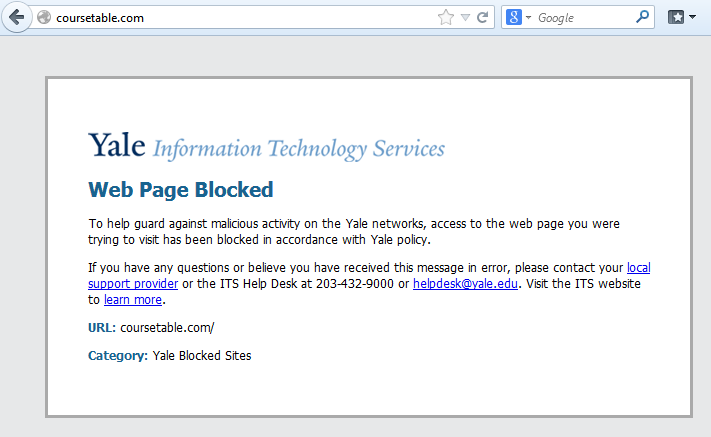
Fast-forward two years. Last Friday (1/10/14), Yale blocked YBB+’s IP address on the school network without warning. When contacted, Yale said that YBB+ infringed upon Yale’s trademark. Harry and Peter quickly removed the Yale name from the site, rebranded it as CourseTable and relaunched. Yale blocked the website again, declaring the website to be malicious activity.
Later that weekend, Yale’s administration told the student developers that the school didn’t approve of the use of its course evaluation data, saying that their website “let students see the averaged evaluations far too easilyâ€. Harry and Peter were told to remove the feature from the CourseTable website or else they would be referred to the school’s punishment committee. …
What if someone made a piece of software that displays Yale’s course evaluation data in a way that Yale disapproves of, while also (1) not infringing on Yale’s copyrights or trademarks, (2) not storing any sensitive data, (3) not scraping or collecting Yale’s data, and (4) not causing damages to Yale’s network or servers? If Yale censors this piece of software or punishes the software developer, it would clearly characterize Yale as an institution where having authority over students trumps freedom of speech.
Guess what? I made it last night.
I built a Chrome Extension called Banned Bluebook. It modifies the Chrome browser to add CourseTable’s functionality to Yale’s official course selection website, showing the course’s average rating and workload next to each search result. It also allows students to sort these courses by rating and workload. This is the original site, and this is the site with Banned Bluebook enabled (this demo uses randomly generated rating values).
Banned Bluebook never stores data on any servers. It never talks to any non-Yale servers. Moreover, since my software is smarter at caching data locally than the official Yale course website, I expect that students using this extension will consume less bandwidth over time than students without it. Don’t believe me? You can read the source code. No data ever leaves Yale’s control. Trademarks, copyright infringement, and data security are non-issues. It’s 100% kosher.
My intent behind Banned Bluebook is to demonstrate two points to Dean Miller and the Yale administration:
If Yale grants students access to data, the university does not have the right to specify exactly how students must view the data.
Censorship through IP blocking and Deep Packet Inspection is not only unethical, it’s also futile.
Don’t the Nazi tools they hire to run Yale even go to the cinema? If Dean Wurmser has seen Josh Wheedon’s “Serenity” (2005), he or she would have heard the line from Mr. Universe: You can’t stop the signal, Mal.
Theodore Dalrymple reflects, in Taki’s magazine, on the modern state’s law enforcement priorities and their deeper meaning.
A couple of American filmmakers came to Paris to interview me—it always surprises me that anybody would take so much trouble to interview anybody, let alone me—and decided that the little park opposite my flat, with a pretty little bandstand, would be a good place to do so. They set up the camera, but a few seconds later, before they could ask me a single question, a municipal policeman arrived. They were not allowed to film here without a permit from the mairie of the arrondissement, he said. I explained that these were Americans, come all the way from Texas expressly to interview me. He, a very pleasant and polite man of African origin, phoned his chief to see whether an exception could be made. As I suspected, it could not.
The contrast between the authorities’ alacrity on one hand in preventing innocent filming for a matter of a few minutes (the policeman said authorization was necessary because it might cause a disturbance, and, being kind, I refrained from laughing), and on the other their slow response to a nasty incident that might have ended in murder, was emblematic of the modern state’s capacity to get everything exactly the wrong way around, to ascribe importance to trivia and to ignore the important. There are, of course, many more employment opportunities in trivia, since there is much more that is trivial in the world than is important.
France is not unique in this respect, or even the worst example I know. In London I once parked outside a hotel where I proposed to stay. Parking was forbidden outside, but I stopped only to take my baggage inside. I received a parking ticket within sixty seconds, a miracle of efficiency (I genuinely admired it in a way), though it was perfectly obvious from my car’s open doors that I did not propose to stay long and was only taking my luggage into the hotel. But on another occasion when my wife telephoned the police to inform them that youths were committing arson in our front garden before her very eyes, they had no time to attend to it. A more senior officer, however, did find the time a quarter of an hour later to complain to my wife that she had wasted police time by complaining in the first place.
It often seems, then, as if modern state authorities live in a looking-glass world: What normal people regard as important is for them of no importance, while what they regard as of supreme importance normal people regard as of no importance. For them the respectable are suspect and the suspect respectable. A tweed jacket is a sign of menace, while a broken bottle is a sign of harmless intent.
One must not exaggerate the degree to which official idiocy impinges on our lives. The exaggeration of misery is one of the royal roads to political disaster. Still, I have seen the future, and it is idiocy.
D.C. McAllister, at Ricochet, describes the spectacular impact of the Age of Imbecility on children’s school supplies.
The back-to-school ritual of downloading the required school supplies list from my children’s schools and heading down to Target or Wal-Mart or Staples to purchase the exact supplies dictated by the teachers and administrators is an act of dread.
I hate it. I hate the lines. I hate that I have to buy tissue, paper towels, soap, reams of paper, and hand sanitizer — not for my child, but for the collective. I hate the pushing and shoving to get the last batch of neon-colored dividers or packet of green and pink highlighters.
I hate the high prices, and the tyrannical demands issued down from the school that the supplies have to be a certain type, even a specific brand. It can’t just be a simple spiral notebook; it has to be a hard-covered, three-subject spiral notebook with pockets.
It can’t just be a cheap calculator for my middle school child (or none at all, which is what I’d prefer); it has to be a TI 84 plus c programmable, graphing, etc., etc., I don’t know what that is, but I do know is that it costs more than a hundred bucks. I bought one for my seventh grader last year. She lost it. Now we’re buying another one because the school demands it. …
I remember when I went to school (back when we walked to school uphill both ways), my parents sent me out the door with a notebook and a pencil. That was it. Maybe a binder with loose-leaf paper. No calculator. No multicolored dry erase markers. No glue sticks. I didn’t even have a backpack. I lugged my books around under my arm. Back in those days, we actually used our lockers. Kids today load up their stuff in $80 backpacks, and many don’t even use the locker assigned to them.
When I went to school there were no supply lists handed down from on high. There were no directives to only buy “Magic Rub†erasers. (I’ve often wondered what would happen if I sent my child to school with a “Pink Pearl†instead. Would the eraser Nazis sweep down and haul him off to detention for violating the supply list directive?)
There have been a rash of stories recently about kids getting suspended from school for bringing in toy guns, and even merely for making a drawing of a gun, but this story from WMAL sets some kind of a new record.
The father of a middle schooler in Calvert County, Md. says his 11-year-old son was suspended for 10 days for merely talking about guns on the bus ride home.
Bruce Henkelman of Huntingtown says his son, a sixth grader at Northern Middle School in Owings, was talking with friends about the Sandy Hook Elementary School massacre when the bus driver hauled him back to school to be questioned by the principal, Darrel Prioleau.
“The principal told me that with what happened at Sandy Hook if you say the word ‘gun’ in my school you are going to get suspended for 10 days,” Henkelman said in an interview with WMAL.com.
So what did the boy say? According to his father, he neither threatened nor bullied anyone.
“He said, I wish I had a gun to protect everyone. He wanted to defeat the bad guys. That’s the context of what he said,” Henkelman said. “He wanted to be the hero.”
The boy was questioned by the principal and a sheriff’s deputy, who also wanted to search the family home without a warrant, Henkelman said. “He started asking me questions about if I have firearms, and [the deputy said] he’s going to have to search my house. Search my house? I just wanted to know what happened.”
No search was performed, and the deputy left Henkelman’s home after the father answered questions in a four-page questionnaire issued by the Sheriff’s Office.
Thirteen year-old Briar MacLean tackled a knife-wielding bully who was attacking a classmate. Instead of praising MacLean’s intervention, the Calgary school officials admonished him for playing hero. As the National Post reported:
Briar MacLean was sitting in class during a study period Tuesday, the teacher was on the other side of the room and, as Grade 7 bullies are wont to do, one kid started harassing another.
“I was in between two desks and he was poking and prodding the guy,†Briar, 13, said at the kitchen table of his Calgary home Friday.
“He put him in a headlock, and I saw that.â€
He added he didn’t see the knife, but “I heard the flick, and I heard them say there was a knife.â€
I heard the flick, and I heard them say there was a knife
The rest was just instinct. Briar stepped up to defend his classmate, pushing the knife-wielding bully away.
The teacher took notice, the principal was summoned and Briar went about his day. It wasn’t until fourth period everything went haywire.
“I got called to the office and I wasn’t able to leave until the end of the day,†he said.
That’s when Leah O’Donnell, Briar’s mother, received a call from the vice-principal.
“They phoned me and said, ‘Briar was involved in an incident today,’†she said. “That he decided to ‘play hero’ and jump in.â€
Ms. O’Donnell was politely informed the school did not “condone heroics,†she said. Instead, Briar should have found a teacher to handle the situation.
“I asked: ‘In the time it would have taken him to go get a teacher, could that kid’s throat have been slit?’ She said yes, but that’s beside the point. That we ‘don’t condone heroics in this school.’ â€
Instead of getting a pat on the back for his bravery, Briar was made to feel as if he had done something terribly wrong. The police were called, the teen filed a statement and his locker was searched.
Democratic Western societies have obviously developed a fatal habit of placing people with ideological and personality disorders in positions of authority. Canada has some great hunting & fishing, but I could never live there.